HMRC’s 2026 crypto letter has no deadline. What it says, why you got it, what to check before doing nothing

Published 14 November 2026 Reviewed against gov.uk 14 November 2026 12 min readHMRC and compliance
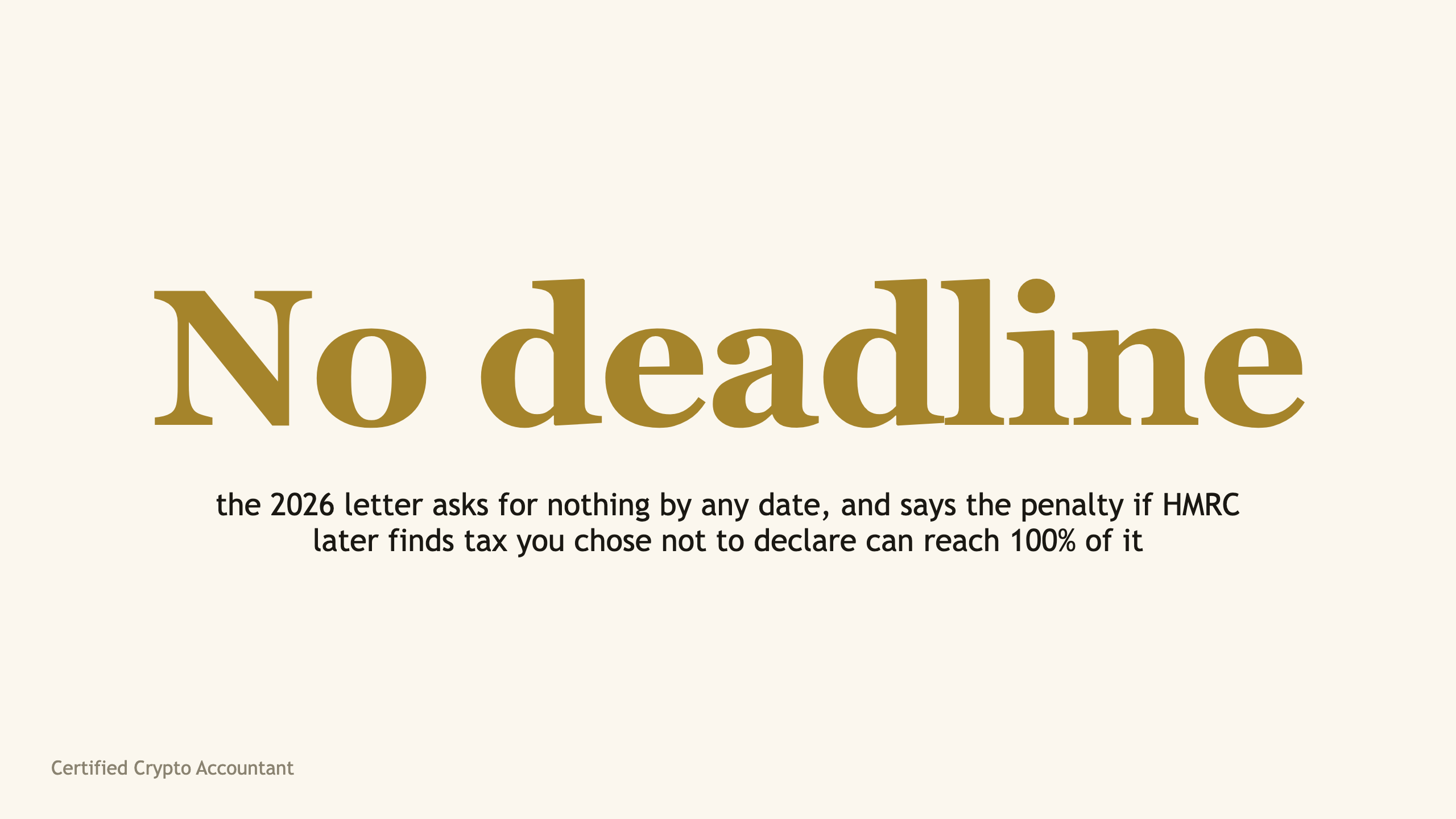
The letter headed Cryptoassets, information to help you understand your tax position, which opens with the words we have information that suggests you’ve engaged in cryptoasset activities, is HMRC’s July 2026 one to many letter. It is going to people on a list built from exchange data between July 2026 and March 2027, by post, by email and by text message, with a copy to your agent if HMRC knows you have one. It is a prompt rather than an enquiry, and unlike the 2024 letter it sets no date and says you need do nothing if your affairs are correct. That offer is genuine, and it is only safe to take once a computation has shown nothing is due.
This page quotes the letter, from the template HMRC shared with the professional bodies and the Institute of Chartered Accountants in England and Wales published on 23 July 2026. Your copy carries your own reference and date, and the email and text versions are shorter, but the words below are the words HMRC is sending. The guide to the 2026 to 2027 campaign covers the numbers, the data behind it and the two routes in detail. This page is about the letter in your hand and the decision it leaves with you. Not sure which letter you have? Paste its first lines and the page names it.
HMRC’s July 2026 crypto letter opens with we have information that suggests you’ve engaged in cryptoasset activities, sets no deadline, and says you need do nothing if your affairs are correct. The same letter says that if HMRC later finds tax you chose not to declare it may bill you with interest and a penalty up to 100%. Rebuild the history first, amend 2024 to 2025 by 31 January 2027 if something is owed, disclose anything older, put 2025 to 2026 in the SA108 crypto boxes, and only then take the no action offer.
What the letter says, in its own words
It begins, “We’re writing because we have information that suggests you’ve engaged in cryptoasset activities. We want to help you understand when you need to report cryptoasset transactions, and how to update your tax position.”
Under the heading When you sell, use, or receive cryptoassets it says HMRC usually treats cryptoassets the same way as other assets, and lists when Capital Gains Tax may be due. Selling them for fiat currency like pounds or dollars, “even if you don’t withdraw the money you make from the cryptoasset exchange”. Exchanging them for another cryptoasset, “like exchanging bitcoin for Ether, or using bitcoin to buy a non-fungible token (NFT)”, taxable “even if you don’t convert the gains back to fiat currency”. Using them to buy goods or services. And giving them away to someone who is not your spouse or civil partner, where “you’ll be treated as having received the pound sterling value of the cryptoasset, even if you don’t actually receive anything”. That list matches HMRC’s manual at CRYPTO22100, and it is the reason a year of swaps with no withdrawals is a year of disposals.
It then lists when Income Tax may be due. Income from “cryptoasset-related activities, like lending, staking and mining”, income received in the form of cryptoassets, and the case where “your cryptoasset activities constitute a trade, although only in exceptional circumstances would we accept this to be the case”. That last clause is HMRC closing the door on the argument that heavy trading turns gains into trading losses, and it is worth reading twice if you were counting on it.
Under Reporting unpaid tax on cryptoassets it gives the routes. “You can amend your Self Assessment return if you’re within the time limit for the relevant tax year.” “From tax year 2024 to 2025, Self Assessment returns have a dedicated cryptoasset section on form SA108 – boxes 13.1 to 13.8.” “If it’s too late to amend your return, you can use our disclosure service.” And then the line this page exists for. “If you’re satisfied your tax affairs are correct you don’t need to take any further action or contact us.”
Under If you owe more tax but don’t take any action it says, “If we later find you have tax to pay and you’ve chosen not to tell us, we may work out what we think you owe and send you a bill. We’ll charge interest on any tax you pay late.” Then, “We may also charge a penalty which could be up to 100% of the additional tax you owe”, pointing to the factsheets CC/FS7a and CC/FS11. It gives a phone number, 03000 552294, open Monday to Friday 9am to 4.30pm, and an email address for the upstream response team, adds that HMRC cannot correct your return, work out your position or give specific advice over the phone, and closes with “It’s your responsibility to make sure your tax returns are completed correctly.” It is signed Wealthy Mid-sized Business Compliance.
How it differs from the 2024 letter
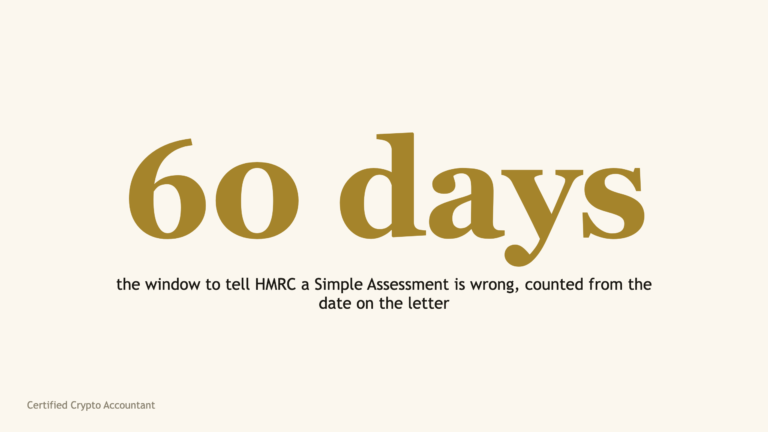
If your letter instead opens “our records show you have disposed of cryptoassets” and gives you 60 days, you have the 2024 letter, which was still being sent through 2025. The two are different documents from the same team, and the differences change what you should do.
| Point | 2024 letter | 2026 letter |
|---|---|---|
| Opening words | Our records show you have disposed of cryptoassets. However, you haven’t declared everything correctly. | We have information that suggests you’ve engaged in cryptoasset activities. |
| Deadline | 60 days from the date of the letter | None |
| If nothing is owed | Contact HMRC with information showing why | No further action, no contact needed |
| Channels | Letter, copy to adviser | Letter, email and text, copy to adviser |
| Penalty wording | Case by case, inaccuracy or failure to notify | Up to 100% of the additional tax |
| Form reference | None | SA108 boxes 13.1 to 13.8 |
The 2024 letter told you HMRC believed you had got it wrong. The 2026 letter says only that HMRC holds information. It is softer in tone, and it leaves the whole decision with you, which is a heavier thing to be handed than a date.
Why you, and which years it is really about
Exchanges have supplied customer records to HMRC under its information powers for years. ICAEW’s report says the campaign is aimed at people HMRC believes may have underpaid Income Tax or Capital Gains Tax on crypto, and the Wealthy and Mid-sized Business Compliance signature tells you which team built the list. Being on it means an exchange has reported activity in your name that HMRC cannot match to a return. It does not mean HMRC has computed your tax, and the exchange figure is proceeds, which says nothing about cost.
The years are narrower than the letter sounds. The return for the year to 5 April 2026 is the one being filed now, due 31 January 2027, so nothing for that year is late yet, and the crypto boxes on SA108 are where its disposals go. The year to 5 April 2025 can still be amended until 31 January 2027. Anything before that is a disclosure. So the practical question the letter asks is whether 2024 to 2025 and earlier were right, and for most people that comes down to two or three years of exchange and wallet history.
The order to do things in
One. Treat no deadline as a decision you have to earn. The letter asks for nothing, so nothing will remind you. Put a date in your own diary, 60 days on, by which the computation below is done, and treat that as the deadline the letter did not give you.
Two. Rebuild the history before deciding. Every exchange, every wallet, every chain, including the closed ones, pooled under CRYPTO22200 for each year with the sterling value on the day of each disposal. CRYPTO10400 puts the duty to hold those records on you. Until that is done you do not know whether you are in the no action group or the amendment group, and the page on reports that overstate the gain explains why a software report on its own does not settle it.
Three. Take the route the computation gives you. Gains below the annual exempt amount in every year and no income means the letter’s own words apply, no further action. Keep the schedules, because the enquiry letter under section 9A is the one that asks for them. Something owed for 2024 to 2025 means an amendment with the crypto boxes completed, by 31 January 2027. Something owed for an earlier year means the disclosure service, and the page on never having declared walks through it year by year.
Four. Claim the losses while you are there. A year that shows a net loss is a year to claim it, in the return or in writing within four years of the end of the tax year, and the guide to claiming capital losses has the wording. People who take the no action offer usually leave an unclaimed loss behind, and it is the one thing in this exercise that puts money back.
What the letter does to penalties
Once it has arrived, a disclosure is prompted. CC/FS11 says a disclosure is unprompted only if you tell HMRC before you have any reason to believe it has discovered or is about to discover the failure, and CC/FS7a uses the same test for an inaccuracy in a return. A letter saying HMRC holds information about your cryptoasset activity is that reason. For a non deliberate failure to notify more than twelve months old the range moves from 10% to 30% of the tax to 20% to 30%. For a careless inaccuracy in a filed return it moves from 0% to 30% to 15% to 30%. Deliberate behaviour sits at 35% to 70% once prompted, and the letter’s own ceiling of 100% is the deliberate and concealed column.
The reductions for telling, helping and giving access to records still apply and still take a prompted penalty to the bottom of its range. CC/FS7a also lets HMRC suspend a careless penalty for up to two years on conditions. An amendment that arrives before anyone from HMRC has written to you a second time, with the schedules attached, is the version that earns both.
A worked example with figures
Suppose the letter is dated 20 October 2026. You filed a 2024 to 2025 return for your employment and left crypto off it, because you took no money out that year. Rebuilt, the year shows swaps and sales with proceeds of £26,000 against pooled costs of £18,600, gains of £7,400, no income. The annual exempt amount for 2024 to 2025 was £3,000, so £4,400 is taxable, at the published 18% or 24% depending on your other income, £792 or £1,056.
The route is an amendment to the 2024 to 2025 return by 31 January 2027, with the crypto section completed, the tax paid with it, and late payment interest from 31 January 2026 at HMRC’s published rate. HMRC may then consider a penalty for the original omission as a careless inaccuracy, prompted, 15% to 30% of the tax, £119 to £238 on the lower figure, reduced towards the bottom for a full and early amendment and open to suspension. The same exercise on the year to 5 April 2024 shows gains of £4,100 against that year’s £6,000 allowance, so nothing is owed and nothing needs saying. The 2025 to 2026 disposals go in boxes 13.1 to 13.8 of the return being filed now.
If instead the rebuilt 2024 to 2025 year had shown gains of £2,200, the letter’s own words apply. No action, no contact, and the schedule goes in a folder in case a second letter ever asks for it.
Is it genuine
HMRC lists this contact on its page of genuine contact that uses more than one method, under Cryptoassets. It says HMRC may contact you by letter, email or text message, that the letter or email gives links to guidance on checking you have declared crypto activities correctly, reporting crypto income and gains, a YouTube video on how crypto transactions are taxed and the guidance on paying tax when you sell cryptoassets, and that the text message directs you to guidance on GOV.UK. The genuine letter asks for no payment and gives no bank details. It gives the 03000 number above and an hmrc.gov.uk email address, and it tells you to go to GOV.UK and search for a page title rather than giving a link to click. Anything that asks you to pay, to log in through a link, or to reply with personal details is something else.
When it needs an accountant
If the letter covers one exchange and one or two years, and a report the free review confirms is right shows gains below the allowance, you can take the no action offer with a clear conscience and keep the schedule. It becomes a job when the history runs across platforms and chains, when an exchange has closed and costs have to be rebuilt, when more than one year owes and the choice between amendment and disclosure has to be made correctly, or when the behaviour question is open and the penalty turns on how the first contact with HMRC is written. A letter with unfiled years behind it is the staged engagement below, and we act as agent from the first reply.
Three fixed fees, quoted in writing before any work starts
One taxpayer, one tax year unless the line says otherwise. Written position within 15 working days of software access.
For an exchange-only history under about 5,000 trades where the software report is already built.£499
For several platforms, wallet transfers read as sales, duplicates, and one or two back years.£950
For DeFi, derivatives, high volume, or balances that do not tie.£1,750
Send your software report to zar@certifiedcryptoaccountant.com for a written fee the same working day, or start with the free review. Licensed and regulated by the AAT, licence 1010475.
Questions about the 2026 HMRC crypto letter
Is this letter an investigation?
No. It is a one to many letter, the same text sent to everyone on a list HMRC built from exchange data, signed Wealthy Mid-sized Business Compliance. An enquiry into a return is opened by a separate letter under section 9A of the Taxes Management Act 1970 and carries statutory powers. This letter carries none, and it says so by asking nothing of you.
It says I need take no further action. Can I ignore it?
You can, once a computation has shown that every year the letter could mean had gains under the annual exempt amount and no crypto income. The same letter says that if HMRC later finds tax you chose not to declare it may bill you with interest and a penalty up to 100%. Ignoring it without the computation is a bet on the exchange data HMRC holds, and that data shows proceeds without cost.
Why did I get it when I never took any money out?
Because the letter's own list says gains are taxable even if you don't withdraw the money from the exchange, and that exchanging one cryptoasset for another is taxable even if you don't convert back to fiat. HMRC's manual says the same. A year of swaps with no withdrawals is a year of disposals.
I got a text message, not a letter. Is it real?
HMRC's page on genuine contact that uses more than one method lists cryptoasset contact by letter, email and text, and says the text directs you to guidance on GOV.UK. A genuine text asks for nothing and gives no link to pay or log in. If yours does, it is a scam using the campaign as cover, and the gov.uk page is the place to check.
What are boxes 13.1 to 13.8?
The letter says that from tax year 2024 to 2025 the Self Assessment capital gains pages, form SA108, carry a dedicated cryptoasset section, boxes 13.1 to 13.8. Disposals of crypto go there rather than in the other property and assets boxes, and the return for the year to 5 April 2026, due 31 January 2027, is the first most people will complete with them.
Is my disclosure still unprompted if I move quickly?
No. CC/FS11 and CC/FS7a say a disclosure is unprompted only if made before you had any reason to believe HMRC had discovered or was about to discover the failure, and this letter is that reason. The range for a non deliberate failure to notify moves from 10% to 30% to 20% to 30%. The reductions for telling, helping and giving access still apply and still take it to the bottom of the range.
Sources
Every figure on this page was checked against the source below on 14 November 2026.
- HMRC one to many letter, Cryptoassets, information to help you understand your tax position, form CAMM3MM, July 2026. HM Revenue and Customs, published by ICAEW, checked 14 November 2026
- HMRC targets tax liabilities from cryptoassets. ICAEW Tax Faculty, 23 July 2026, checked 14 November 2026
- Check genuine HMRC contact that uses more than one communication method, Cryptoassets. GOV.UK, checked 14 November 2026
- HMRC one to many letter on cryptoasset disposals, template dated 24 July 2024. HM Revenue and Customs, published by the Chartered Institute of Taxation, checked 14 November 2026
- Tell HMRC about unpaid tax on cryptoassets. HM Revenue and Customs, checked 14 November 2026
- Self Assessment tax returns, if you need to change your return. GOV.UK, checked 14 November 2026
- Self Assessment, Capital gains summary (SA108). HM Revenue and Customs, checked 14 November 2026
- CC/FS7a, penalties for inaccuracies in returns or documents. HM Revenue and Customs, checked 14 November 2026
- CC/FS11, penalties for failure to notify. HM Revenue and Customs, checked 14 November 2026
- CRYPTO22100, Capital Gains Tax, what is a disposal. HM Revenue and Customs, checked 14 November 2026
- CRYPTO22200, Capital Gains Tax, pooling. HM Revenue and Customs, checked 14 November 2026
- CRYPTO10400, record keeping. HM Revenue and Customs, checked 14 November 2026
- Capital Gains Tax rates and annual tax-free allowances. HM Revenue and Customs, checked 14 November 2026
- HMRC interest rates for late and early payments. HM Revenue and Customs, checked 14 November 2026
- Taxes Management Act 1970, section 9A. legislation.gov.uk, checked 14 November 2026

Fahad Zar
Crypto tax accountantAAT licensed 1010475
- AAT Licensed Accountant and MAAT, licence 1010475
- MSc Accounting and Finance, BPP University London
- Six years inside digital asset accounting, across several crypto tax firms
- Practises through Zar Enterprises Ltd, ICO registration ZC225094
- Supervised for anti-money laundering by the AAT
What matters to me is that the number on the return is true, whatever it turns out to be.
Whether this is worth a conversation
Where this stops being a reading job and starts being a hiring one.
- The letter covers years across several platforms or chains, or an exchange that has closed, and the history has to be rebuilt before the no action decision can be made
- More than one year owes tax and the split between amendment and disclosure has to be got right
- The behaviour question is open and the penalty turns on how the first contact with HMRC is written
If it is one exchange, one or two years, and a report the free review confirms is right shows gains below the allowance, take the letter at its word. No action, no contact, and the schedule kept in a folder.
If one of these is you, the first look costs nothing.
Read next
HMRC's 2026 to 2027 crypto letter campaign
The numbers, the data behind the list, and the two routes in detail.
Reviewed 14 November 2026ExplainerThe 2024 letter, you have disposed of cryptoassets
The 60 day version, quoted, with what to send when nothing is owed.
Reviewed 14 November 2026ExplainerNever declared crypto for several years
The disclosure route year by year, with the penalty you propose and a worked example.
Reviewed 14 November 2026Deep guideHMRC crypto nudge letters
The campaign since 2021, the volumes, and what each letter has asked for.
Reviewed 14 November 2026 ExplainerHMRC's compliance check letter about your crypto return. The opening pack, the 12 month window, the 30 days
The letter this one is not. What a section 9A compliance check letter looks like, with the factsheet quoted, so you can tell the two apart.
Reviewed 14 November 2026