What HMRC expects you to keep after every crypto trade

Published 8 July 2026· Reviewed against gov.uk 25 August 2026· 7 min read·Tools and record keeping
If you have ever sold, swapped or spent cryptoassets, the most useful thing you can do for your tax position is also the least glamorous: keep good records. Crypto record keeping UK rules put the burden squarely on you, the taxpayer, not on the exchange you traded through. HMRC expects you to show every disposal, every acquisition cost and every pound of gain, and to keep the paperwork that proves it.
That matters because exchanges only ever held part of your story, and some no longer exist at all. This guide explains what records HMRC expects crypto investors to keep, why the responsibility sits with you, how long to hold on to everything, and what happens to your tax bill when a single acquisition record goes missing.
Why crypto record keeping in the UK is your job, not the exchange’s
Under UK tax law, the obligation to keep accurate records and report the right figures rests with the individual. The HMRC Cryptoassets Manual makes this clear: taxpayers are expected to keep their own records of cryptoasset transactions, because exchanges often do not provide a complete history and records may be lost if a platform closes down.
This is unlike a bank account, where the bank holds a tidy statement going back years. In crypto, you might trade across three exchanges, two hardware wallets and a handful of decentralised protocols, with no single party holding the full picture. If you cannot reconstruct it, HMRC will not do it for you, and the gaps tend to count against you.
What records HMRC expects you to keep
The good news is that the list of what to keep is finite and specific. For each transaction, HMRC expects you to be able to evidence the following.
| Record | Why HMRC wants it |
|---|---|
| Type of token | Each token is a separate pooled asset and cannot be mixed. |
| Date of each transaction | Fixes the tax year and the GBP value to use. |
| Number of units bought or sold | Drives the gain or loss on each disposal. |
| GBP value at the time | All gains are calculated in pounds. |
| Running Section 104 pool cost | Sets your average cost basis for each gain. |
| Wallet addresses | Traces funds on-chain when an exchange record is gone. |
| Bank statements | Evidence the fiat on-ramps and off-ramps. |
Taken together, these let you produce a year-by-year position that ties back to documents. That is what HMRC asks for if it opens an enquiry, and what underpins an accurate Capital Gains Tax figure on your return.
Valuing every transaction in GBP at the time
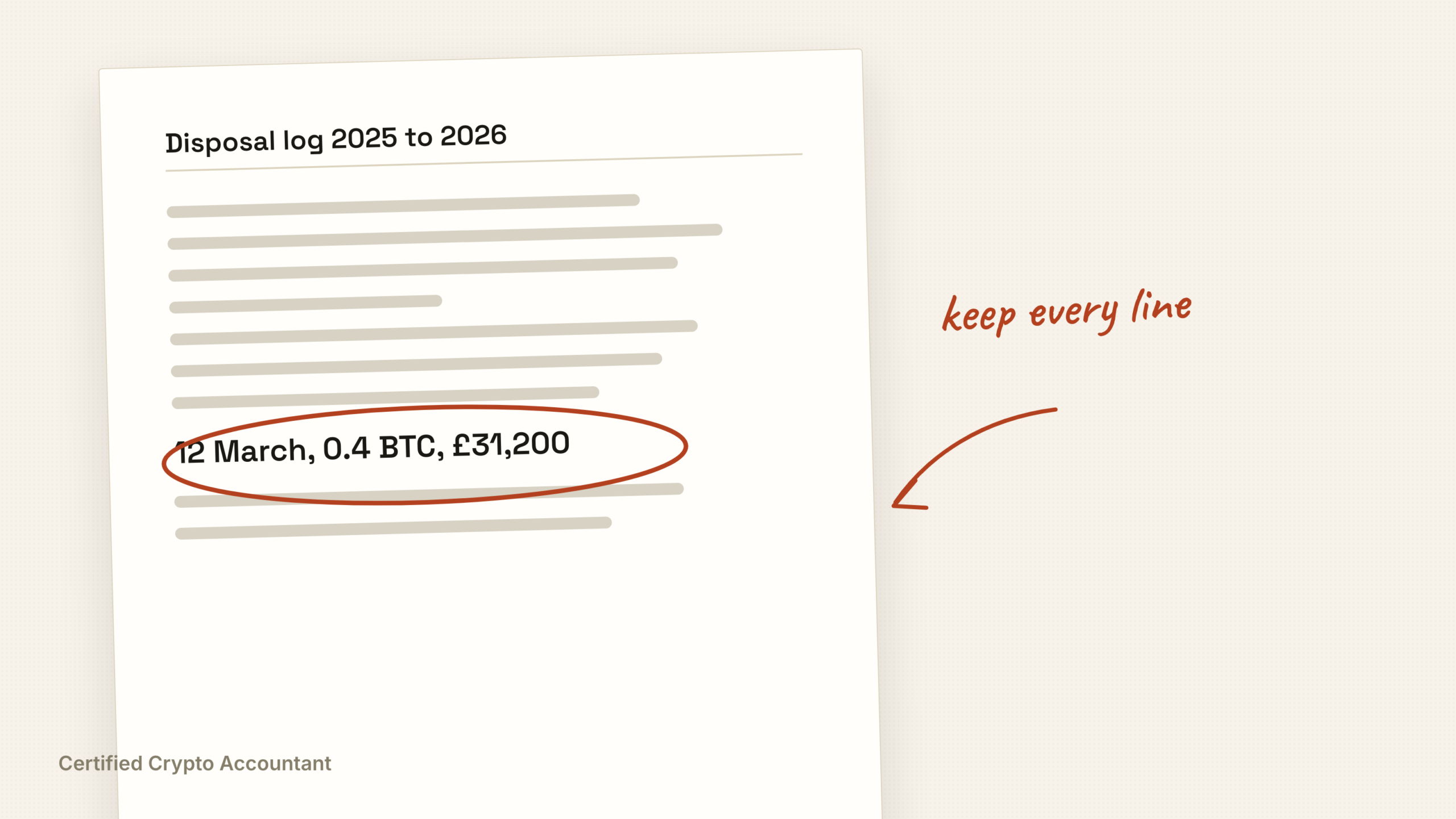
One detail trips up almost every DIY investor: the value you record is the GBP value at the moment of the transaction, not the price today. The figure that goes into your pool is what the token was worth in pounds when you acquired it. When you later dispose of it, the proceeds are again the GBP value on the day of disposal.
This applies even to crypto-to-crypto swaps. Trading one token for another is a disposal of the first token, valued in pounds, even though no fiat changed hands. Recording the GBP value at the time of each leg is what keeps your Section 104 pool accurate over the years.
Dead and closed exchanges, the biggest gap
The single largest record-keeping hole we see is the exchange that no longer exists. When a platform collapses or shuts its UK service, your trade history can vanish with it, and there is rarely a support desk left to email. If you relied on the exchange to remember your transactions, you can be left unable to prove what you paid for assets you still hold or have since sold.
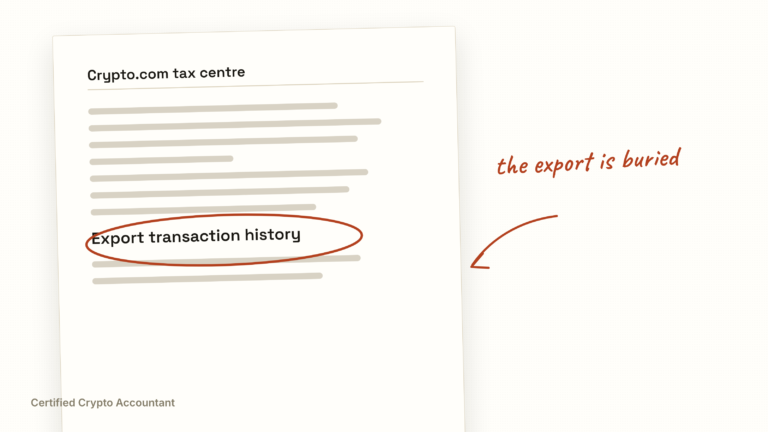
This is precisely why HMRC tells you to keep your own records as you go. Exporting your full history regularly, and saving wallet addresses and bank statements alongside it, means a dead exchange becomes an inconvenience rather than a disaster. Reconstructing a lost history afterwards is possible, but slow, and any gap that cannot be evidenced can cost you tax.
How long to keep your crypto records
For most individual taxpayers, the standard Self Assessment record-keeping rule applies. If you file on or before the deadline, you should keep your records for at least 22 months after the end of the tax year the return is for. If you file late, the period runs to at least 15 months after you sent the return, and if you are self-employed you should keep records for longer.
Those are minimums. In practice, crypto investors should keep records far longer, because cost basis can stretch back many years: a token bought five years ago still needs its acquisition cost the day you sell it. And where there is a serious problem, HMRC can look back well beyond the minimum: up to 4 years where reasonable care was taken, 6 years for carelessness and 20 years for deliberate behaviour.
How good records save you tax and stress
Clean records are not just about avoiding penalties, they directly lower your tax. With a complete history you can claim the full acquisition cost of everything you sell, offset capital losses, and make full use of the Capital Gains Tax annual exempt amount, which is £3,000 for 2026/27. Without records, you forfeit these advantages one by one and pay more than you should.
Worked example, how a missing acquisition record inflates the bill
Imagine Priya bought 2 ETH in 2021 for £3,000, then bought 1 more ETH in 2023 for £1,500. Her Section 104 pool holds 3 ETH at a total cost of £4,500. In the 2025/26 tax year she sells 1 ETH for £3,200.
With complete records, her cost basis for that 1 ETH is the pool average, £4,500 divided by 3, which is £1,500. Her gain is £3,200 minus £1,500, equal to £1,700. That sits within the £3,000 annual exempt amount, so she owes no Capital Gains Tax.
Now suppose the exchange she used in 2021 has closed and she cannot evidence that first £3,000 purchase. Only the 2023 acquisition can be proven, so HMRC may treat the unproven units as having a nil cost basis. Her cost basis falls toward £0, and her gain jumps from £1,700 to as much as £3,200. That now exceeds the £3,000 exemption, leaving £200 taxable and producing a Capital Gains Tax bill where there was none, all because one acquisition record went missing.
How a specialist handles it
When records are incomplete or an exchange has vanished, we rebuild the history methodically: pulling on-chain data from wallet addresses, cross-referencing bank statements for fiat movements, recovering whatever exports survive, and reconstructing the Section 104 pool token by token. The goal is a defensible cost basis for every asset, so you claim every pound of acquisition cost you are entitled to.
Frequently asked questions
Does my exchange keep records for me?
Only partially, and not reliably. Exchanges retain limited data and may delete it after a period or lose it entirely if they close. HMRC expects you to keep your own records, so export your full history regularly rather than depend on the platform.
What exactly does HMRC want me to record?
For each transaction: the token type, the date, the number of units bought or sold, the GBP value at the time, your running Section 104 pool cost, the wallet addresses involved, and bank statements for any fiat moving in or out.
How long do I need to keep crypto records?
At least 22 months after the end of the relevant tax year if you filed on time, longer if you filed late or are self-employed. In practice keep them far longer, as HMRC can look back up to 20 years in serious cases.
What if I lost records when an exchange shut down?
It is not hopeless. Transactions can often be reconstructed from on-chain data, wallet addresses and bank statements. But any acquisition you cannot evidence risks a low or nil cost basis, which increases your gain.
Do I record crypto-to-crypto swaps?
Yes. Swapping one token for another is a disposal of the first token for Capital Gains Tax purposes, valued in GBP at the time, and must be recorded just like a sale for fiat.
Can poor records actually increase my tax?
Yes. If you cannot prove what you paid, HMRC may treat the cost as nil, which inflates your gain. Good records let you claim full acquisition costs, use losses and apply your annual exempt amount.
Get your crypto records right before HMRC asks
If your transaction history is scattered across live and dead exchanges, the time to fix it is before a letter arrives, not after. We help UK clients reconstruct complete, HMRC-ready records and calculate the correct position year by year. Book a free, confidential review at certifiedcryptoaccountant.com, and see how our crypto tax services can turn a messy history into a defensible one.
The full set of UK rules sits on our crypto tax UK guide. If you would rather someone else did the pooling and the pounds-sterling conversions, that is what our crypto tax accountants are for.
Sources
Every figure on this page was checked against the source below on 25 August 2026.
- HMRC Cryptoassets Manual. GOV.UK, checked 25 August 2026
- Capital Gains Tax. GOV.UK, checked 25 August 2026
- Self Assessment record-keeping. GOV.UK, checked 25 August 2026
- Keep your records for at least 22 months. GOV.UK, checked 25 August 2026
- 4 years where reasonable care was taken, 6 years for carelessness and 20 years. GOV.UK, checked 25 August 2026
Fahad Zar
Crypto tax accountantAAT licensed 1010475
- AAT Licensed Accountant and MAAT, licence 1010475
- MSc Accounting and Finance, BPP University London
- Six years inside digital asset accounting, across several crypto tax firms
- Practises through Zar Enterprises Ltd, ICO registration ZC225094
- Supervised for anti-money laundering by the AAT
What matters to me is that the number on the return is true, whatever it turns out to be.
Whether this is worth a conversation
Most people who read this page do not need an accountant. A few do.
- Your exports do not agree with each other
- An exchange died with your records inside
- You want records that survive an HMRC question
If your records reconcile and back up somewhere safe, you are already ahead of most.
If one of these is you, the first look costs nothing.
Read next
Why crypto tax software gets UK returns wrong
Koinly, CoinTracker and CoinLedger compared for UK tax, and where each one gets HMRC rules wrong. What the best crypto…
Reviewed 25 Aug 2026DeadlineCrypto tax deadlines for the 2026 to 2027 tax year
Key UK crypto tax dates for 2025/26: Self Assessment registration, the 31 January filing and payment deadline, and what…
Reviewed 25 Aug 2026 ExplainerHMRC money laundering registration costs £700 in year one and trading before approval is an offence
Why a supervised accountant asks for exchange histories at onboarding.
Reviewed 5 September 2026