Koinly’s missing price warning means that transaction is worth nil until you set it. The two minute fix

Published 13 November 2026 Reviewed against gov.uk 13 November 2026 11 min readTools and records
The missing price warning means Koinly could not find a market value for one transaction on its date, so it has recorded that transaction as worth nil. Open the Warnings filter, choose Missing price, open the transaction, set its worth in pounds from a published price for that day and save. The warning disappears and the gain or loss on that asset is recomputed. The video below shows the clicks in under two minutes. The rest of this page covers what the video cannot, which price HMRC will accept, the one case where nil is the right answer, and what the warning costs when it is left alone.
Koinly’s own help page describes the warning as “No market price found for XYZ on this date” and says that if you do not set the worth, Koinly assumes a value of nil for the transaction. It adds that if nil is the true value, the warning does not need clearing. The page is here. Everything that follows is about deciding whether nil is true, and what to enter when it is not.
The missing price warning means Koinly recorded that transaction as worth nil. Set the worth in pounds from a published price for that day, using one source the same way all year and keeping the page you took it from, and the figure on your return is right. Leave it at nil only where nil is true, which is spam and tokens received for nothing.
Why Koinly shows it
After an import Koinly sets the worth of each transaction from price aggregators, CoinMarketCap and CoinGecko by its own account. The warning appears in two situations the help page names. The token is listed on neither aggregator, or the transaction happened before the token was listed, so there is no price for that day.
A third cause sits behind many of the warnings we see. Koinly has imported a token it did not recognise, shown with a grey icon in place of a logo, even though the real token is listed on its Markets page with a price. The help page on wrong tokens says the deposits and withdrawals of such a token show the missing price warning, and that the fix is Change currency, which points the transactions at the correct, tracked asset. Once that is done the prices fill in on their own and nothing has to be typed.
The fourth cause is the one in the video. An NFT is a single token with no aggregator price, so a deposit or a sale of one almost always arrives with the warning. In our files NFTs account for more missing price warnings than every obscure token together.
What nil does to your tax
It depends which side of the transaction carries the warning. On an acquisition, a nil worth is a nil cost, and CRYPTO22150 says the allowable cost is the sterling originally paid plus the fees for getting the transaction onto the ledger, so nil is nearly always too low. When that asset is later sold, the whole sale price is gain. On a disposal, a nil worth is nil proceeds, and Koinly books a loss equal to the cost. A loss that never happened, carried into a return, is the kind of figure that does not survive an enquiry.
How far the error spreads depends on the asset. CRYPTO22200 says non-fungible tokens are separately identifiable, so they are not pooled and no matching rules apply. A nil on an NFT stays on that NFT. A fungible token is different. Every unit of it sits in one pool under section 104 of the Taxation of Chargeable Gains Act 1992 with a single pooled cost, so a nil on one acquisition lowers the cost carried by every later disposal of that token.
The record is yours to hold either way. CRYPTO10400 lists what HMRC expects, including the value of the transaction in pound sterling as at its date, and says exchanges may only keep records for a short period, so the onus is on the individual.
The two minute fix, step by step
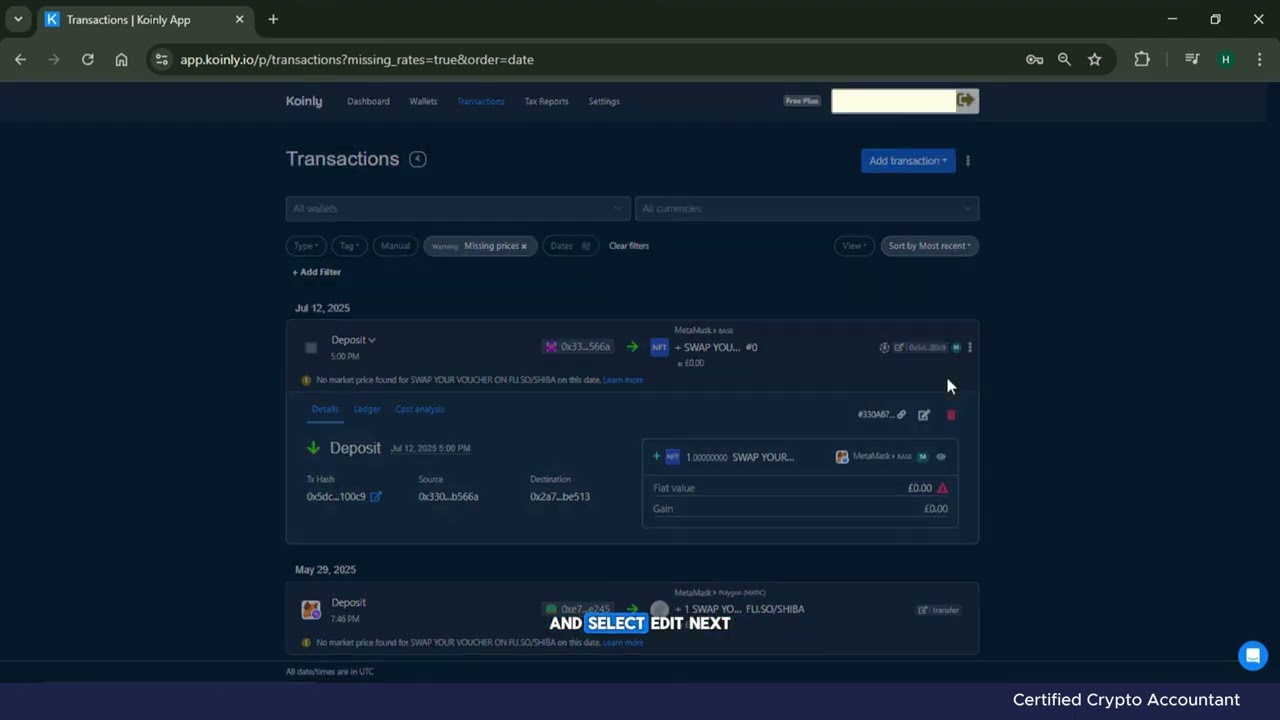
One. Find the warnings. Open the Transactions tab and click Warnings, then Missing price. Koinly lists every transaction it could not value. Work from the largest down, because a warning on a token worth pennies can wait and a warning on an NFT you later sold for four figures cannot.
Two. Check the token before you type anything. If the asset shows a grey icon and the real token is on Koinly’s Markets page, use Change currency and the price fills in by itself. If the token is spam, an unsolicited deposit that mimics a real token, mark it as spam and move on. Only an asset that is genuinely unpriced needs a worth entered by hand.
Three. Find the value on the day in pounds. For an NFT you bought, the marketplace record gives the price in ether or another coin, and the sterling price of that coin at the hour of the trade, from CoinMarketCap or CoinGecko, turns it into pounds. For a small token, Koinly’s help page suggests other aggregators such as Coinpaprika and the DEX trackers such as Dexscreener. Save the page you took the price from, with its URL and the time, beside your records.
Four. Enter the worth. Click the three dots on the transaction, choose Edit, then Change next to the worth. Koinly asks for the worth of the whole transaction rather than the unit price, and lets you pick the fiat currency, so choose GBP if your base currency is anything else. Save. The help page also allows a shortcut, clicking the value on the right of the transaction row and filling the worth in the popup. Both routes are described here.
Five. Refresh the page. The warning is gone and the transaction carries your figure. If the asset is one you still hold and it is untracked, the dashboard will still show it at nil. Koinly’s page on that says the dashboard uses live aggregator prices and ignores the worth you set, and that this skews the portfolio value but does not touch the gains calculation, which uses your figure. Custom prices under Settings keep the dashboard honest if the holding matters to you.
There is a better fix for one common case. If the warning sits on a token you received in a swap, and Koinly left the two legs as a separate withdrawal of ether and a separate deposit of the new token, select both and merge them. Koinly then values the whole trade from the coin it does know and the warning clears on its own. That is also the right answer in law. CRYPTO22100 treats a swap as a disposal of the token you gave up, and the sterling value of what changed hands that day is both the proceeds of the old token and the cost of the new one.
Which price HMRC will accept
HMRC’s Cryptoassets Manual at CRYPTO23000 says that where a transaction does not have a pound sterling value, for example where bitcoin is exchanged for ether, an appropriate exchange rate must be established to convert the transaction to pound sterling, that reasonable care should be taken to arrive at an appropriate valuation using a consistent methodology, and that details of the valuation methodology should be kept.
Three words in that paragraph do the work. Consistent means one source and one convention for the whole year, the price at the hour of the trade or the daily close, never the one that happens to give the lower tax on each occasion. Methodology means you can say in a sentence how every figure was reached. Kept means the sentence and the screenshots are filed with the return. A figure from a named aggregator, at the time of the trade, used the same way throughout, with the pages saved, meets all three. A figure typed from memory meets none.
For an NFT the best evidence is the consideration itself. The marketplace shows what was paid in ether and the chain shows when, so the sterling value of that ether at that time is the cost, and the gas fee paid to have the transaction included on the ledger is added to it under CRYPTO22150. Where an NFT came free, by airdrop or a mint with no price, a nil cost may be right, and the next section covers when.
When nil is the right answer
Koinly’s help page says the warning can be left where nil is the true value, and sometimes it is. A spam token that landed in your wallet unasked, with no market anywhere, is worth nil and should be marked as spam so it leaves the report altogether. A token you were sent for nothing and could not have sold is worth nil on the day it arrived.
Two cautions. CRYPTO22350 says airdropped tokens get no cost on arrival, so nil is right for the acquisition, but if the airdrop was received in return for something, or as part of a trade, it may be income at its sterling value on the day, and the airdrop tax guide works through that test. And nil on a disposal is almost never right, because a sale that fetched nothing is not a sale. If Koinly shows a missing price on something you sold, the proceeds exist somewhere, on the exchange, in the marketplace or on the chain, and they belong in the figure.
A worked example with figures
Suppose you bought an NFT on 12 July 2025 for 0.4 ether on a marketplace, when ether was £2,200, so the cost was £880 plus a £12 gas fee, £892 in all. Koinly imported the deposit of the NFT with a missing price warning and left it at nil. In January 2026 you sold it for 0.9 ether when ether was £2,400, and that side Koinly priced on its own at £2,160.
As the report stands, the gain on the NFT is the full £2,160. Say your other disposals in the year to 5 April 2026 produced gains of £2,000. The year’s gains are £4,160, the £3,000 annual exempt amount leaves £1,160 taxable, and at the published rates for 2025 to 2026 of 18% and 24% the tax is £208.80 or £278.40.
Set the worth to £892 and the gain on the NFT falls to £1,268. The year’s gains are £3,268, the taxable amount is £268, and the tax is £48.24 or £64.32. One warning on one NFT was costing £160.56 or £214.08. Multiply that by a wallet with a dozen mints and the figure stops being small. The return that carries the right number is due online, with the payment, by 11.59pm on 31 January 2027.
The warnings that travel with this one
Missing price rarely arrives alone, and the others in the Warnings menu are more expensive. Missing purchase history means Koinly saw you sell coins it never saw you buy, so the whole sale is gain, and Koinly’s page on it says the missing part is given a cost of nil. A negative balance is the same gap seen from the ledger, the running balance of a coin going below zero on the day of a sale. And a transfer counted as a sale is a withdrawal to your own wallet that Koinly could not pair with its deposit, taxed as if you had sold. Each has its own page with the steps.
When it needs an accountant
A handful of missing price warnings on tokens you can look up is an evening’s work with the steps above, and you should do it yourself first. It becomes a job when the warnings run into the hundreds across several chains, when the NFTs were traded in and out of collections dozens of times, or when the same wallet carries missing purchase history and negative balances that mean the whole history has to be rebuilt before any single price matters. Then it needs someone who can read the chain, value each trade on a consistent basis and write the methodology HMRC asks for. The fees below cover the whole report.
Three fixed fees, quoted in writing before any work starts
One taxpayer, one tax year unless the line says otherwise. Written position within 15 working days of software access.
For an exchange-only history under about 5,000 trades where the software report is already built.£499
For several platforms, wallet transfers read as sales, duplicates, and one or two back years.£950
For DeFi, derivatives, high volume, or balances that do not tie.£1,750
Send your software report to zar@certifiedcryptoaccountant.com for a written fee the same working day, or start with the free review. Licensed and regulated by the AAT, licence 1010475.
Questions about the missing price warning
What does the missing price warning mean in Koinly?
Koinly could not find a market price for that asset on the date of the transaction, so it has recorded the transaction as worth nil. Its help page names two causes, a token listed on neither CoinMarketCap nor CoinGecko, and a transaction dated before the token was listed. A third is a token Koinly imported without recognising it, shown with a grey icon, which Change currency fixes without typing a price.
What happens if I ignore the missing price warning?
Koinly keeps the transaction at nil. On an acquisition that means a nil cost, so the whole of the later sale is taxed as gain. On a disposal it means nil proceeds, so Koinly books a loss that did not happen. The gains report and the figures on your Self Assessment return carry the error either way.
How do I set the worth of a transaction in Koinly?
Click the three dots on the transaction, choose Edit, then Change next to the worth, and enter the value of the whole transaction in pounds rather than the price per unit. Koinly also lets you click the value on the right of the transaction row and fill it in the popup. Save, refresh the page and the warning is gone.
Where do I find the price HMRC will accept?
HMRC's manual at CRYPTO23000 asks for an appropriate exchange rate, reasonable care, a consistent methodology and a record of how the figure was reached. A price from a named aggregator at the time of the trade, used the same way for every missing price in the year, with the page saved, meets that. For an NFT you bought, the ether paid converted to pounds at the hour of the trade is the cost, plus the gas fee.
Is it ever right to leave the warning at nil?
Yes, where nil is the true value. A spam token that arrived unasked with no market anywhere is worth nil and is better marked as spam. A token received for nothing has no cost under CRYPTO22350. A missing price on something you sold is a different matter, because the proceeds exist and belong in the figure.
Sources
Every figure on this page was checked against the source below on 13 November 2026.
- Market prices for XYZ are missing. Koinly help centre, checked 13 November 2026
- I set the market price for a token but my dashboard still shows zero. Koinly help centre, checked 13 November 2026
- Wrong token imported. Koinly help centre, checked 13 November 2026
- Missing purchase history for XYZ. Koinly help centre, checked 13 November 2026
- CRYPTO23000, Cryptoassets for individuals, valuation. HM Revenue and Customs, checked 13 November 2026
- CRYPTO22200, Capital Gains Tax, pooling. HM Revenue and Customs, checked 13 November 2026
- CRYPTO22150, Capital Gains Tax, allowable expenses. HM Revenue and Customs, checked 13 November 2026
- CRYPTO22100, Capital Gains Tax, what is a disposal. HM Revenue and Customs, checked 13 November 2026
- CRYPTO22350, Capital Gains Tax, airdrops. HM Revenue and Customs, checked 13 November 2026
- CRYPTO10400, record keeping. HM Revenue and Customs, checked 13 November 2026
- Capital Gains Tax rates and annual tax-free allowances. HM Revenue and Customs, checked 13 November 2026
- Self Assessment tax returns, deadlines. GOV.UK, checked 13 November 2026
- Taxation of Chargeable Gains Act 1992, section 104. legislation.gov.uk, checked 13 November 2026

Fahad Zar
Crypto tax accountantAAT licensed 1010475
- AAT Licensed Accountant and MAAT, licence 1010475
- MSc Accounting and Finance, BPP University London
- Six years inside digital asset accounting, across several crypto tax firms
- Practises through Zar Enterprises Ltd, ICO registration ZC225094
- Supervised for anti-money laundering by the AAT
What matters to me is that the number on the return is true, whatever it turns out to be.
Whether this is worth a conversation
Where this stops being a reading job and starts being a hiring one.
- Your Warnings menu shows missing prices in the hundreds across several chains or NFT collections and the return is due by 31 January 2027
- The same wallet carries missing purchase history or negative balances, so the history has to be rebuilt before any single price matters
- You need the valuation methodology written up in a form HMRC will accept, with every figure traceable to a named source
If the warnings are few, the tokens can be looked up on a named aggregator and the NFTs have a marketplace record, you have fixed it yourself. Enter the figures, save the pages you took them from, and file.
If one of these is you, the first look costs nothing.
Read next
Missing purchase history means the software gave your coins a nil cost
The other nil, on the cost side, and the five places the real cost is found.
Reviewed 13 November 2026ExplainerA negative balance means the software sold coins it never saw you buy
The ledger view of the same gap, and the date that tells you where it is.
Reviewed 13 November 2026ExplainerYour tax report counted a transfer to your own wallet as a sale
The six checks a transfer must pass to be paired, and the repair.
Reviewed 13 November 2026Deep guideNFT creators and traders are taxed under different rules
Why an NFT is never pooled, and how a collection is taxed when it is sold.
Reviewed 13 November 2026 ExplainerMerging two rows in Koinly turns a sale and a purchase back into one transfer. How to merge, split and edit
The second page of the set. Merging, splitting and editing transactions in Koinly, and the tax each click moves.
Reviewed 13 November 2026