
Crypto accountants for UK investors,
so the figure you file is the figure you owe.
Certified Crypto Accountant is a UK firm that works only on crypto tax. We rebuild your exchange, wallet and DeFi history from source, apply HMRC’s share pooling rules, and file the Self Assessment ourselves, on a fixed fee agreed before any work starts.
Most reports we are sent overstate the gain. Usually a transfer between your own wallets has been read as a sale, or an acquisition cost never reached the pool. We find that before you file, so you pay what you owe and nothing above it.
Works with
and the report from whichever crypto tax software you already use.
What HMRC is doing right now, from our guides
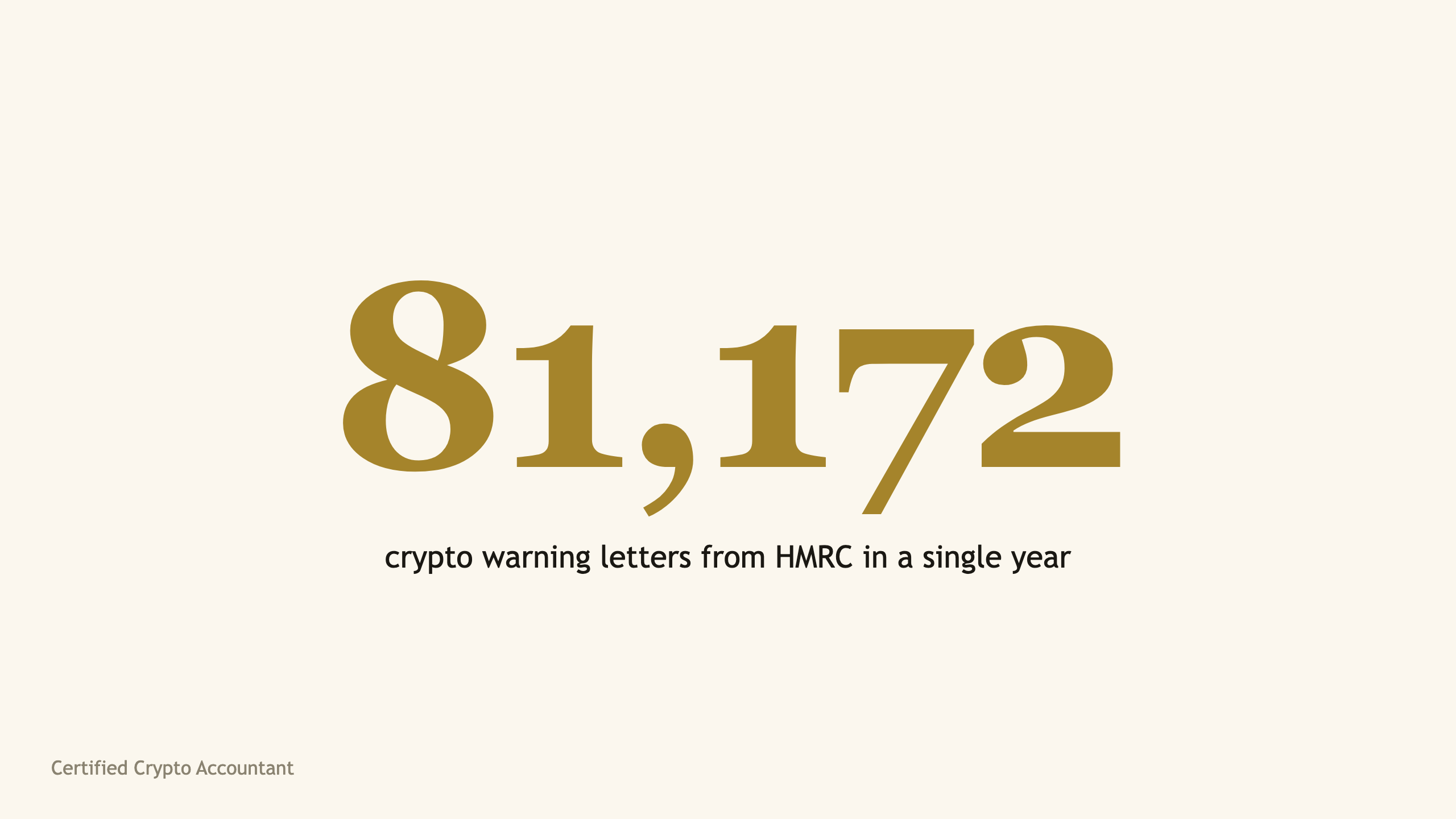
HMRC posted 81,172 crypto warning letters in the year to 5 April 2026, up from 65,000 the year before.
Read the numbersUK crypto platforms have collected your identity and transaction data under CARF since 1 January 2026. The first reports reach HMRC by 31 May 2027.
What CARF sendsAn HMRC nudge letter is not a tax bill. Replying early, and correctly, keeps the penalty band low.
How to answer oneA careless error tops out at 30% of the tax, a deliberate one at 70%, and deliberate and concealed at 100%, doubling to 200% where the assets count as offshore.
The penalty bandsNever filed before? You must register for Self Assessment by 5 October 2026 to file for the 2025 to 2026 year.
Every deadlineA transfer between your own wallets is not a sale. It is the most common reason a software report overstates the gain.
Why it happensHMRC uses share pooling. Identical coins go into a section 104 pool with an averaged cost, with same day and 30 day rules around each sale.
How UK crypto tax worksThe annual capital gains exemption is £3,000, so more people cross the line than expect to.
When you owe CGTWhy is your crypto tax report probably wrong?
Crypto tax software and general practice accountants get crypto wrong in the same three places, and the errors run in one direction, towards a bigger bill now or a penalty later.
Crypto tax software gets the UK rules wrong
Cost basis goes missing when an exchange closes, a transfer between your own wallets gets booked as a sale, and first in first out gets used where HMRC requires section 104 pooling. Each one pushes the gain up. We reconcile the file by hand before anything is filed.
General accountants are not crypto accountants
How HMRC taxes crypto turns on pooling, the 30 day rule, staking income and DeFi classification. Crypto tax is all we do, and HMRC is who we do it for.
HMRC already holds your exchange data
Nudge letters are generated from records HMRC has already matched against returns, and from 2027 CARF gives it a full annual feed from every UK platform. What to do about a nudge letter.
Crypto tax, handled end to end.
From a software report that looks wrong to a letter that has already arrived, one firm covers it for UK filers. Every engagement is a fixed quote, agreed before we start.
Crypto tax accountants
Crypto tax accountants for UK investors. Self Assessment with the separate cryptoasset boxes HMRC added for 2024 to 2025 returns onwards, and the section 104 pool built from source.
Crypto tax accountants for UK filingCrypto tax reconciliation
Every exchange, wallet and DeFi protocol matched into one history you can defend, with each figure traced to a source row. The fix for a crypto tax report that looks wrong.
How crypto reconciliation worksCapital gains tax accountant
One capital gains tax accountant for crypto, shares and property, with the matching rules applied, the £3,000 allowance used and both rates worked through before anything is filed.
Capital gains tax accountantCrypto tax advisors
Nudge letters, enquiries and voluntary disclosure handled from the first reply, while the penalty position is still yours to choose.
Crypto tax advisors for HMRC lettersAlso here, the full crypto tax service and every service in one place. Work a number out first with the capital gains tax calculator or the crypto tax calculator.
We work remotely with clients across the whole UK. Crypto tax accountants for London, Manchester, Birmingham, Leeds, Liverpool, Bristol, Edinburgh and Glasgow.
How much does a crypto accountant cost?
Among UK firms that do only crypto tax the going rate for one properly reconciled and filed year is £750 to £2,000, checked against published prices in September 2026. A simple year filed from a clean software report can cost £300 or less. Heavy DeFi or NFT years usually run £1,200 to £2,500, and a multi year catch up with a disclosure to HMRC lands between £1,500 and £3,500. US full service firms charge £2,200 to £4,700 a year once converted from dollars.
What moves the price is the number of open years, the number of transactions, whether your platforms still exist and how much of the history has to be rebuilt. How much crypto you hold has nothing to do with it. The pricing calculator prints a range for your own case before you speak to anyone, and the free review turns that range into one fixed quote. What each service includes is set out on the services page.
The 2025 to 2026 tax year is closed. The clock is already running.
A multi year crypto history takes weeks to rebuild. Start now and you choose your filing position.
Never filed before? You must register for Self Assessment by 5 October 2026 to file for the 2025 to 2026 year, and a paper return has to reach HMRC by 31 October 2026.
From first call to filed return, in four steps.
A free call first
Thirty minutes on your wallets, exchanges and tax years. You leave knowing where you stand and the fixed price.
You send what you have
API keys, exports or wallet addresses. We extract the rest, dead exchanges included.
We rebuild and review
Your full history rebuilt under HMRC rules, every figure traced to a source row and explained in plain English.
You approve, we file
You sign off, we submit, you get the confirmation. Next year is already set up.
The fee is fixed before we start and nothing is billed by the hour.
What crypto investors say after we check the numbers.
Verified reviews on Google and Trustpilot
Crypto tax questions, answered plainly.
The questions UK crypto investors actually ask us, with straight answers and a link to the full guide on each. Tap any question to open it.
Do you need an accountant for crypto?
What does a crypto accountant do?
How much does a crypto tax accountant cost in the UK?
Is cryptocurrency taxable in the UK?
How much tax do I pay on crypto in the UK?
What is the crypto tax free allowance in the UK?
Do I still pay tax if I only made a small profit?
Do I pay tax on crypto if I never cash out to my bank?
Can HMRC see your crypto?
What is an HMRC crypto nudge letter and what should I do?
What is CARF and how does it affect me?
Does Coinbase report to HMRC?
Does Binance report to HMRC?
I haven't declared my crypto for years. What should I do?
What happens if I don't report my crypto to HMRC?
What are the penalties for filing crypto tax late?
What happens in an HMRC crypto enquiry?
Is swapping one crypto for another taxable?
Do I pay tax moving crypto between my own wallets?
Is staking taxed in the UK?
How are airdrops taxed in the UK?
How is crypto mining taxed in the UK?
Is DeFi taxed in the UK?
How are NFTs taxed in the UK?
Do I pay tax on crypto I gift to someone?
Is crypto subject to inheritance tax?
Am I trading or investing in HMRC's eyes?
I moved to or from the UK. How does that affect my crypto tax?
My Koinly gains figure looks wrong. Can you fix it?
Is crypto tax software enough to file my crypto taxes?
What records do I need to keep for crypto tax?
How are crypto gains actually calculated in the UK?
Can I offset my crypto losses against my gains?
What do I need to bring to the first call?
How do you price the work?
Who actually does the work?
Crypto tax guides, written by the accountant who files them.
Every figure checked against HMRC guidance, with the date it was checked on the page.
 Deep guide
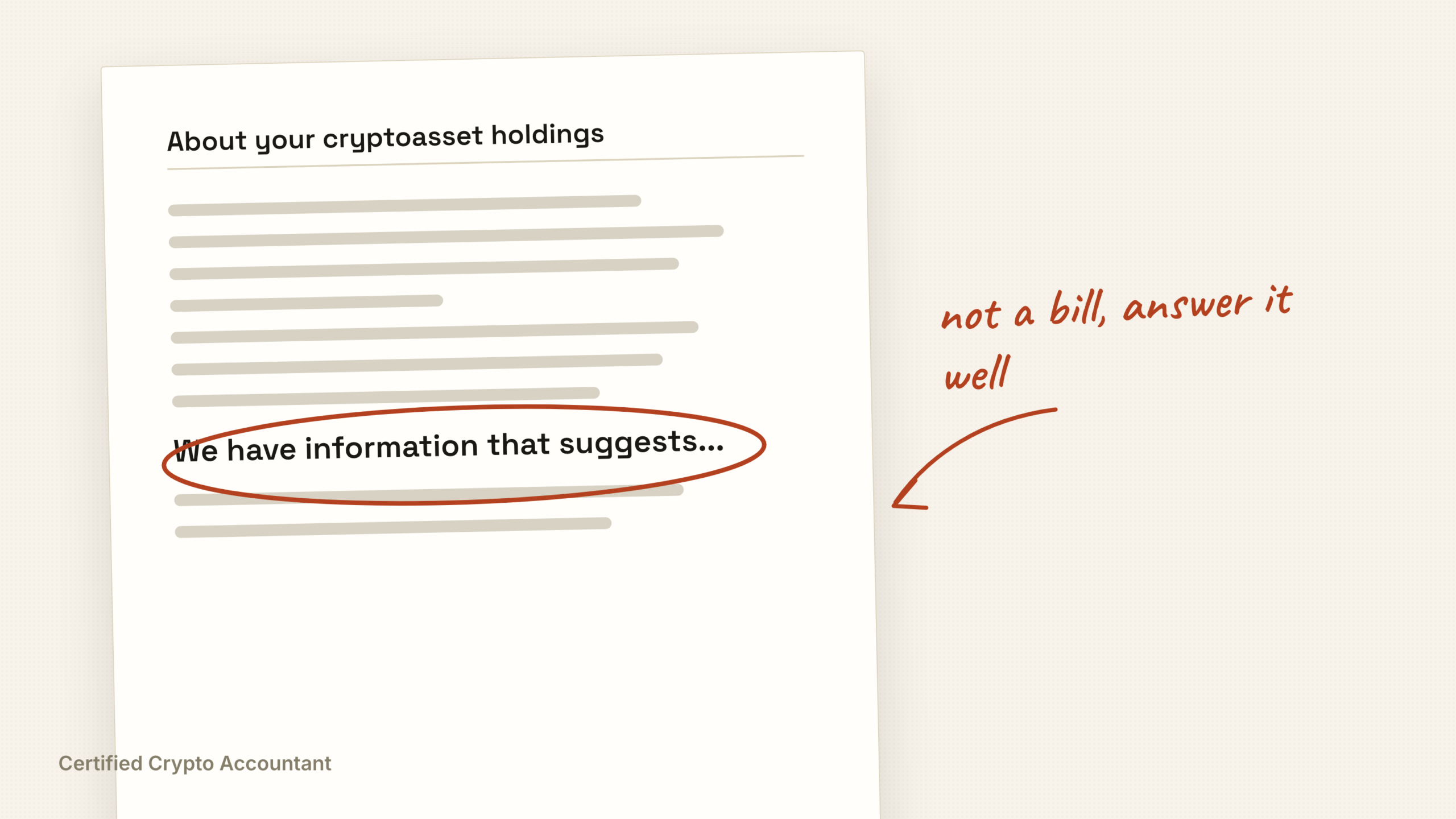
An HMRC nudge letter is not a tax bill
Reviewed 3 September 2026
Deep guide
An HMRC nudge letter is not a tax bill
Reviewed 3 September 2026
 News
HMRC sent 81,000 crypto letters last year, four for every person who filed
Published 29 August 2026
News
HMRC sent 81,000 crypto letters last year, four for every person who filed
Published 29 August 2026
 Explainer
What Coinbase and Binance actually send to HMRC
Reviewed 29 August 2026
Explainer
What Coinbase and Binance actually send to HMRC
Reviewed 29 August 2026
Browse every crypto tax guide Or start from the resources hub, sorted by the question you have.
What stands behind every figure on this page
Every guide on this site is written by a practising crypto tax accountant who files these returns with HMRC. Every figure and every date is checked against gov.uk before a page goes live. When the guidance changes, the page is re-read and the checked date moves with it.
Certified Crypto Accountant is the trading name of Zar Enterprises Ltd, a UK limited company. The firm is licensed and regulated by the Association of Accounting Technicians, which also supervises it for anti-money laundering. The company is registered with the ICO as a data controller and holds professional indemnity insurance, so a named entity answers for every figure you read here. More about the firm, or get in touch.
- Last checked against gov.uk
- Company
- Zar Enterprises Ltd, company number 17310916
- Regulation
- Licensed and regulated by the AAT, licence 1010475
- Data protection
- ICO registration ZC225094
- Insurance
- Professional indemnity insurance with Hiscox
Speak to a crypto tax accountant before HMRC writes first.
Book a free 30-minute call. We will tell you exactly where you stand, what needs doing, and the fixed price, whether you need a full reconciliation, a corrected software report, or help answering a letter that has already arrived.
Book a free callNo commitment. Fixed pricing. UK crypto tax only. Prefer to write first? Send a message.