HMRC is writing to crypto investors until March 2027, and the letter leaves you two routes

Published 5 November 2026 Reviewed against gov.uk 4 November 2026 9 min readHMRC and compliance
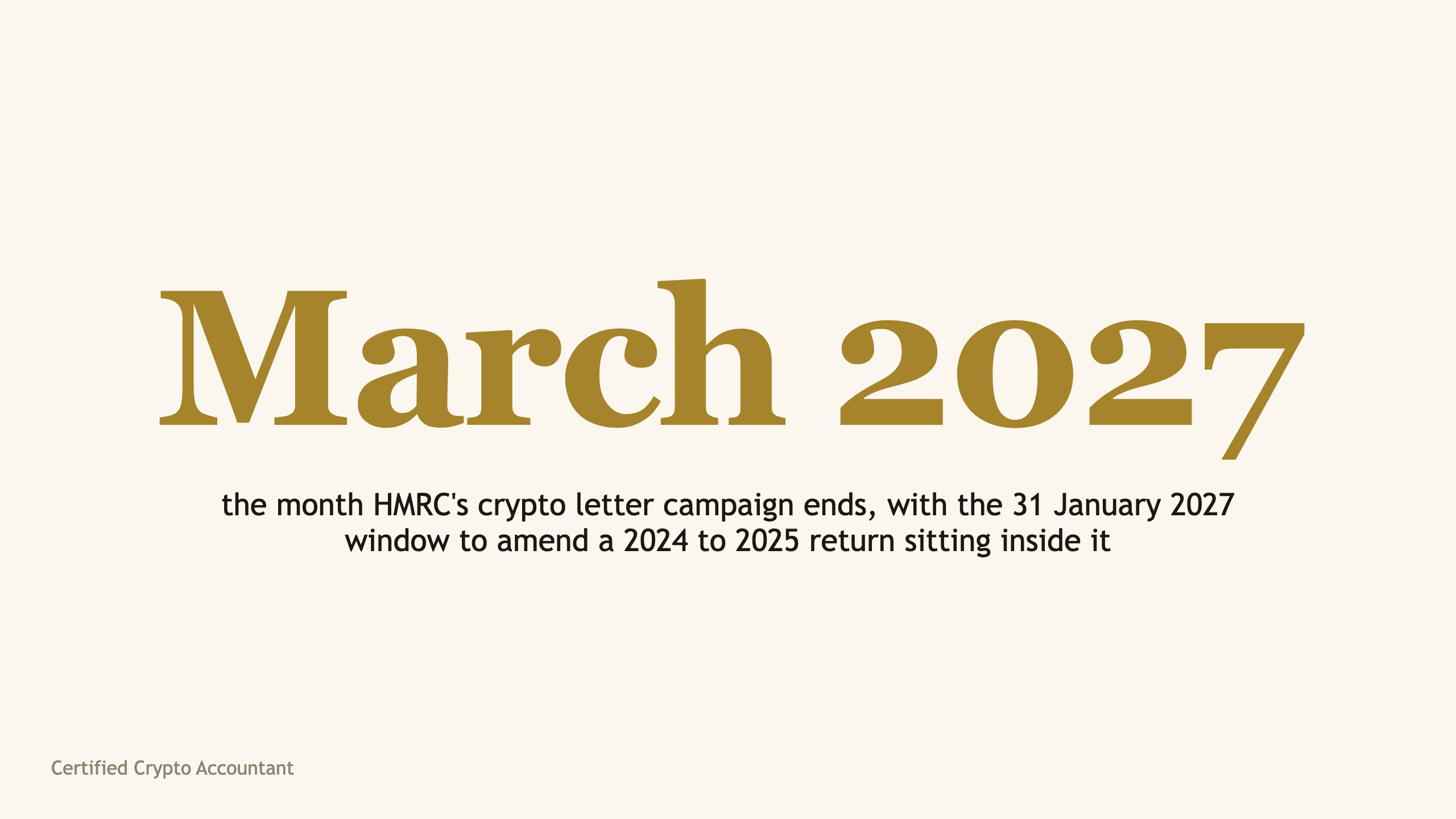
The letter is real, it is part of a programme, and it is not the start of an enquiry. HMRC’s Wealthy and Mid-sized Business Compliance team is contacting individuals it believes may have underpaid Income Tax or Capital Gains Tax on cryptoasset transactions, from July 2026 to March 2027, by letter, email or text message, and your agent gets a copy if you have one. That is ICAEW’s account of the letter, published on 23 July 2026, and HMRC’s own list of genuine contact, updated 27 October 2026, carries a cryptoassets entry naming the same three channels. The letter asks you to check whether your crypto was declared correctly and tells you what to do if it was not. There are two routes, amend or disclose, and the right one depends on the year. Everything below was checked on GOV.UK on 4 November 2026.
The letter is a prompt with a calendar attached. Amend by 31 January 2027 where you still can, disclose where you cannot, and settle the figures before you say a word to HMRC.
What the letter says
It explains when a cryptoasset transaction creates taxable income or a chargeable gain, which means selling for pounds, swapping one coin for another or spending coins, per HMRC’s guidance on selling cryptoassets, or being paid in them, per its guidance on receiving cryptoassets. It then asks you to look at your own returns against that list. If there is something to report and the return can still be changed, you amend it. If the amendment window has closed, you use HMRC’s disclosure service. If there is nothing to report, you do nothing, and the letter says so.
The text message version is thinner. HMRC’s genuine contact page says the text only points you to GOV.UK guidance, so a text that asks for bank details, a password or a payment is a fake whatever it says about crypto. Our sorting method for HMRC scams covers the tells.
Why you, and what HMRC already holds
HMRC did not guess. It has been serving data notices on exchanges for years, and Kraken’s own support page now describes handing over three tax years of UK account data under one of them, which our Kraken guide reads line by line. From 1 January 2026 the Cryptoasset Reporting Framework adds an automatic feed, with the first reports due by 31 May 2027 covering the 2026 calendar year, per HMRC’s reporting guidance. The letters in between are the matching exercise, a name on an exchange file that does not appear on a return.
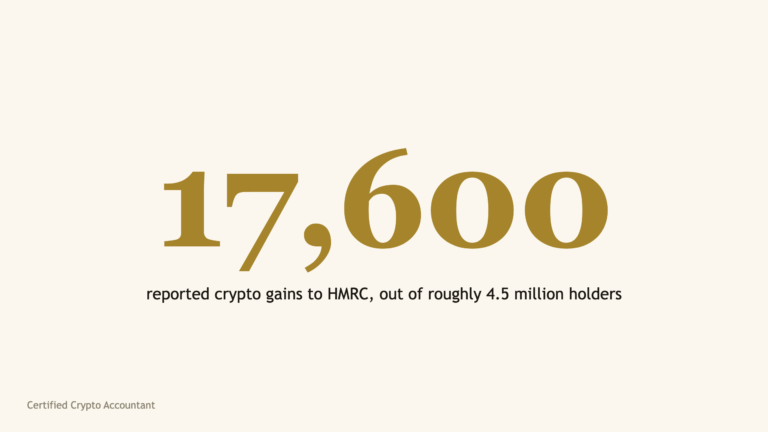
The scale is on the public record. UHY Hacker Young’s request produced the figure of 81,172 crypto letters in the year to 5 April 2026, which our breakdown of the 81,000 letters sets against the 17,600 people who declared a crypto gain. HMRC’s own plan for wealthy compliance, published with the Budget on 28 October 2026, records over 180,000 educational communications, over 800 disclosures through the Cryptoasset Disclosure Service and £188.4 million of crypto compliance yield in 2025 to 2026. A campaign that returns that much is not going to stop in March 2027. It will restart with better data.
Route one, amend the return by 31 January 2027
You can correct a Self Assessment return within 12 months of the filing deadline, online or on paper, and GOV.UK’s corrections page gives the example that matters this winter. For the 2024 to 2025 tax year the change has to be made by 31 January 2027. The 2025 to 2026 return, due the same day, can be amended until 31 January 2028. You wait at least 72 hours after filing before amending online, then open Tax return options in your Self Assessment account, choose the year, correct the figures and file again.
Two things people get wrong here. The first is the reporting test. The SA108 notes for 2026 say the Capital Gains Tax summary pages are needed if your chargeable gains before losses were more than £3,000 or you disposed of chargeable assets worth more than £50,000, and an active exchange account clears £50,000 of proceeds on churn alone, so a year with a small gain can still need the pages. The second is the box. From 2024 to 2025 the return has its own cryptoasset section, per HMRC’s cryptoassets guidance, and the figure that goes in it is a pooled computation, which no exchange statement gives you. Our reporting guide walks the boxes.
Interest runs from the original due date whichever route you take. HMRC’s interest rates page puts late payment interest at base rate plus 4% since 6 April 2025, which is 7.75% from 9 January 2026. On an amended return the tax and the interest are collected through your account. The penalty question is separate and sits below.
Route two, the cryptoasset disclosure service for older years
Anything that can no longer be amended goes through HMRC’s Tell HMRC about unpaid tax on cryptoassets service, and the page sets out the years by behaviour. If you took reasonable care and still got it wrong, you pay for four years. If you were careless, six. If the omission was deliberate, which HMRC defines as knowing you owed tax and choosing not to tell it, or knowing the return was wrong when you sent it, twenty. You work out the Capital Gains Tax and Income Tax yourself, add interest from each due date, choose a penalty percentage from HMRC’s factsheets, and submit the lot as an offer. HMRC says it will reject a disclosure whose interest is wrong, that payment is due within 30 days of submitting, and that if it thinks your penalty is too low it may open a wider check.
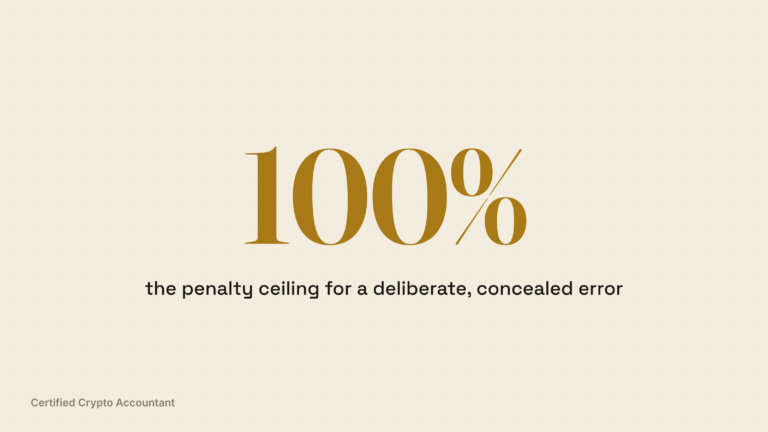
The penalty ranges are the part to read twice. For an inaccuracy in a return, HMRC’s Compliance Handbook at CH82470 gives 0% to 30% of the tax for a careless error disclosed unprompted and 15% to 30% once prompted, 20% to 70% and 35% to 70% for a deliberate error, and 30% to 100% and 50% to 100% where it was deliberate and concealed. Where you never registered for Self Assessment at all, the failure to notify factsheet applies, and its non-deliberate range is 0% to 30% unprompted within twelve months, rising to 20% to 30% once prompted and more than twelve months late.
So is a disclosure made after this letter prompted or unprompted? The factsheet defines unprompted as telling HMRC before you had any reason to believe it was about to find the failure. A letter saying HMRC holds information about your crypto is hard to read any other way, so we work the figures on the prompted ranges and treat anything kinder as a bonus. The disclosure guide has the full route, including the digital disclosure service for mixed income.
The arithmetic on a typical year
Take a 2023 to 2024 year with £20,000 of gains above that year’s £6,000 allowance, all at the then 20% higher rate, so £4,000 of Capital Gains Tax unpaid since 31 January 2025. Interest at the current 7.75% adds roughly £300 a year while it stays unpaid. A careless, prompted disclosure carries a penalty between £600 and £1,200. The same figures treated as deliberate run from £1,400 to £2,800. Saying nothing, and leaving HMRC to find the exchange data itself, pushes the behaviour finding towards deliberate and the year count towards twenty, and the enquiry that follows has statutory powers the letter does not. The tax is the same in each of those outcomes. The behaviour finding is the only number you still control, and it is decided in the first reply.
What to do in the first week
Do not ring the number on the letter to talk it through, and do not reply in writing before you know the figures. HMRC’s numbers come from data feeds and data feeds are wrong more often than people expect. Check the letter against the genuine contact page. Pull the full export from every exchange and wallet you have ever used, including the dead ones, so nothing is left out. GOV.UK’s disclosure page warns that if HMRC’s checks show you knowingly gave incorrect information, it may look at your tax affairs again and you may be liable to higher penalties. Reconcile the lot into one pooled computation, read what each year actually shows, and only then choose the route. If you have an agent, they already have the letter, so the first call is to them.
The fees for the work a letter leads to are set out below, and the reply itself is the job our crypto tax advisors for HMRC letters do once the figures behind it are settled. If you already have a software report, the free review tells you within 48 hours whether it will survive the comparison HMRC is about to run.
Three fixed fees, quoted in writing before any work starts
One taxpayer, one tax year unless the line says otherwise. Written position within 15 working days of software access.
For an exchange-only history under about 5,000 trades where the software report is already built.£499
For several platforms, wallet transfers read as sales, duplicates, and one or two back years.£950
For DeFi, derivatives, high volume, or balances that do not tie.£1,750
Send your software report to zar@certifiedcryptoaccountant.com for a written fee the same working day, or start with the free review. Licensed and regulated by the AAT, licence 1010475.
Questions about the HMRC crypto letter
Is the HMRC crypto letter a tax investigation?
No. It is a one to many letter sent to a group of people HMRC's data suggests may have underpaid, and it asks you to check your own position. An enquiry is opened by a separate letter under section 9A of the Taxes Management Act 1970 and carries statutory powers. Ignoring the first letter is the most reliable way to receive the second.
What happens if I ignore the HMRC crypto letter?
Nothing arrives by return of post, which is why people relax. The letter has already told you HMRC holds information, so any later disclosure is treated as prompted and the penalty range starts higher. If HMRC then opens a check using the exchange data, the behaviour finding drifts towards deliberate, which carries a penalty of 35% to 70% of the tax and lets HMRC assess up to twenty years.
Can I still amend my 2024 to 2025 tax return?
Yes, until 31 January 2027. GOV.UK allows a Self Assessment return to be corrected within 12 months of its filing deadline, online or on paper. After that date the only route for 2024 to 2025 is a disclosure, so a letter received this winter about that year has a hard date on it.
How many years do I have to disclose?
HMRC's cryptoasset disclosure page gives four years where you took reasonable care, six where you were careless and twenty where the failure was deliberate. The behaviour is judged on the facts of each year, and the disclosure has to include interest from each year's due date or HMRC rejects it.
Is the HMRC crypto text message real?
It can be. HMRC's genuine contact page lists text messages as one of the three channels for the cryptoassets campaign, and says the text only directs you to GOV.UK guidance. A text that asks for payment, bank details or a login is a scam regardless of how it is worded.
Sources
Every figure on this page was checked against the source below on 4 November 2026.
- HMRC targets tax liabilities from cryptoassets, 23 July 2026. ICAEW, checked 4 November 2026
- Check genuine HMRC contact that uses more than one communication method. HM Revenue and Customs, checked 4 November 2026
- Self Assessment tax returns, if you need to change your return. GOV.UK, checked 4 November 2026
- Tell HMRC about unpaid tax on cryptoassets. HM Revenue and Customs, checked 4 November 2026
- CH82470, penalty ranges for inaccuracies. HM Revenue and Customs, checked 4 November 2026
- CC/FS11, penalties for failure to notify. HM Revenue and Customs, checked 4 November 2026
- HMRC interest rates for late and early payments. HM Revenue and Customs, checked 4 November 2026
- SA108 Capital gains summary notes 2026. HM Revenue and Customs, checked 4 November 2026
- Check if you need to pay tax when you sell cryptoassets. HM Revenue and Customs, checked 4 November 2026
- Modernising HMRC's approach to wealthy compliance. HM Revenue and Customs, checked 4 November 2026
- Reporting cryptoasset user and transaction data. HM Revenue and Customs, checked 4 November 2026
- Check if you need to pay tax when you receive cryptoassets. HM Revenue and Customs, checked 5 November 2026

Fahad Zar
Crypto tax accountantAAT licensed 1010475
- AAT Licensed Accountant and MAAT, licence 1010475
- MSc Accounting and Finance, BPP University London
- Six years inside digital asset accounting, across several crypto tax firms
- Practises through Zar Enterprises Ltd, ICO registration ZC225094
- Supervised for anti-money laundering by the AAT
What matters to me is that the number on the return is true, whatever it turns out to be.
Whether this is worth a conversation
Where this stops being a reading job and starts being a hiring one.
- The letter, email or text has arrived and you want the figures settled before anyone replies
- A 2024 to 2025 return needs amending before 31 January 2027 and the crypto figure in it was never a pooled computation
- Older years were never filed and the disclosure has to carry the right years, interest and penalty first time
If every year is filed from a full reconciliation and the letter is a mismatch HMRC's own data created, a short letter back with the computation attached usually closes it, and you may not need us for that.
If one of these is you, the first look costs nothing.
Read next
What HMRC crypto nudge letters mean and what to do next
The letter itself, the three routes and the 30 day plan.
Reviewed 4 November 2026ExplainerWhat happens in an HMRC crypto tax enquiry
Where a letter ignored ends up, with section 9A and the time limits.
Reviewed 4 November 2026Deep guideHow to disclose unpaid crypto tax before HMRC finds it
The disclosure service step by step, including mixed income.
Reviewed 4 November 2026ExplainerHMRC sent 81,000 crypto letters last year
The scale of the programme against the number of people who filed.
Reviewed 4 November 2026 ExplainerHMRC's letter says you have disposed of cryptoassets. What it is, the 60 days, and what to send back
What the letter says when it arrives, from the template HMRC shared in July 2024, and the order to do things in before the 60 days run out.
Reviewed 12 November 2026ExplainerHMRC's 2026 crypto letter has no deadline. What it says, why you got it, what to check before doing nothing
The July 2026 letter itself, quoted word for word. Why it has no deadline, what no further action means, and the sentence about a penalty up to 100%.
Reviewed 14 November 2026