HMRC’s compliance check letter about your crypto return. The opening pack, the 12 month window, the 30 days

Published 14 November 2026 Reviewed against gov.uk 14 November 2026 13 min readHMRC and compliance
A letter from a named HMRC officer, with a direct phone number, saying they intend to enquire into or check your Self Assessment return for a named tax year, asking for documents by a date, and enclosing factsheet CC/FS1a, is a notice of enquiry under section 9A of the Taxes Management Act 1970. HMRC’s public name for it is a compliance check. It is the letter the nudge letters say they are not, and it carries powers they do not have. It also arrives inside a window set by law, asks for things HMRC’s own manual lists, and ends in a notice you can force if it drags, so most of what feels unknowable about it is written down.
HMRC does not publish the standard letter itself. Its Enquiry Manual says officers “must use the standard opening letters on SEES”, HMRC’s internal system, so this page quotes what HMRC tells its officers the letter must contain, the one opening letter that sits verbatim in a public primary source, and the factsheet that goes in the same envelope. The guide to an HMRC crypto enquiry covers the whole process from this letter to closure, discovery for older years and the behaviour based penalties. This page is about recognising the letter and answering it. Not sure which letter you have? Paste its first lines and the page names it.
The compliance check letter is a notice of enquiry under section 9A, from a named officer, naming one return, enclosing CC/FS1a, and it must arrive within twelve months of the day you filed. The first request for documents is informal with a date, normally 30 days, and missing it brings the Schedule 36 information notice. For crypto it asks for the computation behind the returned figure and the exchange and bank records. Rebuild the computation first, reply by the date with the working, say so in the first letter if the figure differs, and use the section 28A closure route if the check drifts.
What the opening pack contains
HMRC’s own research into its opening correspondence, published in 2021, describes the set. “At the outset of a compliance check for Self Assessment, HMRC issues a set of opening correspondence to introduce the check to selected customers and outline its requirements.” It lists three documents, an opening letter introducing the check, a notice of enquiry telling you the check is starting and the documents HMRC requires, and a factsheet on the process and its possible outcomes. The same report says the letters are written in the first person from a specific officer, which is why yours reads I rather than we.
The Enquiry Manual sets the rules for it. EM1551 says the officer must “send the notice of enquiry to the taxpayer as required by the statute, enclose a copy of the relevant general information factsheet CC/FS1 (a, b or c), and if there is an agent acting address your enquiries to them”. EM1560 says, “You should make it clear in your opening letter whether the enquiry is into the whole of the return or particular entries. In the latter case you should make it clear that the enquiry could be extended into the whole of the return. You should not tell the taxpayer why the enquiry has been opened.” The Compliance Handbook at CH206100 repeats it, “You must tell the person what is being checked and the risks being addressed but not how the case was selected.”
The one opening letter reproduced in full in a public primary source is the 2011 letter the Upper Tribunal set out in HMRC v Mabbutt. “Thank you for your Tax Return for the year ended 6 April 2009. I am writing to tell you that I intend to enquire into this Return. I have written to your agent, Dickinsons to ask for the information I need and a copy of my letter is enclosed for your information. I will not be checking other areas of your Return unless the reply, or other information, gives me reason to do so. In such circumstances, the scope of the enquiry could be widened to cover the whole of the Tax Return.” The wording has been modernised since and the tribunal confirmed the letter need not cite section 9A to be valid, but the shape is the one in your envelope, a named year, an intention to enquire, a limited scope that can widen, and a request for information.
How to tell it from a nudge letter
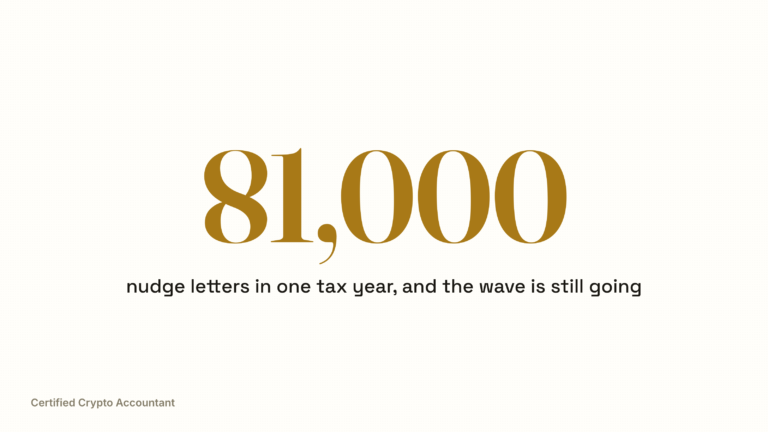
The nudge letters say what they are. HMRC’s September 2025 one to many letter reads, “This isn’t a formal compliance check”, and its 2021 crypto letter to agents said, “This is not an enquiry”. The 2026 crypto letter and the 2024 one are signed by a team, Wealthy Mid-sized Business Compliance, give a shared phone line, and ask you to check your own position.
The compliance check letter is signed by a person, gives that person’s direct number and reference, names one tax year and one return, says it is checking that return, asks for specific documents by a specific date, and comes with CC/FS1a. The factsheet’s first line is, “We’ve asked you to read this factsheet because we’ve started a compliance check. Please keep it safe because you may need to refer to it during the check.” If that sentence is in the envelope, the check has started.
The twelve month window
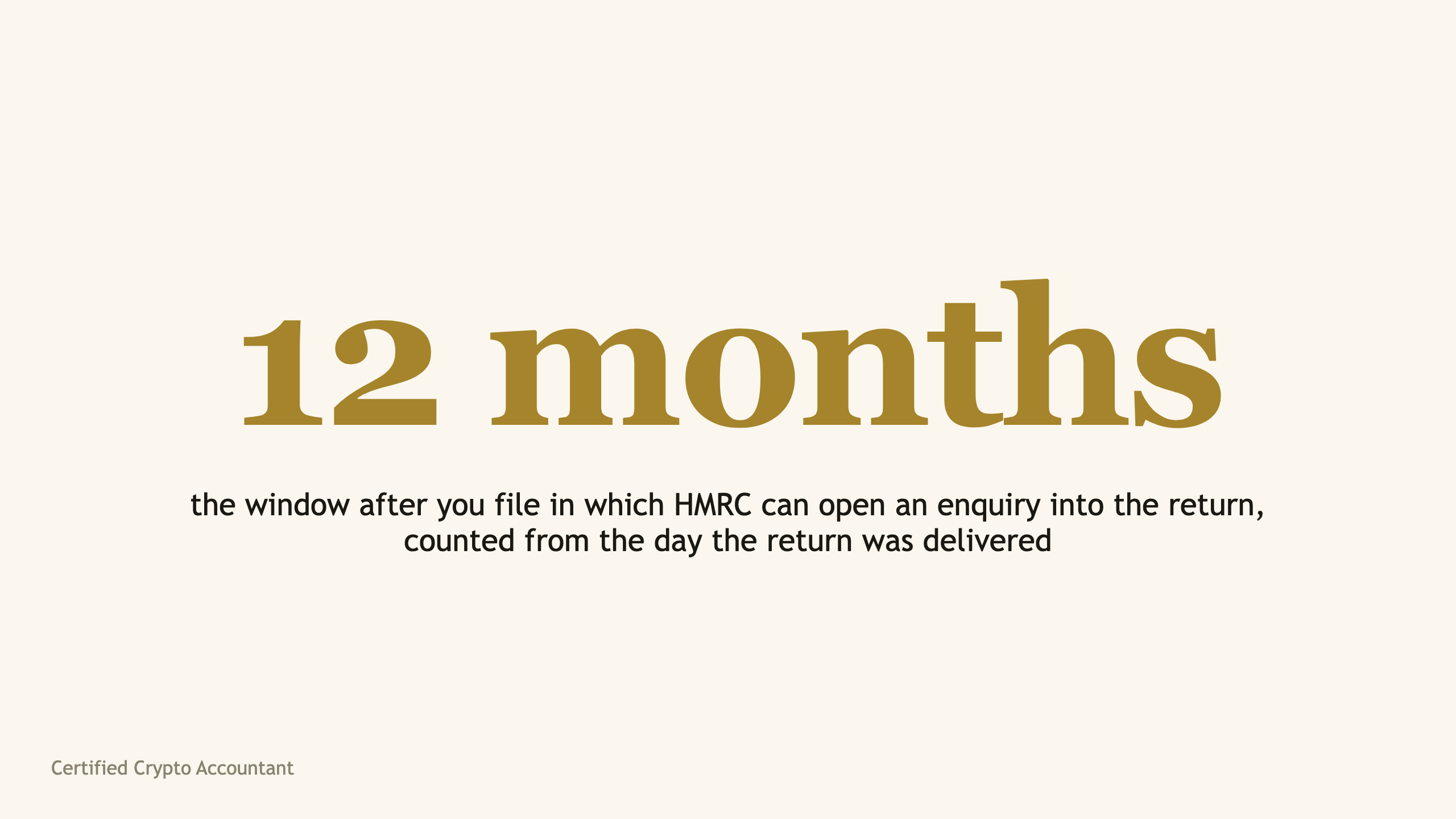
Section 9A(2) sets the time allowed. If the return was delivered on or before the filing date, “up to the end of the period of twelve months after the day on which the return was delivered”. If it was delivered late, up to the quarter day following the first anniversary of delivery, the quarter days being 31 January, 30 April, 31 July and 31 October. If you amended the return, the amendment opens its own window to the quarter day after the first anniversary of the amendment. EM1506 gives the example, “for a return received by HMRC on 20 June 2018, the enquiry window will run to 20 June 2019”, and says the notice “must be received before the time limit”.
So a 2024 to 2025 return filed on 20 January 2026 can be enquired into until 20 January 2027, and one filed on 31 January 2026 until 31 January 2027. Section 9A(3) says a return that has had one notice of enquiry may not have another, except following an amendment. After the window, HMRC’s route to the same year is a discovery assessment, which the page on how far back HMRC can go covers, and which needs more from HMRC than the enquiry does.
What it asks for, and the thirty days
The first request is informal. EM1555 tells the officer, “On each occasion your initial request should be informal. You should not normally issue an information notice unless the taxpayer or agent has failed to produce or provide some or all of the documents or information you have requested.” EM1580 sets the time, “Your opening letter of the enquiry should contain an informal request for information and should state the date by which it should be produced. You are encouraged to agree a time limit for response (normally 30 days as a minimum) but you should show a flexible approach where warranted”, with an extra week for letters sent 1 to 20 December and two extra weeks for 21 December to 31 January. EM1590 says what happens if the date passes, a notice under Schedule 36 “requiring the production of the information requested in the earlier letter or such of it as remains outstanding”, and the page on the information notice covers the penalties that attach to that one.
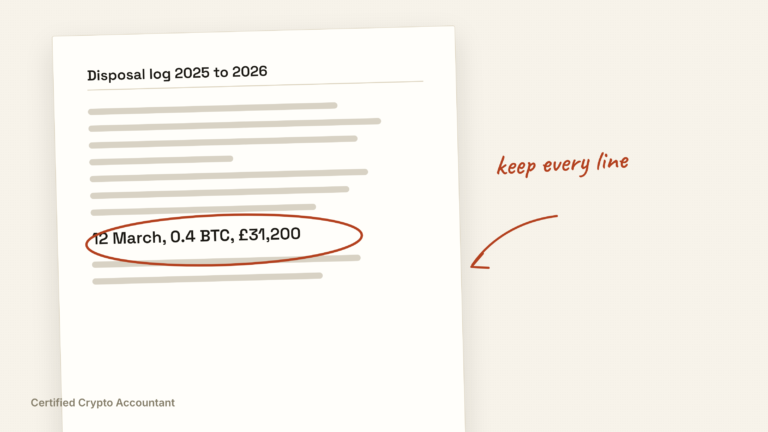
What the officer asks for is also written down. EM1570, for a taxpayer without a business, lists dividend vouchers, certificates, accounts and “a detailed Capital Gains computation”, and says private bank statements should only be requested where their relevance to the return can be shown. HMRC’s crypto guidance lists the records behind that computation, “type of tokens, date you disposed of them, number of tokens you’ve disposed of, number of tokens you have left, value of the tokens in pound sterling, bank statements, pooled costs before and after you disposed of them”, with wallet addresses as records you “may also want to keep”, and warns that exchange reports “are not tax calculations” and “will not keep track of your pooled costs”. A crypto enquiry letter therefore tends to ask for the computation behind the figure in the return, the statements from each exchange named on it, and the bank account that funded them, and it is entitled to all three.
What the factsheet tells you
CC/FS1a is short and most of it matters. It says HMRC may ask you to send information or documents, may ask for a meeting, “you can choose if you want to have this meeting or not”, and that if it cannot agree things with you it “may have to use our legal powers to get what we need”. It says, “Please continue to send returns or make payments during this compliance check, if they’re due.” It explains the penalty reductions, “If we’re considering charging you a penalty, we’ll look at how much assistance you’ve given us during the check. We call this assistance the ‘quality of disclosure’ or ‘telling, helping and giving'”, and that to get the maximum reduction you must “tell us everything you know about it immediately” and “work with us to calculate the right amount of tax”. It adds a line people miss, that where a disclosure has taken a long time, “for example, 3 years or more”, HMRC usually restricts the reduction “to 10 percentage points above the minimum of the penalty range”.
It gives you two levers. “If you think we should stop the check, you first need to tell us why. If we don’t agree, you may be able to ask the independent tribunal that deals with tax matters to decide if we should stop it.” That is the closure application under section 28A, where the tribunal “shall give the direction applied for unless satisfied that there are reasonable grounds for not issuing” a closure notice within a specified period. And at the end, when a decision notice arrives, “You’ll usually have 3 options”, new information to the officer, a review by an uninvolved officer, or the tribunal, and “You must do this within 30 days of our letter.” It also says you have “the right to be represented”, by anyone you choose to appoint, and that HMRC may look at open source material, naming “blogs and social networking sites where no privacy settings have been applied”.
The order to do things in
One. Check the window and the scope. Note the date the letter was received against the date you filed. Read whether it names the whole return or particular entries. A letter outside the twelve months, or one about a year you have not filed, is a different letter and the reply starts by saying so.
Two. Rebuild the computation before replying. The enquiry is into the figure you returned, and the question is whether that figure survives a pooled computation under CRYPTO22200 built from every exchange and wallet, with the sterling value on each disposal date. If the figure in the return came from software you did not check, the page on reports that overstate the gain and the one on missing purchase history describe the two ways it is usually wrong, in opposite directions.
Three. Reply by the date, with the computation and the records behind it, or ask for time before the date. The informal request carries no penalty of its own. The officer’s next step when it passes is the information notice, though, and the reductions in CC/FS1a for telling, helping and giving start running from this reply. If the rebuilt figure differs from the return, say so in the first letter and show the working. An inaccuracy you point out yourself in the first reply is treated under CC/FS7a as prompted, because the enquiry has started, but it sits at the bottom of its range and a careless one can be suspended.
Four. Keep the enquiry to its scope, and use the closure route if it drifts. The letter told you whether it was the whole return or particular entries. Answer what was asked, keep a dated copy of everything, and if months pass with nothing from the officer, write asking for a closure notice and say the tribunal application follows if it does not come.
A worked example with dates and figures
Suppose you filed your 2024 to 2025 return on 20 January 2026 with a capital gains figure of £6,100 taken from a software report, and the letter, dated 10 November 2026 from a named officer, says it is checking the capital gains pages, asks for the computation behind the figure and the statements from the two exchanges it names, by 10 December 2026, and encloses CC/FS1a. The window runs to 20 January 2027, so the notice is in time, and the scope is the capital gains entries.
Rebuilt from both exchanges, a wallet the report never saw and the bank account that funded them, the year’s gains are £9,400 rather than £6,100, because a transfer between your own wallets had been read as a purchase at the wrong cost. The reply on 5 December encloses the pooled schedule, the statements, the bank lines, and a covering letter saying the returned figure was understated by £3,300, the additional tax at the 24% rate is £792, and asking for the amendment to be made in the closure notice. The penalty question is then a careless inaccuracy, prompted, 15% to 30% of £792, £119 to £238, reduced towards the bottom for a full first reply and open to suspension on conditions. Had the rebuilt figure been £5,200, the same reply shows the return overstated the gain, and the closure notice reduces it.
When it needs an accountant
If the letter checks one year, names one exchange and asks for a computation you already hold and trust, reply yourself with the schedule, the statements and the bank lines, by the date. It becomes a job when the figure in the return came from a report nobody checked, when the history runs across platforms and chains or an exchange has closed, when the rebuilt figure differs from the return and the first letter has to put that right in the way that keeps the penalty at the bottom of its range, or when the enquiry starts reaching into other years or other entries. We act as agent from the first reply, the letters go to us, and the computation goes in with the reply rather than after it.
Three fixed fees, quoted in writing before any work starts
One taxpayer, one tax year unless the line says otherwise. Written position within 15 working days of software access.
For an exchange-only history under about 5,000 trades where the software report is already built.£499
For several platforms, wallet transfers read as sales, duplicates, and one or two back years.£950
For DeFi, derivatives, high volume, or balances that do not tie.£1,750
Send your software report to zar@certifiedcryptoaccountant.com for a written fee the same working day, or start with the free review. Licensed and regulated by the AAT, licence 1010475.
Questions about the HMRC compliance check letter
Is a compliance check the same as an enquiry?
Yes. Gov.uk says a compliance check is sometimes known as a tax enquiry. The legal power to check a filed Self Assessment return is section 9A of the Taxes Management Act 1970, and the letter is the notice of enquiry that section requires, whether or not it uses the word enquiry or cites the section. The Upper Tribunal confirmed in HMRC v Mabbutt that the letter need not refer to section 9A to be valid.
How long does HMRC have to open one?
Twelve months from the day the return was delivered, if it was delivered on time. If it was late, until the quarter day following the first anniversary of delivery, the quarter days being 31 January, 30 April, 31 July and 31 October. An amendment opens its own window. HMRC's manual says the notice must be received before the time limit, and a return can only be enquired into once.
Why will the officer not tell me why my return was picked?
Because HMRC's instructions say not to. The Enquiry Manual tells officers to make clear whether the whole return or particular entries are being checked, and that the scope can widen, but that they should not tell the taxpayer why the enquiry was opened. The Compliance Handbook repeats it. For crypto the honest answer is usually exchange data that does not match the return.
What happens if I miss the date in the letter?
Nothing in law on that date, because the first request is informal. HMRC's manual then tells the officer to issue an information notice under Schedule 36 for whatever remains outstanding, and that notice carries a £300 penalty, up to £60 a day after it, and a 30 day appeal right that does not cover your statutory records. The informal date is the cheap one to meet.
Do I have to go to a meeting?
No. CC/FS1a says HMRC may ask for a meeting and will explain why, and that you can choose whether to have it. Most crypto enquiries are settled on paper, with the computation and the records. If a meeting would help, it can be held with your agent present and after the computation exists rather than before.
Can I make HMRC finish it?
Yes. Section 28A lets you apply to the tribunal for a direction that HMRC issue a closure notice within a specified period, and the tribunal must give it unless HMRC shows reasonable grounds for not doing so. CC/FS1a describes the same route in plain words. Ask the officer in writing first, with a date, and say the application follows.
Sources
Every figure on this page was checked against the source below on 14 November 2026.
- Taxes Management Act 1970, section 9A, notice of enquiry. legislation.gov.uk, checked 14 November 2026
- Taxes Management Act 1970, section 28A, completion of enquiry. legislation.gov.uk, checked 14 November 2026
- CC/FS1a, About compliance checks. HM Revenue and Customs, checked 14 November 2026
- CC/FS7a, penalties for inaccuracies in returns or documents. HM Revenue and Customs, checked 14 November 2026
- EM1506, time limits for opening an enquiry. HM Revenue and Customs, checked 14 November 2026
- EM1551, opening the enquiry, what you must do. HM Revenue and Customs, checked 14 November 2026
- EM1555, opening letter, what to request. HM Revenue and Customs, checked 14 November 2026
- EM1560, opening letter, scope of the enquiry. HM Revenue and Customs, checked 14 November 2026
- EM1570, opening letter, non business taxpayer. HM Revenue and Customs, checked 14 November 2026
- EM1580, opening letter, time to respond. HM Revenue and Customs, checked 14 November 2026
- EM1590, opening letter, information not produced. HM Revenue and Customs, checked 14 November 2026
- CH206100, starting a compliance check. HM Revenue and Customs, checked 14 November 2026
- HMRC v Mabbutt [2017] UKUT, the 2011 opening letter at paragraphs 8 and 9. Upper Tribunal, GOV.UK, checked 14 November 2026
- Compliance checks opening correspondence research, HMRC Research Report 620. HM Revenue and Customs, Kantar Public, 2021, checked 14 November 2026
- HMRC compliance checks, help and support. GOV.UK, checked 14 November 2026
- Check if you need to pay tax when you sell cryptoassets, records. HM Revenue and Customs, checked 14 November 2026
- HMRC one to many letter, September 2025, this isn't a formal compliance check. HM Revenue and Customs, published by ICAEW, checked 14 November 2026
- CRYPTO22200, Capital Gains Tax, pooling. HM Revenue and Customs, checked 14 November 2026
- Capital Gains Tax rates and annual tax-free allowances. HM Revenue and Customs, checked 14 November 2026

Fahad Zar
Crypto tax accountantAAT licensed 1010475
- AAT Licensed Accountant and MAAT, licence 1010475
- MSc Accounting and Finance, BPP University London
- Six years inside digital asset accounting, across several crypto tax firms
- Practises through Zar Enterprises Ltd, ICO registration ZC225094
- Supervised for anti-money laundering by the AAT
What matters to me is that the number on the return is true, whatever it turns out to be.
Whether this is worth a conversation
Where this stops being a reading job and starts being a hiring one.
- The figure in the return came from a software report nobody checked and the enquiry is now asking for the computation behind it
- The history runs across platforms and chains, or an exchange has closed, and the records HMRC lists have to be rebuilt before the date
- The rebuilt figure differs from the return and the first letter has to put that right in the way that keeps the penalty at the bottom of its range
If the letter checks one year, names one exchange and asks for a computation you already hold and trust, reply yourself by the date with the pooled schedule, the statements and the bank lines, and keep a dated copy.
If one of these is you, the first look costs nothing.
Read next
What happens in an HMRC crypto tax enquiry
The whole process, discovery for older years, COP8 and COP9, and the behaviour based penalties.
Reviewed 14 November 2026ExplainerHMRC's information notice under Schedule 36
The letter that follows an unanswered request, the £300 and £60 a day, and the 30 day appeal.
Reviewed 14 November 2026ExplainerHow far back HMRC can go
Four, six, twelve or twenty years, and what picks the number.
Reviewed 14 November 2026ExplainerWhen the software has no purchase history
Why the returned figure is often wrong, and how cost is rebuilt.
Reviewed 14 November 2026