An HMRC nudge letter is not a tax bill

Published 10 June 2026· Reviewed against gov.uk 25 August 2026· 6 min read·HMRC and compliance
An HMRC crypto nudge letter is a warning that HMRC believes you hold or have disposed of cryptoassets and may owe tax you have not declared. HMRC posted 81,172 of them in the year to 5 April 2026, per figures obtained by UHY Hacker Young, nearly triple the 27,714 it sent two years earlier. It is a prompt rather than a tax bill or an enquiry, but how you respond over the next few weeks is the difference between a quiet correction and a multi-year enquiry with penalties attached.
The letters are still accelerating, KPMG counts the latest wave running from July 2026 to March 2027, and their character is about to change. Every letter so far was written before HMRC held automatic exchange data. From 31 May 2027 the first Crypto-Asset Reporting Framework feeds arrive from 52 countries, and a nudge letter stops being a question HMRC cannot answer itself. The full trajectory is in our breakdown of the 81,172 letters.
This guide explains exactly what an HMRC crypto nudge letter is, why you received one, what it can cost you if you get it wrong, and the precise steps to take before you reply.
What is an HMRC crypto nudge letter?
A nudge letter (HMRC calls these “one to many” letters) is a standard prompt sent to large groups of taxpayers HMRC believes may have under-reported. It is not a formal enquiry under section 9A of the Taxes Management Act 1970, and on its own it does not mean you are under investigation.
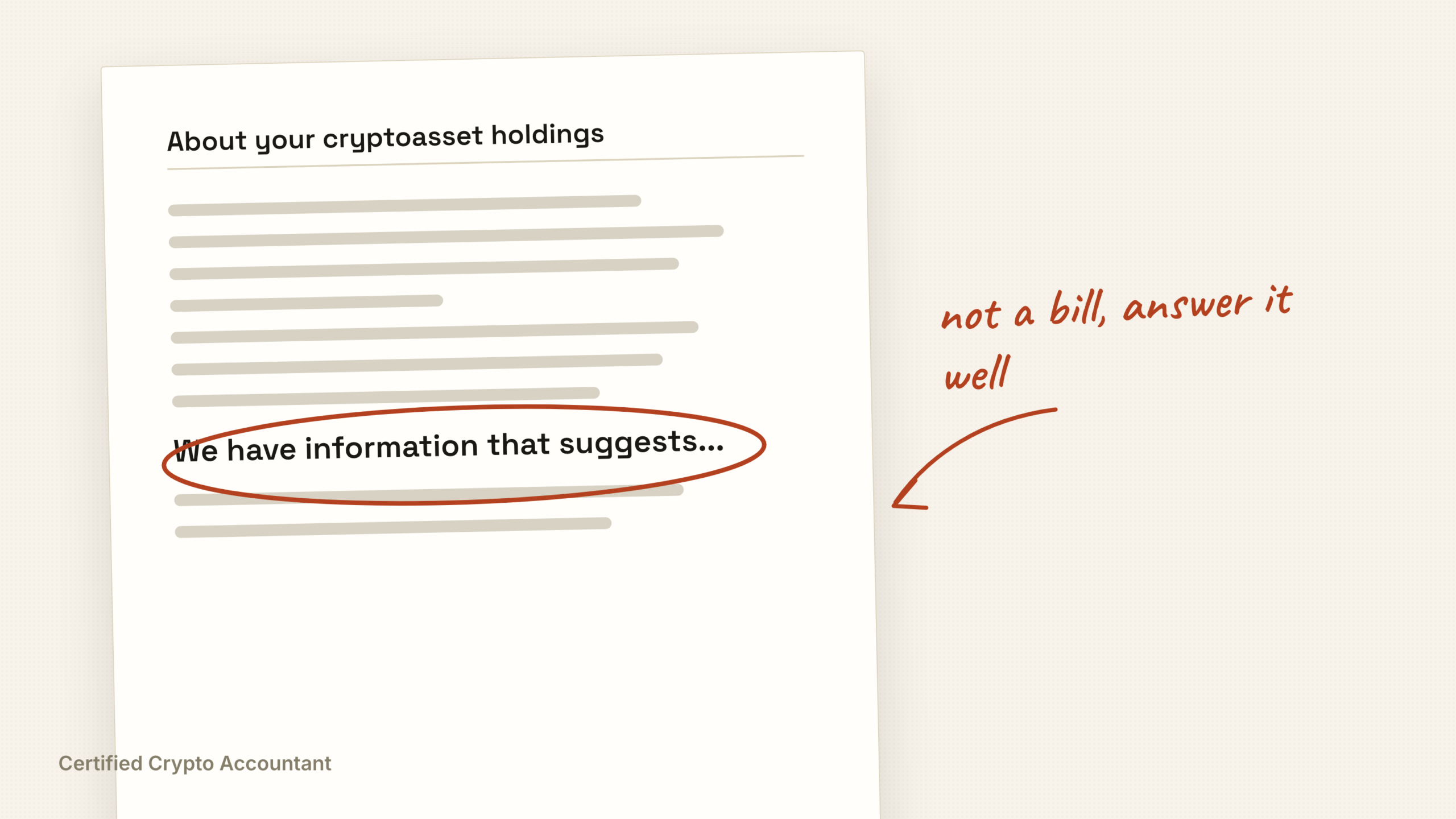
The letter typically states that HMRC holds information suggesting you have disposed of cryptoassets, and asks you to check whether your tax returns are correct and to put things right if they are not. The operative word is prompt: HMRC is inviting you to correct your own position before it decides whether to open a formal case.
Why did you receive one?
HMRC did not guess. It is matching real data against your Self Assessment record:
- HMRC has been buying transaction data from UK and international exchanges since 2019 and cross-checking it against filed returns.
- The letters have nearly tripled in three years, 27,714 in 2023-24, around 65,000 in 2024-25, then 81,172 in the year to 5 April 2026, per figures obtained by UHY Hacker Young.
- From 1 January 2026, the OECD Crypto-Asset Reporting Framework (CARF) requires exchanges and custodial wallet providers to collect and report your identity, residence, tax reference and transaction totals to HMRC. The first reports are due by 31 May 2027, after which the data is shared automatically between tax authorities internationally.
The gap between what exchanges know and what HMRC knows is closing fast. A nudge letter usually means your name is already on a list.
Is a nudge letter a tax investigation?
No, but it is the step immediately before one. Think of it as a fork in the road:
- Respond well and the matter usually ends there.
- Ignore it, or reply carelessly, and HMRC can escalate to a formal enquiry. Because you were “prompted,” the penalty floor is then higher.
What happens if you get it wrong? The penalties
Penalties are based on behaviour, not just the amount owed. The worse HMRC judges your conduct, the higher the percentage and the further back it can look.
| Behaviour | Penalty (% of unpaid tax) | HMRC can look back |
|---|---|---|
| Reasonable care (genuine error) | None (tax and interest only) | 4 years |
| Careless | Up to 30% | 6 years |
| Deliberate | 20% to 70% | 20 years |
| Deliberate and concealed | 30% to 100% | 20 years |
Two things stack on top:
- Offshore holdings (most foreign exchanges) can attract penalty loadings of up to 200%.
- A separate failure-to-notify penalty applies if you had a liability and never registered for Self Assessment at all.
Coming forward voluntarily moves you toward the bottom of each band. Being prompted and then failing to cooperate pushes you to the top.
What to do in the 30 days after a nudge letter
- Do not reply immediately. The letter gives you a response window, often 30 to 60 days. A rushed, wrong answer is exactly what turns a prompt into an enquiry.
- Reconcile your full history. Pull every wallet address, exchange account (including dead and closed ones) and on-chain transaction into one reconciled view. This is where most DIY reports fall apart.
- Compare it to what you filed. Work out, year by year, whether there is an under-declaration, an over-declaration, or nothing owed.
- Choose your response route (see below).
- Document the evidence trail before you reply. Whatever you tell HMRC, you should be able to prove it.
How to respond, your three routes
| Route | When it fits | What it involves |
|---|---|---|
| Amend your Self Assessment | The error is in a return still inside the 12-month amendment window | Correct the return online and pay the extra tax plus interest |
| Disclose via the Cryptoasset Disclosure Facility | Tax is owed on older years, outside the amendment window | A formal voluntary disclosure, with lower penalty bands for coming forward |
| Evidenced “no further action” reply | You have checked and nothing is owed | Reply confirming your position, keeping your reconciliation as proof |
There is a fourth route, and it is the only wrong one: silence.
A worked example
Say HMRC letter relates to 2022/23. You traded on two exchanges and a DeFi wallet, and your original return showed no crypto. After reconciliation, you find a real capital gain of £9,000 above that year allowance, producing £1,800 of CGT.
- If you disclose it voluntarily and cooperate: you pay the £1,800, plus interest, plus a careless-band penalty of 15 to 30%, the prompted range. The 0% floor only exists for disclosures made before HMRC prompts you, and a nudge letter counts as a prompt.
- If you ignore the letter and HMRC opens an enquiry: the same £1,800 can carry a deliberate-band penalty of 35 to 70%, and HMRC can examine up to 20 years of history.
Same tax. Very different bill. The difference is entirely in how you respond.
How a specialist handles it
When a client forwards a nudge letter, we work in one order: data first, reply second. We reconcile every wallet and exchange (including the dead ones), establish the true position for each year, choose the correct route, and deal with HMRC directly. The reply only goes out once the evidence behind it is solid.
Frequently asked questions
Does a nudge letter mean HMRC is investigating me?
No. It is a prompt, not a formal enquiry. But ignoring it or replying carelessly can trigger one.
How did HMRC know I hold crypto?
HMRC buys transaction data from UK and overseas exchanges and matches it to your records. From 2026, CARF makes that data-sharing automatic.
How far back can HMRC go?
Up to 4 years for a genuine error, 6 years for careless behaviour, and 20 years for deliberate non-disclosure.
What if I cannot afford the tax I owe?
HMRC offers Time to Pay arrangements. Disclosing and agreeing a payment plan is far cheaper than the penalties for non-disclosure.
Should I ignore the letter if I think I owe nothing?
No. Reply with evidence. A non-response can be treated as a failure to cooperate and push up the penalty position if HMRC later disagrees.
Is it too late to come forward after a nudge letter?
The letter makes any disclosure “prompted” rather than “unprompted,” which raises the penalty floor slightly, but cooperating still keeps you far below the deliberate-default bands.
Get your position checked before you reply
Received a crypto nudge letter? The safe move is to get your full transaction history reconciled before you respond, not after. At Certified Crypto Accountant we handle HMRC crypto enquiries for UK clients every week: we reconcile the data, choose the right disclosure route, and deal with HMRC on your behalf. Book a free, confidential review at certifiedcryptoaccountant.com.
For tailored help, see our crypto tax services or book a free review.
Authoritative sources: HMRC: tell HMRC about unpaid crypto tax; HMRC Cryptoassets Manual.
The practical question is what you actually owe, not what the letter implies. Work out a starting figure with the capital gains tax calculator, and if crypto is involved our crypto tax accountants can check it against the real transaction history.
Sources
Every figure on this page was checked against the source below on 25 August 2026.
- KPMG counts the latest wave of letters running from July 2026 to March 2027. KPMG, checked 25 August 2026
- HMRC: tell HMRC about unpaid crypto tax. GOV.UK, checked 25 August 2026
- HMRC Cryptoassets Manual. GOV.UK, checked 25 August 2026
Fahad Zar
Crypto tax accountantAAT licensed 1010475
- AAT Licensed Accountant and MAAT, licence 1010475
- MSc Accounting and Finance, BPP University London
- Six years inside digital asset accounting, across several crypto tax firms
- Practises through Zar Enterprises Ltd, ICO registration ZC225094
- Supervised for anti-money laundering by the AAT
What matters to me is that the number on the return is true, whatever it turns out to be.
Whether this is worth a conversation
Most people who read this page do not need an accountant. A few do.
- A letter from HMRC has arrived
- You have years HMRC does not know about
- HMRC's figures do not match yours
If your letter is a routine tax code notice and your filings are current, you probably just needed this page.
If one of these is you, the first look costs nothing.
Read next
Crypto tax deadlines for the 2026 to 2027 tax year
Key UK crypto tax dates for 2025/26: Self Assessment registration, the 31 January filing and payment deadline, and what…
Reviewed 25 Aug 2026Deep guideHow much HMRC can charge for unpaid crypto tax
What HMRC crypto tax penalties actually cost: late filing, late payment and undeclared gains. How penalties are…
Reviewed 25 Aug 2026ExplainerHow to tell a real HMRC letter from a scam
HMRC never threatens arrest and never asks for bank details to pay a refund. The thirty second sorting method, and…
Reviewed 25 Aug 2026DeadlineThe HMRC savings tax warning is about your bank interest
Banks report interest automatically and rising rates pushed ordinary savers over the £1,000 allowance. What the letters…
Reviewed 25 Aug 2026