What happens during an HMRC crypto enquiry

Published 13 July 2026· Reviewed against gov.uk 25 August 2026· 8 min read·HMRC and compliance
An HMRC crypto enquiry is a structured investigation into your tax return, with statutory powers behind it, deadlines you cannot ignore, and penalties that depend heavily on how you behave from the first letter onwards. It is something else entirely from a nudge letter, which is only a prompt inviting you to check your own position. If the nudge letter is HMRC clearing its throat, the enquiry is HMRC sitting down at the table.
This guide explains what a formal HMRC enquiry into your cryptoassets actually involves, how it differs from a nudge letter, the law that lets HMRC open one, how far back it can reach, and the path it can take if matters escalate. It also covers realistic timelines and, crucially, what to do (and what never to do) once an enquiry lands.
Nudge letter versus formal HMRC crypto enquiry
The two are often confused, but they sit at different stages. A nudge letter (HMRC’s “one to many” prompt) is not an investigation. It simply says HMRC holds information suggesting you may have disposed of cryptoassets and asks you to check your returns. You are being invited to put things right yourself.
A formal enquiry is HMRC formally opening your return for examination. Once it is open, HMRC can issue information and document requests, review your records in detail and, in some cases, ask to meet you. The shift from “please check” to “we are now examining this” is the line between the two.
| Feature | Nudge letter | Formal enquiry |
|---|---|---|
| Status | A prompt to self-check | A formal investigation |
| Legal basis | None: voluntary prompt | Section 9A TMA 1970 (or discovery) |
| HMRC powers | No formal information powers used | Information notices, record review, meetings |
| Typical outcome | You amend, disclose or evidence nothing is owed | A settlement of tax, interest and any penalty |
What opens an HMRC crypto enquiry, section 9A
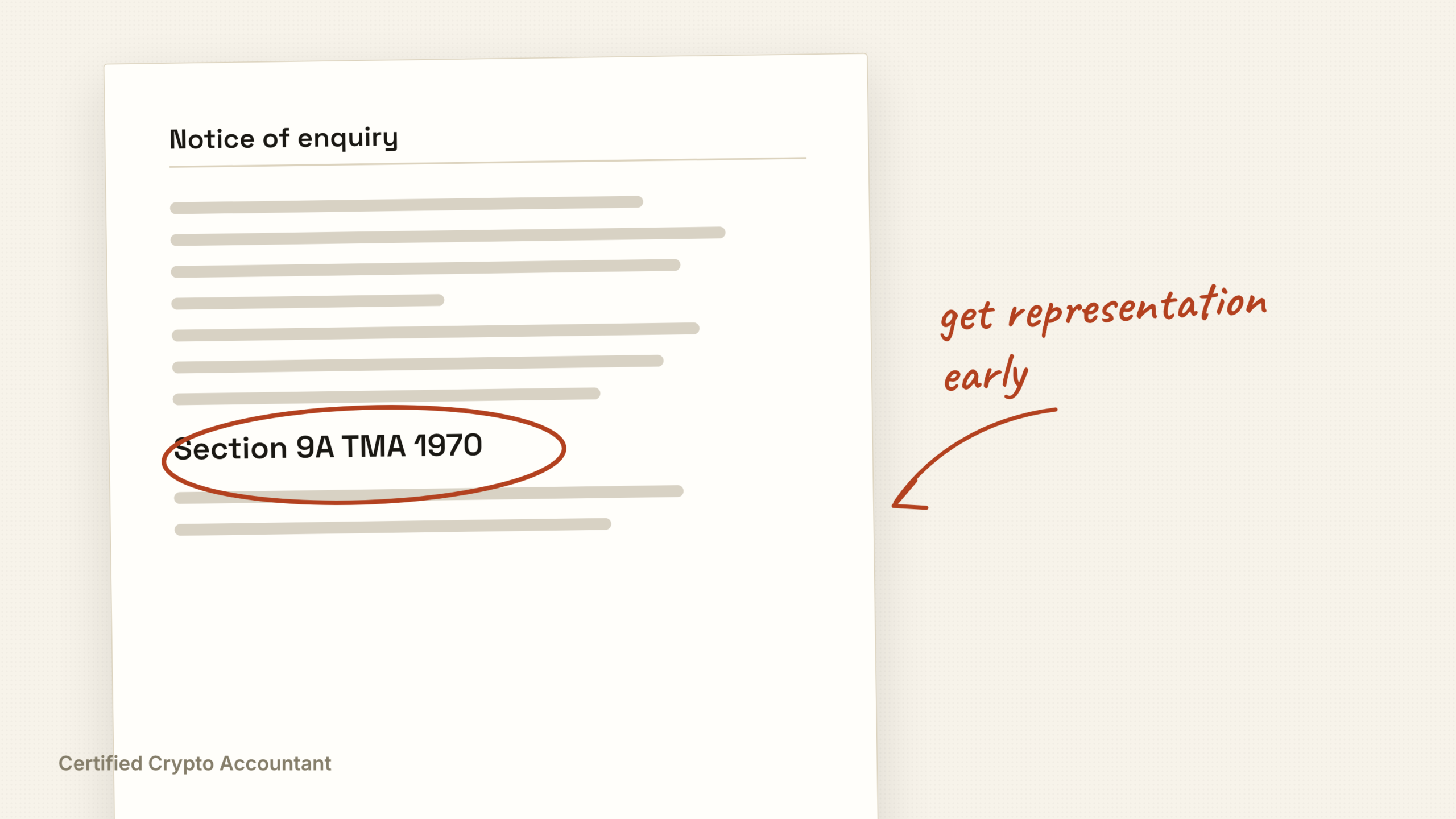
HMRC’s main tool for examining a filed return is section 9A of the Taxes Management Act 1970. To open an enquiry this way, HMRC must give you written notice, and it normally has to do so within 12 months of the date the return was delivered. If you filed your 2023/24 return in January 2025, the section 9A window generally runs to January 2026.
An enquiry can be “full” (HMRC looks at the whole return) or “aspect” (HMRC focuses on one area, such as your capital gains from crypto disposals). For cryptoassets, an aspect enquiry into reported, or unreported, disposals is very common, because HMRC increasingly holds exchange data it can compare with what you declared. The treatment of those disposals follows the HMRC Cryptoassets Manual, which remains the primary guidance on how crypto is taxed.
Discovery, how HMRC reaches older years
The 12-month section 9A window does not protect older years if tax has been lost. Where HMRC discovers that a previous year was under-assessed, it can raise a discovery assessment to recover the tax. How far back it can go depends entirely on your behaviour:
- 4 years where you took reasonable care but still made a genuine error.
- 6 years where the under-declaration was careless.
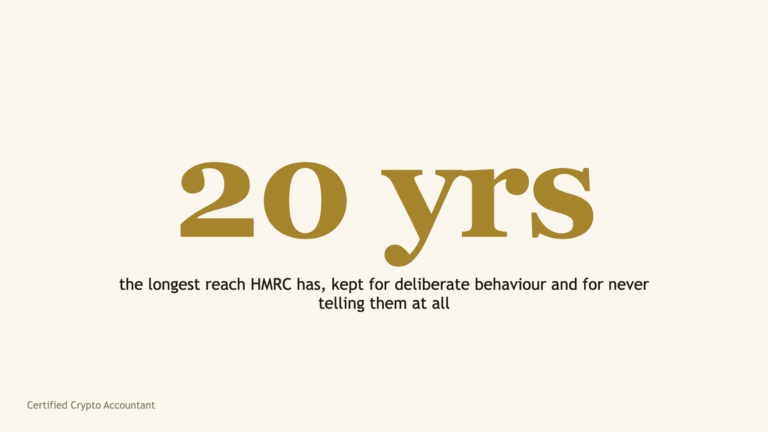
- 20 years where it was deliberate, or where you failed to notify HMRC of a liability at all.
This is why crypto enquiries can feel open-ended. A single discovery can pull a decade or more of trading history into scope if HMRC considers the conduct deliberate.
When an enquiry escalates, COP8 and COP9
Most crypto enquiries are routine civil compliance checks handled by an ordinary caseworker. A minority escalate to HMRC’s Fraud Investigation Service under one of two codes of practice, and the distinction matters enormously.
Code of Practice 8 (COP8) is used where HMRC suspects a significant loss of tax, often through complex avoidance arrangements, but does not suspect fraud. It is still a civil investigation, but a serious one.
Code of Practice 9 (COP9) is used where HMRC suspects deliberate tax fraud. Under COP9, HMRC offers the Contractual Disclosure Facility (CDF): if you make a complete and accurate disclosure of your deliberate conduct, HMRC agrees not to pursue a criminal investigation with a view to prosecution for what you disclose. You have 60 days from receiving the offer to accept it. Rejecting it, or making an incomplete disclosure, removes that protection. A COP9 letter is one of the few HMRC communications you should never answer without specialist representation in place first.
How long an HMRC crypto enquiry takes
There is no fixed duration. A clean aspect enquiry, where your records are tidy and the only issue is a single year of unreported disposals, can sometimes close within a few months. A full enquiry spanning multiple years, several exchanges, DeFi activity and missing records can run for a year or more. COP8 and COP9 cases, by their nature, typically take the longest, often well over a year.
The single biggest accelerator is the quality of your reconciliation. When you can hand HMRC a clear, year-by-year computation backed by exchange and on-chain data, the enquiry has far less to argue about. When records are fragmentary, every gap becomes a question, and every question adds months.
Behaviour-based penalties, the worked example
Penalties in an enquiry are not a flat percentage. They are set by your behaviour, then reduced by how fully you cooperate. The same unpaid tax can produce very different bills.
| Behaviour | Penalty (% of unpaid tax) | HMRC can look back |
|---|---|---|
| Reasonable care (genuine error) | None: tax plus interest only | 4 years |
| Careless | Up to 30% | 6 years |
| Deliberate | 20% to 70% | 20 years |
| Deliberate and concealed | 30% to 100% | 20 years |
| Offshore element | Up to 200% | Up to 20 years |
Worked example, the same gain, three behaviours
Suppose an enquiry establishes an undeclared capital gain that produced £4,000 of unpaid Capital Gains Tax for a single year. The tax itself is the same in every scenario; only the penalty changes with behaviour.
- Careless: a penalty of up to 30% adds up to £1,200, for a total of £5,200 plus interest.
- Deliberate: a penalty in the 20% to 70% band. At the top of the range, 70% adds £2,800, for a total of £6,800 plus interest.
- Deliberate and concealed: a penalty in the 30% to 100% band. At 100%, that adds a further £4,000, doubling the bill to £8,000 plus interest.
Same £4,000 of tax, but the penalty can swing from nothing (if reasonable care is accepted) to £4,000. Full cooperation and prompt disclosure push you toward the bottom of each band; obstruction pushes you to the top. The behaviour you show during the enquiry is, in pound terms, the most expensive variable you control.
How a specialist handles it
When a client forwards an enquiry letter, we work in one order: data first, response second. We reconcile every wallet and exchange (including the dead and closed ones), build a defensible year-by-year computation, and only then engage HMRC, dealing with information requests and any meetings on the client’s behalf. We never destroy or fabricate records, and we never let a COP9 offer go unanswered. The aim is to argue your behaviour into the lowest band the facts support and close the enquiry as quickly as the evidence allows.
Frequently asked questions
Is an HMRC crypto enquiry the same as a nudge letter?
No. A nudge letter is a prompt asking you to check your own position. An enquiry is a formal investigation opened under section 9A TMA 1970, with statutory powers behind it.
How long does HMRC have to open an enquiry?
For a Self Assessment return, HMRC normally has 12 months from the date you filed the return to open a section 9A enquiry. For older years, it relies on discovery assessments instead.
How far back can an enquiry reach?
Through discovery, HMRC can assess 4 years for a genuine error taken with reasonable care, 6 years for careless behaviour, and up to 20 years where the conduct was deliberate or you failed to notify a liability.
What is the difference between COP8 and COP9?
COP8 is used where HMRC suspects a significant loss of tax, usually through avoidance, but not fraud. COP9 is used where HMRC suspects deliberate fraud and offers the Contractual Disclosure Facility, with 60 days to accept.
How long will my enquiry take?
It varies from a few months for a simple, well-evidenced aspect enquiry to well over a year for multi-year or fraud-track cases. Clean, reconciled records are the fastest way to shorten it.
What should I never do during an enquiry?
Never destroy, alter or fabricate records, never ignore deadlines, and never answer a COP9 offer without representation. Cooperating honestly is what keeps penalties in the lowest available band.
Facing an HMRC crypto enquiry? Get the right help early
An enquiry is won or lost on preparation, not panic. The earlier you get your transaction history reconciled and your behaviour positioned correctly, the cheaper and shorter the process tends to be. Book a free, confidential review at certifiedcryptoaccountant.com, and see how our crypto tax services handle HMRC enquiries for UK clients from the first letter to final settlement.
Answering HMRC well is mostly a matter of having the underlying figures straight before you reply. If those figures involve exchange and wallet history, our crypto tax accountants rebuild them, and the capital gains tax calculator will give you a rough position in the meantime.
Sources
Every figure on this page was checked against the source below on 25 August 2026.
- Section 9A of the Taxes Management Act 1970. GOV.UK, checked 25 August 2026
- Section 9A. legislation.gov.uk, checked 25 August 2026
- Capital gains. GOV.UK, checked 25 August 2026
- HMRC Cryptoassets Manual. GOV.UK, checked 25 August 2026
- Compliance checks. GOV.UK, checked 25 August 2026
- Code of Practice 8 (COP8). GOV.UK, checked 25 August 2026
- Code of Practice 9 (COP9). GOV.UK, checked 25 August 2026
Fahad Zar
Crypto tax accountantAAT licensed 1010475
- AAT Licensed Accountant and MAAT, licence 1010475
- MSc Accounting and Finance, BPP University London
- Six years inside digital asset accounting, across several crypto tax firms
- Practises through Zar Enterprises Ltd, ICO registration ZC225094
- Supervised for anti-money laundering by the AAT
What matters to me is that the number on the return is true, whatever it turns out to be.
Whether this is worth a conversation
Most people who read this page do not need an accountant. A few do.
- A letter from HMRC has arrived
- You have years HMRC does not know about
- HMRC's figures do not match yours
If your letter is a routine tax code notice and your filings are current, you probably just needed this page.
If one of these is you, the first look costs nothing.
Read next
Crypto tax deadlines for the 2026 to 2027 tax year
Key UK crypto tax dates for 2025/26: Self Assessment registration, the 31 January filing and payment deadline, and what…
Reviewed 25 Aug 2026Deep guideHow much HMRC can charge for unpaid crypto tax
What HMRC crypto tax penalties actually cost: late filing, late payment and undeclared gains. How penalties are…
Reviewed 25 Aug 2026ExplainerHow to tell a real HMRC letter from a scam
HMRC never threatens arrest and never asks for bank details to pay a refund. The thirty second sorting method, and…
Reviewed 25 Aug 2026DeadlineThe HMRC savings tax warning is about your bank interest
Banks report interest automatically and rising rates pushed ordinary savers over the £1,000 allowance. What the letters…
Reviewed 25 Aug 2026 ExplainerHMRC can go back four, six, twelve or twenty years and your own conduct picks the number
The four, six, twelve and twenty year limits, and which one an enquiry is really about.
Reviewed 5 September 2026