HMRC money laundering registration costs £700 in year one and trading before approval is an offence

Published 14 September 2026 Reviewed against gov.uk 5 September 2026 7 min readCrypto income and business
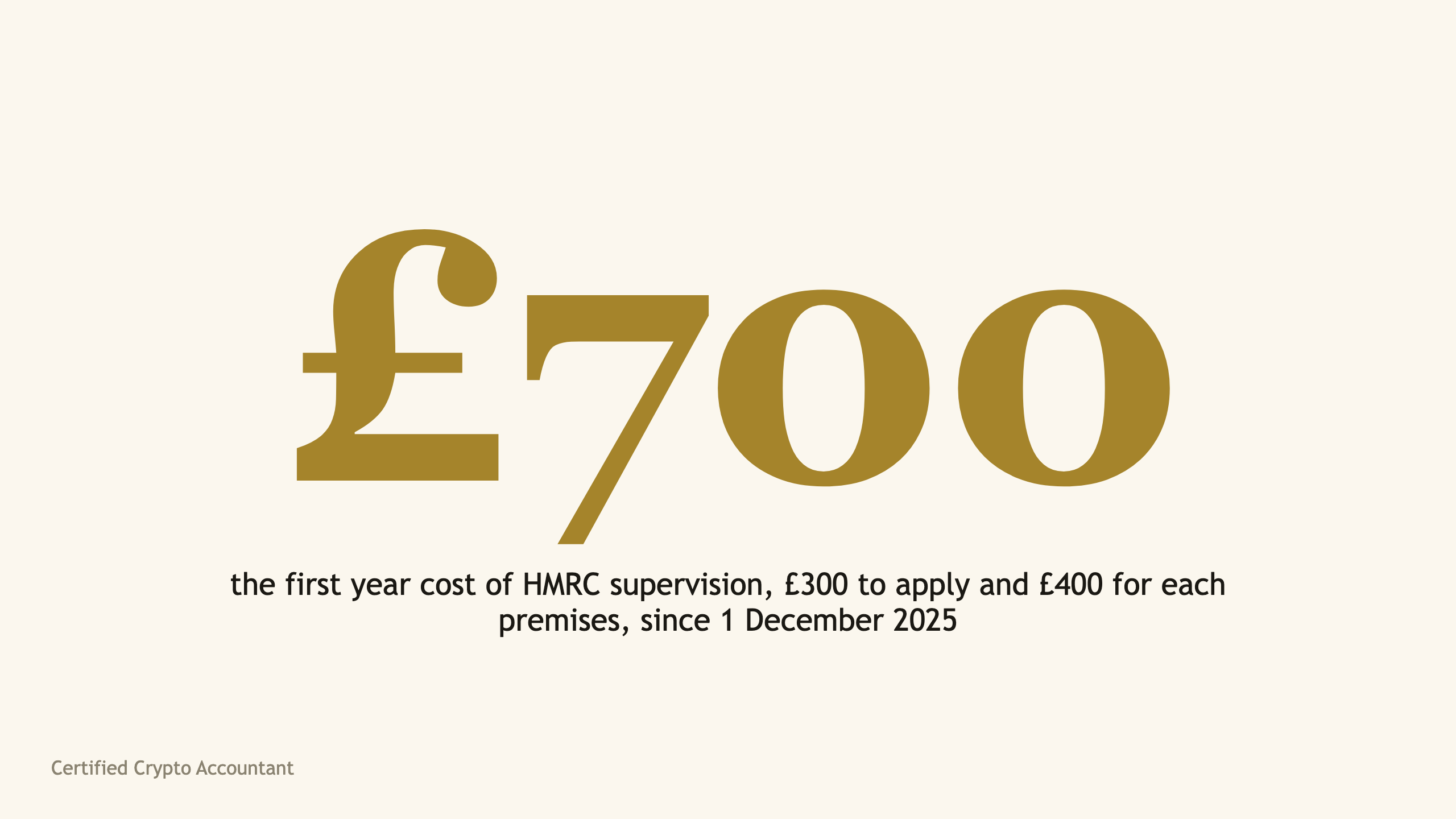
Registering with HMRC for anti money laundering supervision costs £700 for a single premises in the first year, made up of a £300 application fee and a £400 annual premises fee, under the fee scale that took effect on 1 December 2025 and is set out on GOV.UK. Nine kinds of business have to register when nobody else supervises them, carrying on that business while unregistered is a criminal offence, and the most common penalty HMRC hands out is for exactly that. Cryptoasset businesses are the exception people get wrong. They register with the FCA instead. Every figure here was checked against GOV.UK and the FCA on 5 September 2026.
The fee is small and the offence is not. Register before the first client, with HMRC if nobody else supervises you, and with the FCA if the business is crypto.
Who has to register with HMRC
The Money Laundering Regulations 2017 require every business in a regulated sector to be supervised, and HMRC is the supervisor of last resort for the sectors below where no professional body or other regulator already covers the firm. GOV.UK’s list of who needs to register runs as follows.
| Business type | Registers with HMRC when |
|---|---|
| Money service businesses | Not supervised by the FCA |
| High value dealers | Accepting cash payments of 10,000 euros or more, in one or linked transactions |
| Trust or company service providers | Not supervised by the FCA or a professional body |
| Accountancy service providers | Not supervised by a professional body |
| Estate agency businesses | Always |
| Letting agency businesses | Letting property at 10,000 euros a month or more |
| Art market participants | Buying or selling works of art at 10,000 euros or more |
| Bill payment service providers | Not supervised by the FCA |
| Telecommunications, digital and IT payment service providers | Not supervised by the FCA |
The accountancy line reaches further than people expect. A bookkeeper, tax adviser or payroll provider working alone, without membership of a body such as ICAEW, ACCA, AAT or CIOT, is an accountancy service provider and has to register with HMRC before taking a client. Membership of a body moves the supervision to the body, which is why most practices never deal with HMRC’s register at all.
Who does not, because someone else supervises them
GOV.UK’s registration page sets out the other supervisors. Financial and credit businesses answer to the FCA. Casinos answer to the Gambling Commission. Accountants, tax advisers, auditors, solicitors, barristers and insolvency practitioners who belong to a listed professional body are supervised by that body. And cryptoasset businesses answer to the FCA, which is the point the whole crypto sector needs to know. Since January 2020 any UK business that exchanges cryptoassets for money, exchanges one cryptoasset for another, operates a crypto ATM, or holds cryptoassets or private keys for customers has had to be registered with the FCA under regulation 14A of the regulations before starting, per the FCA’s own page. HMRC’s register does not apply, and an application to HMRC for a crypto exchange would be refused as the wrong door.
That split matters for a crypto business that also does something on HMRC’s list. A company that runs an over the counter desk and also acts as a company formation agent needs the FCA for the desk and HMRC, or a professional body, for the formation work. One activity does not cover the other.
What it costs
| Fee | Amount from 1 December 2025 | Who pays it |
|---|---|---|
| Application fee | £300 | Every new registration, once, not refundable |
| Premises fee | £400 | Every premises, every year |
| Fit and proper test | £500 | Each person tested, money service businesses and trust or company service providers |
| Approval process | £40 | Each person checked, accountancy, estate agency, letting, art market and high value dealers |
| Small business reduction | £500 refund | Turnover under £5,000, after the application or annual declaration is accepted |
So a sole practitioner bookkeeper registering one office pays £300 plus £400 plus £40 for their own approval check, £740 in the first year and £400 a year after that. A small business under the £5,000 turnover line pays the full amount up front and receives £500 back once accepted. The premises fee was £300 until December 2025 and the application fee had been scrapped in 2019 and was reintroduced with the new scale, which is why older guides show a lower total.
Trading before approval
GOV.UK’s wording is blunt. A business must not trade without registering with HMRC under the regulations, and trading while not registered is a criminal offence. Money service businesses and trust or company service providers cannot trade at all until HMRC confirms the registration. The other sectors may carry on while the application is being processed, which is a real difference and worth knowing before you take the first client.
HMRC publishes the penalties. Its list for 1 April to 30 September 2025, updated on 25 March 2026, runs to 531 penalty notices totalling £1,427,486 by our count of the table, and the overwhelming majority of them are for one breach, failure to apply for registration at the required time. The largest single penalty on the list was £104,000 against a precious metals dealer. Most are far smaller, and they are published with the business name and address attached, which for a small firm lasts longer than the fine.
The fit and proper and approval tests
Registration covers the business and the people who run it. Money service businesses and trust or company service providers have their owners, officers and managers put through a fit and proper test at £500 each, which considers convictions, disqualifications and previous regulatory history. The other sectors go through the £40 approval process for the same people, a lighter check with the same purpose. A person who fails either cannot hold the role, and the business cannot be registered with them in it. Changes in the people afterwards have to be reported, and the annual declaration that renews the premises fee is where HMRC expects to hear about them.
What supervision asks of you afterwards
Registration is the start of the obligation rather than the end of it. A supervised business has to hold a written risk assessment, carry out customer due diligence before acting, keep records of the checks, and report suspicions. For an accountancy practice taking on crypto clients that means identity checks that can cope with income sourced from wallets rather than payslips, and a source of funds conversation that understands what an exchange statement is. Our guide to the records HMRC expects a crypto holder to keep is the client side of the same conversation, and a practice that asks for them at onboarding has done half of its due diligence already. For a crypto company deciding how to structure itself, the FCA registration is a licensing question that belongs in the company planning our limited company guide describes, and in my experience it is the item founders leave latest and regret most.
Registration questions
Who needs to register with HMRC for anti money laundering supervision?
Money service businesses, high value dealers, trust or company service providers, accountancy service providers, estate agents, letting agents above the 10,000 euro monthly threshold, art market participants, and bill payment and telecoms payment providers, in each case where no professional body or other regulator already supervises them.
How much does HMRC AML registration cost?
From 1 December 2025, £300 to apply plus £400 a year for each premises, with a £500 fit and proper fee per person for money service and trust or company service businesses and a £40 approval fee per person for the other sectors. Turnover under £5,000 earns a £500 refund.
Can I trade while my HMRC AML registration is pending?
Estate agents, accountancy providers, letting agents, art market participants and high value dealers may trade while the application is processed. Money service businesses and trust or company service providers must wait until HMRC confirms the registration.
Do crypto businesses register with HMRC for money laundering?
No. Cryptoasset exchanges, custodian wallet providers and crypto ATM operators register with the FCA under regulation 14A of the Money Laundering Regulations 2017, and have had to since January 2020.
What happens if I do not register?
Trading unregistered is a criminal offence and HMRC issues penalties for it, published with the business name. Its list for April to September 2025 runs to 531 notices, almost all for failing to register at the required time.
Sources
Every figure on this page was checked against the source below on 5 September 2026.
- Money laundering regulations, who needs to register. HM Revenue and Customs, checked 5 September 2026
- Money laundering regulations, registration fees. HM Revenue and Customs, updated 22 December 2025, checked 5 September 2026
- Anti money laundering registration. GOV.UK, checked 5 September 2026
- Cryptoassets, AML and CTF regime. Financial Conduct Authority, checked 5 September 2026
- Businesses that have not complied with the money laundering regulations, 2025 to 2026. HM Revenue and Customs, updated 25 March 2026, checked 5 September 2026
Fahad Zar
Crypto tax accountantAAT licensed 1010475
- AAT Licensed Accountant and MAAT, licence 1010475
- MSc Accounting and Finance, BPP University London
- Six years inside digital asset accounting, across several crypto tax firms
- Practises through Zar Enterprises Ltd, ICO registration ZC225094
- Supervised for anti-money laundering by the AAT
What matters to me is that the number on the return is true, whatever it turns out to be.
Whether this is worth a conversation
Where this stops being a reading job and starts being a hiring one.
- You run a crypto business that also does something on HMRC's list and need both registrations sorted in the right order
- You are setting up a practice that will serve crypto clients and want the due diligence built for wallet sourced income from day one
- A penalty notice has arrived for trading unregistered and there are also tax years to put right
If you are a member of a professional body that supervises you, HMRC's register is not your problem and this page was for someone else.
If one of these is you, the first look costs nothing.
Read next
Crypto Tax for Limited Companies and Businesses UK
Where the FCA registration sits in the planning of a crypto company.
Reviewed 5 September 2026Deep guideWhat HMRC expects you to keep after every crypto trade
The client side of due diligence, and the records a practice should ask for.
Reviewed 5 September 2026ExplainerThe badges of trade decide if HMRC calls you a trader
When a crypto activity becomes a business with obligations of its own.
Reviewed 5 September 2026ExplainerHow to change accountants without losing your records
What a supervised practice has to collect before it can act for you.
Reviewed 5 September 2026