How to report crypto to HMRC

Published 21 August 2026· Reviewed against gov.uk 25 August 2026· 6 min read·HMRC and compliance
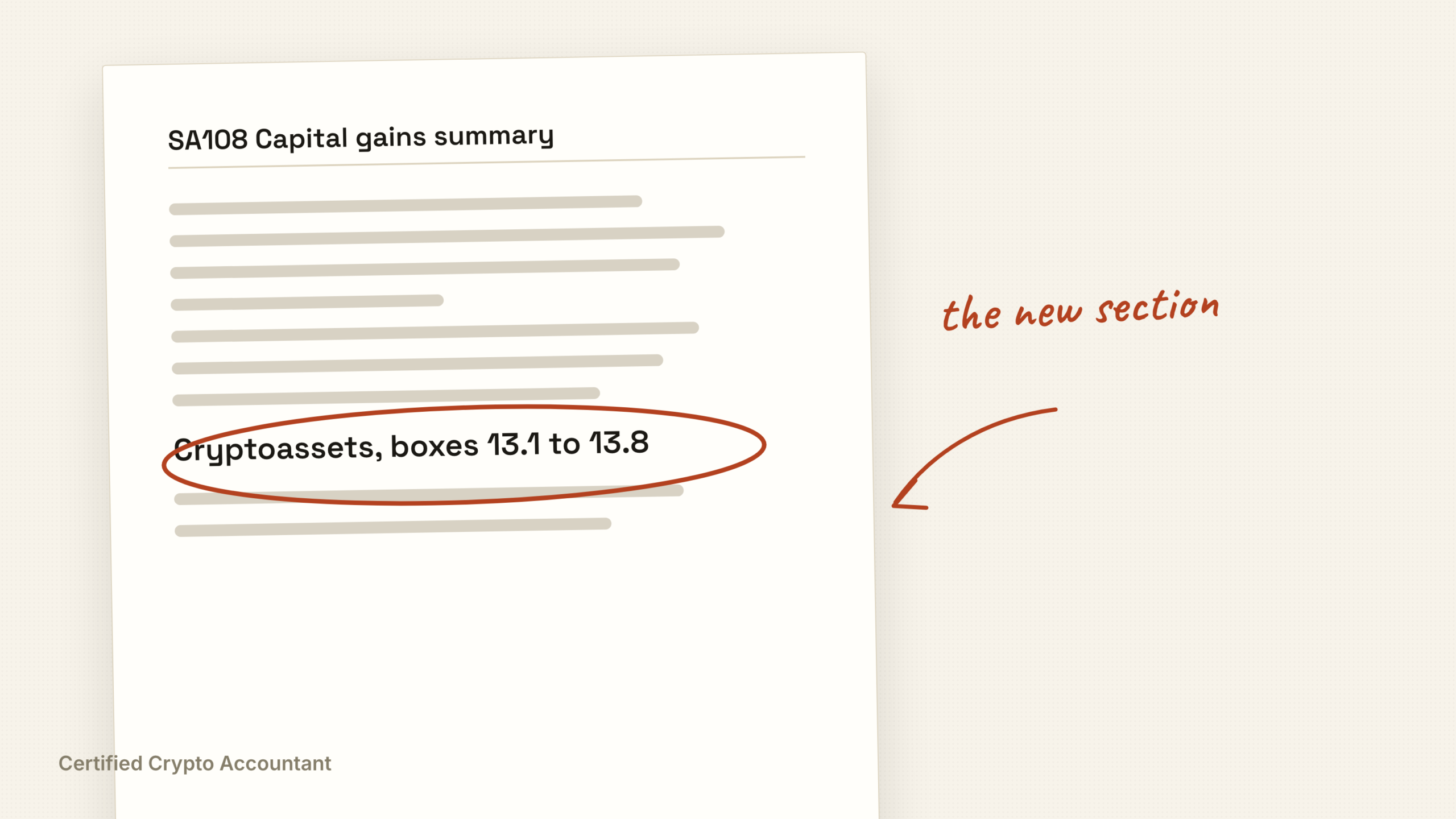
There are two official ways to report crypto to HMRC. The main one is a Self Assessment return, where cryptoasset disposals now carry their own section on the SA108 capital gains pages, boxes 13.1 to 13.8. The other is the real time Capital Gains Tax service, which reports a gain on its own without a full return. Which route you need, and whether you need to report at all, comes down to two thresholds and a registration deadline that arrives three months before the filing one.
The two routes
If you already file a Self Assessment return, crypto goes on it. Gains and losses belong on the SA108 capital gains summary, income from crypto goes on the income pages, and the deadline is the one you already know, 31 January online.
The real time service exists for people who are not otherwise in Self Assessment and would rather not join it for one disposal. You report the gain when it happens, any time up to 31 December after the tax year ends, and HMRC sends a reference to pay against. Payment is still due by 31 January. LITRG’s guide to the reporting routes is the clearest independent walkthrough of how the two interact.
One wrinkle worth knowing. If you use the real time service and later turn out to need a return anyway, those gains still get listed on the SA108, in box 13.7, with the tax you already paid in box 13.8. Reporting twice feels absurd until you realise the return is the reconciliation of record.
The crypto boxes on the SA108
From the 2024 to 2025 return onwards, cryptoassets stopped sharing space with shares and got eight boxes of their own. The section asks for the number of disposals in 13.1, total proceeds in 13.2, allowable costs including what you paid in 13.3, gains before losses in 13.4, losses in 13.5, any claim or election codes in 13.6, then the real time entries in 13.7 and 13.8. Everything goes in pound sterling, which means every disposal needs a sterling value on the day it happened, even the ones where one token was swapped straight into another.
We walked through where these figures sit inside the wider return in capital gains tax on a Self Assessment return. The short version is that the crypto section is a subset of the capital gains pages, not a separate return.
Whether you need to report at all
You must report and pay if your total gains for the year are above the annual exempt amount, which is £3,000. The rates for the 2025 to 2026 year are 18 per cent within the basic rate band and 24 per cent above it.
Below £3,000 in gains there is usually nothing to do. Two exceptions catch people. If you are already in Self Assessment and your total disposal proceeds for the year passed £50,000, the capital gains pages have to be completed even when no tax is due. And if you want a loss to be usable against future gains, HMRC has to be told about it within four years, either on a return or in writing. A loss nobody claimed is a loss that does not exist.
If you are not in Self Assessment and need to be, the registration deadline is 5 October following the end of the tax year. Gains made in the year to 5 April 2026 mean registering by 5 October 2026, which is sooner than most people expect. Our guide to registering for Self Assessment covers the mechanics.
Getting the numbers right
The boxes are the easy part. The number that goes in them depends on HMRC’s pooling rules, which treat every token type as a single pool with an averaged cost, then override that average when you buy on the same day as selling or buy back within 30 days. Software applies these rules mechanically to whatever data it holds. Missing deposits, duplicated imports, transfers between your own wallets that never matched up, and exchanges that no longer exist all produce a pool with the wrong cost in it, and a wrong cost flows straight into box 13.4 as an inflated gain.
This is most of what we do all day. Before anything gets filed, the transaction history has to reconcile, every wallet in and every disposal accounted for, with pooled costs rebuilt where the software guessed. That work is crypto reconciliation, and it is the difference between reporting your gain and reporting a number a tool produced.
Staking, mining and being paid in crypto
Not everything is a capital gain. Tokens from mining, staking or lending, where the activity does not amount to a trade, are treated as miscellaneous income at their sterling value on the day they arrive, and that value becomes the base cost for the eventual disposal. The £1,000 trading and miscellaneous income allowance can cover small amounts. Between £1,000 and £2,500 of such income means telling HMRC, and above £2,500 means a return. Crypto received from an employer counts as money’s worth and runs through employment income, per HMRC’s cryptoassets manual.
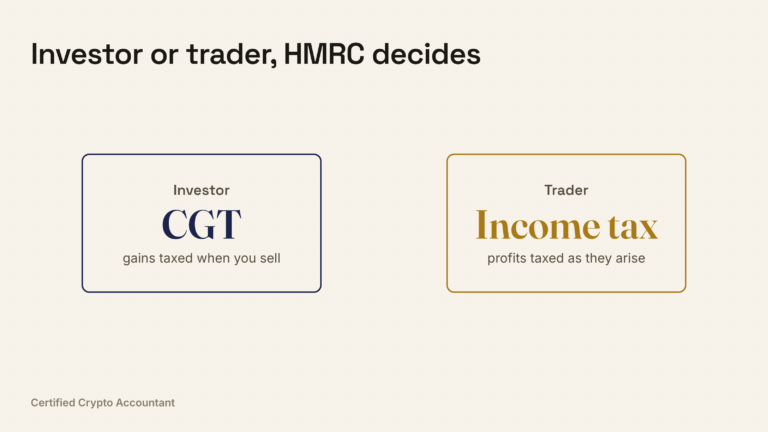
Whether an activity amounts to a trade is its own question with its own consequences, and HMRC decides it on conduct rather than volume alone. How often you deal and how commercially you organise it both count, and we covered how that test works in the badges of trade.
Years you never reported
The return only covers one tax year. Anything older goes through a disclosure instead, and doing that before HMRC writes to you first is the cheapest version of fixing it, because the penalty position for an unprompted disclosure is a fraction of the prompted one. The process and its 90 day clock are in our guide to disclosing unpaid crypto tax.
Waiting is a worse bet than it used to be. Since January 2026 UK platforms have been collecting user and transaction data under CARF, and HMRC will not need to guess who has been trading.
Questions we get on reporting
Do I need to report crypto if I only made a loss?
There is no tax to pay, but an unclaimed loss cannot offset anything later. Claim it on a return or in writing within four years of the end of the tax year it arose in, and it sits available indefinitely after that.
Do I have to report swapping one coin for another?
Yes. Exchanging one cryptoasset for another is a disposal of the first one at its sterling value on the day, exactly as if you had sold for pounds and rebought. Most inflated tax bills we see trace back to years of swaps nobody priced at the time.
What happens if my gains are under £3,000?
Usually nothing needs filing. The exception is if you are already in Self Assessment and total proceeds passed £50,000 for the year, in which case the pages get completed even though the tax due is nil.
How does HMRC know I have crypto?
Exchanges have shared account data with HMRC for years under information notices, and from January 2026 the CARF framework made collection systematic across platforms. The nudge letters going out are generated from that data, so the safe assumption is that HMRC already knows the accounts exist.
If you want the numbers checked before they go anywhere near a return, our free review will tell you whether your software’s figures survive contact with the pooling rules.
Sources
Every figure on this page was checked against the source below on 25 August 2026.
- SA108 capital gains summary. GOV.UK, checked 25 August 2026
- Real time service. GOV.UK, checked 25 August 2026
- LITRG's guide to the reporting routes. Low Incomes Tax Reform Group, checked 25 August 2026
- £3,000. GOV.UK, checked 25 August 2026
- HMRC's pooling rules. GOV.UK, checked 25 August 2026
- Miscellaneous income. GOV.UK, checked 25 August 2026
- HMRC's cryptoassets manual. GOV.UK, checked 25 August 2026
Fahad Zar
Crypto tax accountantAAT licensed 1010475
- AAT Licensed Accountant and MAAT, licence 1010475
- MSc Accounting and Finance, BPP University London
- Six years inside digital asset accounting, across several crypto tax firms
- Practises through Zar Enterprises Ltd, ICO registration ZC225094
- Supervised for anti-money laundering by the AAT
What matters to me is that the number on the return is true, whatever it turns out to be.
Whether this is worth a conversation
Most people who read this page do not need an accountant. A few do.
- A letter from HMRC has arrived
- You have years HMRC does not know about
- HMRC's figures do not match yours
If your letter is a routine tax code notice and your filings are current, you probably just needed this page.
If one of these is you, the first look costs nothing.
Read next
Crypto tax deadlines for the 2026 to 2027 tax year
Key UK crypto tax dates for 2025/26: Self Assessment registration, the 31 January filing and payment deadline, and what…
Reviewed 25 Aug 2026Deep guideHow much HMRC can charge for unpaid crypto tax
What HMRC crypto tax penalties actually cost: late filing, late payment and undeclared gains. How penalties are…
Reviewed 25 Aug 2026ExplainerHow to tell a real HMRC letter from a scam
HMRC never threatens arrest and never asks for bank details to pay a refund. The thirty second sorting method, and…
Reviewed 25 Aug 2026DeadlineThe HMRC savings tax warning is about your bank interest
Banks report interest automatically and rising rates pushed ordinary savers over the £1,000 allowance. What the letters…
Reviewed 25 Aug 2026 ExplainerDo I need to declare crypto to HMRC
The three thresholds that decide whether a return is due at all.
Reviewed 5 September 2026