How to disclose unpaid crypto tax before HMRC finds it

Published 11 June 2026· Reviewed against gov.uk 25 August 2026· 8 min read·HMRC and compliance
A crypto voluntary disclosure is the formal way to tell HMRC about unpaid tax on past crypto gains or income before HMRC comes to you first, and coming forward unprompted puts you in the lowest penalty band available. It is not an admission that you are a tax evader. For most people it is simply the correct route to put right an honest gap, often caused by years of scattered wallets, dead exchanges and rules that were never clearly explained, and the only question is not whether to act but how.
The timing pressure is not theoretical. BDO calls the 2026 reporting rules the point where evasion gets hard, because exchange data starts flowing to HMRC automatically.
This guide walks through when a disclosure is needed, the routes available, the step-by-step process, and why coming forward yourself almost always costs far less than waiting to be caught. The tone here is deliberately calm, because a disclosure handled properly is a manageable, finite process with a known endpoint.
When do you need a crypto voluntary disclosure to HMRC?
You need to disclose when there is unpaid UK tax on cryptoassets from a tax year you can no longer simply amend. That tax can take several forms:
- Capital Gains Tax on disposals you never reported, including crypto-to-crypto swaps, spending crypto and selling for fiat.
- Income Tax on staking rewards, mining, airdrops received in the course of a trade, or payment received in crypto.
- A liability you had in a year where you never registered for Self Assessment at all.
The trigger for a formal disclosure, rather than a quick correction, is usually time. You can amend a Self Assessment return online within 12 months of its filing deadline. Once a year falls outside that window, the amendment option closes and a formal disclosure becomes the proper route. Many people only discover the scale of their crypto position years later, which is exactly why the disclosure facilities exist.
What are the routes for disclosing crypto tax?
There is no single button marked “fix everything”. The right route depends on how old the error is and whether any of your activity sits offshore. There are three main paths, and choosing correctly matters because it affects both the process and the penalty position.
| Route | When it fits | What it involves |
|---|---|---|
| Amend the Self Assessment return | The error is in a return still within 12 months of its filing deadline | Correct the return online and pay the extra tax plus interest, with no formal disclosure needed |
| Cryptoasset Disclosure Facility / Digital Disclosure Service | Unpaid tax on older UK years, outside the amendment window | A formal disclosure: notify, reconcile, calculate, disclose and pay the tax, interest and any penalty |
| Worldwide Disclosure Facility | There is an offshore element to the liability, common with foreign exchanges | A formal offshore disclosure, where penalty loadings can be significantly higher |
Most crypto cases run through the Cryptoasset Disclosure Facility or the Digital Disclosure Service. Where exchanges or custodians sit outside the UK, the offshore route may apply, and getting that classification right early prevents a disclosure being reopened later.
How does the disclosure process actually work?
A voluntary disclosure follows a clear sequence. Rushing any stage, especially the reconciliation, is where most do-it-yourself attempts unravel. The order matters:
- Notify. You tell HMRC you intend to make a disclosure. This registers your intention and starts the formal clock.
- Reconcile. You pull together every wallet address and exchange account, including closed and dead exchanges, and rebuild your full transaction history with a defensible cost basis.
- Calculate. You work out, year by year, the gains and income, the tax due, and the interest that has accrued from the original due dates.
- Disclose. You submit the disclosure with the figures and an honest assessment of the behaviour behind the error, which drives the penalty.
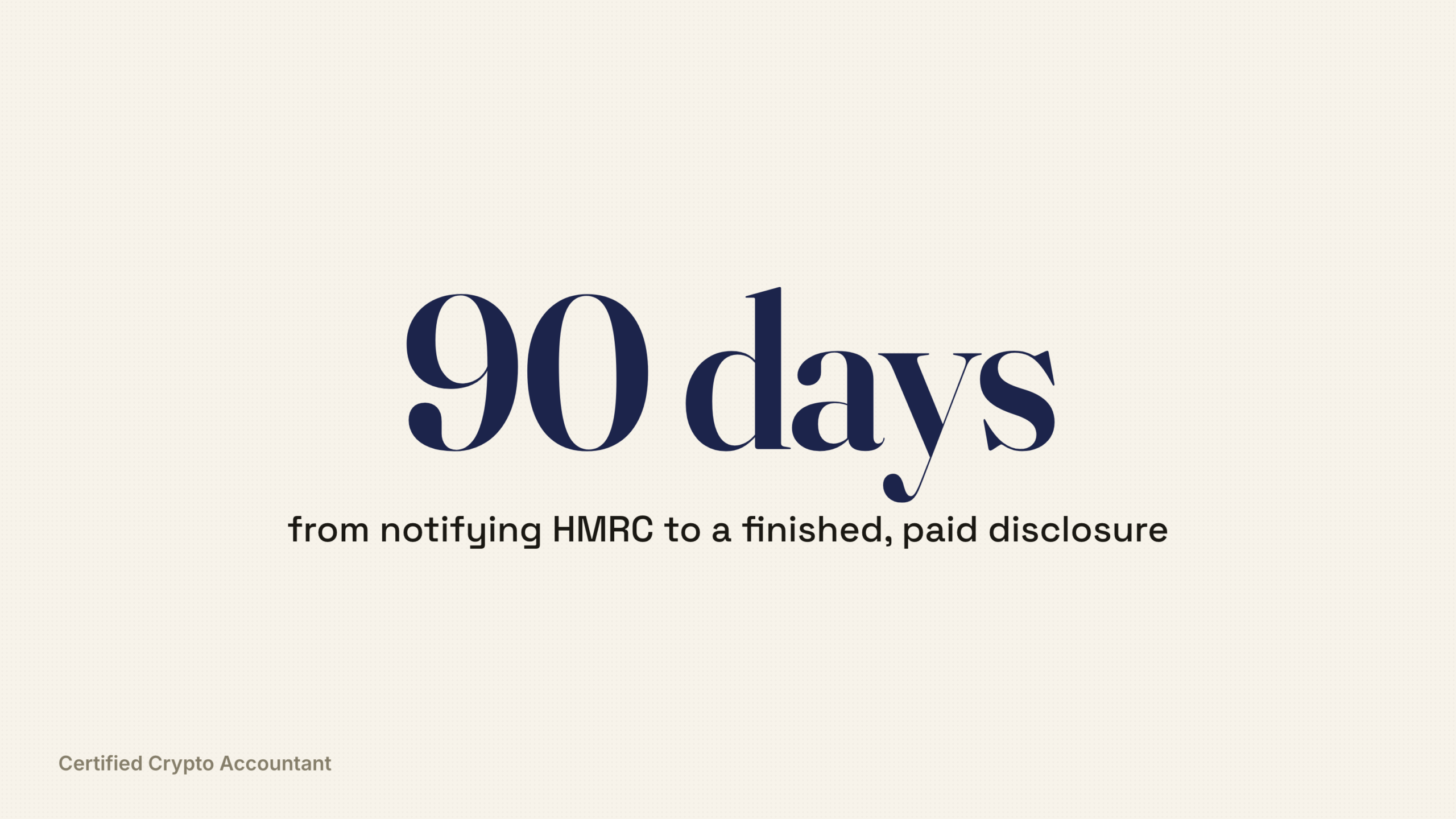
- Pay. You pay the tax, interest and any penalty. After receiving your payment reference, payment is generally expected within 30 days of submitting the disclosure.
The reconciliation in step two is the foundation for everything that follows. A disclosure built on incomplete data is worse than no disclosure at all, because it can convert an honest correction into something HMRC views as careless or deliberate.
How do penalties work, and why does coming forward help?
Penalties under Schedule 24 of the Finance Act 2007 are based on behaviour, not just the amount owed. The worse HMRC judges the conduct, the higher the percentage and the further back it can look. Crucially, an unprompted voluntary disclosure attracts the lowest penalty within each band, which is the entire financial case for coming forward.
| Behaviour | Penalty (% of unpaid tax) | HMRC can look back |
|---|---|---|
| Reasonable care (genuine error) | None: tax and interest only | 4 years |
| Careless | Up to 30% | 6 years |
| Deliberate | 20% to 70% | 20 years |
| Deliberate and concealed | 30% to 100% | 20 years |
Two further points sit on top. Where there is an offshore element, penalty loadings can reach up to 200% of the tax. And a separate failure-to-notify position applies, with the same 20-year reach, where you had a liability but never registered for Self Assessment. One common worry is worth addressing directly: “I didn’t know crypto was taxable” does not, on its own, remove penalties. Genuine reasonable care can, but ignorance alone is not treated as a defence.
What does a crypto voluntary disclosure cost? A worked example
Imagine the unreported tax relates to the 2021/22 tax year, now well outside the amendment window. You traded across two exchanges, one since closed, plus a DeFi wallet, and your original return showed no crypto. After a full reconciliation, the true position is a capital gain that produces £6,000 of unpaid CGT.
- Unprompted voluntary disclosure, careless behaviour: you pay the £6,000 of tax, plus interest, plus a careless-band penalty. Because the disclosure is unprompted, that penalty sits at the bottom of the up-to-30% band, so the penalty element can be a small fraction of the £6,000.
- Caught by HMRC, deliberate behaviour: the same £6,000 can attract a deliberate-band penalty of 20% to 70%, so a 60% penalty alone would add £3,600, on top of tax and interest, with a 20-year lookback in play.
The tax is identical. The total bill is not. The difference is driven almost entirely by who moved first and how the behaviour is judged. If paying the full amount at once is difficult, a Time to Pay arrangement can spread the cost, which is far cheaper than the penalties for non-disclosure.
How long does a disclosure take, and what should you expect?
A disclosure is a finite process, not an open-ended investigation. After you notify and submit, HMRC issues a payment reference number, and payment is generally expected within 30 days of the disclosure being submitted. The reconciliation stage is usually the longest part, because rebuilding years of activity across multiple platforms takes time and care.
What you should expect throughout is correspondence rather than confrontation. A well-prepared, fully evidenced disclosure gives HMRC little to challenge, which is precisely why the preparation matters more than the paperwork at the end.
How a specialist handles a crypto disclosure
When a client comes to us with unpaid crypto tax, we work in a strict order: data first, disclosure second. We reconcile every wallet and exchange, including the dead ones, establish the true taxable position for each year, classify the behaviour honestly, choose the correct route, and deal with HMRC directly. The disclosure only goes in once the numbers behind it are solid and defensible, which is what keeps the penalty at the bottom of the band and the process short.
Frequently asked questions
Is a voluntary disclosure the same as admitting tax evasion?
No. A voluntary disclosure is the standard, expected route for putting right unpaid tax. Most crypto disclosures involve honest gaps from scattered records, not deliberate evasion, and the behaviour you declare directly affects the penalty.
Can I still amend my return instead of disclosing?
Only if the year is still within 12 months of its Self Assessment filing deadline. Once that window closes, you can no longer amend online and a formal disclosure through the Cryptoasset Disclosure Facility or Digital Disclosure Service is the correct route.
How far back do I have to go?
It depends on behaviour. HMRC can look back 4 years where you took reasonable care, 6 years if you were careless, and up to 20 years for deliberate behaviour or a failure to notify.
What if I cannot pay the full amount straight away?
HMRC offers Time to Pay arrangements that let you spread the cost over an agreed period. Disclosing and agreeing a payment plan is far cheaper than the penalties and interest that build up from leaving it unreported.
Does “I didn’t know crypto was taxable” reduce my penalty?
Not on its own. Ignorance of the rules is not treated as a defence that removes penalties. Genuine reasonable care can place you in the no-penalty band, but that is judged on the facts, not on a simple lack of awareness.
What if some of my exchanges were based overseas?
An offshore element can bring the Worldwide Disclosure Facility into play, and penalty loadings can be higher, up to 200% of the tax. Getting that classification right at the start matters, because it changes both the route and the figures.
Put it right before HMRC asks
The window for a low-cost correction is widest before HMRC contacts you, and it narrows the moment a letter arrives. A clean crypto voluntary disclosure to HMRC, built on a full reconciliation, turns an uncertain liability into a finite, manageable bill. Book a free, confidential review at certifiedcryptoaccountant.com.
For tailored help, see our crypto tax services or book a free review.
Authoritative sources: HMRC: tell HMRC about unpaid crypto tax; HMRC Cryptoassets Manual.
The practical question is what you actually owe, not what the letter implies. Work out a starting figure with the capital gains tax calculator, and if crypto is involved our crypto tax accountants can check it against the real transaction history.
Sources
Every figure on this page was checked against the source below on 25 August 2026.
- BDO calls the 2026 reporting rules the point where evasion gets hard. BDO, checked 25 August 2026
- HMRC: tell HMRC about unpaid crypto tax. GOV.UK, checked 25 August 2026
- HMRC Cryptoassets Manual. GOV.UK, checked 25 August 2026
Fahad Zar
Crypto tax accountantAAT licensed 1010475
- AAT Licensed Accountant and MAAT, licence 1010475
- MSc Accounting and Finance, BPP University London
- Six years inside digital asset accounting, across several crypto tax firms
- Practises through Zar Enterprises Ltd, ICO registration ZC225094
- Supervised for anti-money laundering by the AAT
What matters to me is that the number on the return is true, whatever it turns out to be.
Whether this is worth a conversation
Most people who read this page do not need an accountant. A few do.
- A letter from HMRC has arrived
- You have years HMRC does not know about
- HMRC's figures do not match yours
If your letter is a routine tax code notice and your filings are current, you probably just needed this page.
If one of these is you, the first look costs nothing.
Read next
Crypto tax deadlines for the 2026 to 2027 tax year
Key UK crypto tax dates for 2025/26: Self Assessment registration, the 31 January filing and payment deadline, and what…
Reviewed 25 Aug 2026Deep guideHow much HMRC can charge for unpaid crypto tax
What HMRC crypto tax penalties actually cost: late filing, late payment and undeclared gains. How penalties are…
Reviewed 25 Aug 2026ExplainerHow to tell a real HMRC letter from a scam
HMRC never threatens arrest and never asks for bank details to pay a refund. The thirty second sorting method, and…
Reviewed 25 Aug 2026DeadlineThe HMRC savings tax warning is about your bank interest
Banks report interest automatically and rising rates pushed ordinary savers over the £1,000 allowance. What the letters…
Reviewed 25 Aug 2026 ExplainerHMRC can go back four, six, twelve or twenty years and your own conduct picks the number
How many years a disclosure has to cover, and why unfiled crypto usually means all of them.
Reviewed 5 September 2026