HMRC’s letter says you have disposed of cryptoassets. What it is, the 60 days, and what to send back

Published 12 November 2026 Reviewed against gov.uk 12 November 2026 11 min readHMRC and compliance
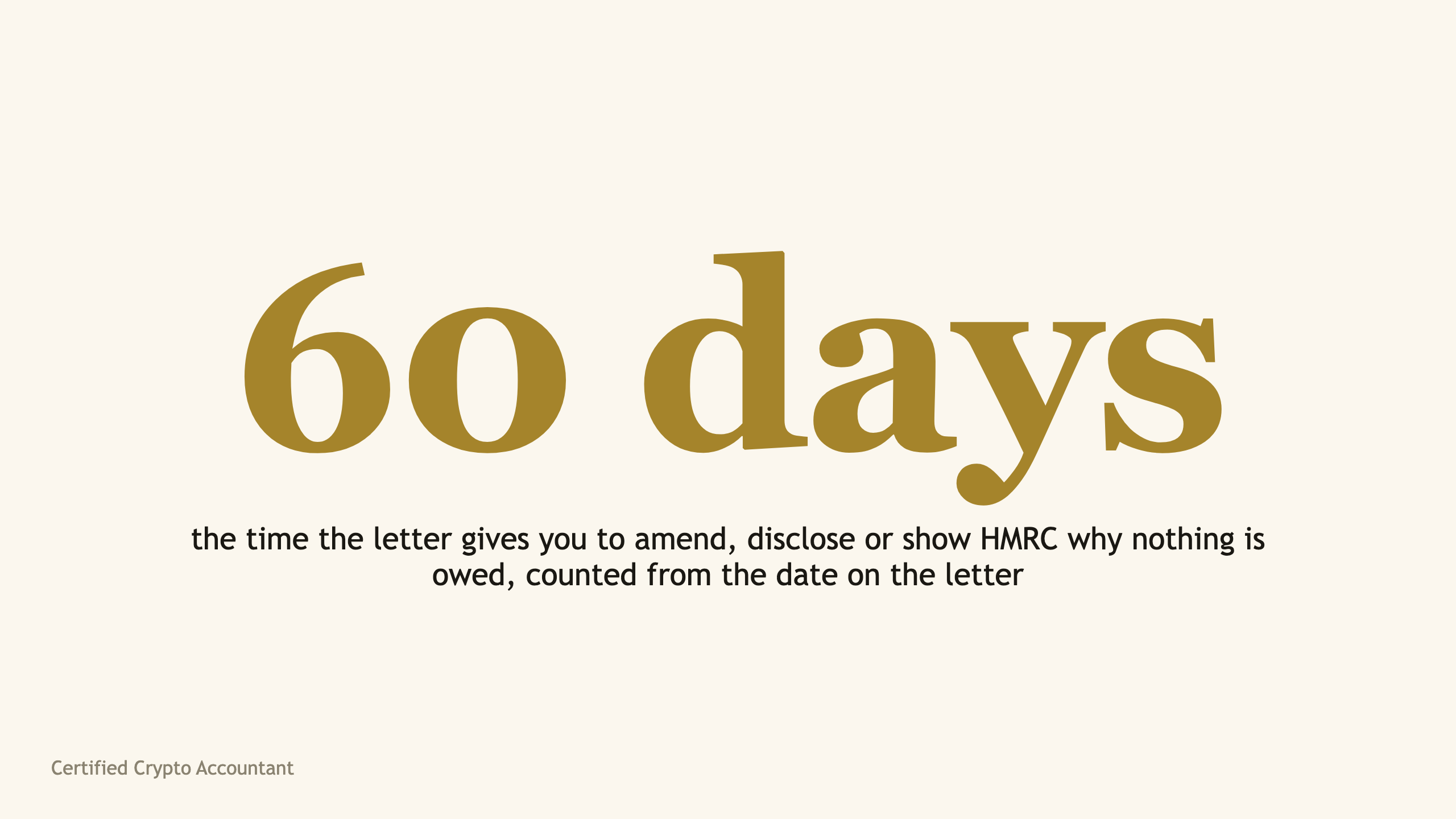
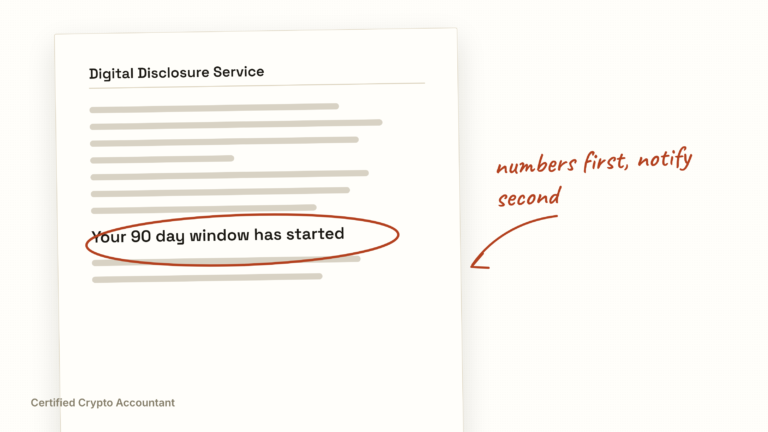
The letter that opens with the words our records show you have disposed of cryptoassets is a one to many letter from HMRC’s Wealthy and Mid-sized Business Compliance team, sent to people whose exchange data suggests disposals that were not declared. It is a prompt rather than an enquiry. It gives you 60 days from its date to do one of three things, amend a return, make a disclosure, or tell HMRC with evidence that nothing is due, and the right one depends on a computation you have not yet done.
This page quotes the letter, from the template HMRC shared with the professional bodies in July 2024 and the Chartered Institute of Taxation published. Your copy may differ in small ways, and the reference and the date at the top are yours alone. The guide to the nudge letter campaign covers the numbers and the history. This page is about the letter in your hand. Not sure which letter you have? Paste its first lines and the page names it.
The letter that says HMRC’s records show you have disposed of cryptoassets is a one to many prompt from Wealthy and Mid-sized Business Compliance rather than an enquiry. It gives 60 days to amend, disclose, or show with evidence that nothing is due. Rebuild the history before choosing, reply in writing inside the date with the computation, and claim any losses in the same letter. Once it has arrived, a disclosure is prompted and the penalty range starts higher, so the quality of what you send is what brings it down.
What the letter says, in its own words
It begins, “We’re writing to you as our records show you have disposed of cryptoassets. However, you haven’t declared everything correctly. This means you may have tax to pay.”
Under the heading What is a cryptoasset disposal it lists four events. Selling cryptoassets for fiat currency, with the note that gains are taxable even if the money is not withdrawn from the exchange. Exchanging one cryptoasset for another, treated as a disposal of the old and an acquisition of the new, taxable even if nothing was converted back to pounds. Using cryptoassets to buy goods or services. And giving them away to someone who is not your spouse or civil partner, where you are treated as having received the sterling value even though you received nothing. That list matches HMRC’s manual at CRYPTO22100, and it is the reason a year in which you took no money out can still owe tax.
Under What you need to do now it says you may have capital gains or income relating to cryptoassets that you have not told HMRC about or included in your Self Assessment or Capital Gains Real Time transaction returns, and asks you to contact them with information about it. It gives three routes. Declare any income or gains on your Self Assessment return if you are within the time limit to amend. Use the cryptoasset disclosure service for unpaid tax from previous years. Or, if you are satisfied that you do not have any cryptoasset related tax to pay, contact HMRC and include information that shows why.
Then the sentence with the date in it. “Please act now. You can do this by making an amendment, disclosure or giving us information. You must do this by” a date 60 days ahead of the letter.
Under What happens next it says HMRC may raise an assessment for any additional tax, will charge interest on tax paid late, and will consider on a case by case basis whether to charge an inaccuracy penalty under CC/FS7a or a failure to notify penalty under CC/FS11. It gives a phone number, 03000 552294, open Monday to Friday 9am to 4.30pm, and an email address for the response team, and it adds that HMRC cannot correct your return over the phone, cannot help you work out your tax position, and cannot give you specific advice. It closes with “It’s your responsibility to make sure your tax returns are completed correctly” and is signed Wealthy Midsized Business Compliance.
What it is, and what it is not
It is a one to many letter, the same text sent to everyone on a list HMRC built from data. The exchanges have supplied customer records under HMRC’s information powers for years, and from 1 January 2026 UK platforms collect the details that the Cryptoasset Reporting Framework will send to HMRC each May, which the page on the 2027 campaign covers. Your name being on the list means an exchange has reported disposals in your name for a year in which HMRC holds no matching return. It does not mean HMRC has worked out your tax, and it does not mean the figure it holds is right, because the exchange reports proceeds and knows nothing of your cost.
It is not an enquiry. An enquiry into a return is opened by a separate letter under section 9A of the Taxes Management Act 1970 and carries statutory powers. This letter carries none. It carries a date, and what happens after the date is HMRC’s choice. The reliable way to receive the section 9A letter is to let the 60 days pass without a reply.
The order to do things in
One. Do not phone to explain. The letter itself says the line cannot help you work out your position, and anything you say about years and amounts before you have the computation is a statement you may have to walk back. Note the date on the letter and the reference, and count the 60 days.
Two. Rebuild the history before deciding which reply is yours. Every exchange, every wallet, every chain, including the closed ones, pooled under CRYPTO22200 for each year, with the sterling value on the day of every disposal. CRYPTO10400 puts the duty to hold those records on you. Until this is done you do not know whether the answer is amend, disclose, or nothing to pay, and people guess wrong in both directions. The page on reports that overstate the gain is the reason a software report is not the computation on its own.
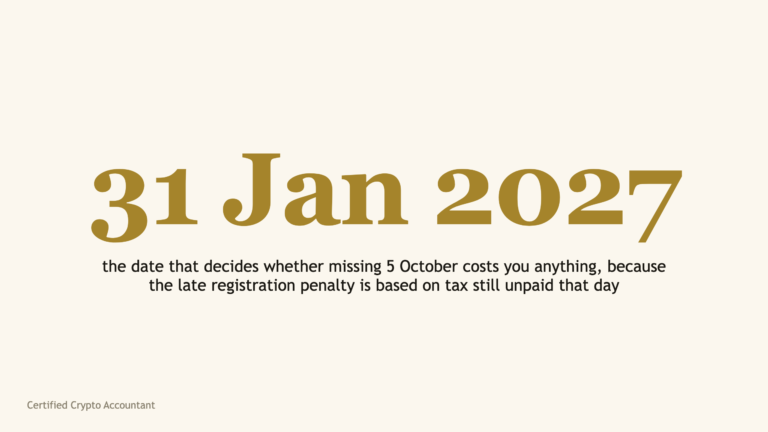
Three. Pick the reply the computation gives you. If a return for the year was filed and can still be amended, amend it. Gov.uk says a return can be corrected within 12 months of the filing deadline, so a 2024 to 2025 return can be changed until 31 January 2027. If the years are older or no return was filed, use the cryptoasset disclosure service, and the page on never having declared walks through it year by year. If the computation shows gains below the annual exempt amount in every year the letter could mean, and no income, the reply is the third one, and it is the one most people get wrong.
Four. Reply inside the 60 days, in writing, with the working. Even where the answer is a disclosure that will take longer than 60 days to assemble, a letter inside the window saying that a disclosure is being prepared, which years it covers and when it will be submitted is the difference between a prompted disclosure and a compliance check.
What to send when nothing is owed
The letter asks for information that shows why you do not have to pay tax. A sentence saying you lost money is not that. What satisfies the request is the computation itself, and in our files it has four parts.
A schedule for each tax year the letter could cover, listing every disposal with its date, the asset, the quantity, the proceeds in sterling, the pooled cost under section 104 with same day and 30 day matching applied, and the gain or loss on each. A summary for each year showing total gains, total losses, the net figure, and the annual exempt amount for that year, so that the reader sees the net gain sat below £12,300, £6,000 or £3,000 as the year requires. The source behind the schedule, the exchange exports and the chain records for the acquisitions, with the bank statement lines that put sterling in. And a short covering letter quoting HMRC’s reference, stating that the schedules show no Capital Gains Tax or Income Tax is due for the years listed, and offering the underlying files on request.
Where losses arose, the same reply is also the place to claim them. A loss claimed in writing within four years of the end of the tax year carries forward against future gains, and the guide to claiming capital losses covers the wording. Replying to a nudge letter with an unclaimed loss and not claiming it is the commonest missed opportunity in these files.
What the letter does to penalties
Once it has arrived, any disclosure is prompted. CC/FS11 says a disclosure is unprompted only if you tell HMRC before you had any reason to believe it was about to find the failure. For a non deliberate failure to notify that is more than twelve months old, the range moves from 10% to 30% of the tax to 20% to 30%. For an inaccuracy in a filed return, CC/FS7a moves a careless error from 0% to 30% to 15% to 30%. Deliberate behaviour sits at 35% to 70% in both factsheets once prompted.
The reductions for telling, helping and giving access to records still apply, and they are what take a prompted penalty to the bottom of its range. A disclosure that arrives inside the 60 days with the full computation attached is the version that earns them. A disclosure made after HMRC has opened a check is still possible, but by then the factsheet treats it as prompted in every case and the check itself is under way.
A worked example with figures
Suppose the letter is dated 3 November 2026 and the reply date is 2 January 2027. The exchange reported disposals of £38,000 in the year to 5 April 2025, and no return was filed. Rebuilt, the year shows proceeds of £38,000 against pooled costs of £36,200, gains of £1,800, all after 30 October 2024, and no income. The annual exempt amount for 2024 to 2025 was £3,000, so no tax is due for that year. The year to 5 April 2024 shows proceeds of £9,000 against costs of £4,500, a gain of £4,500 under the £6,000 allowance, again nothing due.
The reply is the third route. Two schedules, two summaries, the exports and the bank lines behind the costs, and a covering letter quoting the reference, sent before 2 January. If instead the rebuilt 2024 to 2025 year had shown gains of £8,000, the reply would be a disclosure through the service for £5,000 of taxable gain at the published 18% or 24% rate, £900 or £1,200 of tax, plus interest from 31 January 2026, plus a penalty you propose in the prompted range, with a holding letter inside the 60 days saying the disclosure is coming and when.
When it needs an accountant
If the letter covers one exchange and one or two years, and a report you trust shows gains below the allowance, you can write the reply yourself, and the free review will tell you whether the report is right first. It becomes a job when the history runs across platforms and chains, when exchanges have closed and costs have to be rebuilt or estimated, when more than one year owes and the disclosure has to be assembled and submitted inside a date, or when the behaviour question is open and the penalty turns on how the reply is written. A letter with unfiled years behind it is the staged engagement below, and we act as agent in the correspondence from the first reply.
Three fixed fees, quoted in writing before any work starts
One taxpayer, one tax year unless the line says otherwise. Written position within 15 working days of software access.
For an exchange-only history under about 5,000 trades where the software report is already built.£499
For several platforms, wallet transfers read as sales, duplicates, and one or two back years.£950
For DeFi, derivatives, high volume, or balances that do not tie.£1,750
Send your software report to zar@certifiedcryptoaccountant.com for a written fee the same working day, or start with the free review. Licensed and regulated by the AAT, licence 1010475.
Questions about the HMRC letter on cryptoasset disposals
Is this letter an investigation?
No. It is a one to many letter sent to everyone on a list HMRC built from exchange data, signed by Wealthy Midsized Business Compliance. An enquiry is opened by a separate letter under section 9A of the Taxes Management Act 1970 and carries statutory powers. This letter carries a date, and ignoring the date is the reliable way to receive the second letter.
Why did I get it when I never took any money out?
Because the letter's own list of disposals includes exchanging one cryptoasset for another and using cryptoassets to buy goods or services, and says gains are taxable even if the money is not withdrawn from the exchange. HMRC's manual says the same. A year of swaps with no withdrawals is a year of disposals.
What does the 60 days mean?
The letter says you must act by a date 60 days ahead of its own date, by amending a return, making a disclosure or giving HMRC information. A reply inside the window that says a disclosure is being prepared, which years, and when, counts. No reply by the date is what moves the file on.
What do I send if I owe nothing?
The computation. A schedule of every disposal for each year with proceeds, pooled cost and gain or loss, a summary showing the net gain against that year's annual exempt amount, the exchange exports and bank lines behind the costs, and a covering letter quoting the reference. The letter asks for information that shows why no tax is due, and a schedule is that information. A sentence saying you lost money is not.
Is my disclosure still unprompted if I move quickly?
No. The factsheets say a disclosure is unprompted only if made before you had any reason to believe HMRC was about to find the failure, and the letter is that reason. The range for a non deliberate failure to notify moves from 10% to 30% to 20% to 30%. The reductions for telling, helping and giving access still apply and still take it to the bottom of the range.
Can I claim losses in my reply?
Yes, and you should. Where the rebuilt years show net losses, the same letter claims them in writing, and a loss claimed within four years of the end of the tax year carries forward against future gains. Replying to the letter without claiming an available loss is the commonest thing people leave on the table.
Sources
Every figure on this page was checked against the source below on 12 November 2026.
- HMRC one to many letter on cryptoasset disposals, template dated 24 July 2024. HM Revenue and Customs, published by the Chartered Institute of Taxation, checked 12 November 2026
- Crypto investors urged to review tax obligations as HMRC sends nudge letters. Chartered Institute of Taxation, checked 12 November 2026
- Tell HMRC about unpaid tax on cryptoassets. HM Revenue and Customs, checked 12 November 2026
- Self Assessment tax returns, if you need to change your return. GOV.UK, checked 12 November 2026
- CC/FS11, penalties for failure to notify. HM Revenue and Customs, checked 12 November 2026
- CC/FS7a, penalties for inaccuracies in returns or documents. HM Revenue and Customs, checked 12 November 2026
- CRYPTO22100, Capital Gains Tax, what is a disposal. HM Revenue and Customs, checked 12 November 2026
- CRYPTO22200, Capital Gains Tax, pooling. HM Revenue and Customs, checked 12 November 2026
- CRYPTO10400, record keeping. HM Revenue and Customs, checked 12 November 2026
- Capital Gains Tax rates and annual tax-free allowances. HM Revenue and Customs, checked 12 November 2026
- Taxes Management Act 1970, section 9A. legislation.gov.uk, checked 12 November 2026

Fahad Zar
Crypto tax accountantAAT licensed 1010475
- AAT Licensed Accountant and MAAT, licence 1010475
- MSc Accounting and Finance, BPP University London
- Six years inside digital asset accounting, across several crypto tax firms
- Practises through Zar Enterprises Ltd, ICO registration ZC225094
- Supervised for anti-money laundering by the AAT
What matters to me is that the number on the return is true, whatever it turns out to be.
Whether this is worth a conversation
Where this stops being a reading job and starts being a hiring one.
- The letter covers years across several platforms or chains, or exchanges that have closed, and the history has to be rebuilt inside the 60 days
- More than one year owes tax and a disclosure has to be assembled, submitted and paid against the date
- The behaviour question is open and the penalty turns on how the reply is written
If it is one exchange, one or two years, and a report the free review confirms is right shows gains below the allowance, write the reply yourself. Two schedules, the exports and bank lines behind them, and a covering letter quoting the reference, sent before the date on the letter.
If one of these is you, the first look costs nothing.
Read next
HMRC crypto nudge letters
The campaign, the numbers, and what the letters have asked for since 2021.
Reviewed 12 November 2026ExplainerNever declared crypto for several years
The disclosure route year by year, with the penalty you propose and a worked example.
Reviewed 12 November 2026ExplainerHMRC's 2027 crypto letter campaign
What the Cryptoasset Reporting Framework sends HMRC each May and who gets written to.
Reviewed 12 November 2026Deep guideHow to claim unclaimed capital losses
The four year window and the wording of a claim in a letter.
Reviewed 12 November 2026 ExplainerHMRC's 2026 crypto letter has no deadline. What it says, why you got it, what to check before doing nothing
The newer letter. If yours opens with information that suggests you've engaged in cryptoasset activities and gives no date, it is the 2026 version, quoted here.
Reviewed 14 November 2026