Only 17,600 people reported crypto gains to HMRC last year

Published 28 August 2026· Reviewed against gov.uk 28 August 2026· 8 min read·Crypto Tax
HMRC published something unusual this week. For the first time, it put real numbers on who actually reports crypto gains in the UK, and the press release led with the most flattering figure in the dataset. 240 people declared more than £1 million each in crypto gains in the 2024-25 tax year.
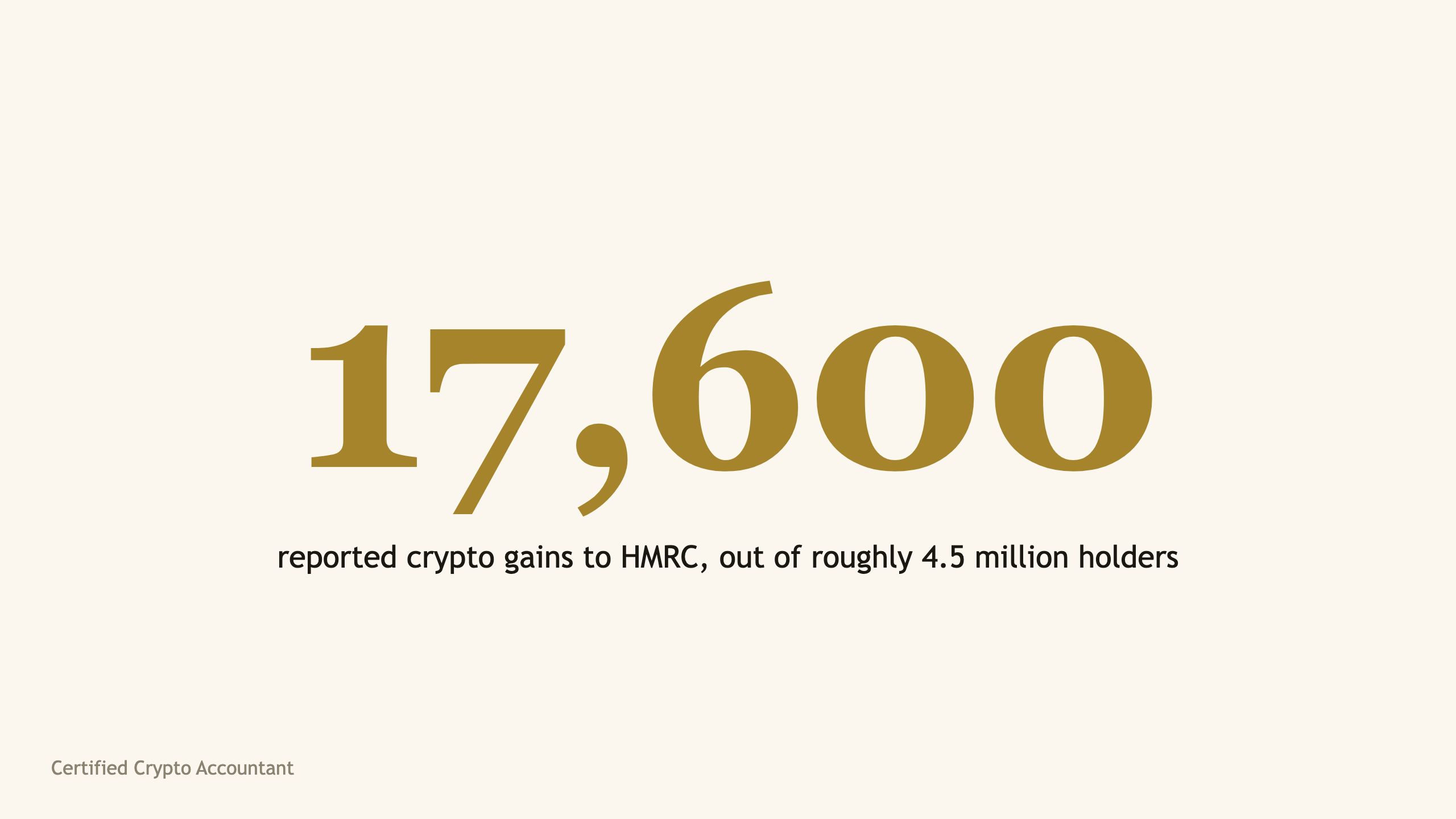
That number went straight into every headline. It is also the least interesting number in the release. The one that matters is 17,600, because that is everyone, in the entire country, who reported a crypto gain to HMRC last year. Set that against what the FCA has published about how many people hold crypto in the UK, and you get a picture HMRC did not spell out but plainly wants understood. This article spells it out instead.
Most of the gap between 17,600 and 4.5 million is innocent. From May 2027 HMRC stops guessing which part, and the window for sorting it out cheaply is open now.
What HMRC actually published
The release covers Self Assessment data for the 2024-25 tax year. In that year, 17,600 individuals reported capital gains tax liable disposals of cryptoassets. Between them they declared £13.8 billion in disposal proceeds and £1.38 billion in gains, an average of £78,000 of gain per person.
At the top of the distribution sit the 240 people who each declared more than £1 million of crypto gains. They reported £717 million between them, roughly £3 million each. That means 1.4 percent of the people who filed accounted for over half of all the crypto gains declared in the country.
Two other details are worth holding on to. HMRC says its compliance and education activity, which so far mostly means one to many letters and reminders, generated an additional £168 million of capital gains tax in 2024-25. And around 87 percent of the people reporting crypto gains were men, which says something about who this market still is.
The number the release does not contain
The FCA’s most recent consumer research, published in December 2025, estimates that around 8 percent of UK adults hold cryptoassets. That is roughly 4.5 million people, and it is the low point of the cycle. The previous wave counted about 7 million.
Put the two official numbers side by side. Roughly 4.5 million holders. Exactly 17,600 reporters. One person filed for every 250 who hold.

Now, most of that gap is legitimate, and any honest reading has to start there. Buying and holding is not a taxable event, and a large share of those 4.5 million people did nothing with their coins all year. Gains only need reporting once they clear the £3,000 annual exempt amount, or once total proceeds cross the £50,000 reporting threshold for people already in Self Assessment. And 2024-25 contained a long drawdown, which produces more losses than gains.
But the gap does not survive that explanation intact, for one reason most holders still do not know. Selling for pounds is not the only disposal. Swapping one coin for another is a disposal. Spending crypto is a disposal. Gifting it to anyone other than a spouse or civil partner is a disposal. Anyone who touched their portfolio during the year, rebalanced into stablecoins, chased a narrative, moved into a new token, made disposals, whether or not a single pound ever reached their bank account.
Look at who the 17,600 actually are and the picture sharpens. They declared nearly £800,000 of proceeds each, on average. These are serious, active accounts. The casual holder who swapped a few thousand pounds around during the year is almost entirely absent from the data. Some of those people genuinely owed nothing. A meaningful number owed something, or had reportable proceeds, or had losses that would have been worth banking, and filed nothing at all.
Why the gap exists
Very little of this is deliberate evasion. After years of reviewing crypto tax histories, the same four explanations come up over and over.
First, the cash out myth. The single most common belief among UK holders is that tax only happens when money reaches the bank. It is wrong, and it has been wrong since HMRC first published its cryptoassets manual, but it survives because it feels intuitive and because everyone repeats it to each other.
Second, the software gap. People connect their exchanges to a tax tool, see a number, and assume the number is right. Where the history is incomplete, a dead exchange, an import that only caught one side of a transfer, missing purchase prices, the software computes confidently on top of the gap and shows no warning at all.
Third, records. Anyone who started before 2020 almost certainly used a platform that no longer exists. When you cannot prove what you paid for a coin, the calculation defaults against you, and for some people that fear alone is the reason the spreadsheet stays closed. Our guide to crypto record keeping covers what HMRC actually expects you to hold.
Fourth, honest paralysis. Years of activity, no idea where to start, and a professional industry where most local firms will honestly say crypto is not really their area.
None of those explanations will matter much to a computer doing data matching. Which brings us to next May.
What changes in May
Since 1 January 2026, every UK crypto platform has been required to collect identifying details from its customers, names, addresses, tax identifiers, alongside their transaction records, under the Cryptoasset Reporting Framework. The first reports covering the whole of 2026 must reach HMRC by 31 May 2027. Partner countries exchange the same data for UK residents using overseas platforms, and individuals who refuse to provide their details to a platform face a penalty of up to £300. The full mechanics are in our CARF guide.
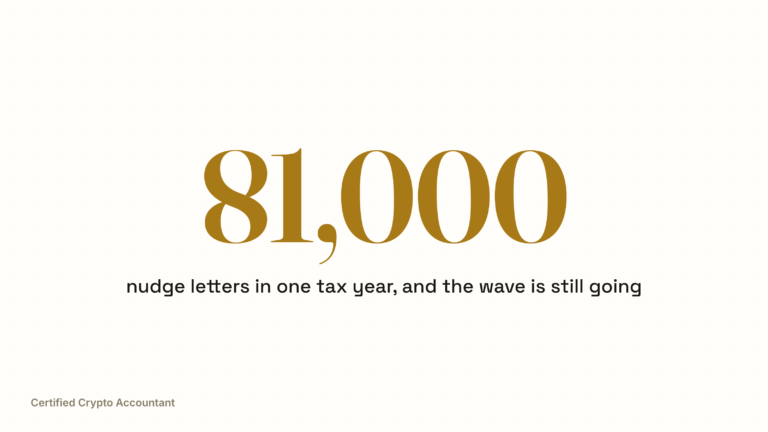
HMRC’s own forecast says this regime will raise £315 million across the four years to 2030. Spread across millions of holders, that figure tells you the plan is not a wave of investigations. It is matching at scale. Software compares the platform’s number with your return, and where the two disagree, a letter is generated. The £168 million already collected from simple letters, before any of this data arrives, is the proof of concept.
The 2024-25 figures in this release are the before photo. From May 2027, HMRC will be able to compare 17,600 against something much closer to the real number of people making disposals, and the difference between those two figures is the workload it has been building towards.
Who hears about it first
Data matching finds mismatches, not intent. That has an uncomfortable consequence. The person with sophisticated offshore structures produces few easy mismatches and sits at the expensive end of HMRC’s effort. The ordinary holder whose records are scattered across two dead exchanges and five wallets produces a mismatch on the first automated pass.
In other words, the first people to hear from HMRC will disproportionately be the ones with gaps rather than the ones with intent. If your history is incomplete, that is worth taking personally, because the machine will. What those first letters look like, and how to answer one, is covered in our guide to HMRC crypto nudge letters.
What to do now, depending on who you are
If you made disposals in past years and never filed, the strongest position is the one you create before the letter, not after it. HMRC runs a dedicated disclosure route for cryptoassets, and coming forward unprompted is treated very differently from being caught by a data match. What it costs to wait is set out in our guide to crypto tax penalties.
If you lost money in 2022, and a very large number of people did, those losses are worth real money against future gains, but only once they are claimed. For losses from the 2022-23 tax year, the collapse year of Luna, Celsius and FTX, the claim window closes on 5 April 2027. A loss that is never claimed simply expires.
If your records are scattered or your old platforms are gone, the history can almost always be rebuilt. Chain data does not shut down when a company does, banks hold statements for six years, and old email archives hold more trade confirmations than most people expect. The rebuild is slow, but it is cheaper than defaulting to a calculation with no purchase costs in it.
And if you have been filing all along, this release is your reassurance. You are one of the 17,600, the matching machine will find your return where it expects to find it, and your only job is to keep the records that prove your numbers if a query ever comes. For how the tax itself is calculated, see our full guide to crypto gains tax in the UK.
The shortest route from that gap to a return HMRC can match is the end to end crypto tax service, from raw exports to a filed return.
Questions on the gap
How many people report crypto gains to HMRC?
17,600 individuals reported capital gains tax liable crypto disposals in the 2024-25 tax year, declaring £1.38 billion in gains between them, according to HMRC's August 2026 release.
Do I need to report crypto if I never cashed out to my bank?
Often yes. Swapping one coin for another, spending crypto, and gifting it to anyone other than a spouse or civil partner are all disposals for capital gains tax, whether or not any money reached your bank.
When do crypto gains have to be reported?
Once your total gains across all assets pass the £3,000 annual exempt amount, or once total disposal proceeds pass £50,000 if you already file Self Assessment. Losses are worth reporting even when no tax is due, because unclaimed losses eventually expire.
What data will HMRC get about my crypto in 2027?
Under the Cryptoasset Reporting Framework, UK platforms have been collecting names, addresses, tax identifiers and transaction records since 1 January 2026. The first reports covering 2026 reach HMRC by 31 May 2027, and partner countries exchange the same data for overseas platforms.
Sources
Every figure on this page was checked against the source below on 28 August 2026.
- 240 crypto millionaires revealed in new government data. GOV.UK, checked 28 August 2026
- Cryptoassets consumer research 2025. FCA, checked 28 August 2026
- Implementation of the Cryptoasset Reporting Framework. GOV.UK, checked 28 August 2026
- The Cryptoasset Service Providers (Due Diligence and Reporting Requirements) Regulations 2025. legislation.gov.uk, checked 28 August 2026
Fahad Zar
Crypto tax accountantAAT licensed 1010475
- AAT Licensed Accountant and MAAT, licence 1010475
- MSc Accounting and Finance, BPP University London
- Six years inside digital asset accounting, across several crypto tax firms
- Practises through Zar Enterprises Ltd, ICO registration ZC225094
- Supervised for anti-money laundering by the AAT
What matters to me is that the number on the return is true, whatever it turns out to be.
Whether this is worth a conversation
Where this stops being a reading job and starts being a hiring one.
- You made disposals in past years, filed nothing, and want the position fixed before the 2027 data arrives
- Your history runs through dead exchanges and you cannot prove what you paid
- You have 2022 losses that were never claimed and the April 2027 window matters to you
If you bought, held, and never disposed of anything, there is nothing to report and nothing to fix. Keep your records and carry on.
If one of these is you, the first look costs nothing.
Read next
CARF and UK crypto, what changes and when
The reporting machinery behind the May 2027 date, in full.
Reviewed 28 August 2026Deep guideCrypto tax penalties in the UK
What waiting for the letter actually costs, with the penalty maths.
Reviewed 28 August 2026ExplainerThe HMRC crypto nudge letter
What the first contact looks like and how to answer it.
Reviewed 28 August 2026Deep guideDisclosing crypto to HMRC
The unprompted route, step by step, before the data match does it for you.
Reviewed 28 August 2026