Your exchange must hold your tax details by 31 December and tell you by 31 January 2027 what it will send HMRC

Published 9 November 2026 Reviewed against gov.uk 4 November 2026 8 min readHMRC and compliance
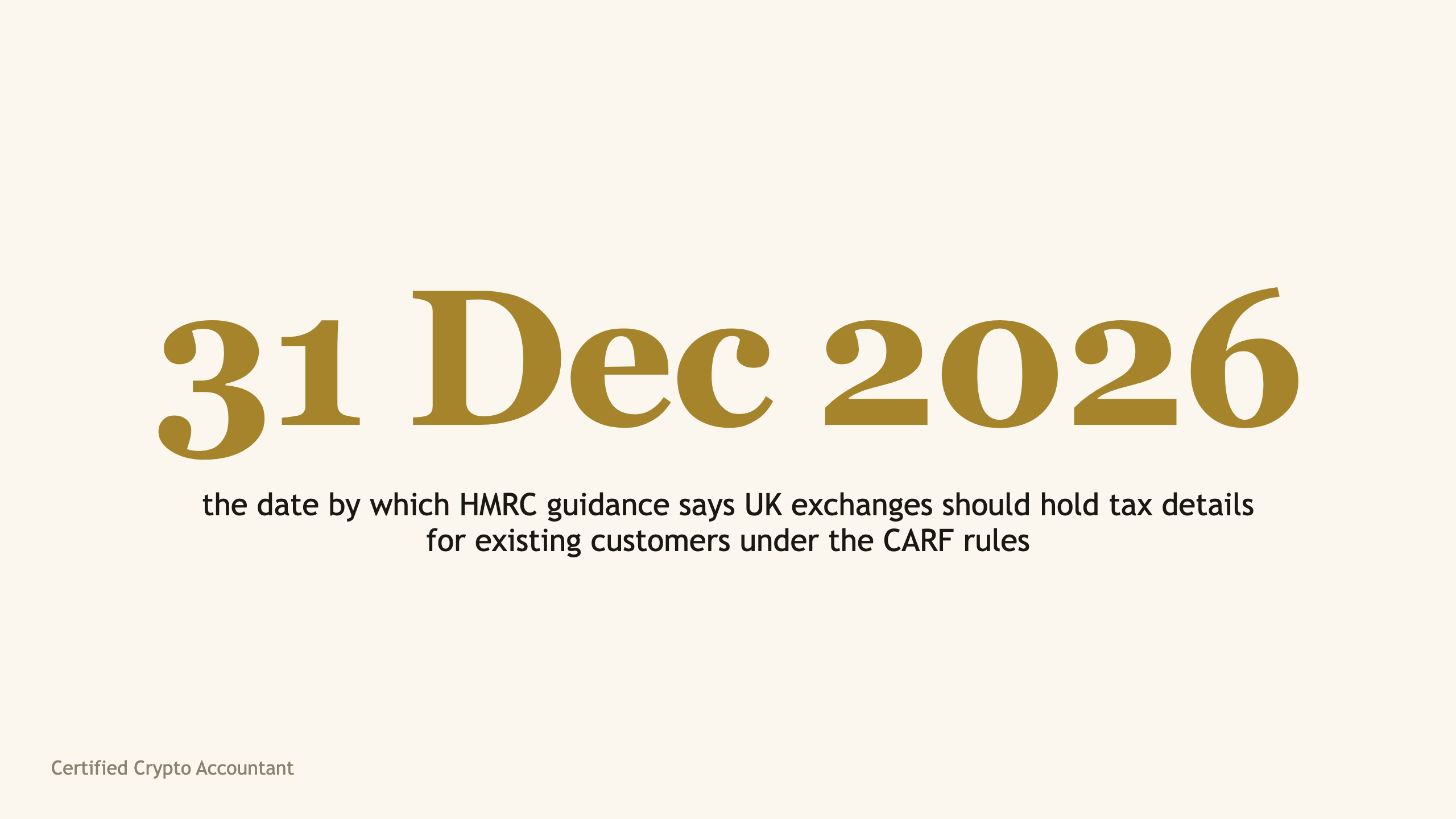
The email from your exchange asking for your National Insurance number, your date of birth and the country you pay tax in is the Cryptoasset Reporting Framework arriving at your inbox. It has been UK law since 1 January 2026, when the Reporting Cryptoasset Service Providers Regulations 2025 came into force, and it carries three dates for a customer. Existing users have until 31 December 2026 to supply the details before the exchange should stop trading for them. The exchange must tell every reportable user, on or before 31 January 2027, that their information will be reported. And the first report itself reaches HMRC by 31 May 2027, covering everything from 1 January to 31 December 2026. A user who ignores the request can be charged up to £300. Everything below was read in the regulations and in HMRC’s guidance on 4 November 2026.
Three dates. Give the exchange your details before 31 December 2026, expect its notice by 31 January 2027, and know that HMRC holds your 2026 totals from 31 May 2027. The return you file this winter is the first one it will compare them against.
What the exchange has to collect, and why it wants a National Insurance number
HMRC’s guidance for the exchanges, last updated on 1 January 2026, lists the fields for an individual. Name, date of birth, home address, country of residence, and for a UK resident either a National Insurance number or a Unique Taxpayer Reference. A non UK resident gives the tax identification number of their own country and the country that issued it, unless that country does not issue one. The document the exchange asks you to sign is a self certification, and regulation 5 of the rules puts the duty on you to provide it when asked. The exchange is not being nosy. It is a reporting cryptoasset service provider under the regulations and it is collecting the exact fields the law names, nothing more.
The National Insurance number is the field people hesitate over, and it is the one that matters most to HMRC. It is how the report is matched to a Self Assessment record. A report filed with a correct National Insurance number lands on your file automatically. A report filed without one still reaches HMRC and is matched by name, address and date of birth.
What happens on 31 December 2026 if you have not replied
HMRC’s manual at IEIM8000470 sets the time limits. For a new user the exchange should hold a valid self certificate before it carries out any transaction. For a user whose account existed on 1 January 2026, the exchange has twelve months from 31 December 2025 to collect one, so the window closes on 31 December 2026, and the same page tells exchanges to obtain the certificate before continuing to carry out transactions for those users, to avoid a penalty position if people do not respond in time. HMRC’s cryptoassets manual at CRYPTO10410 puts the customer side plainly. Failure to provide the information may result in a penalty, and the provider may refuse to provide further services.
So the restriction you may have read about is the exchange protecting itself. The penalty table at IEIM8000620 gives an exchange up to £300 for each user it fails to collect a valid self certificate from, and up to £100 per user for other due diligence failures, so an exchange with a hundred thousand UK customers has every reason to freeze the accounts that have not answered. On your side, regulation 13 makes you liable to a penalty of up to £300 where the failure to provide a valid certificate is deliberate or from not taking reasonable care. Giving false information carries its own penalty under the policy paper, which says individuals could be penalised for false self certifications.
What gets reported, and when
Regulation 6 requires the report on or before 31 May following the end of each calendar year. HMRC’s reporting guidance, updated 2 November 2026, says the first report is due by 31 May 2027 with details for 1 January 2026 to 31 December 2026, and that an exchange only reports users who are tax resident in the UK or in another country signed up to the CARF rules. What goes in is a summary of your transactions for the year rather than a tax computation, so HMRC receives totals by type and by asset. It does not receive your cost basis, your pooled figures, your losses or anything from a wallet you hold yourself. Our CARF guide sets out the reportable transaction types and the international exchange that follows.
Nothing before 1 January 2026 goes through this channel. The regulations commence on that date, and HMRC’s commencement page defines the first reportable period as the 2026 calendar year. That is not the same as saying HMRC has no earlier data. It has been obtaining it under separate notices for years, and Kraken’s own page describes handing over the three tax years from 2022 to 2023 through 2024 to 2025, which our Kraken guide goes through. CARF is the feed that stops HMRC having to ask.
The notice you must receive by 31 January 2027
An exchange must give each reportable user notice that their information will be reported to HMRC, and under regulation 8(2) that notice has to be given on or before 31 January following the first calendar year for which reporting is required. For every account that existed in 2026, that is 31 January 2027. The penalty on an exchange for failing to notify, at IEIM8000620, is up to £100 per user plus up to £100 a day while the failure continues, so the notices will go out, and most will arrive in January.
Read it when it comes, because it tells you two things. First, that your 2026 activity on that platform is on its way to HMRC. Second, by implication, which tax years it touches. The 2026 calendar year straddles two UK tax years. January to 5 April 2026 sits in 2025 to 2026, whose return is due on 31 January 2027, the same day the notice is due. 6 April to 31 December 2026 sits in 2026 to 2027, due 31 January 2028. So the first return HMRC will compare against CARF data is the one you are filing this winter, and HMRC will hold the exchange’s totals for it from 31 May 2027. Our guide to what HMRC can see explains how that comparison is run.
What this means if a year was never filed
If every year is filed from a full reconciliation, the self certification is a form and the notice is a letter to keep. If 2026 is fine but an earlier year was never declared, the position is different, because the first thing a CARF report does for HMRC is confirm that a person with a live account exists, and the second thing HMRC does with a confirmed person is look back. GOV.UK’s corrections page allows a 2024 to 2025 return to be amended until 31 January 2027. Anything older goes through the cryptoasset disclosure service, which asks for four years where you took reasonable care, six where you were careless and twenty where the omission was deliberate, and our disclosure guide walks the route. A disclosure made before the data arrives is unprompted. One made after HMRC has written is prompted, and the penalty range starts higher.
The notice from your exchange is the cheapest warning you will get, and it comes with a date. The work it leads to is priced below, and the reply to anything HMRC sends afterwards is the job of our crypto tax advisors for HMRC letters. If a software report already exists for the years in question, the free review says within 48 hours whether its totals will match what the exchange is about to send.
Three fixed fees, quoted in writing before any work starts
One taxpayer, one tax year unless the line says otherwise. Written position within 15 working days of software access.
For an exchange-only history under about 5,000 trades where the software report is already built.£499
For several platforms, wallet transfers read as sales, duplicates, and one or two back years.£950
For DeFi, derivatives, high volume, or balances that do not tie.£1,750
Send your software report to zar@certifiedcryptoaccountant.com for a written fee the same working day, or start with the free review. Licensed and regulated by the AAT, licence 1010475.
Questions about the exchange request
Why is my crypto exchange asking for my National Insurance number?
Because the Reporting Cryptoasset Service Providers Regulations 2025 require it to collect a self certification from every user, and HMRC's guidance lists a National Insurance number or UTR as the identifier for a UK resident, alongside name, date of birth, home address and country of residence. The rules have applied since 1 January 2026.
What happens if I do not give my exchange my tax details?
For an account that existed on 1 January 2026, the exchange has until 31 December 2026 to collect them, and HMRC's manual says exchanges "should obtain" your self certification before they carry on transacting for you. You can be charged up to £300 under regulation 13 if the failure is deliberate or careless, and the exchange can refuse further services.
Does CARF report my trades from before 2026?
No. The regulations came into force on 1 January 2026 and the first reportable period is the 2026 calendar year. Earlier years are not reported through CARF, although HMRC has obtained earlier exchange data under separate notices, including three tax years from Kraken.
When will HMRC see my 2026 crypto transactions?
The first report is due by 31 May 2027 and covers 1 January to 31 December 2026. That period spans two UK tax years, so the data touches the 2025 to 2026 return due on 31 January 2027 and the 2026 to 2027 return due on 31 January 2028.
Will my exchange tell me what it reported?
It must tell you that your information will be reported. Regulation 8 requires the notice on or before 31 January following the first calendar year for which reporting is required, so 31 January 2027 for accounts active in 2026, and an exchange that fails to notify faces up to £100 per user plus £100 a day.
Sources
Every figure on this page was checked against the source below on 4 November 2026.
- The Reporting Cryptoasset Service Providers (Due Diligence and Reporting Requirements) Regulations 2025, SI 2025/744. legislation.gov.uk, checked 4 November 2026
- Collecting cryptoasset user and transaction data. HM Revenue and Customs, checked 4 November 2026
- Reporting cryptoasset user and transaction data. HM Revenue and Customs, checked 4 November 2026
- IEIM8000470, self-certificates, time limits. HM Revenue and Customs, checked 4 November 2026
- IEIM8000620, overview of penalties. HM Revenue and Customs, checked 4 November 2026
- IEIM8000050, commencement. HM Revenue and Customs, checked 4 November 2026
- CRYPTO10410, Cryptoasset Reporting Framework. HM Revenue and Customs, checked 4 November 2026
- Implementation of the Cryptoasset Reporting Framework, policy paper. HM Revenue and Customs, checked 4 November 2026
- Tell HMRC about unpaid tax on cryptoassets. HM Revenue and Customs, checked 4 November 2026
- Self Assessment tax returns, if you need to change your return. GOV.UK, checked 4 November 2026

Fahad Zar
Crypto tax accountantAAT licensed 1010475
- AAT Licensed Accountant and MAAT, licence 1010475
- MSc Accounting and Finance, BPP University London
- Six years inside digital asset accounting, across several crypto tax firms
- Practises through Zar Enterprises Ltd, ICO registration ZC225094
- Supervised for anti-money laundering by the AAT
What matters to me is that the number on the return is true, whatever it turns out to be.
Whether this is worth a conversation
Where this stops being a reading job and starts being a hiring one.
- An exchange has asked for your tax details and an earlier year on that exchange was never on a return
- You want the 2025 to 2026 return built from a pooled computation before the first CARF data reaches HMRC on 31 May 2027
- You hold accounts on several platforms and need one record that will match what each of them reports
If every year is filed from a full reconciliation and the only thing in front of you is the self certification form, complete it and keep the notice. You do not need an accountant for that.
If one of these is you, the first look costs nothing.
Read next
CARF, the crypto reporting rules that started in January 2026
The framework itself, the reportable transactions and the international exchange.
Reviewed 4 November 2026ExplainerCan HMRC see my crypto wallet
What HMRC already holds, what arrives automatically, and how a wallet becomes visible.
Reviewed 4 November 2026ExplainerWhat Coinbase and Binance actually send to HMRC
The data requests before CARF and the shape of the data under it.
Reviewed 4 November 2026ExplainerKraken is giving HMRC three tax years of UK account data
The years before 2026, handed over under a separate notice.
Reviewed 4 November 2026