How much HMRC can charge for unpaid crypto tax

Published 11 June 2026· Reviewed against gov.uk 24 August 2026· 8 min read·HMRC and compliance
Under crypto tax penalties UK rules, the figure HMRC can add to your bill is not fixed, it runs from 0% to 200% of the tax owed. It scales with your behaviour, with how the holdings sat, onshore or offshore, and above all with whether you came forward first or were caught. If you have undeclared or under-declared cryptoasset gains, the penalty on top is what keeps people awake, and it is also the part you can still influence.
For the machinery behind these numbers across all taxes, LITRG explains the penalty system in plain English.
The reassuring part, and it is genuinely reassuring, is that the system rewards honesty. A genuine mistake can carry no penalty at all. Coming forward voluntarily moves you to the bottom of every band. Being chased after a nudge letter and then stonewalling HMRC pushes you to the top. This guide explains exactly how the penalties work, how far back HMRC can look, and the legitimate levers that bring the number down.
What you end up paying turns less on the tax than on whether you got to HMRC before HMRC got to you.
How does HMRC decide crypto tax penalties in the UK?
Penalties for inaccurate returns are not a flat fine. Under Schedule 24 of the Finance Act 2007, they are calculated as a percentage of the unpaid tax, and that percentage depends entirely on how HMRC judges your conduct. The same £2,000 of underpaid Capital Gains Tax can carry no penalty, or it can carry £2,000 on top. The difference is behaviour.
HMRC works through four behaviour categories. The better your conduct, the lower the percentage and the shorter the period HMRC can reach back into:
- Reasonable care: you took genuine care but still made an error. No penalty applies. You pay the tax plus interest only.
- Careless: you did not take reasonable care. Penalty up to 30% of the unpaid tax.
- Deliberate: you knowingly under-declared. Penalty of 20% to 70%.
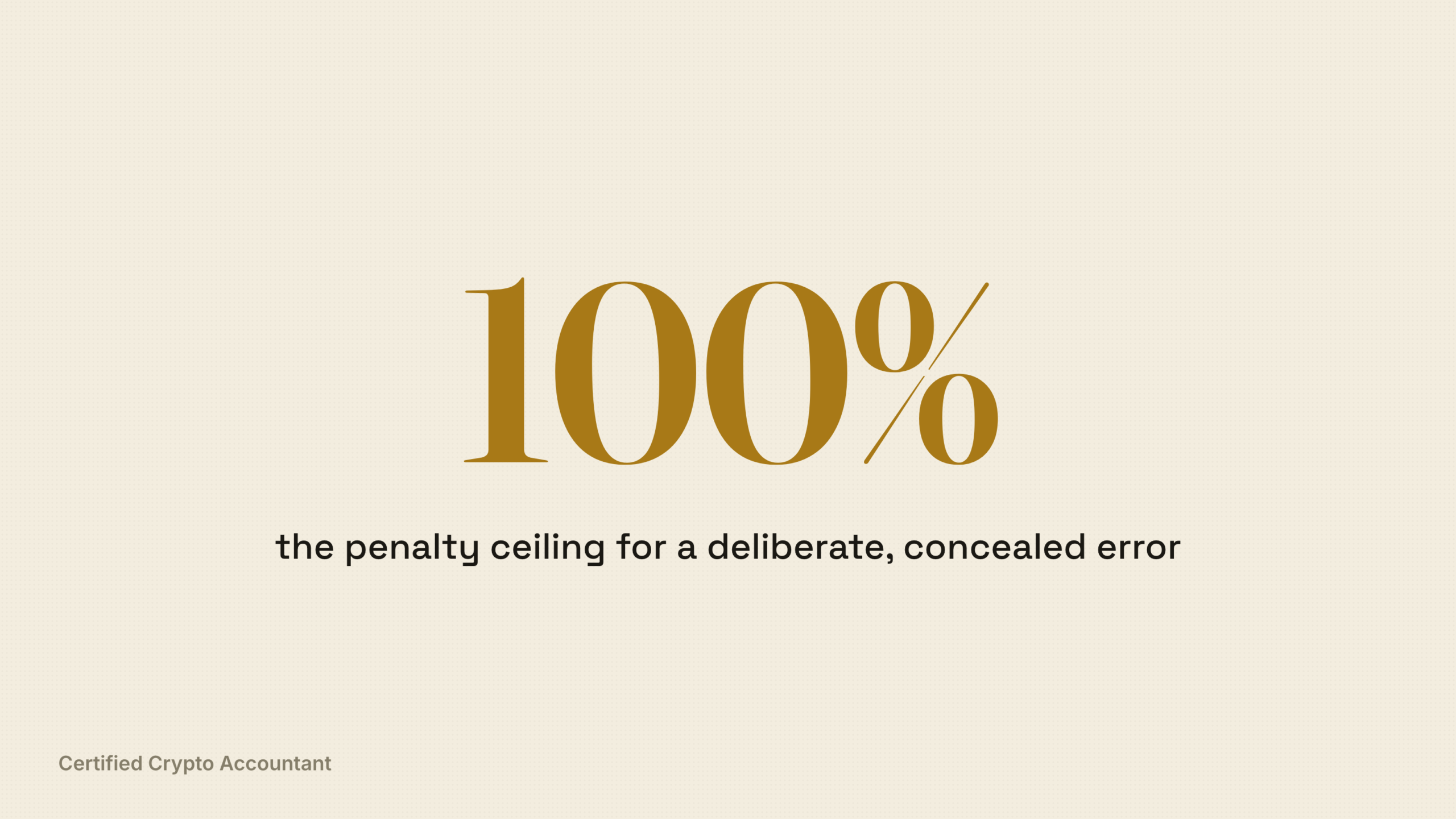
- Deliberate and concealed: you under-declared and took steps to hide it. Penalty of 30% to 100%.
The crypto tax penalty bands and lookback periods
The table below sets out the behaviour bands, the penalty range as a percentage of the unpaid tax, and how far back HMRC can assess. These are the core figures behind almost every crypto tax penalties UK calculation.
| Behaviour | Penalty (% of unpaid tax) | HMRC lookback |
|---|---|---|
| Reasonable care (genuine error) | None: tax plus interest only | 4 years |
| Careless | Up to 30% | 6 years |
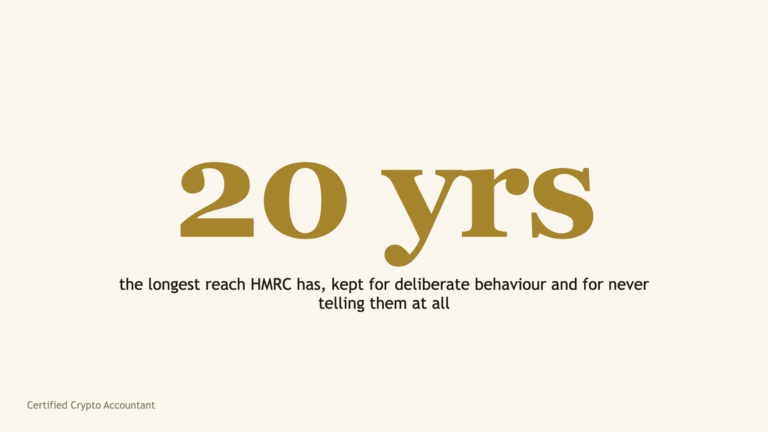
| Deliberate | 20% to 70% | 20 years |
| Deliberate and concealed | 30% to 100% | 20 years |
Two things sit within each range. Where you land between the floor and the ceiling is set by the quality of your disclosure: telling HMRC, helping HMRC, and giving HMRC access to records. Do all three well and you sit near the floor. Refuse and you sit near the ceiling.
Why do offshore crypto holdings cost more?
Most crypto investors used at least one foreign exchange. That matters, because gains connected to assets held outside the UK fall into HMRC’s offshore penalty regime, which carries higher loadings. For the least transparent territories, the penalty for deliberate and concealed behaviour can reach as high as 200% of the unpaid tax.
The logic is simple from HMRC’s side: assets held offshore were historically harder for it to see, so the deterrent is stronger. The practical takeaway is that if your trading history runs across overseas platforms, the cost of being caught is materially higher than for purely UK activity, which makes coming forward first even more valuable.
What is the separate failure-to-notify penalty?
There is a second, distinct penalty that catches many crypto investors by surprise. The bands above apply to inaccuracies on a return you filed. But if you had a tax liability and never registered for Self Assessment at all, you face a separate failure-to-notify penalty under Schedule 41 of the Finance Act 2008.
This is common in crypto. Someone makes gains over a few years, never realises they crossed into reportable territory, and simply never tells HMRC they exist. That is a failure to notify, and it carries its own behaviour-based penalty alongside any tax and interest. The lookback for failure to notify reaches up to 20 years, the same as deliberate behaviour. The cleanest way to deal with it is the same as everything else here: come forward before HMRC does.
How interest and time to pay fit in
Separate from penalties, HMRC charges interest on any tax paid late, running from the date the tax was originally due until it is paid. Interest is not a penalty and it is not negotiable. It simply reflects the time value of tax HMRC should have had.
If you cannot pay the full amount immediately, that does not mean disaster. HMRC offers Time to Pay arrangements, which let you settle a tax debt in instalments over an agreed period. Agreeing a payment plan is far cheaper, and far less stressful, than ignoring a liability and letting penalties and enforcement build. A specialist will usually fold the Time to Pay conversation into the disclosure itself.
How do you pay less? The legitimate levers
None of this involves hiding anything. Every lever below is built into the rules and rewards exactly the behaviour HMRC wants to see.
- Unprompted voluntary disclosure. Coming forward before HMRC contacts you about a specific matter is the single biggest reducer. It moves you toward the bottom of whichever band applies. HMRC’s Cryptoasset Disclosure Facility, launched on 29 November 2023, sits alongside the Digital Disclosure Service as the formal route to do this.
- Demonstrating reasonable care. If you genuinely tried to get it right, kept records and made an honest error, there may be no penalty at all. Evidence is everything here.
- Full cooperation. Telling, helping and giving access, promptly and completely, pushes you toward the floor of the band rather than the ceiling.
- Time to Pay. Agreeing an instalment plan keeps you compliant and avoids enforcement, even if you cannot clear the bill in one go.
The opposite of all this is the expensive path. A taxpayer prompted by a nudge letter who then fails to engage is treated as prompted and uncooperative, which lands them near the top of the band. Same tax, very different penalty.
Worked example, voluntary disclosure versus being caught
Suppose you have an undeclared capital gain from 2024/25 trading across two exchanges, one of them offshore. After reconciliation, the gain above the £3,000 annual exempt amount is £20,000, and as a higher-rate taxpayer your Capital Gains Tax is charged at 24%. That is £4,800 of tax owed.
- Unprompted voluntary disclosure, full cooperation: you pay the £4,800 of tax, plus interest, plus a careless-band penalty near the floor. At, say, 10%, that is a £480 penalty. Total beyond the tax: roughly £480 plus interest.
- Caught after a nudge letter, treated as deliberate and uncooperative, offshore loading applied: the same £4,800 of tax can carry a penalty pushing toward, or beyond, 100% of the tax. A penalty of £4,800 or more, plus interest, is realistic.
The tax is identical at £4,800. The penalty swings from a few hundred pounds to several thousand. The entire difference is behaviour and timing, and both are within your control right now.
How a specialist keeps the penalty down
When a crypto investor comes to us worried about penalties, we work in one order: establish the true position, then disclose it cleanly. We reconcile every wallet and exchange, including closed and offshore accounts, to fix the real liability for each year. We then frame the disclosure to evidence reasonable care or, where tax is owed, to secure the lowest defensible band through unprompted disclosure and full cooperation. Where cash is tight, we agree Time to Pay as part of the same process. The goal is always the same: the correct tax, the smallest lawful penalty, and HMRC handled on your behalf.
Frequently asked questions
Can I really avoid a penalty on undeclared crypto?
Yes, in two situations. If HMRC accepts you took reasonable care and made a genuine error, no penalty applies and you pay only the tax plus interest. And even where a penalty does apply, an unprompted voluntary disclosure with full cooperation can bring it close to the floor of the band.
How far back can HMRC go on my crypto?
It depends on behaviour: up to 4 years for a genuine error with reasonable care, 6 years for careless behaviour, and up to 20 years for deliberate behaviour or a failure to notify HMRC at all.
Why might my penalty be higher because I used a foreign exchange?
Gains connected to assets held offshore fall into HMRC’s offshore penalty regime, which carries higher loadings. For the least transparent territories, penalties for the worst behaviour can reach up to 200% of the unpaid tax.
What is the failure-to-notify penalty?
It is a separate penalty under Schedule 41 of the Finance Act 2008 that applies when you had a tax liability but never registered for Self Assessment. It sits alongside the inaccuracy penalties and any tax and interest owed.
What if I cannot afford the tax and penalty?
HMRC offers Time to Pay arrangements that let you settle in instalments over an agreed period. Disclosing and agreeing a payment plan is far cheaper than letting a liability sit and accumulate penalties and interest.
Is it too late to come forward once I have a nudge letter?
No. A nudge letter makes any disclosure prompted rather than unprompted, which raises the penalty floor slightly, but cooperating fully still keeps you far below the worst bands. The expensive outcome is receiving a letter and then doing nothing.
Sources
Every figure on this page was checked against the source below on 24 August 2026.
- Self Assessment tax returns, penalties. GOV.UK, checked 24 August 2026
- CH82470, maximum and minimum penalties for each type of behaviour. HMRC Compliance Handbook, checked 24 August 2026
- CH73200, failure to notify, maximum and minimum penalties. HMRC Compliance Handbook, checked 24 August 2026
- CH53100, assessing time limits, extended time limits. HMRC Compliance Handbook, checked 24 August 2026
- Finance Act 2007, Schedule 24, penalties for errors. legislation.gov.uk, checked 24 August 2026
- Finance Act 2008, Schedule 41, penalties for failure to notify. legislation.gov.uk, checked 24 August 2026
- EM1506, enquiries, the section 9A window. HMRC Enquiry Manual, checked 24 August 2026
Fahad Zar
Crypto tax accountantAAT licensed 1010475
- AAT Licensed Accountant and MAAT, licence 1010475
- MSc Accounting and Finance, BPP University London
- Six years inside digital asset accounting, across several crypto tax firms
- Practises through Zar Enterprises Ltd, ICO registration ZC225094
- Supervised for anti-money laundering by the AAT
What matters to me is that the number on the return is true, whatever it turns out to be.
Whether this is worth a conversation
Penalty work is worth paying for at a specific point, and not before it.
- A penalty letter has arrived
- You are late and the numbers are growing
- You want to disclose before HMRC writes first
If you filed late by a fortnight and the tax was paid on time, the penalty is £100 and you can appeal it yourself if you have a reasonable excuse. That is not work worth buying.
If one of these is you, the first look costs nothing.
Read next
How to disclose unpaid crypto tax before HMRC finds it
The unprompted route, which is what moves a penalty from 15% to nil.
Reviewed 24 Aug 2026Deep guideWhat happens during an HMRC crypto enquiry
What the same penalty rules look like once HMRC has already opened a check.
Reviewed 24 Aug 2026ExplainerAn HMRC nudge letter is not a tax bill
The stage before an enquiry, and the point at which disclosure is still unprompted.
Reviewed 24 Aug 2026DeadlineCrypto tax deadlines for the 2026 to 2027 tax year
The dates that decide whether any of this applies to you at all.
Reviewed 24 Aug 2026 ExplainerHMRC can go back four, six, twelve or twenty years and your own conduct picks the number
The same behaviour tests decide how far back HMRC can go.
Reviewed 5 September 2026