HMRC’s information notice is the letter you cannot ignore. Schedule 36, the £300, and what you must produce

Published 14 November 2026 Reviewed against gov.uk 14 November 2026 13 min readHMRC and compliance
A letter that says this is an information notice issued under Schedule 36 of the Finance Act 2008, and that you are legally required to produce the documents and provide the information listed by a date, is HMRC using a statutory power rather than asking a question. It usually arrives inside a compliance check, after an informal request for the same things went unanswered or was answered in part. It carries a fixed penalty, a daily penalty, a 30 day appeal right that does not cover most of what it asks for, and a criminal offence for destroying anything on the list. It is the one letter in the sequence where doing nothing has a price in law.
HMRC does not publish the notice template. The wording below is the standard text as reproduced in the appendix to a published tribunal decision, with the Finance Act and HMRC’s own factsheet and manuals behind every rule. The guide to an HMRC crypto enquiry covers the whole process from first letter to closure. This page is about the notice in your hand and the dates on it. Not sure which letter you have? Paste its first lines and the page names it.
An information notice under Schedule 36 is HMRC requiring rather than asking, and it says so in terms, you are legally required to produce the documents by a date. It comes with factsheet CC/FS2. Missing the date costs £300 then up to £60 a day unless the officer agreed more time or there is a reasonable excuse. You can appeal within 30 days in writing with grounds, though statutory records sit outside the appeal, which for a crypto holder means the exchange statements, bank lines and pooled computation. HMRC can require a computation that does not yet exist as information. Answer it item by item, precisely, by the date.
What the notice says, in its own words
The standard opening, in the version the tribunal reproduced, is “This is an information notice issued under Paragraph 2 of Schedule 36 of the Finance Act 2008”, followed in that case by the name of the judge who approved it. A notice sent to you about your own tax cites paragraph 1 and, unless HMRC went to the tribunal first, carries no approval line. It continues, “To help with my check, I need documents and information from you. I have listed what I need on the schedule enclosed/overleaf. This notice means that you are legally required to produce the documents and provide the information I need by” a date.
Under the heading What will happen if you do not do what this information notice asks it says, “If you do not do what this information notice asks, we may charge you a penalty of £300. If you still have not done what this notice asks by the time I issue that penalty, we may charge a further daily penalty of up to £60 a day until you do.” Then, “It is a criminal offence to conceal, destroy or otherwise dispose of any document that we have asked for, or to arrange for it to be concealed, destroyed or disposed of.” And, “If you carelessly or deliberately produce a document containing an inaccuracy or provide inaccurate information, we may charge you a penalty of up to £3,000 for each inaccuracy. We will not charge a penalty if you tell us about the inaccuracy at the time you produce the document or provide the information.”
The schedule of what is wanted follows, headed Documents or information that we need, with the definition, “In this context ‘document’ means anything in which information is recorded. This includes all records or data held in any form, electronic or otherwise.” A CSV export, a screenshot and a wallet’s public history are all documents under that sentence.
A request or a notice, how to tell
HMRC’s normal approach is to ask first. The Compliance Handbook at CH21150 says, “our normal approach is always to ask first. We will use our legal powers only where a person does not co-operate with our requests for information or documents”, and adds that HMRC is not obliged to ask first and may go straight to a notice “where there is a history of non-cooperation or where tax evasion is a feature of the case”. The Enquiry Manual at EM1590 tells the officer what to do when the opening letter’s date passes with nothing produced, which is to send a paragraph 1 notice “requiring the production of the information requested in the earlier letter or such of it as remains outstanding”.
So the test is the language. A letter that says please let me have, or I would be grateful if, with a date, is the informal request, and nothing in law happens if you miss it except that the notice follows. A letter that says information notice, cites Schedule 36 and says you are legally required, is the notice. CC/FS2 defines it as “a legal document that requires a person to provide information and produce documents to HMRC”, and HMRC’s rule is that the factsheet goes out with every notice and never with a mere request, so the presence of CC/FS2 in the envelope is itself the answer.
The date, and what missing it costs
Paragraph 7 says you must comply “within such period, and at such time, by such means and in such form (if any), as is reasonably specified or described in the notice”. There is no statutory minimum. HMRC’s own guidance at CH23420 says, “As a general rule of thumb, it might be reasonable to expect that most information or documents could be provided or produced within 30 days from the date of the notice”, and tells officers to “consider carefully any reasonable request the person makes for more time”. CC/FS2 says the same to you, “If you need more time to give us what the notice asks for, contact the officer who gave you the notice.” Extra time the officer allows defeats the penalty under paragraph 44, so the first thing to do with a notice whose date you cannot meet is to write and ask, before the date, saying why and when.
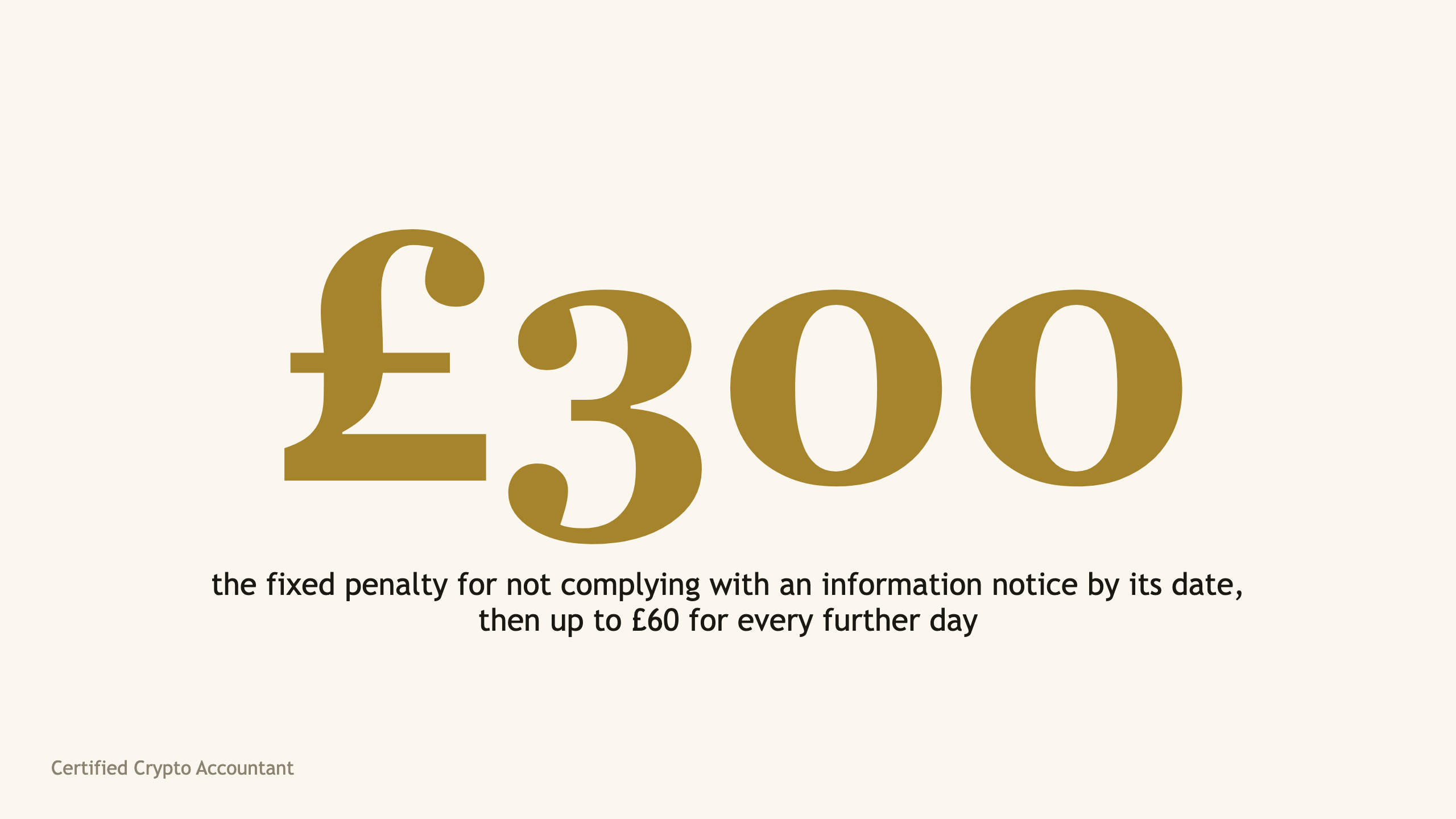
Miss the date without an extension and paragraph 39 applies, “The person is liable to a penalty of £300.” If the failure continues after that penalty is imposed, paragraph 40 adds “a further penalty or penalties not exceeding £60 for each subsequent day on which the failure or obstruction continues”. CC/FS2 adds the next step, “After that, we can charge you a penalty based on the amount of tax we believe you owe us. This type of penalty must be authorised by the independent tribunal that deals with tax.”
Paragraph 45 removes the penalty where there is a reasonable excuse. CC/FS2 gives serious illness, a bereavement and losing the documents in a fire or flood as examples, and the statute says an insufficiency of funds is no excuse unless caused by events outside your control, that relying on someone else is no excuse unless you took reasonable care, and that once the excuse ends you must put things right without unreasonable delay. An exchange that has closed and taken your statements with it is a real difficulty, and the way to deal with it is to say so in the reply and produce what the chain and your bank still show, rather than to produce nothing.
Appealing, and the records you cannot appeal about
Paragraph 29 gives a right of appeal against the notice or any requirement in it, with two exceptions that decide most crypto cases. There is no appeal against “a requirement in a taxpayer notice to provide any information, or produce any document, that forms part of the taxpayer’s statutory records”, and no appeal at all if the tribunal approved the notice. Paragraph 32 sets the mechanics, in writing, “before the end of the period of 30 days beginning with the date on which the information notice is given”, to the officer who gave it, stating the grounds. The tribunal can confirm, vary or set aside the notice, and its decision is final.
Statutory records, under paragraph 62, are the records you are required to keep under the Taxes Acts, which for an individual means section 12B of the Taxes Management Act, the records needed to make a correct and complete return. For a non business record the paragraph says it only becomes a statutory record once the tax year it relates to has ended, which for any year under enquiry it has. HMRC’s own crypto guidance lists what those records are, “type of tokens, date you disposed of them, number of tokens you’ve disposed of, number of tokens you have left, value of the tokens in pound sterling, bank statements, pooled costs before and after you disposed of them”, and says “You must keep records as we’ll ask to see them if we carry out a compliance check.” Exchange statements, the bank lines behind your deposits and the pooled computation are therefore records you cannot appeal about. Wallet addresses sit on the other side of the line, the guidance says you “may also want to keep” them, so a requirement to provide them is appealable in principle, and in practice the chain history is the evidence of your own cost, which is why producing it tends to help the person producing it.
If you do appeal part of a notice, CH24320 says you need not comply with the appealed requirements until the appeal is decided but must comply with the rest, and that statutory records must be produced even while other items are under appeal. An appeal is a way to narrow a notice that overreaches. It is not a way to pause it.
What HMRC can and cannot demand
The power in paragraph 1 is limited to what is “reasonably required by the officer for the purpose of checking the taxpayer’s tax position”. CH23560 says that “does not allow you to make speculative enquiries, seeking information merely in the hope that something relevant will crop up”, and that the officer “must be able to identify specific risks”. Where a return has been filed for the year, paragraph 21 adds that a notice about Income Tax or Capital Gains Tax for that year can only be given if an enquiry is open on the point or the officer has reason to suspect an under assessment. A notice about a year you filed, with no enquiry letter before it, is one to question.
The distinction that matters for crypto is between producing and providing. HMRC cannot make you produce a document that does not exist. CH23240 says, “You cannot ask a person to create a document so that you can require them to produce it by an information notice, but you can require a person to provide information”, and that providing information “can cover computations, calculations, analyses, translations of documents written in a foreign language, and so on.” So a requirement for a schedule of every disposal in the year with proceeds, cost and gain is lawful even though you never made one, and the practical consequence is that the computation gets done either by you, properly, or by HMRC from the exchange figures alone, which show proceeds and no cost.
CC/FS2 lists what cannot be demanded, documents you do not have and cannot get, anything created in preparing a tax appeal, anything only about your physical, mental, spiritual or personal welfare, and privileged communications between a lawyer and a client about legal advice. Correspondence with an accountant is not privileged, and the factsheet says so by naming lawyers.
How to answer it
Take the schedule item by item and answer each one in its own numbered paragraph, in the notice’s order, saying what is enclosed, what is enclosed in part and why, and what does not exist and what stands in its place. Where an exchange has closed, say which one, when, what you hold from it and what the chain record shows instead. Where the schedule asks for a computation, send the pooled schedule for each year under CRYPTO22200, with the sterling value on each disposal date and the source of each price. Where the schedule asks for bank statements, send the statements for the accounts that funded exchanges and received withdrawals, and say which accounts those are.
Answer what is asked and answer it precisely. The £3,000 inaccuracy penalty attaches to what you provide, so a figure you are unsure of is given with its basis, and a document you later find to be wrong is corrected without delay, which the notice itself says removes the penalty. Keep a copy of everything and a note of the date it went, because the officer’s next letter will refer to it and the penalty question, if it ever arises, turns on what was produced by when.
A worked example with dates
Suppose the opening enquiry letter into your 2024 to 2025 return asked on 1 October 2026 for the computation behind your capital gains figure and the statements from the two exchanges named on it, by 31 October. Nothing went back. The information notice is dated 1 December 2026 and requires, by 5 January 2027, the statements from both exchanges for the year, the bank statements for the account that funded them, your wallet addresses, and a schedule of every disposal with proceeds, cost and gain.
The statements, the bank statements and the schedule are statutory records and information HMRC can require, so there is no appeal on those three. The wallet addresses are appealable in principle, and sending them is what proves the cost of the coins the exchanges only show you selling. Produce all four by 5 January and nothing further happens on the notice. Produce nothing and the £300 is assessed in the second week of January, then up to £60 a day, so a reply on 5 February costs up to £300 plus 31 days at £60, £2,160. Write before 5 January explaining that one exchange closed in 2023 and its statements will take three weeks to reconstruct from the chain, with the rest enclosed now, and the officer’s agreed extension removes the penalty on the late item under paragraph 44.
When it needs an accountant
If the notice asks for one exchange’s statements and a computation you already hold, send them, numbered, by the date. It becomes a job when the schedule covers several years and platforms, when a closed exchange or a lost wallet means a record has to be rebuilt from the chain and explained, when the computation does not yet exist and HMRC’s version of it would be built from proceeds alone, or when part of the notice overreaches and the appeal has to be drafted inside the 30 days while the rest is complied with. We answer notices as agent, item by item, with the computation attached.
Three fixed fees, quoted in writing before any work starts
One taxpayer, one tax year unless the line says otherwise. Written position within 15 working days of software access.
For an exchange-only history under about 5,000 trades where the software report is already built.£499
For several platforms, wallet transfers read as sales, duplicates, and one or two back years.£950
For DeFi, derivatives, high volume, or balances that do not tie.£1,750
Send your software report to zar@certifiedcryptoaccountant.com for a written fee the same working day, or start with the free review. Licensed and regulated by the AAT, licence 1010475.
Questions about HMRC information notices
How do I know whether my letter is a request or an information notice?
The notice says so. It calls itself an information notice, cites Schedule 36 of the Finance Act 2008 and says you are legally required to produce the documents and provide the information by a date. It arrives with factsheet CC/FS2, which HMRC's rules say goes out with every notice and never with an informal request. A letter that asks, however firmly, with no Schedule 36 reference and no CC/FS2, is the request that comes first.
How long do I get?
Whatever the notice reasonably specifies. There is no statutory minimum. HMRC's own manual says 30 days from the date of the notice is a reasonable rule of thumb for most documents and that officers should consider any reasonable request for more time. Ask in writing before the date, say why and give a date you can meet. Time the officer allows removes the penalty.
What happens if I miss the date?
A fixed penalty of £300 under paragraph 39, then up to £60 for each further day the failure continues under paragraph 40, and CC/FS2 says a penalty based on the tax HMRC believes is owed can follow with the tribunal's approval. A reasonable excuse removes the penalty, and the factsheet gives serious illness, bereavement and documents lost in a fire or flood as examples. Not having got round to it is not one.
Can I appeal?
Within 30 days of the date on the notice, in writing, to the officer who issued it, stating your grounds. You cannot appeal a requirement to produce your statutory records, the records tax law already requires you to keep to make a correct return, and you cannot appeal at all if the tribunal approved the notice. Exchange statements, bank statements and your capital gains computation are statutory records for a year that has ended.
HMRC wants a schedule of every disposal and I have never made one. Do I have to create it?
Yes, if the notice asks for it as information. HMRC's manual says it can require you to provide information even where no document exists, and that includes computations, calculations and analyses. A pooled computation of each year's disposals is the thing you would need to make a correct return in any case, and making it properly is the alternative to HMRC building one from exchange proceeds with no cost.
Do I have to give HMRC my wallet addresses?
A wallet address is not on HMRC's list of records you must keep, so a requirement to provide it can be appealed in principle, and it must still be reasonably required for checking your position. In practice the chain history is the evidence of what the coins cost you and when you moved them between your own wallets, and withholding it leaves HMRC with the exchange figures alone, which show the sale and not the purchase.
Sources
Every figure on this page was checked against the source below on 14 November 2026.
- Finance Act 2008, Schedule 36, Information and inspection powers. legislation.gov.uk, checked 14 November 2026
- Schedule 36, paragraph 1, power to obtain information and documents from taxpayer. legislation.gov.uk, checked 14 November 2026
- Schedule 36, paragraph 7, complying with notices. legislation.gov.uk, checked 14 November 2026
- Schedule 36, paragraph 21, taxpayer notices following a tax return. legislation.gov.uk, checked 14 November 2026
- Schedule 36, paragraph 29, right to appeal against taxpayer notice. legislation.gov.uk, checked 14 November 2026
- Schedule 36, paragraph 32, procedure on appeal. legislation.gov.uk, checked 14 November 2026
- Schedule 36, paragraphs 39 and 40, penalties for failure to comply and daily default penalties. legislation.gov.uk, checked 14 November 2026
- Schedule 36, paragraph 45, reasonable excuse. legislation.gov.uk, checked 14 November 2026
- Schedule 36, paragraph 62, statutory records. legislation.gov.uk, checked 14 November 2026
- CC/FS2, Information notices. HM Revenue and Customs, checked 14 November 2026
- HMRC v Third Party [2023] UKFTT 71 (TC), appendix reproducing the information notice. First-tier Tribunal, The National Archives, checked 14 November 2026
- CH21150, informal requests and formal powers. HM Revenue and Customs, checked 14 November 2026
- CH23240, providing information and producing documents. HM Revenue and Customs, checked 14 November 2026
- CH23420, time to comply with an information notice. HM Revenue and Customs, checked 14 November 2026
- CH23560, reason to suspect. HM Revenue and Customs, checked 14 November 2026
- CH24320, effect of an appeal. HM Revenue and Customs, checked 14 November 2026
- EM1590, opening letter, information not produced. HM Revenue and Customs, checked 14 November 2026
- Check if you need to pay tax when you sell cryptoassets, records. HM Revenue and Customs, checked 14 November 2026
- HMRC compliance checks, help and support. GOV.UK, checked 14 November 2026
- Taxes Management Act 1970, section 12B, records to be kept for purposes of returns. legislation.gov.uk, checked 14 November 2026
- CRYPTO22200, Capital Gains Tax, pooling. HM Revenue and Customs, checked 14 November 2026

Fahad Zar
Crypto tax accountantAAT licensed 1010475
- AAT Licensed Accountant and MAAT, licence 1010475
- MSc Accounting and Finance, BPP University London
- Six years inside digital asset accounting, across several crypto tax firms
- Practises through Zar Enterprises Ltd, ICO registration ZC225094
- Supervised for anti-money laundering by the AAT
What matters to me is that the number on the return is true, whatever it turns out to be.
Whether this is worth a conversation
Where this stops being a reading job and starts being a hiring one.
- The schedule covers several years and platforms, or a closed exchange or lost wallet means records have to be rebuilt from the chain and explained
- The computation the notice requires does not yet exist and HMRC's version would be built from proceeds alone
- Part of the notice overreaches and the appeal has to be drafted inside the 30 days while the rest is complied with
If the notice asks for one exchange's statements and a computation you already hold, answer it yourself, item by item in the notice's order, by the date, and keep a dated copy of what went.
If one of these is you, the first look costs nothing.
Read next
What happens in an HMRC crypto tax enquiry
The whole process, from the section 9A letter to the closure notice.
Reviewed 14 November 2026Deep guideHow much HMRC can charge for unpaid crypto tax
The behaviour based ranges and what reduces them.
Reviewed 14 November 2026ExplainerHow far back HMRC can go
Four, six, twelve or twenty years, and what picks the number.
Reviewed 14 November 2026ExplainerThe exchange has closed and the records went with it
Rebuilding cost from the chain and the bank when the platform is gone.
Reviewed 14 November 2026 ExplainerHMRC's compliance check letter about your crypto return. The opening pack, the 12 month window, the 30 days
The letter that comes before the notice. The section 9A compliance check letter, what it asks for and the informal date whose passing brings the notice.
Reviewed 14 November 2026