How HMRC taxes Polymarket and Kalshi winnings

Published 27 July 2026· Reviewed against gov.uk 25 August 2026· 9 min read·Income, business and NFTs
Prediction markets just had the biggest month in their history. Kalshi and Polymarket did a combined $44.8 billion of volume in June 2026, up 75% on May, with Kalshi’s World Cup winner market alone clearing $832 million. Kalshi raised at a $22 billion valuation in May and is reportedly chasing $40 billion. Polymarket took a $2 billion investment from the owner of the New York Stock Exchange and finally opened its US app to everyone in May 2026. One French trader, the famous “Théo”, walked away from the 2024 election with about $85 million.
Now the question that has quietly become one of the most interesting in tax: what do you owe on your Polymarket taxes or Kalshi winnings? Here is the honest answer almost nobody gives you: in the US there is no IRS guidance of any kind on event contracts, no ruling, no notice, nothing, and in the UK the answer depends on whether these contracts are bets or derivatives, which is exactly the fight regulators are having in court. This guide maps what is settled, what is not, and how to file defensibly in the meantime.
Why is prediction market tax so unsettled?
Because the law cannot decide what these contracts are, and the tax follows the identity. In April 2026 the Third Circuit upheld Kalshi’s injunction against New Jersey, holding that CFTC-regulated event contracts are swaps within the CFTC’s exclusive jurisdiction, beyond state gambling law. Meanwhile 38 state attorneys general filed on the other side in a parallel case, calling the same products illegal gambling, and the CFTC has sued six states in response. Financial instrument in one courtroom, wager in another.
The tax code does not have to follow either answer, and so far the IRS has followed neither. Nothing addresses event contracts: not a revenue ruling, not a notice, not even a private letter ruling. Even Nadex binary options, which traded for years, never got formal IRS confirmation of their status. Every position you take on a Kalshi tax return is, to some degree, an interpretation.
The four US positions, and why the difference is real money
Practitioners currently file prediction market results four different ways, a split Green Trader Tax mapped out in April 2026.
Treat it as gambling and winnings are ordinary income with losses deductible only against winnings, only if you itemise. This reading matches how many people use the sports markets, which are roughly 80% of Kalshi’s volume. It also just got expensive: the July 2025 tax act caps gambling loss deductions at 90% of losses from 2026. Win $100,000 and lose $100,000 and you have $10,000 of taxable income on a break-even year. Courts also require session-by-session netting rather than a single annual figure, which almost nobody’s records support.
Treat the contracts as property and you get capital gains: cleaner netting, but net losses capped at $3,000 a year against ordinary income. This fits positions sold before resolution, where a contract genuinely traded like an asset.
The aggressive position is Section 1256, the 60/40 long-term/short-term treatment for regulated futures, on the argument that Kalshi is a CFTC-designated exchange. The problem: 1256 requires contracts on a mark-to-market margin system, and event contracts are fully collateralised. Worse, the statute excludes swaps, and “these contracts are swaps” is precisely the argument Kalshi has been winning in federal court. Its own courtroom victory undercuts the favourable tax treatment. Kalshi itself takes no 1256 position anywhere in its help pages.
The conservative default is ordinary income, which matches how Kalshi historically framed net winnings on 1099-MISCs. Notably, Kalshi’s current tax documentation page lists only 1099-INT for interest, 1099-MISC for rewards, 1099-B for crypto transfers and 1099-DA via its crypto partner. No form totals your trading profit. The IRS may see fragments of your activity, and you owe tax on all of it regardless.
If you take anything other than the conservative route, do it consistently, with records, and consider disclosing the position on Form 8275. That is not paranoia, it is what filing an interpretation looks like when done properly.
The polymarket twist, you’re also trading crypto
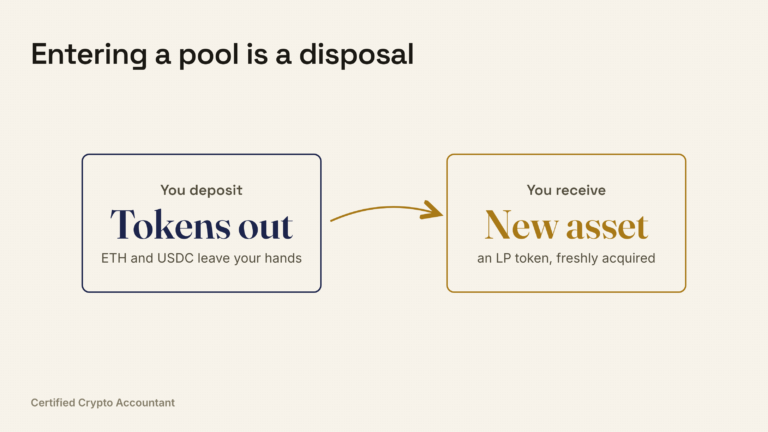
Polymarket runs on USDC. You buy positions with USDC, sell or settle into USDC, and under IRS Notice 2014-21 a stablecoin is property, so every one of those movements is also a disposal or acquisition of the USDC itself. The gains on the stablecoin leg are usually pennies, but the taxable events, the tracking obligation and, in the UK, the CGT disposals are all real. HMRC’s manual is explicit that exchanging one token for another is a disposal (CRYPTO22100).
For the pre-relaunch era, when US users officially were not there at all and many traded anyway, there are no forms and no cover: the record is the blockchain, and reconstructing it is your job before the IRS does it for you. Polymarket’s US exchange, now CFTC-regulated, is widely expected to issue forms for 2026, but nothing official confirms what kind yet.
What about the UK? Are the winnings really tax-free?
Here is where it gets genuinely interesting. The UK exempts betting winnings completely: TCGA 1992 s.51 declares that winnings from betting “are not chargeable gains”, and HMRC’s Business Income Manual confirms gambling is not a trade, quoting the 1925 Graham v Green line that a bet is “merely an irrational agreement that one person should pay another person on the happening of an event”. There is famously no tax on a habit, even a winning one.
But the exemption has a boundary. Contracts for difference are chargeable to CGT (CG56100), and financial spread betting only escapes because no asset is acquired or disposed of (CG56105). A prediction market position is a transferable contract you can buy at 34 cents and sell at 61 without the event ever resolving. That looks less like a bet with a bookmaker and more like a cash-settled derivative, which is precisely how Kalshi describes its own products to American courts. HMRC has published nothing on event contracts, and for what it is worth, its cryptoassets manual pointedly refuses to treat crypto speculation as gambling (CRYPTO10450).
The practical reality softens the urgency: Kalshi lists the UK as a restricted jurisdiction and Polymarket geoblocks UK users, and the FCA banned binary options for retail in 2019, calling them “gambling products dressed up as financial instruments”. So the live UK cases are usually people who traded offshore, through a VPN, or while US-resident. If that is you, remember the two layers: whichever way the winnings themselves fall, bet or chargeable contract, the USDC you moved in and out is a chargeable asset and those disposals belong in your CGT computation.
One aside for the sceptics who ask whether these markets are even real information: the research says yes, mostly. Wolfers and Zitzewitz’s classic Journal of Economic Perspectives paper found market forecasts beat most benchmarks, a 2025 study of $2.4 billion of 2024 election trading found most markets beat chance while pricing the same event differently across venues, and a separate 2025 paper found Polymarket outperformed polling in the swing states. Serious money now treats these prices as data. The tax system just has not caught up with the instrument.
How to stay defensible while the law catches up
Export everything, monthly: Kalshi trade history, Polymarket position history, the on-chain USDC record. Decide a characterisation with an adviser and apply it consistently across years, rather than picking whichever flatters this year’s result. Keep session-level records if any of your activity could be read as wagering, because the 90% rule and session netting punish vagueness from 2026. UK-linked traders should get the bet-versus-CFD question assessed on their actual contracts and disclose the position taken. And do not assume silence from the platforms means silence to the tax authority: the crypto rails already generate 1099-DAs, and the regulated US entities will only report more over time.
Frequently asked questions
Does kalshi send me a tax form for my trading profits?
Not a comprehensive one. Its tax documentation covers interest (1099-INT), promotional rewards (1099-MISC) and crypto transfers (1099-B, 1099-DA). Your contract-level profit and loss is yours to compute and report, whatever forms arrive.
Are kalshi contracts section 1256 contracts with 60/40 treatment?
Unresolved, and Kalshi takes no position. The pro argument is that it is a CFTC-designated exchange; the contra arguments are that the contracts are fully collateralised rather than margined, and that swaps are excluded from 1256, with Kalshi itself winning cases by calling its contracts swaps. Treat 1256 as an aggressive position needing disclosure.
I’m in the UK. Are my polymarket winnings tax-free?
Possibly, if the positions are bets, since betting winnings are not chargeable gains under TCGA 1992 s.51. But if the contracts are analysed like CFDs they are chargeable, and HMRC has published no view. The USDC you used is chargeable either way. Both platforms restrict UK users, so take advice before assuming anything about offshore or VPN activity.
Can I deduct my prediction market losses?
It depends entirely on characterisation. As gambling: only against winnings, only if you itemise, and only 90% of losses from 2026. As capital losses: netted against gains with a $3,000 annual cap against other income. In the UK, betting losses get no relief at all, while CFD-style losses would be allowable. This single question is most of the tax planning.
I traded polymarket from the US before it relaunched. Do I still report?
Yes. Offshore activity was fully taxable when it happened, and no forms exist, so the reporting burden is entirely yours. Reconstruct from the blockchain and file or amend before enquiry letters do it on worse terms.
Trading event contracts? Get the characterisation decided properly
Prediction market tax is the rare area where the biggest risk is not missing a form but filing the wrong theory. At Certified Crypto Accountant we work with UK traders on exactly these unsettled questions: characterisation memos, session records, the USDC layer, offshore-era reconstructions and disclosure statements that protect the position taken. Book a free, confidential review at certifiedcryptoaccountant.com, and see how our crypto tax services keep an interesting portfolio from becoming an interesting enquiry.
If the history behind this is years long and spread over several exchanges, an estimate will not hold up. That is a crypto tax accountant job, and the capital gains tax calculator is the quickest way to see whether the numbers justify one.
Sources
Every figure on this page was checked against the source below on 25 August 2026.
- TCGA 1992 s.51. legislation.gov.uk, checked 25 August 2026
- Business Income Manual. GOV.UK, checked 25 August 2026
Fahad Zar
Crypto tax accountantAAT licensed 1010475
- AAT Licensed Accountant and MAAT, licence 1010475
- MSc Accounting and Finance, BPP University London
- Six years inside digital asset accounting, across several crypto tax firms
- Practises through Zar Enterprises Ltd, ICO registration ZC225094
- Supervised for anti-money laundering by the AAT
What matters to me is that the number on the return is true, whatever it turns out to be.
Whether this is worth a conversation
Most people who read this page do not need an accountant. A few do.
- You were paid in tokens
- Your company holds crypto
- Your NFT sales made real money
If you sold one NFT at a small profit as a hobby, the capital gains pages cover it.
If one of these is you, the first look costs nothing.
Read next
Paid in crypto means income tax before capital gains tax
Paid in crypto in the UK? It is taxed as income at receipt, then again for Capital Gains when you sell. How to report…
Reviewed 25 Aug 2026Deep guideNFT creators and traders are taxed under different rules
How HMRC taxes NFTs in the UK: Capital Gains Tax on disposals, Income Tax for creators and traders, and the record…
Reviewed 25 Aug 2026Deep guideCrypto Tax for Limited Companies and Businesses UK
Crypto tax for UK limited companies: corporation tax not CGT, no annual exempt amount, trading vs investment, and…
Reviewed 25 Aug 2026Deep guideWho pays the tax when a bot does your crypto trading
Every trade your bot makes is your taxable event. How HMRC and the IRS treat automated crypto trading, AI agents, and…
Reviewed 25 Aug 2026