How to use crypto losses to cut your capital gains bill

Published 13 June 2026· Reviewed against gov.uk 25 August 2026· 8 min read·Reducing your tax
If you have made gains on some coins and sat on heavy losses on others, crypto tax loss harvesting UK is the legitimate way to use those losses to cut your capital gains tax bill. The principle is simple: realise a loss, set it against a gain, and pay tax on the smaller net figure. The execution is where most investors trip up, because the tactics shared in US forums do not work the same way under UK rules.
Loss claims live inside the reporting rules, and LITRG covers how a claim interacts with the return.
This guide explains how to harvest crypto losses correctly: offsetting losses against gains in the same year, registering losses with HMRC so you can actually use them, carrying them forward, claiming relief on worthless tokens, and the same-day and 30-day matching rules that quietly defeat a naive sell-and-rebuy. Get the mechanics right and the relief is real. Get them wrong and HMRC simply ignores the loss you thought you had banked.
How crypto tax loss harvesting UK actually works
Capital losses are first set against capital gains of the same tax year. If you realise a £10,000 gain on one token and a £4,000 loss on another in the same year, you are taxed on the £6,000 net gain, not the full £10,000. That is the whole engine behind crypto tax loss harvesting UK: deliberately crystallising losses you already hold so they soak up gains you would otherwise pay tax on.
The catch is that a loss only exists for tax purposes once you have a disposal. Watching a coin fall in value does nothing. You have to actually dispose of it, by selling, swapping for another token, or spending it, before the loss becomes usable. And even then, the loss does not automatically attach to your record. You have to claim it.
You must claim losses, or you lose them
This is the single most expensive mistake we see. Capital losses cannot be used until they are claimed and registered with HMRC. Many investors realise a loss, assume HMRC has noted it, and only discover years later that the relief was never available.
The deadline is firm: you must claim a loss within 4 years of the end of the tax year in which the loss arose. A loss from the 2025/26 tax year (which ends 5 April 2026) must be claimed by 5 April 2030. Miss that window and the loss is gone, even if you have unused gains it could have wiped out.
You claim a loss either on your Self Assessment return for the relevant year, or in writing to HMRC. Once claimed, an unused loss carries forward indefinitely until a future gain uses it up.
The trap, same-day and 30-day matching rules
Here is where copied US tactics fall apart. In the US, investors talk about “wash sales” and the various ways around them. The UK has no wash-sale rule, but it has something that produces a similar block for crypto: the share identification rules, which apply to tokens.
If you sell a token at a loss and then buy the same token back, HMRC does not let you simply pair your sale against your old, cheap pooled cost. Instead, disposals are matched in a strict order:
| Order | Matching rule | What it does |
|---|---|---|
| 1 | Same-day rule | Matches your disposal against any acquisition of the same token on the same day. |
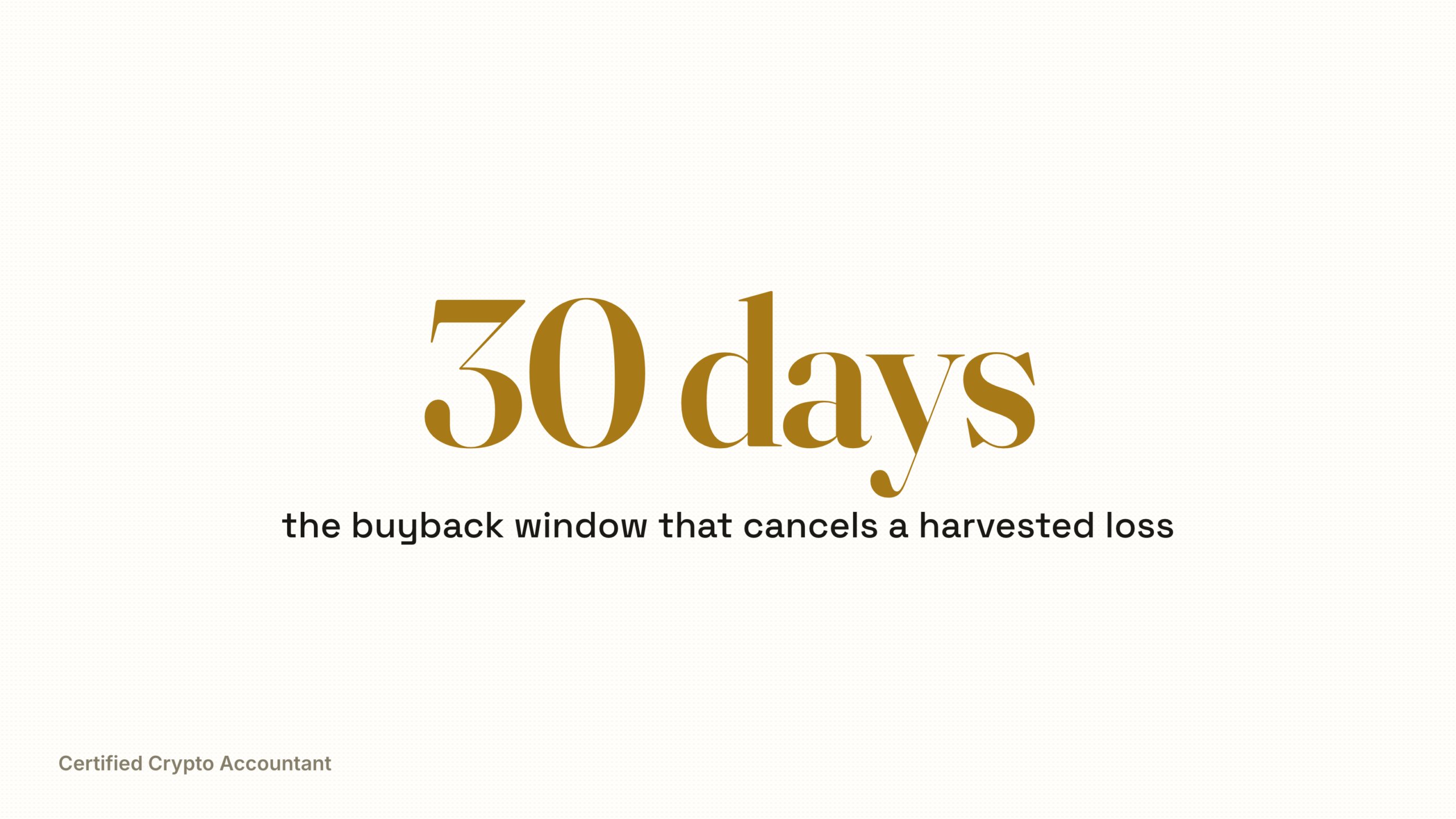
| 2 | 30-day (bed and breakfast) rule | Matches your disposal against acquisitions of the same token in the following 30 days. |
| 3 | Section 104 pool | Only what is left after rules 1 and 2 is matched against your averaged pooled cost. |
The consequence: if you sell Bitcoin at a loss and rebuy Bitcoin the same day or within the next 30 days, your disposal is matched against that fresh purchase, not your old pool. Because the buy-back price is close to the sell price, the loss you were chasing largely vanishes. You have churned your holding and achieved almost nothing.
How to harvest losses without triggering the block
The rules block selling and immediately rebuying the same token. They leave you legitimate options:
- Wait more than 30 days before reacquiring the same token. After the 30-day window the disposal falls back into the Section 104 pool and the loss stands.
- Stay out, or buy a different asset. If your goal is to bank the loss and reduce exposure, you do not have to rebuy at all.
- Accept market risk. The 30-day gap means the price can move against you, which is the genuine cost of doing this correctly. There is no risk-free version.
The key point: never assume a sell-and-rebuy banked a loss. Until you have modelled the matching rules, you do not know what loss, if any, you actually crystallised.
Negligible value claims for dead tokens
Plenty of crypto portfolios contain tokens that are effectively worthless: a failed project, a delisted coin, a rug-pull. You may not be able to sell them at all, so there is no disposal and, on the face of it, no loss.
A negligible value claim solves this. It lets you claim a loss on a token that has become of negligible value while you still hold it, as if you had disposed of and reacquired it. The token has to genuinely be worth next to nothing, not merely down heavily. Done properly, this converts a dead holding into a usable capital loss you can set against gains.
Worked example, offsetting a £10,000 gain, and the 30-day trap
Sana has a realised gain of £10,000 on Ethereum in the 2025/26 tax year. She also holds Solana sitting on a £7,000 unrealised loss.
Done correctly. Sana sells her Solana, crystallising the £7,000 loss, and does not rebuy it within 30 days. Her position for the year:
- Gain: £10,000
- Less claimed loss: £7,000
- Net gain: £3,000
- Less annual exempt amount (£3,000): £0 taxable
Her net gain is fully covered by the £3,000 annual exempt amount for 2025/26, so her CGT bill on this is nil. Without harvesting, a higher-rate taxpayer would have paid 24% on the gain above the allowance: 24% of £7,000, which is £1,680 of tax saved.
The trap. Suppose instead Sana sells the Solana and rebuys the same Solana three days later because she still believes in it. The 30-day rule matches her disposal against that repurchase, not her old pool. Her loss collapses to almost nothing, the £10,000 gain stands largely uncovered, and she pays CGT she thought she had avoided. Same intention, completely different outcome, purely because of the timing of the rebuy.
How a specialist handles it
We treat loss harvesting as a modelling exercise, not a quick sell button. Before any disposal we reconcile every wallet and exchange, build the correct Section 104 pools per token, and run the same-day and 30-day matching so you know the exact loss a trade will produce. We then make sure each loss is formally claimed within the 4-year window, identify dead tokens that qualify for negligible value claims, and carry forward anything unused. The aim is simple: every loss you have is captured, claimed, and working against your gains, with nothing quietly forfeited.
Frequently asked questions
Does the UK have a wash-sale rule for crypto?
No. The UK has no US-style wash-sale rule. But the same-day and 30-day (bed and breakfast) matching rules achieve a similar block, so sell-and-rebuy tactics copied from the US do not transfer.
How long do I have to claim a crypto loss?
You must claim or register the loss with HMRC within 4 years of the end of the tax year in which it arose. After that the relief is lost, even if you never used it.
Can I carry crypto losses forward to future years?
Yes. Once a loss is claimed, any amount not used against gains in the same year carries forward indefinitely and can offset gains in later tax years.
What happens if I sell at a loss and buy back the next day?
The same-day or 30-day rule matches your disposal against the repurchase rather than your pooled cost, so the loss you were trying to bank largely disappears. To keep the full loss, do not reacquire the same token within 30 days.
Can I claim a loss on a token I cannot sell?
Often yes, through a negligible value claim. If the token has genuinely become worthless while you still hold it, you can claim the loss as though you had disposed of it, without needing a buyer.
Do losses reduce the tax-free allowance I can use?
Losses are set against gains first, then the £3,000 annual exempt amount for 2026/27 covers what remains. CGT on crypto is charged at 18% within the basic-rate band and 24% above it for disposals from 30 October 2024.
Turn your losses into a lower CGT bill
Crypto losses are one of the few genuine ways to cut a capital gains tax bill, but only if they are crystallised correctly, claimed in time, and protected from the matching rules. If you are carrying losses, holding dead tokens, or unsure whether past sell-and-rebuys actually worked, get them reviewed before the 4-year clock runs out. Book a free, confidential review at certifiedcryptoaccountant.com.
For tailored help, see our crypto tax services or book a free review.
Authoritative sources: GOV.UK: Capital Gains Tax; HMRC Cryptoassets Manual.
Sources
Every figure on this page was checked against the source below on 25 August 2026.
- LITRG covers how a claim interacts with the return. Low Incomes Tax Reform Group, checked 25 August 2026
- GOV.UK: Capital Gains Tax. GOV.UK, checked 25 August 2026
- HMRC Cryptoassets Manual. GOV.UK, checked 25 August 2026
Fahad Zar
Crypto tax accountantAAT licensed 1010475
- AAT Licensed Accountant and MAAT, licence 1010475
- MSc Accounting and Finance, BPP University London
- Six years inside digital asset accounting, across several crypto tax firms
- Practises through Zar Enterprises Ltd, ICO registration ZC225094
- Supervised for anti-money laundering by the AAT
What matters to me is that the number on the return is true, whatever it turns out to be.
Whether this is worth a conversation
Most people who read this page do not need an accountant. A few do.
- A big disposal is coming
- You have losses and reliefs sitting unused
- You want the plan checked before you act
If the move you are weighing is using this year's allowance before April, just use it.
If one of these is you, the first look costs nothing.
Read next
Gifting crypto outside marriage triggers capital gains tax
Gifting crypto in the UK is usually a disposal for Capital Gains Tax, even with no cash changing hands. When it is…
Reviewed 25 Aug 2026Deep guideWhat you actually pay on crypto gains in 2026 to 2027
How Capital Gains Tax on crypto works in the UK: rates, the annual allowance, Share Pooling, and the same-day and…
Reviewed 25 Aug 2026Deep guideWays to pay less crypto tax that HMRC accepts
Legal ways to reduce your UK crypto tax: the CGT allowance, loss harvesting, spouse transfers, pensions and timing.…
Reviewed 25 Aug 2026Deep guideDonating crypto to charity is not always the cheaper route
Donating crypto to charity in the UK can be free of Capital Gains Tax and may cut your Income Tax. How the relief works…
Reviewed 25 Aug 2026