How HMRC’s Digital Disclosure Service actually works

Published 5 August 2026· Reviewed against gov.uk 25 August 2026· 4 min read·HMRC and compliance
The clients who sleep well are the ones who told HMRC first. The Digital Disclosure Service is the mechanism for doing that, an online route for declaring income or gains from past years that never made it onto a return, and using it voluntarily is the single biggest lever anyone with an old mistake has over what it ends up costing.
Demand for the service tracks the letter campaigns, and KPMG has the current wave running to March 2027.
Here is how the process actually runs, including the deadline everyone underestimates.
What the service covers
The Digital Disclosure Service takes disclosures of onshore and offshore income or gains from previous tax years, from individuals, trustees, estates and companies. Undeclared rent, side income that crossed the threshold years ago, gains that never made a return, crypto disposals from the years nobody thought they were taxable. If the money is offshore, the same portal runs the Worldwide Disclosure Facility, with some rules of its own.
What it is not for: the current tax year, which just goes on a return, or cases where HMRC has already opened an enquiry into the thing you would be disclosing, where the dynamics change entirely and you want representation before your next letter.
The process and the 90 day clock
Step one is notifying HMRC that you intend to disclose. That part is quick. What it triggers matters more: from HMRC’s acknowledgement, you have 90 days to submit the full disclosure and pay. Not to start thinking about it. To calculate every year, work out tax, interest and penalties, submit, and settle.
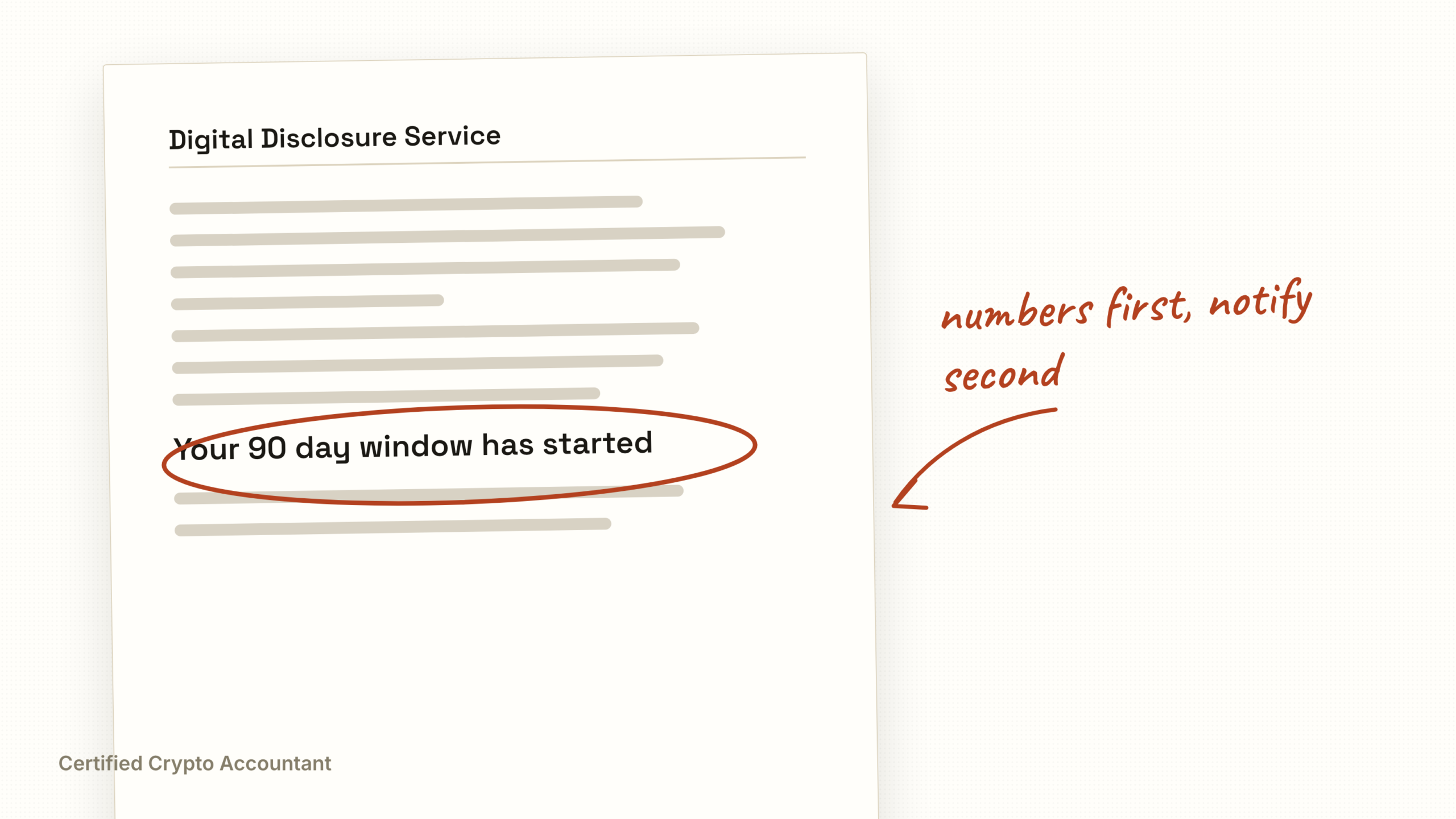
Ninety days sounds generous until you are reconstructing five years of records. For crypto cases it is genuinely tight, because the disclosure is only as good as the gains computation underneath it, and rebuilding cost basis across old exchanges and dead platforms is the slow part. The right order is unglamorous: build the numbers first, notify second, use the 90 days for checking rather than discovering.
How far back you go
The lookback depends on why the tax went unpaid, and the difference is enormous. Took reasonable care and something still slipped through, four years. Careless, six. Deliberate, twenty. Offshore matters carry a twelve year reach of their own. You declare the behaviour category yourself as part of the disclosure, and this is the judgement call where professional input earns its fee, because the category drives both the years included and the penalty percentage applied to them, and an implausibly generous self-assessment invites HMRC to reopen the whole thing.
Penalties for a voluntary, unprompted disclosure sit far below what the same error costs once HMRC has written to you first. That is the entire economics of this decision, and it is why timing beats almost everything else. A nudge letter arriving before your notification moves you from unprompted to prompted, and the floor rises. We covered what those letters look like in the nudge letter guide, and the crypto-specific disclosure mechanics in how to disclose unpaid crypto tax.
What it costs, honestly
The tax was always owed, so that part is not a cost of disclosing, it is a cost of the original income. On top sits interest from when the tax should have been paid, and a penalty calculated as a percentage of the tax, scaled by behaviour and by how much help you give HMRC during the process. Full cooperation on an unprompted careless disclosure can end with a remarkably small penalty. The same facts, discovered rather than disclosed, with the deliberate label attached, can approach the tax itself again in penalties. Our breakdown of how HMRC penalties are built walks the ranges.
Questions we get on disclosures
Will disclosing trigger an investigation?
A well-prepared disclosure is usually accepted and closed. What attracts attention is a disclosure that does not match the data HMRC already holds, which is why the computation has to be right rather than merely finished.
Can I just amend my last return instead?
A return can be amended within twelve months of its filing deadline. Anything older than that needs the disclosure route, which is precisely what it exists for.
What if I cannot pay the full amount within the 90 days?
Payment arrangements can be agreed as part of the process, but ask before the deadline rather than missing it. Silence is the one move that always makes things worse.
Do I need an adviser for a disclosure?
For a single forgotten income stream with clean records, possibly not. For multiple years, crypto computations, offshore elements or anything where the behaviour category is arguable, yes, and preferably before notifying, because the clock starts at acknowledgement and does not pause.
If there is a year sitting in your history that you already know about, the cheapest version of fixing it is the one that starts now, unprompted. Our free review will tell you what a disclosure would involve in your case before you commit to anything.
Sources
Every figure on this page was checked against the source below on 25 August 2026.
- KPMG has the current wave running to March 2027. KPMG, checked 25 August 2026
- Digital Disclosure Service. GOV.UK, checked 25 August 2026
- Worldwide Disclosure Facility. GOV.UK, checked 25 August 2026
- You have 90 days to submit the full disclosure and pay. GOV.UK, checked 25 August 2026
- Amended within twelve months. GOV.UK, checked 25 August 2026
Fahad Zar
Crypto tax accountantAAT licensed 1010475
- AAT Licensed Accountant and MAAT, licence 1010475
- MSc Accounting and Finance, BPP University London
- Six years inside digital asset accounting, across several crypto tax firms
- Practises through Zar Enterprises Ltd, ICO registration ZC225094
- Supervised for anti-money laundering by the AAT
What matters to me is that the number on the return is true, whatever it turns out to be.
Whether this is worth a conversation
Most people who read this page do not need an accountant. A few do.
- A letter from HMRC has arrived
- You have years HMRC does not know about
- HMRC's figures do not match yours
If your letter is a routine tax code notice and your filings are current, you probably just needed this page.
If one of these is you, the first look costs nothing.
Read next
Crypto tax deadlines for the 2026 to 2027 tax year
Key UK crypto tax dates for 2025/26: Self Assessment registration, the 31 January filing and payment deadline, and what…
Reviewed 25 Aug 2026Deep guideHow much HMRC can charge for unpaid crypto tax
What HMRC crypto tax penalties actually cost: late filing, late payment and undeclared gains. How penalties are…
Reviewed 25 Aug 2026ExplainerHow to tell a real HMRC letter from a scam
HMRC never threatens arrest and never asks for bank details to pay a refund. The thirty second sorting method, and…
Reviewed 25 Aug 2026DeadlineThe HMRC savings tax warning is about your bank interest
Banks report interest automatically and rising rates pushed ordinary savers over the £1,000 allowance. What the letters…
Reviewed 25 Aug 2026