How to tell a real HMRC letter from a scam

Published 2 August 2026· Reviewed against gov.uk 25 August 2026· 4 min read·HMRC and compliance
Thirty seconds is enough to sort most of them. A genuine HMRC message never threatens arrest, never demands payment by gift card or transfer to a “safe account”, and never offers a refund in exchange for your card details. If the message does any of those things, you are done reading it.
The harder cases are the careful fakes that copy HMRC’s tone properly, so here is the full sorting method, straight from what HMRC itself publishes and what lands in our clients’ inboxes.
The tells, in order of reliability
HMRC’s own scam identification guidance gives a checklist, and it holds up. Be suspicious of any contact that rushes you, threatens you, arrives unexpectedly, asks for personal or bank information, tells you to transfer money, or offers a refund, rebate or grant.
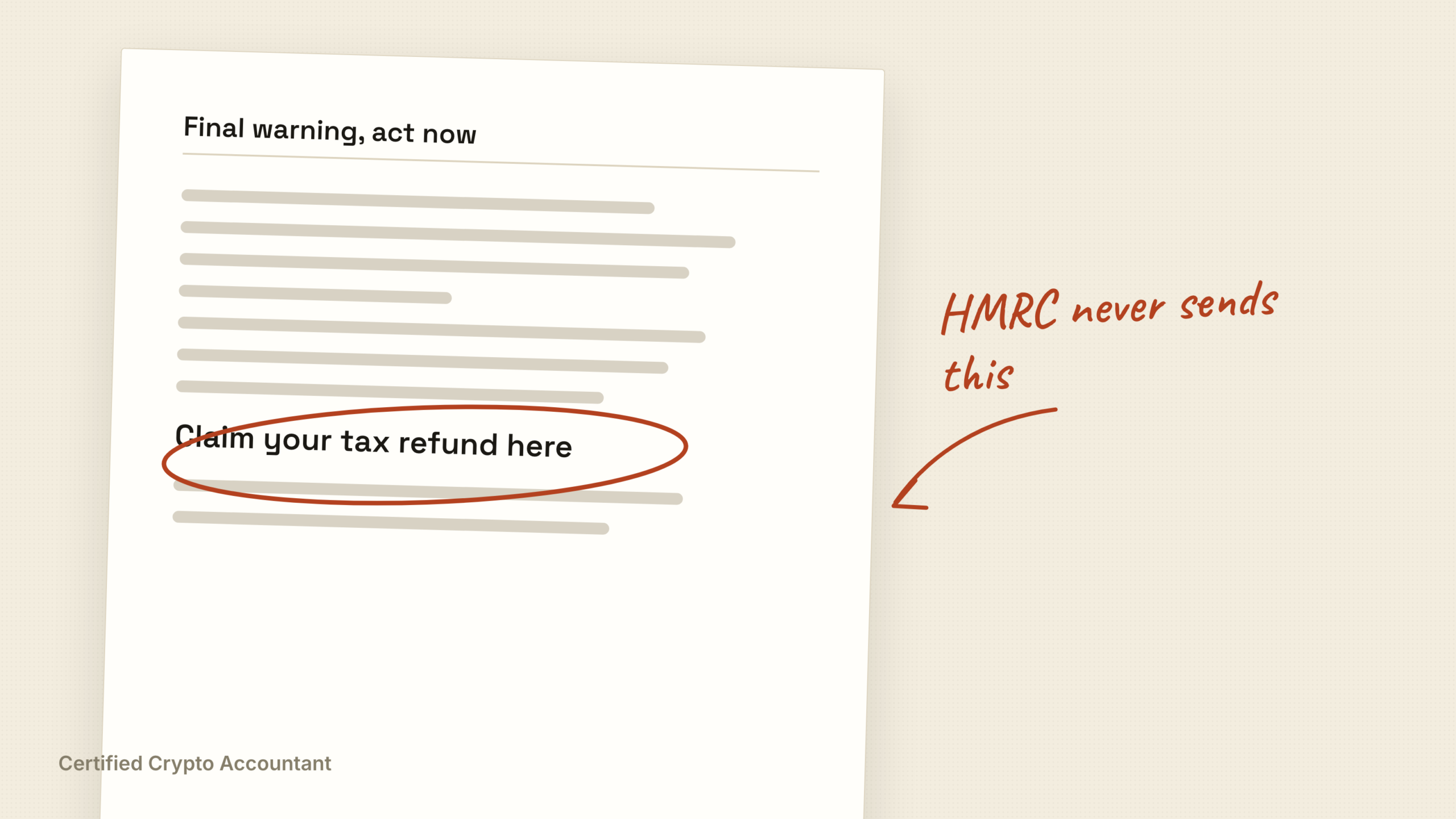
Two of those deserve underlining. Urgency is the scammer’s core tool, because a person given time to think checks things. And the refund lure is the most common shape of all, because who does not want £278.44 back from the taxman? HMRC does issue refunds. It does not ask for your bank details by text to pay them, because it already has a process that does not need them.
On the phone, the line is even brighter. HMRC will not leave a voicemail threatening legal action, and it will not threaten arrest. The aggressive robocall saying a warrant has been issued in your name is a scam every single time.
What makes this confusing
HMRC genuinely does send text messages to some taxpayers, genuinely does email, and genuinely does ring people. So “HMRC never texts” is not a usable rule. The usable rule is about content, not channel. Real messages point you to GOV.UK to sign in through your own account. Fake ones carry links to sites that ask you to enter things. If a message contains a link and a request for details, treat the link as radioactive and go to GOV.UK by typing it yourself.
Letters get faked too, less often but more convincingly. The scam letters we have seen borrow real letterheads and real-sounding reference numbers. The giveaway is nearly always the payment instruction, an account name that is not HMRC, a demand for immediate settlement, a mobile number to call. When in doubt, look up the relevant HMRC department’s number yourself on GOV.UK and ask whether the reference exists. Never use the contact details printed on the thing you are doubting. We wrote more about telling routine letters from serious ones in our guide to HMRC letters.
Where to send the fakes
Forward scam emails to phishing@hmrc.gov.uk. Forward scam texts to 60599. Both go to HMRC’s security team, and the reporting genuinely feeds takedowns. If you have actually lost money, report it through Action Fraud, or by calling 101 in Scotland, and tell your bank immediately because speed changes what can be recovered.
If you already clicked
Entering details on a fake site is recoverable if you move fast. Contact your bank first, change your Government Gateway password second, and watch your tax account for changes you did not make, because harvested details get used to redirect genuine refunds. Nothing about having been caught changes your actual tax position, and HMRC’s phishing reporting page covers the follow-up steps.
Common questions
Does HMRC ever ring about unpaid tax?
Yes, real debt collection calls exist. The difference is manner and method. A real caller can tell you your reference, does not threaten arrest, and directs any payment through your own HMRC account, never to a bank account read out over the phone.
I got a text about a tax refund. Real?
Assume not. Refunds are claimed through your personal tax account on GOV.UK, signed in through your own credentials, not through a link in a text. If a refund genuinely exists you will find it there.
How do scammers know my name and details?
Data breaches, mostly from companies nothing to do with HMRC. A scam message knowing your name or postcode proves nothing about its authenticity.
Can I check whether a specific contact was real?
Yes. HMRC publishes lists of its genuine recent communications, and you can ring the relevant department through the number on GOV.UK to confirm anything with your reference on it.
One more pattern worth knowing. Scam pressure peaks around real deadlines, late January especially, because that is when a message about tax feels most plausible. The real deadlines are in our deadlines guide, and if a genuine HMRC letter is what started your worry, our free review will tell you what it actually means.
Sources
Every figure on this page was checked against the source below on 25 August 2026.
- Scam identification guidance. GOV.UK, checked 25 August 2026
- Action Fraud. Action Fraud, checked 25 August 2026
- Phishing reporting page. GOV.UK, checked 25 August 2026
- The number on GOV.UK. GOV.UK, checked 25 August 2026
Fahad Zar
Crypto tax accountantAAT licensed 1010475
- AAT Licensed Accountant and MAAT, licence 1010475
- MSc Accounting and Finance, BPP University London
- Six years inside digital asset accounting, across several crypto tax firms
- Practises through Zar Enterprises Ltd, ICO registration ZC225094
- Supervised for anti-money laundering by the AAT
What matters to me is that the number on the return is true, whatever it turns out to be.
Whether this is worth a conversation
Most people who read this page do not need an accountant. A few do.
- A letter from HMRC has arrived
- You have years HMRC does not know about
- HMRC's figures do not match yours
If your letter is a routine tax code notice and your filings are current, you probably just needed this page.
If one of these is you, the first look costs nothing.
Read next
Crypto tax deadlines for the 2026 to 2027 tax year
Key UK crypto tax dates for 2025/26: Self Assessment registration, the 31 January filing and payment deadline, and what…
Reviewed 25 Aug 2026Deep guideHow much HMRC can charge for unpaid crypto tax
What HMRC crypto tax penalties actually cost: late filing, late payment and undeclared gains. How penalties are…
Reviewed 25 Aug 2026DeadlineThe HMRC savings tax warning is about your bank interest
Banks report interest automatically and rising rates pushed ordinary savers over the £1,000 allowance. What the letters…
Reviewed 25 Aug 2026ExplainerA letter from HMRC is rarely as bad as it looks
Most HMRC letters are routine and a few are not. How to tell tax codes and calculations apart from nudge letters and…
Reviewed 25 Aug 2026