The badges of trade decide if HMRC calls you a trader

Published 6 August 2026· Reviewed against gov.uk 25 August 2026· 4 min read·HMRC and compliance
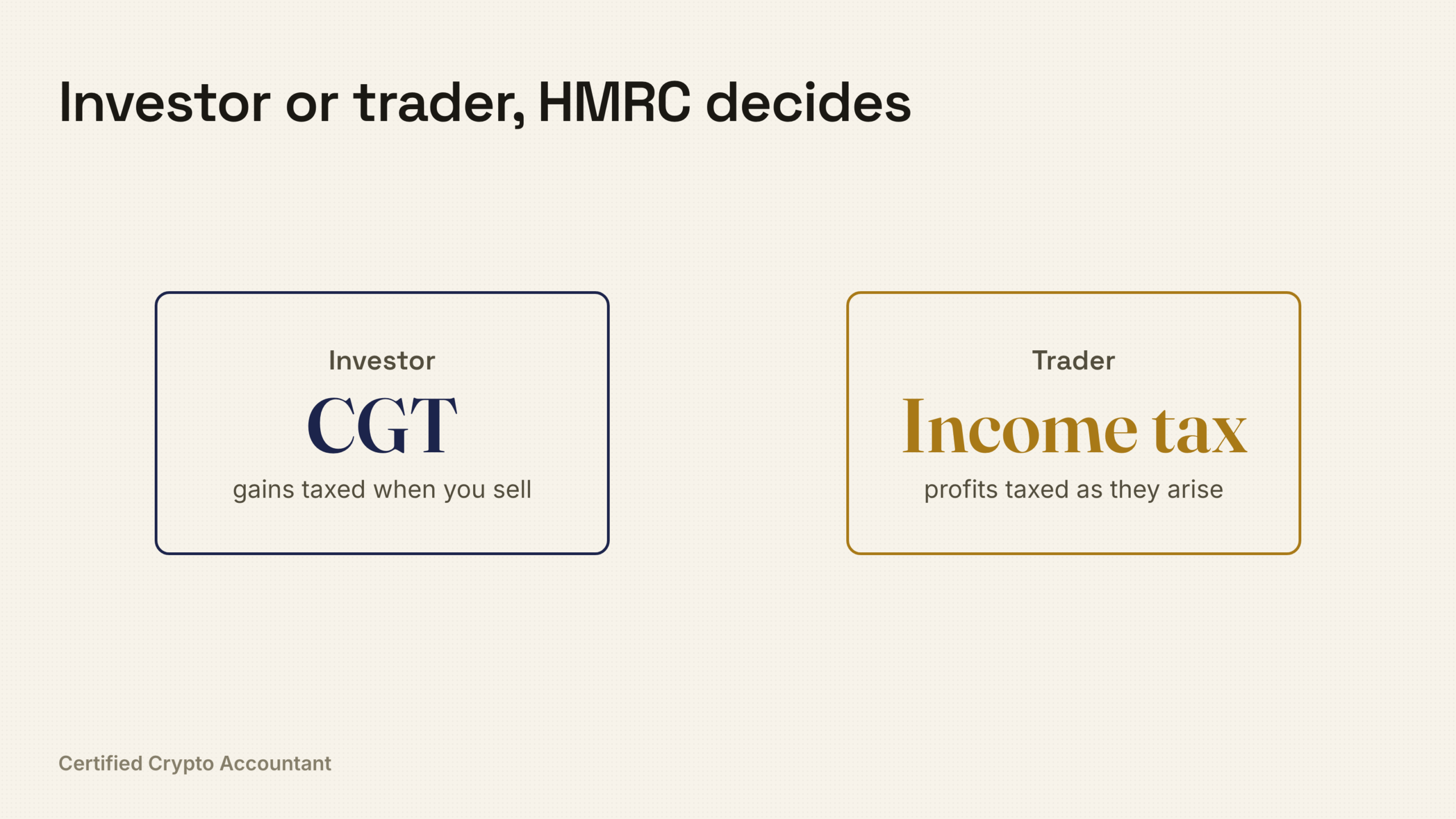
Whether you are trading or investing is worth more money than almost any other question in your tax return, and you do not get to decide the answer. HMRC does, using a set of tests called the badges of trade, and the difference lands hard. An investor pays capital gains tax at 18% or 24% with a £3,000 annual allowance. A trader pays income tax at up to 45% plus National Insurance, on the same profits.
The badges come from decades of case law, distilled in HMRC’s Business Income Manual at BIM20205. There are nine, no single one decides anything, and courts weigh them together.
The nine badges, in plain terms
Profit-seeking motive. Buying with the aim of selling at a profit points toward trade, though on its own it proves little, since every investor wants a profit too.
Number of transactions. One sale looks like investment. The same sale repeated systematically starts to look like a business.
Nature of the asset. Some things are only really held to resell, a thousand toilet rolls, to borrow a real case. Shares and crypto cut the other way, they are classic investment assets, and that matters more than people expect.
Similar trading interests. A builder buying and selling a house looks different from a dentist doing the same thing once.
Changes to the asset. Buying something, improving it, and selling the improved version resembles manufacture.
How the sale was carried out. Marketing, premises, sales machinery, the trappings of a business.
Source of finance. Borrowing that can only be repaid by selling the asset quickly suggests the plan was always a fast turn.
Interval between purchase and sale. Short holding periods lean toward trade, long ones toward investment.
Method of acquisition. Something inherited or received as a gift was not bought to resell, which weakens any trading argument about its sale.
What this means for crypto day traders
The question we hear constantly: I trade every day, am I a trader? Almost always no, and unusually, that is HMRC’s own position. The Cryptoassets Manual says only in exceptional circumstances would it expect individuals buying and selling tokens to be trading. The bar is set where it sits for share dealers, and courts have kept it high there for decades. Volume alone does not clear it. Organisation, premises, methodology, something resembling a financial business does, and a person with a phone and an exchange account is not that.
Most of the time this is good news, capital treatment means the 24% ceiling rather than 45%. It stings in one direction only: loss years. Trading losses can offset general income, capital losses cannot, and every crash produces people hoping to reclassify themselves into trader status for one bad year. HMRC sees that argument coming a long way off, and the badges cut against the person who was an investor in every profitable year. What losses can do for you within capital treatment, we covered in the loss harvesting guide.
Where the line genuinely blurs is activity that stops being speculation and becomes service-like, systematic market making, running validator infrastructure at scale, mining as an operation rather than a hobby. Our guides on mining and DeFi cover where income treatment takes over for reasons of its own.
The contrast worth knowing
Gambling sits outside both regimes. The spread betting punter is not carrying on a trade at all, per BIM22015, so winnings escape tax and losses earn no relief. The badges are the machinery that keeps these categories apart, which is why they surface in every argument about frequent CFD trading, side hustles that grew, and property flips. If your selling activity is on a platform, the sorting logic starts one step earlier, with whether you are trading at all, and we walk that boundary in the marketplace posts.
Common questions
How many trades make me a trader?
There is no number. Frequency is one badge of nine, and for financial assets the courts have found people with enormous volumes to still be investors. Structure and organisation matter more than count.
Can I choose trader status for better loss relief?
You can argue it, and HMRC will test the argument against the badges across all your years rather than the loss-making one alone. Self-serving reclassification in a down year rarely survives contact.
Does trader status ever apply to crypto?
Exceptionally, in HMRC’s own word. Think organised operations with infrastructure and method, not high-frequency personal speculation.
Who decides in the end?
You file on a position, HMRC can challenge it, and a tribunal settles genuine disputes by weighing the badges. Filing on a defensible position with reasoning documented beats discovering your classification during an enquiry.
If your activity sits anywhere near the line, trading volume, mining that grew, a side operation that stopped being casual, the classification is worth settling before HMRC raises it. That is a conversation our free review can start.
Sources
Every figure on this page was checked against the source below on 25 August 2026.
- Capital gains tax at 18% or 24%. GOV.UK, checked 25 August 2026
- Business Income Manual at BIM20205. GOV.UK, checked 25 August 2026
- Cryptoassets Manual. GOV.UK, checked 25 August 2026
- BIM22015. GOV.UK, checked 25 August 2026
Fahad Zar
Crypto tax accountantAAT licensed 1010475
- AAT Licensed Accountant and MAAT, licence 1010475
- MSc Accounting and Finance, BPP University London
- Six years inside digital asset accounting, across several crypto tax firms
- Practises through Zar Enterprises Ltd, ICO registration ZC225094
- Supervised for anti-money laundering by the AAT
What matters to me is that the number on the return is true, whatever it turns out to be.
Whether this is worth a conversation
Most people who read this page do not need an accountant. A few do.
- A letter from HMRC has arrived
- You have years HMRC does not know about
- HMRC's figures do not match yours
If your letter is a routine tax code notice and your filings are current, you probably just needed this page.
If one of these is you, the first look costs nothing.
Read next
Crypto tax deadlines for the 2026 to 2027 tax year
Key UK crypto tax dates for 2025/26: Self Assessment registration, the 31 January filing and payment deadline, and what…
Reviewed 25 Aug 2026Deep guideHow much HMRC can charge for unpaid crypto tax
What HMRC crypto tax penalties actually cost: late filing, late payment and undeclared gains. How penalties are…
Reviewed 25 Aug 2026ExplainerHow to tell a real HMRC letter from a scam
HMRC never threatens arrest and never asks for bank details to pay a refund. The thirty second sorting method, and…
Reviewed 25 Aug 2026DeadlineThe HMRC savings tax warning is about your bank interest
Banks report interest automatically and rising rates pushed ordinary savers over the £1,000 allowance. What the letters…
Reviewed 25 Aug 2026 ExplainerForex profits are taxed three ways in the UK and the product you traded decides which
Why HMRC's own Statement of Practice says a retail forex trader is unlikely to be trading.
Reviewed 5 September 2026