Can HMRC see my bank account

Published 1 August 2026· Reviewed against gov.uk 25 August 2026· 4 min read·HMRC and compliance
Yes, more than most people think, and less than the scarier headlines suggest. HMRC does not sit watching your balance in real time. What it has is better: automatic annual reporting from your bank, data feeds from platforms and exchanges, and the legal power to demand your statements when it wants them.
Here is what each of those actually covers.
What HMRC receives automatically
Your interest, every year. Banks and building societies report the interest they paid you at the end of each tax year, which is how HMRC adjusts tax codes and issues calculations without you telling them anything. The figures behind this are on GOV.UK’s savings interest guidance. Notice what this means in reverse: HMRC can infer roughly what you hold from what it pays, and a five-figure interest entry beside a modest declared income is exactly the kind of mismatch that generates a letter.
Your selling activity. Since January 2024, online platforms have collected and reported seller information under rules that took effect across the UK, with the first reports filed in January 2025. eBay, Vinted, Airbnb, Uber, the lot.
Your crypto. Exchanges already respond to HMRC data requests, and from 2026 the Cryptoasset Reporting Framework makes the flow automatic and international. We covered what that changes in our CARF guide, and which exchanges already share data in this one.
Everything else it always had. PAYE from employers, property transactions via the Land Registry, overseas accounts through the Common Reporting Standard, dividends from registrars. Each feed alone is partial. Matched together they are a fairly complete picture of your financial life, and matching them together is precisely what HMRC’s risk systems do.
What HMRC can demand
When HMRC wants the actual statements, it has Schedule 36 of the Finance Act 2008, the information notice regime. A notice to your bank can require your statements and account details, and since 2021 the financial institution notice version does not need a tribunal’s sign-off first. In practice these arrive during compliance checks, not out of nowhere. The automatic feeds decide who gets looked at, and the notices gather evidence once someone is looking.
What HMRC cannot do
There is no live window into your account. Nobody at HMRC can idly browse your current balance or your Deliveroo habit. Information is either reported to them on a cycle, or requested under a legal power with a paper trail. The gap between those two things is why timing matters: interest earned this year reaches HMRC after the tax year ends, and a compliance check looks backwards, not forwards.
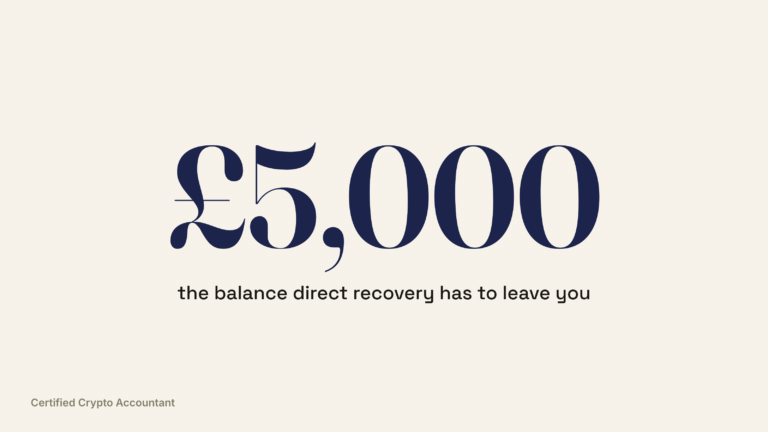
Seeing is also not the same as taking. HMRC does have a separate power to recover established debts directly from bank accounts, with its own thresholds and safeguards, and it deserves its own explanation rather than a scary sentence here.
What actually triggers a look
Mismatches. A declared income that cannot support the interest your accounts earn. A platform reporting sales from someone who has never filed a return. An exchange reporting disposals from someone whose returns show no gains. None of these prove anything is wrong, but each one is cheap for a computer to flag, and the flag becomes a nudge letter or a check. If your numbers all come from the same truth, the feeds agree with your returns and nothing happens. That is the whole game.
Quick answers
Does HMRC check bank accounts randomly?
No. Checks are driven by the data feeds and risk scoring, not lucky dip. The practical consequence is that people are rarely as invisible as they assume, and rarely as watched as they fear.
Can HMRC see accounts I have closed?
Statements for closed accounts still exist at the bank, and an information notice can reach them. Closing an account changes nothing about the history.
Do transfers between my own accounts cause problems?
Moving your own money is not income and is not taxed. It only becomes a question if an enquiry is already open and the movements need explaining, which is a records problem rather than a tax one. The same logic applies to moving crypto between your own wallets.
Does HMRC know about my overseas account?
Probably. More than a hundred jurisdictions exchange account information automatically under the Common Reporting Standard, and offshore is where HMRC’s longest lookback periods and toughest penalties live. If there is undeclared income sitting offshore, disclosing first is dramatically cheaper than being found.
If any of the feeds described above are about to tell HMRC something your returns have not, the order of events matters enormously. Come to us before the letter and the options are wide. Our free review is the place to start.
Sources
Every figure on this page was checked against the source below on 25 August 2026.
- GOV.UK’s savings interest guidance. GOV.UK, checked 25 August 2026
- Rules that took effect across the UK. GOV.UK, checked 25 August 2026
- Common Reporting Standard. GOV.UK, checked 25 August 2026
- Schedule 36 of the Finance Act 2008. legislation.gov.uk, checked 25 August 2026
Fahad Zar
Crypto tax accountantAAT licensed 1010475
- AAT Licensed Accountant and MAAT, licence 1010475
- MSc Accounting and Finance, BPP University London
- Six years inside digital asset accounting, across several crypto tax firms
- Practises through Zar Enterprises Ltd, ICO registration ZC225094
- Supervised for anti-money laundering by the AAT
What matters to me is that the number on the return is true, whatever it turns out to be.
Whether this is worth a conversation
Most people who read this page do not need an accountant. A few do.
- A letter from HMRC has arrived
- You have years HMRC does not know about
- HMRC's figures do not match yours
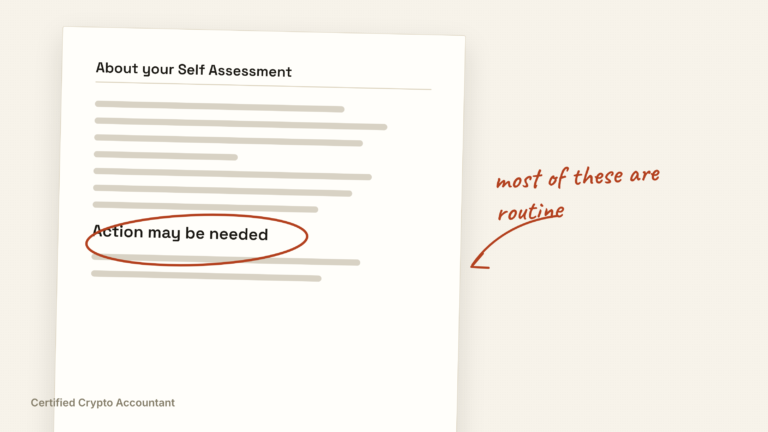
If your letter is a routine tax code notice and your filings are current, you probably just needed this page.
If one of these is you, the first look costs nothing.
Read next
Crypto tax deadlines for the 2026 to 2027 tax year
Key UK crypto tax dates for 2025/26: Self Assessment registration, the 31 January filing and payment deadline, and what…
Reviewed 25 Aug 2026Deep guideHow much HMRC can charge for unpaid crypto tax
What HMRC crypto tax penalties actually cost: late filing, late payment and undeclared gains. How penalties are…
Reviewed 25 Aug 2026ExplainerHow to tell a real HMRC letter from a scam
HMRC never threatens arrest and never asks for bank details to pay a refund. The thirty second sorting method, and…
Reviewed 25 Aug 2026DeadlineThe HMRC savings tax warning is about your bank interest
Banks report interest automatically and rising rates pushed ordinary savers over the £1,000 allowance. What the letters…
Reviewed 25 Aug 2026 ExplainerCan HMRC see my crypto wallet
The same question asked about wallets, exchanges and the tracing software HMRC bought in 2020.
Reviewed 5 September 2026