What Coinbase and Binance actually send to HMRC

Published 14 June 2026· Reviewed against gov.uk 25 August 2026· 8 min read·HMRC and compliance
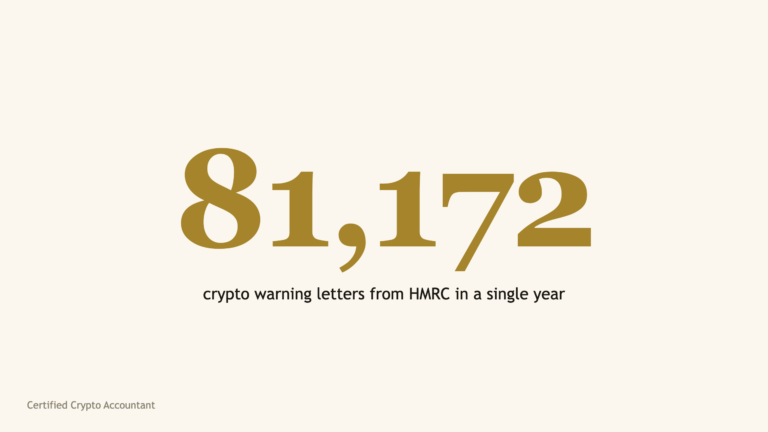
Yes. Coinbase shares UK customer data with HMRC, and it is not alone. HMRC has obtained records straight from exchanges since around 2019, and sent roughly 65,000 crypto nudge letters in 2024/25 off the back of them, up 134% on the year before. Since 1 January 2026 the Crypto-Asset Reporting Framework (CARF) has made this automatic. Exchanges must now collect and report your identity and transaction data every year, and the first reports reach HMRC by 31 May 2027, covering everything you did in 2026.
This guide sets out what exchanges hand over today, what CARF changed in January 2026, and whether a foreign or non-KYC exchange keeps you hidden. It does not. None of it is a reason to panic, because the gap between what you declared and what HMRC can see is fixable, and fixing it before a letter lands is far cheaper than fixing it after.
Does Coinbase report to HMRC right now?
In practical terms, yes. When you opened your Coinbase account you completed know your customer (KYC) checks: you handed over your name, address, date of birth and usually a photo ID. From that moment, every buy, sell, swap and withdrawal is recorded against a verified identity. The exchange knows exactly who you are.
Coinbase has also shared certain UK customer information with HMRC in the past. HMRC has the legal power to require this data, and exchanges operating lawfully with UK customers comply. The principle is settled: the information exists, it is tied to you, and HMRC can ask for it. So the real question is not whether the data exists. It is whether what you declared matches what HMRC can see, which is exactly the gap a nudge letter is designed to expose.
What HMRC already obtains through data requests
HMRC has not waited for new rules. Since around 2019 it has obtained customer data directly from crypto exchanges through formal data requests, then cross-checked that information against filed Self Assessment returns. Where the two do not match, the taxpayer gets a letter.
That programme has scaled sharply. In 2024/25 HMRC issued around 65,000 crypto nudge letters, a 134% increase on the prior year. These are not random: they go to people whose exchange data suggests disposals that were never reported. If you have traded on Coinbase or Binance and left crypto off your return, your name may already be on a list. A nudge letter is a prompt, not a formal investigation, but it signals that HMRC holds information about you, and how you respond shapes everything that follows.
Does Binance report to HMRC too?
Binance is the largest exchange by volume and serves a huge UK user base. Like Coinbase, it applies KYC checks, so the same logic holds: your identity is tied to your trading record. Whether an exchange is headquartered in the UK, the EU or further afield, two things matter to HMRC: does it know who you are, and can HMRC obtain that data, either by request now or automatically from 2026? For the major exchanges, the answer to both is yes.
So “does Coinbase report to HMRC” and “does Binance report to HMRC” have the same answer, because the mechanism is identical: verified identity plus a reporting obligation closing in around it.
What changes from 2026, CARF
The biggest shift is the Crypto-Asset Reporting Framework. From 1 January 2026, reporting crypto-asset service providers must collect and report user identity and gross transaction data to HMRC automatically. There is no data request to wait for and no discretion: the reporting is built into how exchanges operate.
The first report is due by 31 May 2027, covering the 2026 calendar year, after which the data is exchanged internationally between participating tax authorities from 2027. Crucially, CARF reaches across borders: more than 40 jurisdictions are in the first wave, so the data HMRC receives is not limited to UK-based platforms.
| What exchanges share | Now (data requests) | From 2026 (CARF) |
|---|---|---|
| Trigger | HMRC issues a data request to the exchange | Automatic annual reporting, no request needed |
| Your identity | Provided via KYC, shared when requested | Collected and reported as standard |
| Transaction data | Shared in the requested dataset | Gross transaction totals reported each year |
| Overseas exchanges | Harder for HMRC to reach directly | Shared via international exchange from 2027 |
| First HMRC data | Ongoing since around 2019 | First report due 31 May 2027 |
Does a foreign or non-KYC exchange hide you?
This is where a lot of wishful thinking lives, so let us be direct. No, it does not.
- Foreign exchanges: with 40+ jurisdictions participating in CARF and international data exchange from 2027, using an overseas platform does not keep you invisible. The data routes back to HMRC.
- Non-KYC or decentralised venues: avoiding identity checks does not remove your UK tax obligations. On-chain activity is traceable, blockchain analytics are mature, and the duty to self-report still applies in full.
- The fiat on and off ramp: at some point money usually enters or leaves the banking system, a visible, KYC-checked touchpoint regardless of where the trading happened.
Tax residence, not the location of the app, decides what you owe. If you are UK tax resident, your worldwide crypto gains and income are within scope.
A worked scenario, the “invisible” foreign exchange
James, a UK tax resident, assumed that trading on an overseas exchange with light identity checks kept him off HMRC’s radar. In 2025/26 he realised a capital gain of £18,000 on crypto disposals. After deducting that year’s £3,000 capital gains tax annual exempt amount, £15,000 is taxable. As a higher-rate taxpayer at the 24% CGT rate for crypto gains, that is £3,600 of CGT. James filed nothing, confident he was invisible.
He was not. From 2026 the overseas exchange reports under CARF, and that data reaches HMRC through international exchange from 2027. His foreign platform became a reporting channel, not a hiding place. Had James declared the £3,600 and paid on time, that would have been the end of it. By staying silent he now risks interest plus a behaviour-based penalty, and if HMRC judges the omission deliberate it can look back many years. Same gain, far worse outcome.
The calm, sensible thing to do
None of this calls for panic. It calls for getting your position straight before HMRC contacts you, because a voluntary, accurate disclosure always beats a prompted one.
- Reconcile your full history. Pull every exchange account and wallet, including closed and overseas ones, into one reconciled view.
- Work out the real position year by year: a genuine gain, a loss you can claim, or nothing owed.
- Correct what needs correcting, by amending a recent return or making a voluntary disclosure for older years.
- Keep the evidence. Whatever you tell HMRC, you should be able to prove it.
How a specialist handles it
When a client worries that an exchange has reported them, we work in one order: data first, position second, HMRC last. We reconcile every venue, including the foreign and non-KYC ones people assume are invisible, establish the true taxable figure for each year, then choose the right route and deal with HMRC directly. The aim is a clean, evidenced position that holds up whether or not a letter ever arrives.
Frequently asked questions
Does Coinbase report to HMRC?
In effect, yes. Coinbase applies KYC checks that tie your identity to your trades and has shared UK customer information with HMRC. From 2026, reporting becomes automatic for crypto-asset service providers under CARF.
Does Binance report to HMRC?
Binance applies the same KYC identity checks as other major exchanges, so your trading record is linked to you. HMRC can obtain that data by request now and will receive it automatically under CARF from 2026, with international exchange from 2027.
Can I avoid HMRC by using a foreign exchange?
No. More than 40 jurisdictions participate in CARF, and data is exchanged internationally from 2027. Using an overseas platform does not keep you invisible to HMRC.
What about non-KYC or decentralised exchanges?
Avoiding identity checks does not remove your UK tax obligations. On-chain activity is traceable and the duty to self-report still applies. Fiat on and off ramps are also KYC-checked touchpoints.
What exactly will exchanges report under CARF?
From 1 January 2026, providers must collect and report user identity details and gross transaction data to HMRC. The first report is due by 31 May 2027, covering the 2026 calendar year.
I have not declared past crypto, what should I do?
Reconcile your full history, work out the real position for each year, then make a voluntary disclosure or amend recent returns. Coming forward before HMRC contacts you keeps penalties far lower than being prompted.
Get a clear answer before HMRC sends a letter
If “does Coinbase report to HMRC” has been keeping you up at night, the fix is not to hope, it is to know your real position and put it right on your terms. We reconcile your full history across every exchange and wallet, calculate exactly what is owed, and handle HMRC for you, for UK clients. Book a free, confidential review at certifiedcryptoaccountant.com.
For tailored help, see our crypto tax services or book a free review.
Authoritative sources: HMRC Cryptoassets Manual; HMRC: tell HMRC about unpaid crypto tax.
If the letter concerns crypto, the pooling history usually has to be rebuilt before you can answer it honestly, which is the work our crypto tax accountants do. Where the gains are ordinary shares or property, start with the capital gains tax accountant page instead.
Sources
Every figure on this page was checked against the source below on 25 August 2026.
- HMRC Cryptoassets Manual. GOV.UK, checked 25 August 2026
- HMRC: tell HMRC about unpaid crypto tax. GOV.UK, checked 25 August 2026
Fahad Zar
Crypto tax accountantAAT licensed 1010475
- AAT Licensed Accountant and MAAT, licence 1010475
- MSc Accounting and Finance, BPP University London
- Six years inside digital asset accounting, across several crypto tax firms
- Practises through Zar Enterprises Ltd, ICO registration ZC225094
- Supervised for anti-money laundering by the AAT
What matters to me is that the number on the return is true, whatever it turns out to be.
Whether this is worth a conversation
Most people who read this page do not need an accountant. A few do.
- A letter from HMRC has arrived
- You have years HMRC does not know about
- HMRC's figures do not match yours
If your letter is a routine tax code notice and your filings are current, you probably just needed this page.
If one of these is you, the first look costs nothing.
Read next
Crypto tax deadlines for the 2026 to 2027 tax year
Key UK crypto tax dates for 2025/26: Self Assessment registration, the 31 January filing and payment deadline, and what…
Reviewed 25 Aug 2026Deep guideHow much HMRC can charge for unpaid crypto tax
What HMRC crypto tax penalties actually cost: late filing, late payment and undeclared gains. How penalties are…
Reviewed 25 Aug 2026ExplainerHow to tell a real HMRC letter from a scam
HMRC never threatens arrest and never asks for bank details to pay a refund. The thirty second sorting method, and…
Reviewed 25 Aug 2026DeadlineThe HMRC savings tax warning is about your bank interest
Banks report interest automatically and rising rates pushed ordinary savers over the £1,000 allowance. What the letters…
Reviewed 25 Aug 2026 ExplainereToro tax in the UK depends on which of its three products you used
What eToro sends HMRC about crypto, shares and CFDs, and the tax report it gives you.
Reviewed 5 September 2026ExplainerCan HMRC see my crypto wallet
What HMRC can see beyond Coinbase, including self custody wallets and cold storage.
Reviewed 5 September 2026