Missed the 5 October deadline to register for Self Assessment, here is what it costs and what to do this week

Published 10 November 2026 Reviewed against gov.uk 10 November 2026 9 min readSelf Assessment and side income
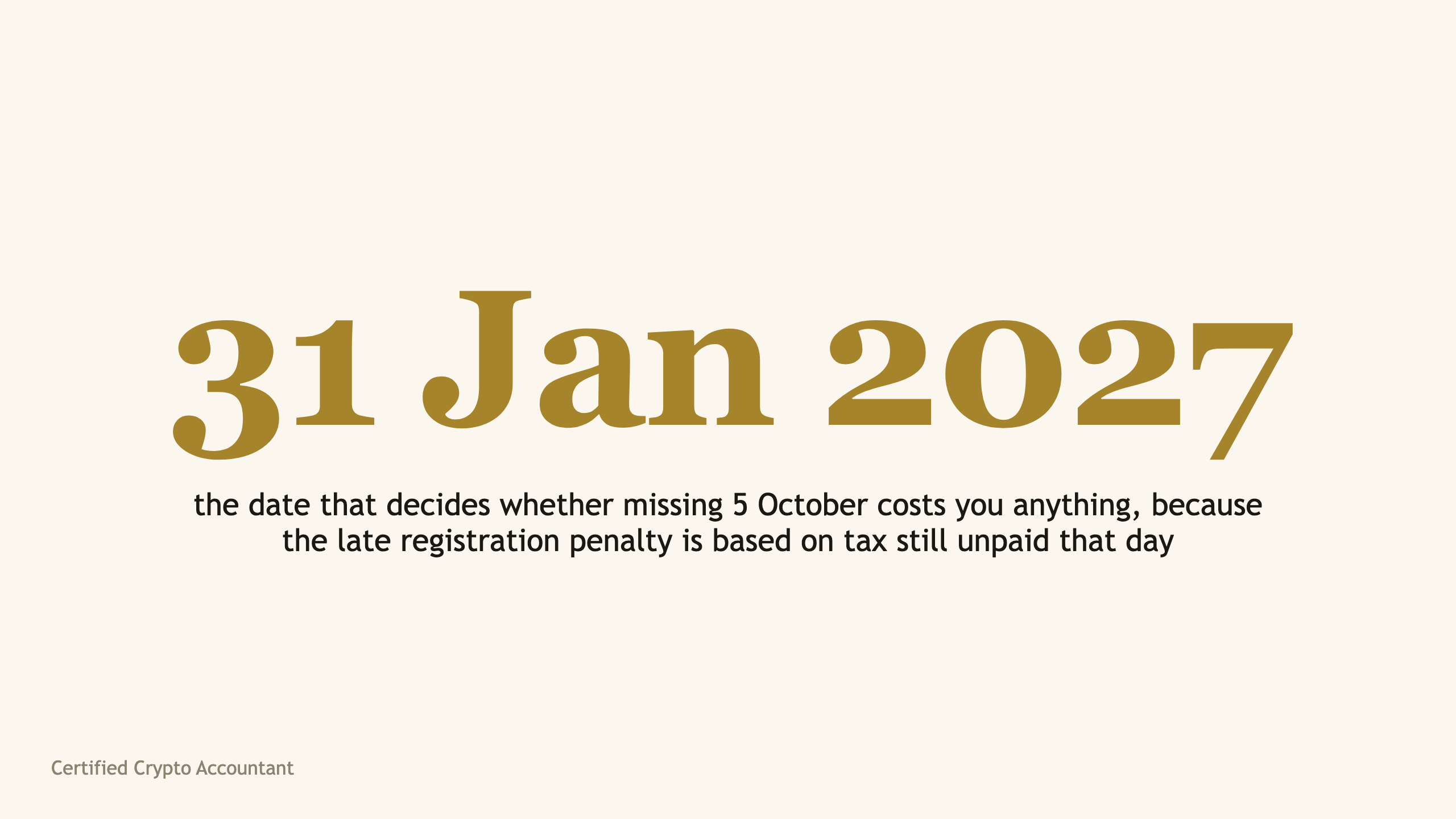
If you sold or swapped crypto in the year to 5 April 2026, made a gain above the £3,000 allowance, and have never filed a tax return, you were meant to tell HMRC by 5 October 2026. That date has gone. The cost of missing it is set by what you do between now and 31 January 2027, and that is the date that matters.
This page sets out what gov.uk and the legislation say about registering late, what the penalty is actually based on, the two routes you can still take, and a worked example with real dates. It covers the 2025 to 2026 tax year, the one whose return is due this winter.
The 5 October date has gone and the cost of missing it is set by 31 January 2027. Pay the tax by then and the late registration penalty is worked out on nil. Register now and HMRC gives you three months from its letter to file, or report a plain capital gain through the real time service by 31 December 2026.
What the 5 October date was, and what it was not
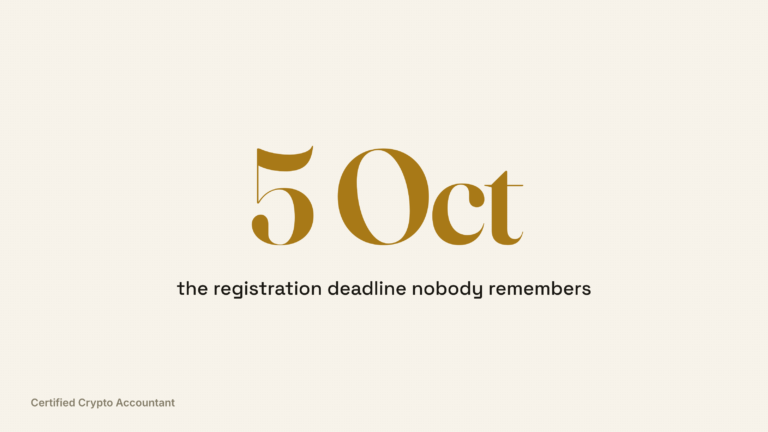
Section 7 of the Taxes Management Act 1970 requires anyone who is chargeable to income tax or capital gains tax for a year, and who has not received a notice to file, to tell HMRC within six months of the end of that year. For the year that ended 5 April 2026 that is 5 October 2026. The gov.uk registration page puts it as plainly as it can, if you tell HMRC after 5 October 2026 you could get a penalty.
What 5 October was not is the filing date, and it was not the payment date. The deadlines page says that if you register after 5 October 2026, HMRC will send you a letter or email with a different deadline to send your return by, three months from the date on that letter or email, and that you must still pay the tax you owe by 11.59pm on 31 January 2027. The statute behind the three months is section 8(1G) of the Taxes Management Act 1970. A notice to file issued after 31 October gives you three months from the date of the notice, online or on paper.
So someone who registers in the second week of November 2026 and receives their notice at the end of the month has until the end of February 2027 to file. The tax does not wait that long. It is due on 31 January 2027 whatever the filing date says, and interest runs from 1 February 2027 on anything unpaid.
What the late registration penalty is based on
The penalty for failing to notify is in Schedule 41 to the Finance Act 2008. Paragraph 6 sets the standard rates, 30% of the potential lost revenue where the failure was not deliberate, 70% where it was deliberate, 100% where it was deliberate and concealed. Paragraph 7(2) says what the potential lost revenue is for income tax and capital gains tax. It is so much of the tax for the year as, by reason of the failure, is unpaid on 31 January following the tax year.
Read that twice, because it is the whole point. The penalty is a percentage of the tax still unpaid on 31 January 2027. If the tax is paid by then, the amount the percentage applies to is nil, and 30% of nil is nil. The gov.uk penalties page says the same thing in plain words. If you register after 5 October and do not pay all of your tax bill by 31 January, you may get a failure to notify penalty, and it is based on the amount still left to pay.
Where tax is still unpaid on 31 January 2027, paragraph 13 cuts the rate for telling HMRC yourself. For a failure that was not deliberate, an unprompted disclosure made within twelve months of the tax falling due takes the minimum to 0%, and 10% after that. A prompted disclosure, meaning one made after you had reason to think HMRC had found or was about to find the omission, has a minimum of 10% or 20% on the same timing. Unprompted means you went to HMRC before HMRC came to you, and with exchange data arriving under the Cryptoasset Reporting Framework from 31 May 2027, the window for being first is this winter.
The two routes still open to you
Which route fits depends on why you need to report at all. The gov.uk page on working out whether you need to pay gives the capital gains tests. You pay when your total taxable gains for the year are above the £3,000 allowance, and if you are already registered for Self Assessment you also report when the total you sold assets for passed £50,000, even with no tax to pay.
Route one is to register for Self Assessment now. Use the register for Self Assessment service, choosing the not self-employed path if your crypto was investment rather than a trade. HMRC posts your Unique Taxpayer Reference, then issues the notice to file that starts the three month clock. You will need the return to carry the SA108 capital gains pages with the cryptoasset boxes, and a computation behind them that pools each token under section 104 and applies the same day and 30 day rules. Our guide to how to report crypto to HMRC walks through the boxes.
Route two is open only where the gain is the sole reason you would be in Self Assessment. The real time Capital Gains Tax service takes gains on assets sold in the 2025 to 2026 tax year, as long as you are UK resident and the gain is not on UK residential property. You report by 31 December 2026 and pay by 31 January 2027, and you must attach a copy of your calculations. Nobody can use it on your behalf, so an accountant prepares the computation and you submit it. If you are already registered for Self Assessment, the gain still has to go on your return as well, so the service does not replace a return for anyone who already files one.
Route two is also closed to crypto income. Staking rewards, lending yield and tokens received for work are income on receipt, and HMRC’s guidance on receiving cryptoassets says that above the £1,000 trading and miscellaneous income allowance you tell HMRC, and above £2,500 you need a Self Assessment return. If your year had both a gain and income of that size, route one is the only one.
A worked example with real dates
Suppose you sold ether and solana between June 2025 and March 2026 for total proceeds of £26,000, and the pooled computation gives a gain of £9,000. You earn £38,000 from employment, pay through PAYE, have never filed a return and received no staking income. The taxable gain is £9,000 less the £3,000 allowance, which is £6,000, and at the 18% rate that applies inside the basic rate band the tax is £1,080.
You register on 11 November 2026. HMRC’s notice to file is dated 28 November. Under section 8(1G) your return is due within three months of that, by 28 February 2027. You pay £1,080 on or before 31 January 2027. Because the tax is paid by that date, the potential lost revenue under paragraph 7(2) is nil and no failure to notify penalty arises. Because the return goes in before 28 February, no late filing penalty arises either. Missing 5 October has cost you nothing.
Now suppose you do nothing until HMRC writes in 2027 on the strength of exchange data. The £1,080 is unpaid on 31 January 2027, so the penalty is a percentage of £1,080, between 10% and 30% of it for a careless failure once HMRC has prompted you, plus interest from 1 February 2027. HMRC’s published interest rates put late payment interest at 8.00% from 24 November 2026. On top of that the return is late against the notice HMRC then issues, and the late filing penalties start at £100 and reach £10 a day after three months. The arithmetic is not frightening on £1,080. It becomes frightening when the gain was £90,000, or when three years are involved rather than one.
What to do this week
First, check whether you need a return at all with HMRC’s check if you need to send a tax return tool, and read our guide to whether you need to declare crypto for the crypto specific tests. Second, if you do, register today or decide on the real time service, and put 31 January 2027 in your diary as the payment date either way. Third, get the computation done before December, because every exchange export has to be reconciled before a figure can be trusted, and the software report most people start with overstates the gain more often than not.
If the year that needs a return is not the only one, because 2023 to 2024 or 2024 to 2025 also had gains that were never declared, registration still comes first, but the earlier years go through a disclosure rather than a late return. Our crypto tax advisors page explains that route and what it costs, and the figures below are what the single year costs.
Three fixed fees, quoted in writing before any work starts
One taxpayer, one tax year unless the line says otherwise. Written position within 15 working days of software access.
For an exchange-only history under about 5,000 trades where the software report is already built.£499
For several platforms, wallet transfers read as sales, duplicates, and one or two back years.£950
For DeFi, derivatives, high volume, or balances that do not tie.£1,750
Send your software report to zar@certifiedcryptoaccountant.com for a written fee the same working day, or start with the free review. Licensed and regulated by the AAT, licence 1010475.
Questions about registering late
I missed the 5 October deadline to register for Self Assessment. Will I get a penalty?
Only if tax is still unpaid on 31 January 2027. The failure to notify penalty in Schedule 41 to the Finance Act 2008 is a percentage of the tax for the year that is unpaid on 31 January following the tax year, so paying in full by that date leaves nothing for the percentage to apply to. Register now, and pay by 31 January 2027.
How long do I have to file if I register after 5 October?
Three months from the date on the letter or email HMRC sends you after you register, per gov.uk and section 8(1G) of the Taxes Management Act 1970. The payment date does not move. Tax for the year to 5 April 2026 is due by 11.59pm on 31 January 2027, and interest runs from 1 February 2027 on anything unpaid.
Can I report a crypto gain without registering for Self Assessment?
Sometimes. The real time Capital Gains Tax service takes gains on assets sold in the 2025 to 2026 tax year, reported by 31 December 2026 and paid by 31 January 2027, if you are UK resident and the gain is not on UK residential property. You must attach your calculations and nobody can submit it for you. It does not cover crypto income, and if you are already registered for Self Assessment the gain still goes on your return.
What if I also had staking or lending income?
Crypto income above the £1,000 trading and miscellaneous income allowance has to be told to HMRC, and above £2,500 HMRC's guidance says you need a Self Assessment return. The real time service does not take income, so register for Self Assessment and report the gain and the income on the same return.
I have gains in earlier years too. Does registering late cover them?
No. Registering now and filing the 2025 to 2026 return deals with one year. Earlier years that were never declared go through a disclosure to HMRC, with tax, interest and a penalty set by the behaviour and by whether you came forward before HMRC wrote to you. The first exchange reports under the Cryptoasset Reporting Framework reach HMRC by 31 May 2027, so the time to come forward unprompted is before then.
Sources
Every figure on this page was checked against the source below on 10 November 2026.
- Self Assessment tax returns, deadlines. GOV.UK, checked 10 November 2026
- Register for Self Assessment. GOV.UK, checked 10 November 2026
- Self Assessment tax returns, penalties. GOV.UK, checked 10 November 2026
- Finance Act 2008, Schedule 41, penalties for failure to notify. legislation.gov.uk, checked 10 November 2026
- Taxes Management Act 1970, section 8, personal return. legislation.gov.uk, checked 10 November 2026
- Report and pay your Capital Gains Tax, if you have other capital gains to report. GOV.UK, checked 10 November 2026
- Capital Gains Tax, work out if you need to pay. GOV.UK, checked 10 November 2026
- Check if you need to pay tax when you receive cryptoassets. HM Revenue and Customs, checked 10 November 2026
- HMRC interest rates for late and early payments. HM Revenue and Customs, checked 10 November 2026
- Check if you need to send a Self Assessment tax return. GOV.UK, checked 10 November 2026

Fahad Zar
Crypto tax accountantAAT licensed 1010475
- AAT Licensed Accountant and MAAT, licence 1010475
- MSc Accounting and Finance, BPP University London
- Six years inside digital asset accounting, across several crypto tax firms
- Practises through Zar Enterprises Ltd, ICO registration ZC225094
- Supervised for anti-money laundering by the AAT
What matters to me is that the number on the return is true, whatever it turns out to be.
Whether this is worth a conversation
Where this stops being a reading job and starts being a hiring one.
- You missed 5 October, you have a crypto gain for the year to 5 April 2026, and you want the computation and the return done before 31 January 2027
- Your software report shows a gain you do not believe and you need the figure checked before you pay it
- More than one year was never declared and you need to know which route each year takes
If your gain is inside the £3,000 allowance, you had no crypto income above £1,000, and you are not already in Self Assessment, you have nothing to register for. Keep the records and the computation that prove it.
If one of these is you, the first look costs nothing.
Read next
How to register for Self Assessment with HMRC
The registration steps, the Unique Taxpayer Reference and the online account.
Reviewed 10 November 2026DeadlineCrypto tax deadlines for the 2025 to 2026 return
Every date between now and 31 January 2027, with what happens if you miss each one.
Reviewed 10 November 2026ExplainerDo I need to declare crypto to HMRC
The three tests that decide whether a return is needed at all.
Reviewed 10 November 2026Deep guideCrypto tax penalties in the UK
Late filing, late payment and inaccuracy penalties, and how disclosure reduces them.
Reviewed 10 November 2026