Crypto tax deadlines for the 2026 to 2027 tax year
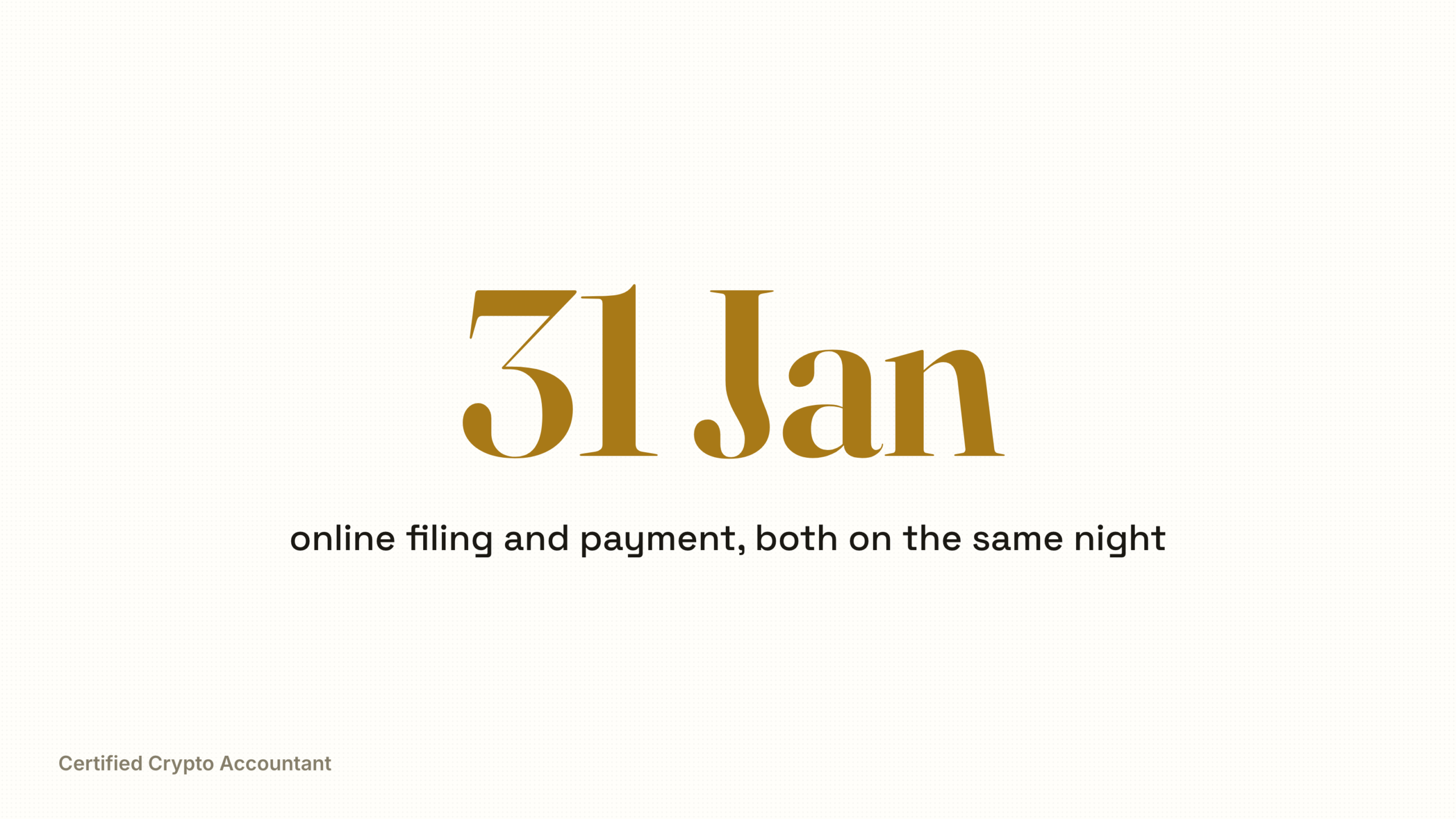
31 January 2027online return and balancing payment for the 2025 to 2026 tax year

Published 14 June 2026· Reviewed against gov.uk 24 August 2026· 8 min read·HMRC and compliance
If you have made any crypto disposal in the last tax year, the single most important number to know is not the price you sold at, it is the date you have to tell HMRC. Miss a crypto tax deadline in the UK and the cost is automatic: a fixed penalty lands whether you owe £5 of tax or £50,000, and interest starts running on anything paid late. The Self Assessment calendar does not bend for a busy quarter or a market crash.
This guide is the one to bookmark. It sets out every UK crypto tax deadline a Self Assessment filer needs from mid-2026 onwards: when to register, when to file on paper or online, when to pay, when payments on account fall due, and where crypto now sits on the return. The 2024/25 filing deadline has passed, so the 2025/26 return, due by 31 January 2027, is the one in your sights.
Every one of these dates is fixed and none of them is negotiable. The only variable you control is how long before them you start.
The UK crypto tax deadline calendar at a glance
UK crypto is taxed through Self Assessment, and Self Assessment runs on a fixed cycle tied to the tax year, which runs from 6 April to 5 April. The same handful of dates repeat every year. Learn them once and you never have to guess again.
| Date | What is due |
|---|---|
| 5 April | End of the tax year. Disposals after this date fall into the next year. |
| 5 October | Deadline to register for Self Assessment if the year just ended was your first with a liability. |
| 31 October | Paper return deadline. |
| 31 January | Online return deadline, plus the balancing payment for the tax year, plus the first payment on account. |
| 31 July | Second payment on account (if you make payments on account). |
For the 2025/26 tax year, which ended on 5 April 2026, that translates to: register by 5 October 2026, file on paper by 31 October 2026 or online by 31 January 2027, and pay by 31 January 2027. The 2024/25 online deadline was 31 January 2026, which has now passed.
Registering for Self Assessment, the deadline people forget
If you have never filed a return and you had a crypto gain or income for the first time, you cannot just turn up on 31 January and file. You first need to be inside the Self Assessment system, and that has its own, earlier cut-off.
You must register by 5 October following the end of the tax year in which the liability first arose. So a first crypto gain in 2025/26 means registering by 5 October 2026. Registration is what generates your Unique Taxpayer Reference, and that number can take time to arrive in the post, so leaving it to the last week is a real risk. Missing the registration deadline can lead to a separate failure-to-notify penalty on top of anything else.
Paper versus online, two different crypto tax deadlines
There are two filing routes, and they do not share a date. This catches people out every year.
- Paper return: due by 31 October. Almost no crypto filer should choose this, because crypto disposals usually involve many transactions that are far easier to handle online.
- Online return: due by 31 January. This is the route to use, and it gives you three extra months.
The trap is assuming you have until January when you have actually decided to file on paper. If a paper return arrives on 1 November, it is already late, even though the online deadline is months away.
Payment dates and payments on account
Filing the return and paying the tax are two separate obligations that happen to share the 31 January date. Your balancing payment for the tax year is due by 31 January, alongside the return.
On top of that, you may have to make payments on account. These are advance instalments towards the following year’s bill, each broadly half of your last bill, and they fall due on 31 January and 31 July. They are typically triggered once your Self Assessment income tax bill passes a threshold and is not mostly collected at source. One important carve-out for crypto investors. Capital Gains Tax is excluded from the payments on account calculation, so a one-off crypto gain does not by itself create them. But where your crypto activity is taxed as income, or you have other untaxed income, payments on account can apply, and paying one and a half years of tax in a single January is a nasty surprise if you did not see it coming.
The new cryptoasset section on the return
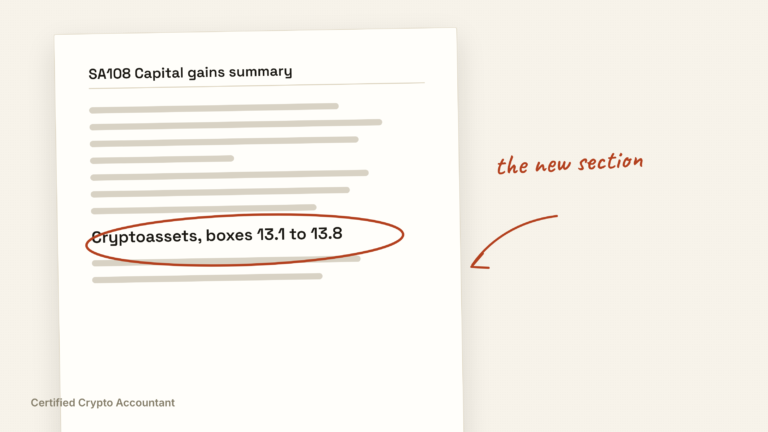
From the 2024/25 tax year onwards, the Self Assessment return includes a dedicated cryptoasset section. Crypto disposals are now reported in their own box rather than being lumped in with other capital gains. This matters for two reasons.
First, it signals that HMRC is treating crypto as a distinct, visible category, not an afterthought. Second, it means the figures you enter need to be reconciled and accurate, because a separate box is easier to scrutinise and to cross-check against the exchange and CARF data HMRC now receives. Reporting in pound sterling, with proper share-pooling of your tokens, is no longer optional housekeeping, it is how the box is designed to be completed.
Penalties for missing each deadline
The penalty regime is largely automatic, which is precisely why deadlines matter so much. You do not get a warning shot for a late online return: the first penalty applies the moment the deadline passes.
| How late the online return is | Penalty |
|---|---|
| 1 day late | Automatic £100, even if no tax is owed. |
| 3 months late | £10 per day, up to a maximum of £900, on top of the £100. |
| 6 months late | A further penalty applies, in addition to the above. |
| 12 months late | Another penalty applies, in addition to the above. |
Separately, interest is charged on any tax paid after 31 January, and late-payment penalties can stack on top of late-filing penalties. The two clocks, filing and paying, run independently, so it is possible to file on time and still be penalised for paying late.
Worked example, a first-time crypto filer for 2025/26
Priya sold Bitcoin and Ethereum during 2025/26, realising a total capital gain of £15,000. She has never filed a Self Assessment return before. Here is the calendar she must hit and the tax involved.
- Register by 5 October 2026. Because 2025/26 is her first year with a liability, she must register and obtain her Unique Taxpayer Reference.
- File online by 31 January 2027. She reports the £15,000 gain in the new cryptoasset section, in pound sterling.
- Pay by 31 January 2027. After deducting the £3,000 annual exempt amount, her taxable gain is £12,000. As a basic-rate taxpayer, that is charged at 18%, giving a CGT bill of £2,160.
If Priya forgets to register, or registers too late, she risks a failure-to-notify penalty. If she files her online return even a day after 31 January 2027, she pays an automatic £100, regardless of the fact that her tax was modest. Hit the three dates and the process is clean. Miss any of them and the cost climbs for no benefit.
How a specialist handles the crypto tax deadline
When a client comes to us with disposals across several exchanges and wallets, we work backwards from 31 January. We reconcile the full transaction history into a single share-pooled position, calculate the gain in pound sterling, confirm whether registration or payments on account apply, and file the cryptoasset section accurately and early. Filing early is deliberate: it locks in the figure, removes the January panic, and leaves room to plan the payment rather than scramble for it.
Frequently asked questions
What is the main crypto tax deadline in the UK?
For most crypto investors it is 31 January. That is the date your online Self Assessment return is due and the date your balancing payment for the tax year must be paid. For the 2025/26 tax year, that date is 31 January 2027.
I had my first crypto gain in 2025/26. When do I need to register?
By 5 October 2026. You register for Self Assessment by 5 October following the end of the tax year in which your liability first arose, which for 2025/26 (ended 5 April 2026) is 5 October 2026.
Where do I report crypto on the Self Assessment return?
From the 2024/25 tax year onwards there is a dedicated cryptoasset section, so your disposals are reported in their own box, in pound sterling, rather than mixed in with other capital gains.
What happens if I file my crypto tax return late?
An automatic £100 penalty applies if the online return is even one day late, regardless of whether any tax is owed. Once the return is three months late, daily penalties of £10 (up to £900) are added, with further penalties after six and twelve months. Interest is charged on tax paid late.
What are payments on account and when are they due?
Payments on account are advance instalments towards next year’s bill, due on 31 January and 31 July. Capital Gains Tax is excluded from the calculation, so a purely capital crypto gain does not create them. They can apply once your Self Assessment bill is large enough and is not mostly collected at source, so a sizeable crypto gain can bring them into play for the first time.
How much is crypto Capital Gains Tax for 2025/26?
The annual exempt amount is £3,000. Gains above that are taxed at 18% within the basic-rate band and 24% above it, following the rates that took effect from 30 October 2024.
Sources
Every figure on this page was checked against the source below on 24 August 2026.
- Self Assessment tax returns, deadlines. GOV.UK, checked 24 August 2026
- Self Assessment tax returns, penalties. GOV.UK, checked 24 August 2026
- Understand your Self Assessment tax bill, payments on account. GOV.UK, checked 24 August 2026
- Capital Gains Tax rates and allowances. HM Revenue and Customs, checked 24 August 2026
- Register for Self Assessment. GOV.UK, checked 24 August 2026
- Cryptoassets Manual, Capital Gains Tax, CRYPTO22000. HM Revenue and Customs, checked 24 August 2026
Fahad Zar
Crypto tax accountantAAT licensed 1010475
- AAT Licensed Accountant and MAAT, licence 1010475
- MSc Accounting and Finance, BPP University London
- Six years inside digital asset accounting, across several crypto tax firms
- Practises through Zar Enterprises Ltd, ICO registration ZC225094
- Supervised for anti-money laundering by the AAT
What matters to me is that the number on the return is true, whatever it turns out to be.
Whether this is worth a conversation
The useful time to call about a January deadline is not January.
- A deadline is closer than your records are ready for
- You missed a date and fear what follows
- More than one year needs filing
If you have one exchange, a clean export and a gain under the allowance, the return takes an evening and the deadline is the only thing you need from this page.
If one of these is you, the first look costs nothing.
Read next
How to register for Self Assessment
The 5 October step, in detail, including what a UTR is and how long it takes.
Reviewed 24 Aug 2026Deep guideHow much HMRC can charge for unpaid crypto tax
What each of these dates costs you once it has passed.
Reviewed 24 Aug 2026ExplainerYour capital gains tax allowance for 2026 to 2027
Whether you have a liability at all, which decides whether the dates apply.
Reviewed 24 Aug 2026ExplainerHow to report crypto to HMRC
The two routes available once you know which deadline you are working to.
Reviewed 24 Aug 2026