You can owe crypto tax without ever selling for pounds

Published 5 September 2026 Reviewed against gov.uk 5 September 2026 7 min readCrypto Tax
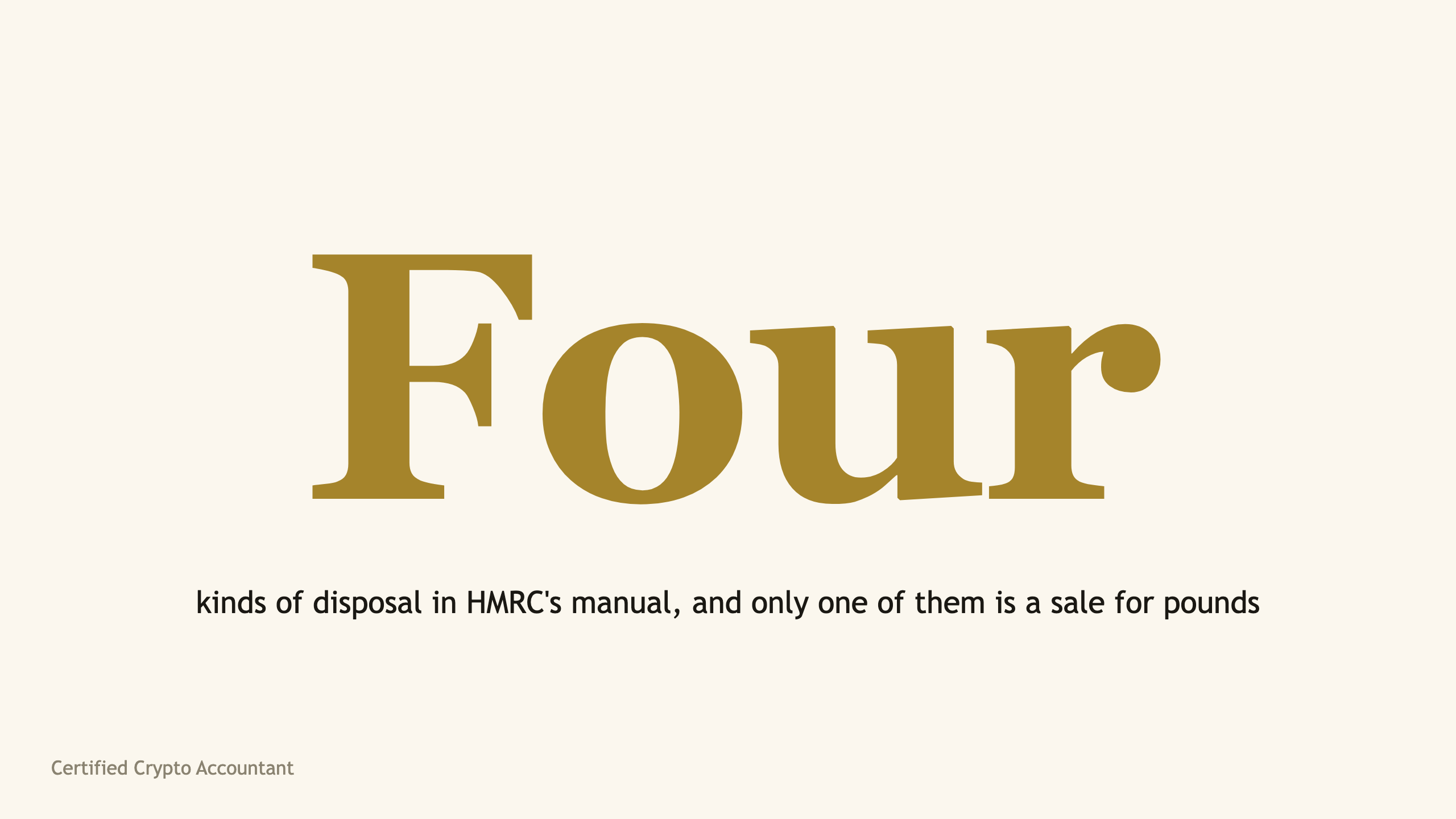
You can, and in my experience this is the rule that catches most people. HMRC’s cryptoassets manual, in the version updated on 28 November 2025, lists four events that count as a disposal for Capital Gains Tax. Selling tokens for money is one of them. The other three are exchanging one token for another, using tokens to pay for goods or services, and giving tokens away to anyone other than a spouse or civil partner. Three of the four never send a penny to your bank account, and each one is taxed exactly as if it had.
Holding is different. If you bought and have done nothing since, there is no tax and nothing to report. The tax question starts the moment a coin leaves your ownership, whatever it turned into.
The bank statement is the last place crypto tax shows up. HMRC taxes the swap, and the swap happened months before any pounds moved.
What HMRC counts as a disposal
The list at CRYPTO22100 is short, and it pays to read it in HMRC’s own words, because the second item is the one people argue with.
| Event | Money reaches your bank | Disposal for Capital Gains Tax |
|---|---|---|
| Selling tokens for pounds | Yes | Yes |
| Exchanging one token for another | No | Yes |
| Paying for goods or services with tokens | No | Yes |
| Giving tokens away | No | Yes, unless the recipient is your spouse or civil partner |
| Moving tokens between wallets you control | No | No |
| Holding | No | No |
The same four appear on HMRC’s plain guidance page, which adds gifts to charity to the exceptions. So a person who bought bitcoin in 2020, traded it into ether in 2024 and has never touched a bank since has made a disposal, and if the ether was worth more than the bitcoin cost, a gain.
Why a swap has a gain when no pounds arrived
A gain is the sterling value of what you received, less the sterling cost of what you gave up, on the day of the trade. Nothing in that sentence mentions a bank. Suppose you bought 1 ETH for £1,400 in 2023 and in March 2026 swapped it for solana when ETH was trading at £2,600. You received £2,600 of solana, you gave up something that cost £1,400, and the gain is £1,200. The solana now carries a cost of £2,600 for whenever it goes. You may never have held a pound of it. The gain is real all the same.
Multiply that by a year of trading and the pattern shows itself. Someone who moved between twenty coins in a bull run has made twenty disposals, each with its own gain or loss, and the software that adds them up is usually right about the number of events and wrong about the cost attached to some of them, which is the whole reason reconciliation exists as a service.
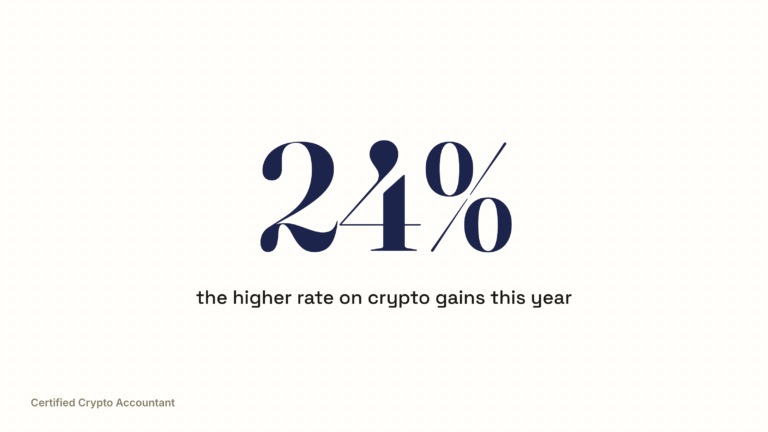
For 2026 to 2027 the first £3,000 of gains in the year is exempt and the rest is taxed at 18% inside the basic rate band and 24% above it, per GOV.UK. Our guide to what you actually pay on crypto gains works through the bands with figures.
The movements that are not disposals
Sending coins from an exchange to your own hardware wallet is not a disposal, because you owned the tokens before and you own them after. HMRC’s manual puts it as there being no disposal where the individual retains beneficial ownership throughout. Software gets this wrong constantly, booking the exchange withdrawal as a sale and the wallet deposit as a purchase at a new price, and the result is a gain that never happened. We covered the mechanics in the wallet transfer guide.
A gift to your spouse or civil partner is treated as no gain and no loss. They take your cost, and the tax waits until they dispose of it. A gift to anyone else, including your children, is a disposal at market value on the day, even though you received nothing, which is the rule that surprises people most and the reason gifting crypto has a guide of its own.
One trap sits inside the exceptions. Passing tokens through a mixer and getting the same token type back is not a disposal. Passing token A through a service and receiving token B is, whatever the service calls itself.
Before withdrawal and after
The question arrives worded as whether you pay tax on crypto before withdrawal, and the honest answer is that withdrawal has nothing to do with it. The tax was triggered by the swap, the spend or the gift, on the day it happened. Moving the resulting pounds from an exchange to your current account later is a bank transfer, and bank transfers are not taxable events. Neither is the reverse. Buying crypto with pounds creates a cost and nothing else.
What withdrawal does do is create a record HMRC can see. Exchanges have handed over customer data on request since 2020, and from 1 January 2026 UK platforms collect it for automatic reporting under the Cryptoasset Reporting Framework. Timing your cash out changes nothing about the liability. It changes how quickly the comparison happens.
The stablecoin move is a sale in everything but name
Selling ether into USDT to sit out a dip feels like parking. For tax it is exchanging one token for another, the second item on HMRC’s list, and it crystallises whatever gain or loss the ether was carrying. I think this is the single most expensive misunderstanding in the market, because people do it dozens of times a year at exactly the moments when prices have moved most. A trader who rotated £40,000 of ether into a stablecoin at a peak and back at the trough has a gain in the first year and a loss in the second, and the two sit in different tax years with different consequences.
If you lost money
Losses follow the same logic in reverse. A swap that received less than the pooled cost of what you gave up is an allowable loss, and it reduces your gains in the same year, with the balance carried forward. Two things have to happen for that to work. The loss has to be claimed, on a return or by letter, within four years of the end of the tax year of the disposal, per GOV.UK. And it has to have been a real disposal. A coin that fell to nothing while you held it is a loss only once you dispose of it or make a negligible value claim, which is the territory of our guide to claiming capital losses.
A final reporting point. If you are in Self Assessment, you have to report disposals where the total proceeds in the year exceed £50,000, even when the gains are inside the £3,000 exemption, a rule GOV.UK sets out on its reporting page. Proceeds means the sterling value of everything you disposed of, including every swap. An active year of coin to coin trading passes £50,000 of proceeds without any single large trade, and the reporting guide shows where the figures go on the return.
Questions on disposals
Do you pay tax on crypto if you don't sell?
Not on holding. You pay when you dispose of it, and disposing includes swapping it for another coin, spending it or giving it away, whether or not any pounds are involved.
Is crypto to crypto taxable in the UK?
Yes. HMRC treats exchanging one token for another as a disposal for Capital Gains Tax, valued in sterling on the day of the trade. The coin you receive takes that sterling value as its cost.
Do you pay tax on crypto before withdrawal?
The withdrawal itself is not taxed. Tax arises on the swap, spend or gift that happened earlier, and it arises on that day whether or not the money ever reaches a bank.
Do I pay tax on crypto if I lost money?
No tax is due on a loss, but the loss only helps you if you claim it, within four years of the end of the tax year it happened in. Claimed losses reduce gains in the same year and carry forward.
Is moving crypto into a stablecoin taxable?
Yes. A stablecoin is a different token, so the exchange is a disposal and it crystallises the gain or loss on whatever you gave up.
Sources
Every figure on this page was checked against the source below on 5 September 2026.
- CRYPTO22100, what is a disposal. HM Revenue and Customs, checked 5 September 2026
- Check if you need to pay tax when you sell cryptoassets. GOV.UK, checked 5 September 2026
- Capital Gains Tax rates. GOV.UK, checked 5 September 2026
- Capital Gains Tax, if you make a loss. GOV.UK, checked 5 September 2026
- Reporting and paying Capital Gains Tax. GOV.UK, checked 5 September 2026
Fahad Zar
Crypto tax accountantAAT licensed 1010475
- AAT Licensed Accountant and MAAT, licence 1010475
- MSc Accounting and Finance, BPP University London
- Six years inside digital asset accounting, across several crypto tax firms
- Practises through Zar Enterprises Ltd, ICO registration ZC225094
- Supervised for anti-money laundering by the AAT
What matters to me is that the number on the return is true, whatever it turns out to be.
Whether this is worth a conversation
Where this stops being a reading job and starts being a hiring one.
- You traded between coins for a year or more and have never worked out what each swap did to your position
- Your software shows a gain on a transfer to your own wallet and you cannot make it stop
- You rotated into stablecoins at the top and have not claimed the losses from the way back down
If you bought once, hold, and have never swapped, spent or gifted, there is no disposal and nothing to do until you make one.
If one of these is you, the first look costs nothing.
Read next
What you actually pay on crypto gains in 2026 to 2027
The bands and the £3,000 exemption, with the sums worked through.
Reviewed 5 September 2026Deep guideDo You Pay Tax Moving Crypto Between Wallets? The UK Rules
The transfer that software books as a sale, and why it is not one.
Reviewed 5 September 2026DeadlineUnclaimed capital losses expire after four years
How to claim a loss and what happens if you leave it.
Reviewed 5 September 2026ExplainerHow to report crypto to HMRC
Where the figures go on the return, including the £50,000 proceeds rule.
Reviewed 5 September 2026