Capital gains tax in Scotland uses UK bands

Published 12 August 2026· Reviewed against gov.uk 25 August 2026· 3 min read·Capital gains tax
Here is the mistake nearly every Scottish taxpayer makes with capital gains tax: applying Scottish income tax bands to it. Capital gains tax is reserved to Westminster, it is identical across the UK, and the band that decides whether you pay 18% or 24% is the UK threshold of £50,270, not any of the Scottish ones. For a meaningful slice of Scottish taxpayers, that mismatch is plain good news.
One tax, two band systems
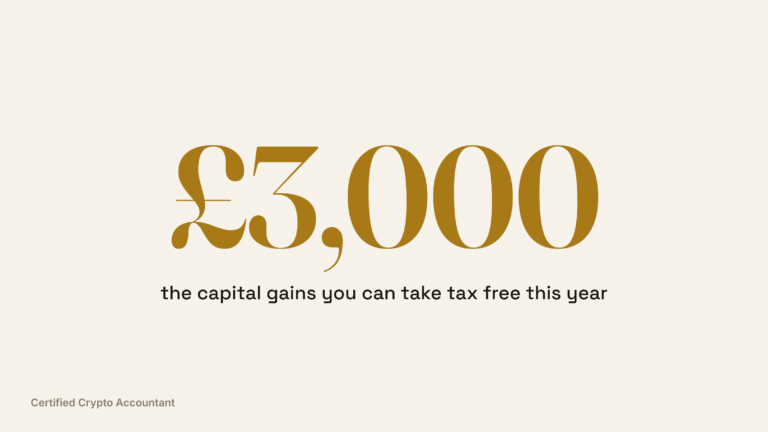
Scotland sets its own income tax rates and bands for earnings, and its higher rates begin at lower income levels than the rest of the UK. Capital gains tax never devolved. Rates, the £3,000 allowance, reliefs and reporting all follow the UK rules on GOV.UK, and when the calculation needs to know how much basic rate band you have left, it uses the UK band running to £50,270.
Feel the oddity of that. A Scottish taxpayer can be paying higher rate income tax on salary under Scottish bands while still counting as basic rate for capital gains, because their income has not crossed the UK threshold. Same person, same year, higher rate for one tax and basic rate for the other. It follows that some Scots pay less capital gains tax than intuition suggests, 18% on gains their payslip logic says should be at 24%.
Worked through
Take a Scottish taxpayer on £46,000 with a £15,000 gain from shares this year. Under Scottish income tax bands, part of that salary is already taxed at Scotland’s higher rates. For capital gains, the calculation asks a different question: how far is £46,000 from £50,270? £4,270 of basic rate band remains. Knock the £3,000 allowance off the gain, leaving £12,000 taxable. The first £4,270 is taxed at 18%, the remaining £7,730 at 24%. Anyone assuming “I am a higher rate taxpayer so it is all 24%” overpays.
Our capital gains tax calculator does this split automatically, and because it uses the UK threshold it is right for Scottish taxpayers too.
Everything else is the same, including the traps
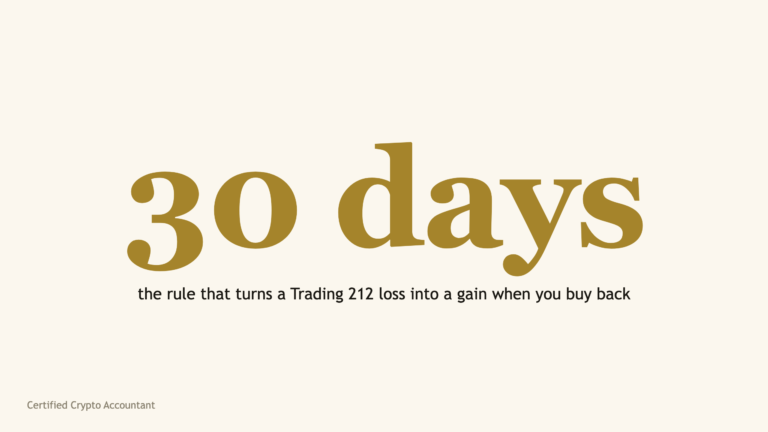
The £3,000 allowance, the four year window for claiming losses, the 30 day rule on shares and crypto, spouse transfers at no gain, all identical in Kirkwall and Kensington. So is the 60 day deadline for reporting UK residential property sales, which applies to a Dundee buy-to-let exactly as it does in Manchester. Land and Buildings Transaction Tax replaces stamp duty north of the border on the way in, but the way out, the gain, is UK law.
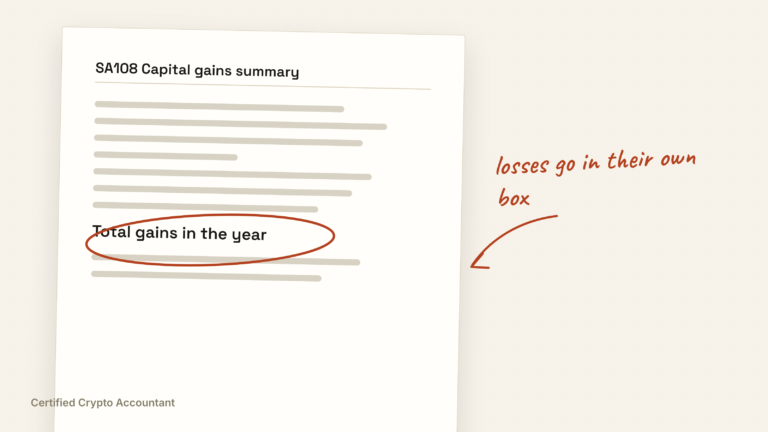
Reporting runs through the same Self Assessment machinery too, the SA108 pages we covered in the reporting guide, with the same £50,000 proceeds rule.
Scottish CGT questions
Does Scotland have its own capital gains tax rates?
No. Capital gains tax is UK-wide, 18% and 24% with a £3,000 allowance, wherever in the UK you live.
I pay scottish higher rate income tax. Is my CGT automatically 24%?
Not necessarily, and this is the point most guides miss. The CGT split uses the UK threshold of £50,270. If your income sits between the Scottish higher rate threshold and the UK one, part of your gain is still taxed at 18%.
Do scottish taxpayers use different CGT reporting?
No. Same return, same SA108, same 60 day property service, same deadlines.
Does this apply to crypto gains in Scotland?
Entirely. Crypto disposals are capital gains under the same UK rules, with the same band calculation, as our crypto gains guide sets out.
If your income sits in the zone between the Scottish and UK thresholds, your capital gains position is better than you probably assumed, and worth calculating properly rather than at the pessimistic rate. That is a ten minute job for our free review.
Sources
Every figure on this page was checked against the source below on 25 August 2026.
- Income tax rates and bands. GOV.UK, checked 25 August 2026
- GOV.UK. GOV.UK, checked 25 August 2026
- £3,000 allowance. GOV.UK, checked 25 August 2026
- Reporting UK residential property sales. GOV.UK, checked 25 August 2026
Fahad Zar
Crypto tax accountantAAT licensed 1010475
- AAT Licensed Accountant and MAAT, licence 1010475
- MSc Accounting and Finance, BPP University London
- Six years inside digital asset accounting, across several crypto tax firms
- Practises through Zar Enterprises Ltd, ICO registration ZC225094
- Supervised for anti-money laundering by the AAT
What matters to me is that the number on the return is true, whatever it turns out to be.
Whether this is worth a conversation
Most people who read this page do not need an accountant. A few do.
- Your gains are near the £3,000 line
- You have swapped tokens and doubt the numbers
- You have old losses nobody ever claimed
If you sold one holding once and the figures are plain, file it yourself. Paying someone to check arithmetic you can do is not a service.
If one of these is you, the first look costs nothing.
Read next
Your capital gains tax allowance for 2026 to 2027
£3,000 per person, resets each April, never carries forward. How the annual exempt amount works, the spouse doubling,…
Reviewed 25 Aug 2026ExplainerHow to report capital gains on your Self Assessment
Gains go on the SA108, property runs on its own 60 day track, and proceeds over £50,000 mean reporting even with no tax…
Reviewed 25 Aug 2026ExplainerCapital gains tax on shares and the 30 day trap
Share matching rules define your cost, the 30 day rule rewrites rebuys, and accumulation funds hide base cost. What…
Reviewed 25 Aug 2026DeadlineUnclaimed capital losses expire after four years
A loss HMRC has never been told about is worth nothing, and the claim window closes four years after the tax year ends.…
Reviewed 25 Aug 2026