Dividend tax went up this April and most investors have not noticed

Published 25 August 2026· Reviewed against gov.uk 25 August 2026· 4 min read·Capital gains tax
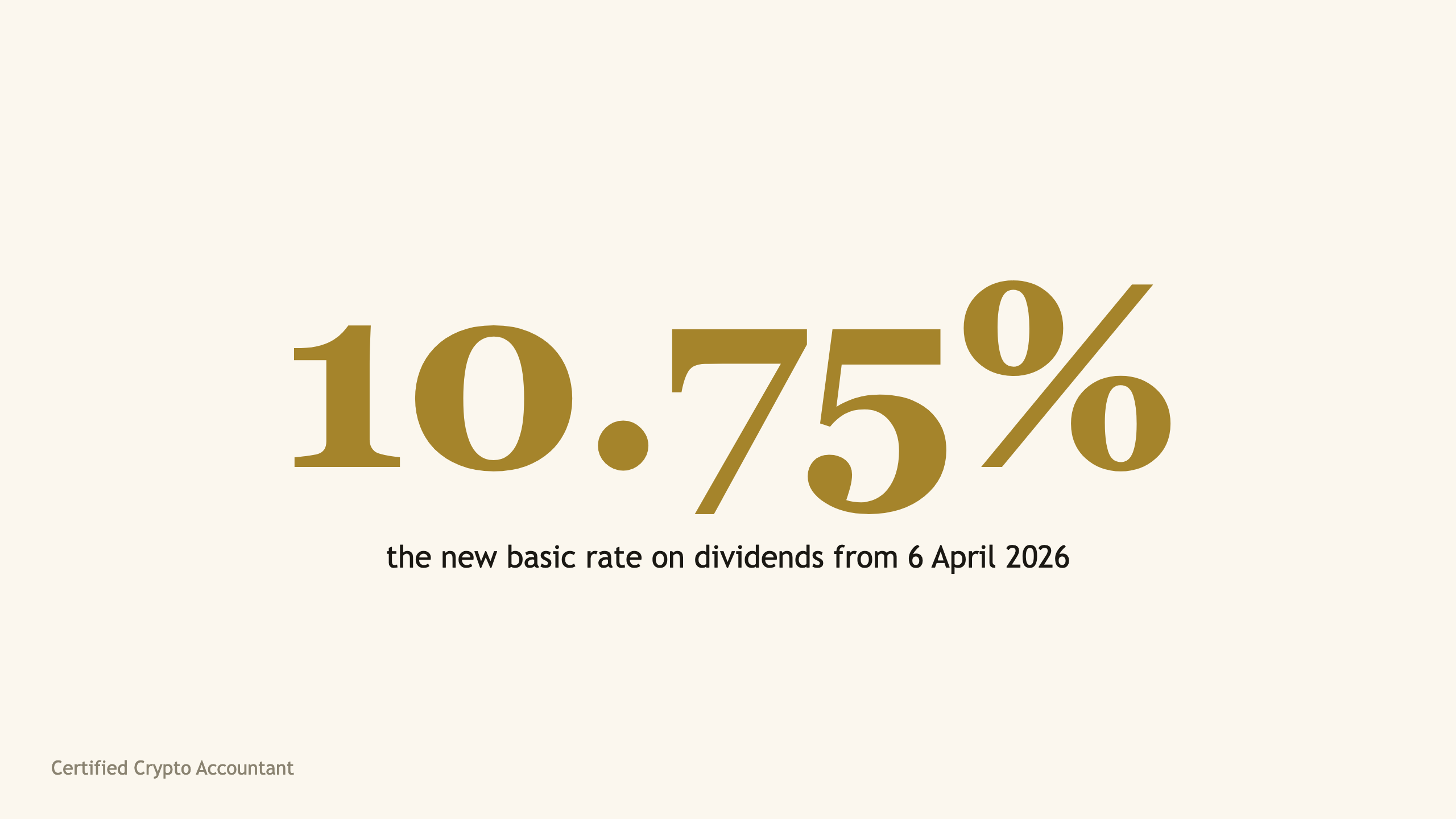
If you hold shares outside an ISA, the dividends they pay are taxed at higher rates this year than last, and the change arrived with very little noise. From 6 April 2026 the basic rate on dividends is 10.75% and the higher rate is 35.75%, per GOV.UK. Last year those figures were 8.75% and 33.75%. The additional rate stays at 39.35%. On £10,000 of taxable dividends at basic rate, that is £200 more than the same dividends cost the year before.
None of this touches dividends inside an ISA or a pension. It only reaches what you hold in a general investment account, or shares in your own company.
A rate rise with no letter attached is still a rate rise. Check which band your dividends land in before January, not after.
How the £500 allowance works
Every taxpayer gets a £500 dividend allowance each year. Dividends inside it are taxed at nil, whatever band you are in. Dividends that fall within your unused Personal Allowance are not taxed either, which matters for anyone with low income and a portfolio, since up to £12,570 of income including dividends can sit inside the Personal Allowance before either tax starts.
The allowance was £5,000 as recently as 2017. It has been cut repeatedly, to £2,000, then £1,000, then £500, which is why dividend tax now reaches people with quite ordinary portfolios. A holding yielding 4% breaches the £500 allowance at £12,500 of investments.
Working out which rate you pay
Dividends sit on top of your other income. Add your total dividend income to everything else, take off the Personal Allowance, and whichever band the dividends land in sets the rate. They can straddle two bands, in which case part is taxed at 10.75% and part at 35.75%.
| Where the dividends land in 2026 to 2027 | Rate on dividends above the £500 allowance |
|---|---|
| Within the Personal Allowance | 0% |
| Basic rate band | 10.75% |
| Higher rate band | 35.75% |
| Additional rate | 39.35% |
GOV.UK’s own worked example runs like this. Wages of £29,570 and dividends of £3,000 make £32,570 of income. The Personal Allowance takes £12,570 off, leaving £20,000, all inside the basic rate band. The wages part is taxed at 20%, £500 of the dividends are covered by the allowance, and the remaining £2,500 of dividends are taxed at 10.75%.
When you have to tell HMRC
You report dividends once they exceed both your unused Personal Allowance and the £500 dividend allowance. For most employed people with a portfolio that means Self Assessment, and if this is the first year it happens, the registration deadline is 5 October after the tax year ends. Dividends from your own company always mean a return once they pass the allowance.
If you already file for capital gains, the dividends go on the same return, and the two interact, since your gains and your dividends both stack on the same income to find their rates. Our guide to how capital gains are taxed covers the gains half of that stack.
What stays tax free
Dividends inside an ISA are not taxed and never reported. Dividends inside a pension likewise. Shares held jointly with a spouse split the income between you, which doubles the allowances in play, the same mechanism that works for the capital gains allowance. And if your only untaxed income is a small dividend stream under £500, there is nothing to do at all.
Dividends rarely arrive alone, and our capital gains tax accountants put them on the same return as the disposals they came with.
Dividend questions
What is the dividend tax rate for 2026 to 2027?
Above the £500 allowance, 10.75% at basic rate, 35.75% at higher rate and 39.35% at additional rate. The first two rose on 6 April 2026 from 8.75% and 33.75%.
Do I pay tax on dividends in an ISA?
No. Dividends inside an ISA are tax free and do not use up the £500 allowance. They never need reporting.
How much dividend income is tax free?
£500 under the dividend allowance, plus anything covered by your unused Personal Allowance. Both apply automatically.
Do I need a tax return for dividends?
Once your dividends exceed both your unused Personal Allowance and the £500 dividend allowance you need to report to HMRC, which for most people means Self Assessment.
Sources
Every figure on this page was checked against the source below on 25 August 2026.
- Tax on dividends. GOV.UK, checked 25 August 2026
- Income Tax rates and Personal Allowances. GOV.UK, checked 25 August 2026
- Self Assessment tax returns, deadlines. GOV.UK, checked 25 August 2026
- Individual Savings Accounts. GOV.UK, checked 25 August 2026
Fahad Zar
Crypto tax accountantAAT licensed 1010475
- AAT Licensed Accountant and MAAT, licence 1010475
- MSc Accounting and Finance, BPP University London
- Six years inside digital asset accounting, across several crypto tax firms
- Practises through Zar Enterprises Ltd, ICO registration ZC225094
- Supervised for anti-money laundering by the AAT
What matters to me is that the number on the return is true, whatever it turns out to be.
Whether this is worth a conversation
Where this stops being a reading job and starts being a hiring one.
- Dividends crossed the £500 allowance
- Company payouts meet crypto gains on one return
- You are not sure what your company should pay you
If your dividends are under £500 and your shares sit in an ISA, there is nothing to do and nobody to pay.
If one of these is you, the first look costs nothing.
Read next
Your capital gains tax allowance for 2026 to 2027
The other allowance in the same stack, and it works differently.
Reviewed 25 August 2026ExplainerCapital gains tax on shares
What happens when you sell the shares rather than hold them for income.
Reviewed 25 August 2026DeadlineHow to register for Self Assessment
The 5 October step if this is your first year needing a return.
Reviewed 25 August 2026Deep guideCrypto tax for limited companies
Where dividends from your own company meet a crypto balance sheet.
Reviewed 25 August 2026 ExplainerTrading 212 does not report your trades to HMRC and the pooling rules decide what you owe
What Trading 212 reports to HMRC, which is nothing, and what you report instead.
Reviewed 5 September 2026