
Selling your home rarely triggers capital gains tax

Published 13 August 2026· Reviewed against gov.uk 25 August 2026· 4 min read·Capital gains tax
If the house you are selling has been your only home for the whole time you owned it, you will almost certainly pay no capital gains tax at all. Private Residence Relief covers the lot, no forms, no claim, no tax. Most of the worry behind this search evaporates right there.
The rest of this post is about the exceptions, because every one of them is common, and people discover them at completion rather than before.
When your own home is fully covered
GOV.UK sets the conditions. Full relief applies when the property has been your only or main residence throughout ownership, you have not let part of it out (a single lodger is fine), no part has been used exclusively for business, the grounds are under 5,000 square metres, and you did not buy it mainly to make a gain. Meet all of that and the sale is not even reportable.
The five ways people fall out of full relief
Years lived elsewhere. Relief follows residence. If you owned for fifteen years and lived in it for ten, a slice of the gain is exposed. The final nine months of ownership always count as covered, whether you lived there or not, per helpsheet HS283, which is the buffer that saves most people who moved out while selling. Certain absences, work postings among them, can also count as deemed residence with conditions attached.
Letting it out. The let years fall outside relief. The old lettings relief that used to soften this has narrowed to shared-occupation cases only, so a few years as an accidental landlord now genuinely costs money at sale.
Exclusive business use. A room used only as an office loses its share of relief. The word doing the work is exclusively, a home office that doubles as a spare room does not trip this, which is a design choice worth making deliberately.
Two homes and no election. Own two properties you live between, and which one is your main residence is a question of fact unless you nominate one within two years. High earners with a flat in town and a house elsewhere give away real money by never making the election.
Bought to do up and sell. Relief is for homes, and HMRC can deny it where the property was acquired for profit-making. Serial renovators drift toward being treated as traders altogether, a boundary policed by the badges of trade.
If tax is due, the clock is short
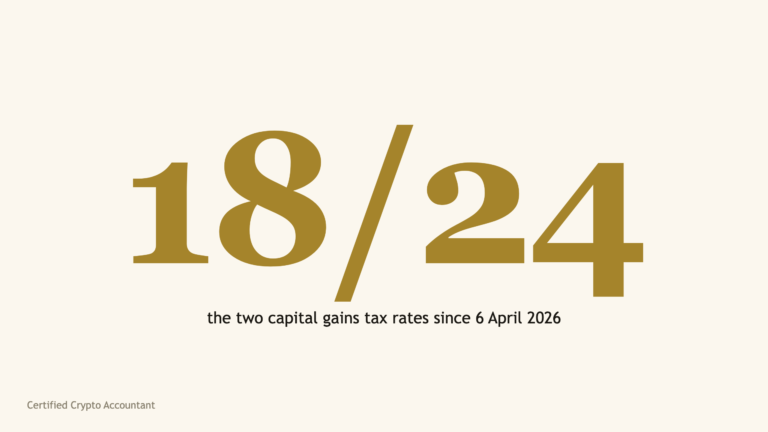
Any taxable slice of a UK residential property gain must be reported and paid within 60 days of completion, on its own return, before your tax return ever gets involved. Residential gains are taxed at 18% and 24% depending on your income, the split our calculator works out. Partial-relief calculations lean on dates, months of residence against months of ownership, so the paperwork that matters is the timeline of when you actually lived there.
Selling a property that was never your home is a different article, and a shorter one, since none of the relief above applies. That is tomorrow’s post on second properties. And if the house came to you through an estate, the base cost works differently in your favour, which we cover the day after.
House sale questions
Do I pay capital gains tax when I sell my house?
Not if it was your only or main home throughout ownership and the other conditions hold. Full Private Residence Relief means no tax and nothing to report.
I moved out eight months ago and it has not sold. Problem?
No. The final nine months of ownership qualify for relief automatically. Beyond nine months, exposure starts to build month by month, which is an argument against letting a sale drift.
I worked from home through the pandemic. Did I lose relief?
Only rooms used exclusively for business lose their share. Ordinary working from a room that stayed part of the home does not.
We rented our old house out for three years before selling. What now?
Those years sit outside relief, so a proportion of the gain is taxable, the 60 day rule applies, and the computation needs doing properly, residence months, the nine month buffer, improvement costs. It is exactly the kind of calculation worth an hour of professional time before the completion date starts the clock.
If your sale has any of the wrinkles above, run the numbers before completion, not after, because the 60 day deadline does not wait for you to find an accountant. Our free review is the fast way to find out whether you have a liability at all.
Sources
Every figure on this page was checked against the source below on 25 August 2026.
- GOV.UK sets the conditions. GOV.UK, checked 25 August 2026
- Helpsheet HS283. GOV.UK, checked 25 August 2026
- Reported and paid within 60 days of completion. GOV.UK, checked 25 August 2026
- 18% and 24%. GOV.UK, checked 25 August 2026
Fahad Zar
Crypto tax accountantAAT licensed 1010475
- AAT Licensed Accountant and MAAT, licence 1010475
- MSc Accounting and Finance, BPP University London
- Six years inside digital asset accounting, across several crypto tax firms
- Practises through Zar Enterprises Ltd, ICO registration ZC225094
- Supervised for anti-money laundering by the AAT
What matters to me is that the number on the return is true, whatever it turns out to be.
Whether this is worth a conversation
Most people who read this page do not need an accountant. A few do.
- Your gains are near the £3,000 line
- You have swapped tokens and doubt the numbers
- You have old losses nobody ever claimed
If you sold one holding once and the figures are plain, file it yourself. Paying someone to check arithmetic you can do is not a service.
If one of these is you, the first look costs nothing.
Read next
Your capital gains tax allowance for 2026 to 2027
£3,000 per person, resets each April, never carries forward. How the annual exempt amount works, the spouse doubling,…
Reviewed 25 Aug 2026ExplainerHow to report capital gains on your Self Assessment
Gains go on the SA108, property runs on its own 60 day track, and proceeds over £50,000 mean reporting even with no tax…
Reviewed 25 Aug 2026ExplainerCapital gains tax on shares and the 30 day trap
Share matching rules define your cost, the 30 day rule rewrites rebuys, and accumulation funds hide base cost. What…
Reviewed 25 Aug 2026DeadlineUnclaimed capital losses expire after four years
A loss HMRC has never been told about is worth nothing, and the claim window closes four years after the tax year ends.…
Reviewed 25 Aug 2026