What you actually pay on crypto gains in 2026 to 2027

Published 3 June 2026· Reviewed against gov.uk 25 August 2026· 6 min read·Reducing your tax
UK crypto capital gains tax rules changed on 30 October 2024, when the Autumn Budget raised the rates for digital assets in line with property. The annual allowance also dropped to £3,000 from April 2024. Combined, the changes mean a typical UK crypto holder filing for the 2024-25 tax year onwards faces materially higher tax than two years earlier.
Here is exactly how crypto gains tax works in the UK for the 2026-27 tax year, with the current rates, allowance, calculation method, and the specific forms you need.
Current UK Crypto Gains Tax Rates
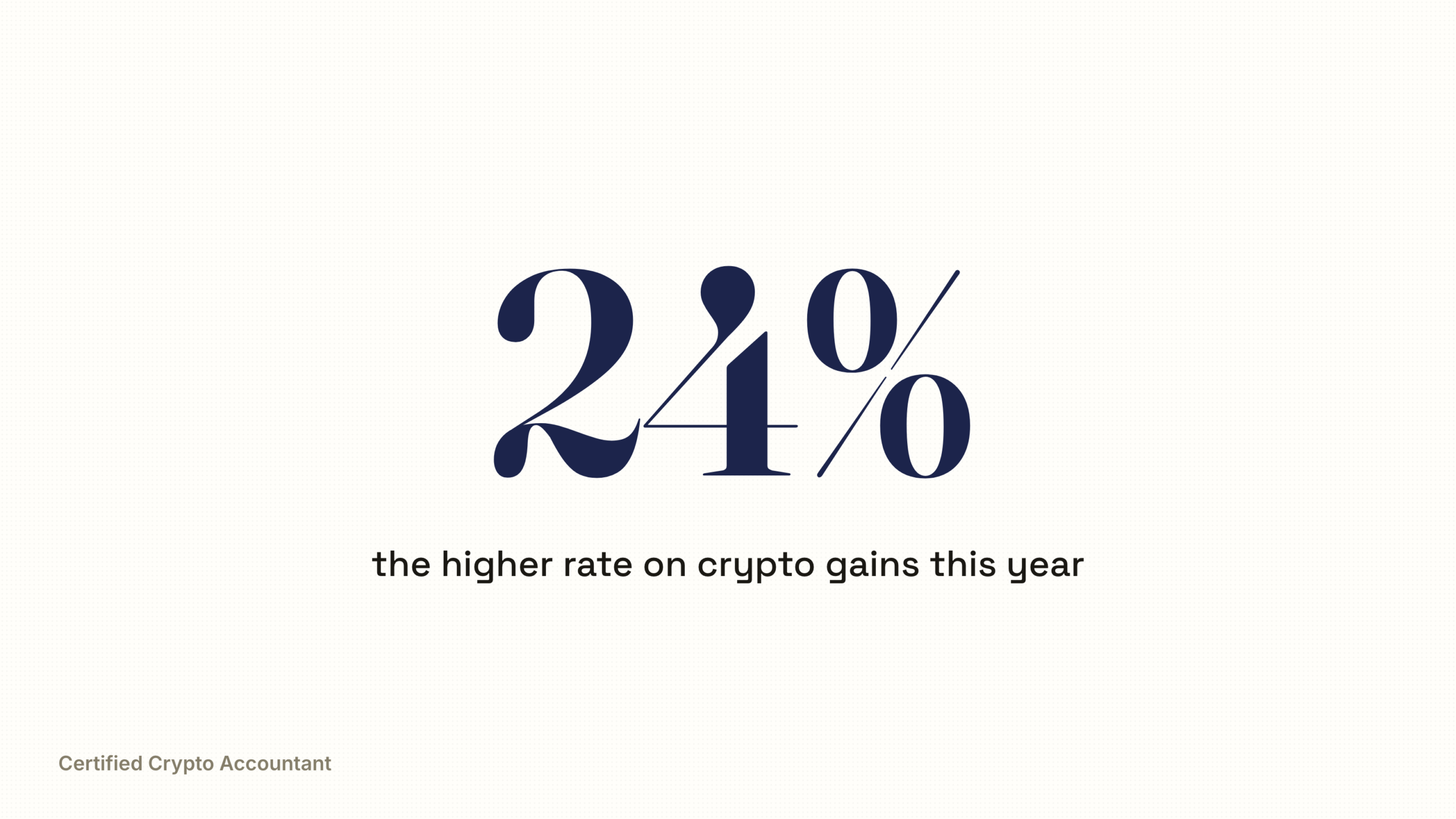
For disposals on or after 30 October 2024, the rates are 18 percent if your total income plus gains stays within the basic rate band (currently up to £50,270), and 24 percent on any portion of gains that falls in the higher or additional rate band.
For disposals between 6 April 2024 and 29 October 2024, the pre-Budget rates apply: 10 percent basic rate and 20 percent higher and additional rate. If you disposed of crypto in both periods within the 2024-25 tax year, the SA108 splits the calculation by date. HMRC’s online filing tool handles this automatically.
The annual exempt amount for 2026-27 is £3,000, down from £6,000 in 2023-24 and £12,300 in 2022-23. This is the amount of total capital gains across all assets (crypto, shares, property) you can realise before any CGT is due.
What Counts as a Disposal
HMRC’s Cryptoassets Manual (CRYPTO22000) treats the following as a disposal subject to capital gains tax:
1. Selling crypto for GBP, USD, EUR or any fiat currency.
2. Swapping one crypto for another (BTC to ETH, USDC to USDT).
3. Spending crypto to buy goods or services.
4. Gifting crypto to anyone other than your spouse or civil partner.
5. Bridging or wrapping (HMRC’s position remains that this is a disposal of the original asset and acquisition of a new one).
Transferring crypto between wallets you control is not a disposal. Moving BTC from Coinbase to a Ledger does not trigger CGT.
How HMRC Calculates Your Gain
Cost basis is calculated using Share Pooling under TCGA 1992 s.104, with two override rules.
Rule 1: same-day rule. Disposals are matched first to acquisitions made on the same day.
Rule 2: bed and breakfasting (30-day rule). Disposals are then matched to acquisitions made in the next 30 days.
Rule 3: Section 104 pool. Everything else falls into the pool, with cost basis averaged across all units in the pool.
Most crypto tax software defaults to FIFO. FIFO is wrong for UK tax. Koinly, CoinTracker, and Recap each offer a UK Share Pooling setting, but you have to enable it. If your software is set to FIFO, your gain figure is incorrect.
Worked Crypto Capital Gains Tax example for 2026-27
In January 2026 you buy 1 BTC at £30,000. In March 2026 you buy 1 BTC at £50,000. In October 2026 you sell 1 BTC at £70,000.
Section 104 pool cost basis equals (30,000 plus 50,000) divided by 2, which is £40,000 per BTC. Sale of 1 BTC equals £70,000 proceeds minus £40,000 cost basis, giving a £30,000 gain. After the £3,000 allowance, £27,000 is taxable. At 24 percent (higher rate), tax due is £6,480.
How and When to File Crypto Tax
Capital gains from crypto go on SA108 (Capital Gains Summary) attached to your SA100 Self Assessment return. The current filing deadlines are 31 October following the tax year end for a paper return, and 31 January following the tax year end for an online return. Tax payment is also due on 31 January.
You must file if any of the following applies:
- Total gains exceeded the £3,000 annual exempt amount.
- Total proceeds (not gains) exceeded £50,000 in the tax year, even if no gain arose.
- You incurred a loss you want to register for carry-forward.
The £50,000 proceeds reporting threshold is the one most UK crypto holders trip over. Even if your net gain was zero or a loss, total sales above £50,000 require reporting.
Staking, Mining, and Airdrops Are Not Capital Gains
Staking rewards, mining income, and most airdrops are taxed as miscellaneous income at the moment of receipt, not as capital gains. They go on the SA100 main return, not the SA108. See our staking guide for the full breakdown.
When you later sell those same tokens, then you have a capital gains event using the GBP value at receipt as cost basis.
Common Errors That Cost Money
Three patterns appear repeatedly in client reviews.
- Error 1: FIFO instead of Share Pooling. This overstates gains by 15 to 40 percent in volatile periods.
- Error 2: missing cost basis on transferred-in coins. This overstates gain by the full original cost.
- Error 3: wallet transfers booked as disposals. This creates phantom gains where no real disposal occurred.
Get the Numbers Right Before You File
The £3,000 allowance plus 18 to 24 percent rates means every miscategorised disposal directly costs money. Filing the wrong figure also creates HMRC nudge letter risk through CARF exchange data matching from 2026 onwards.
At Certified Crypto Accountant we file UK Self Assessment returns for crypto holders every week. We reconcile transactions under HMRC Share Pooling rules and file the SA108 with cost basis correctly applied.
Book a free 30-minute review at Certified Crypto Accountant. We will check your numbers and tell you exactly where you stand.
References and Further Reading
1. HMRC Cryptoassets Manual hub: https://www.gov.uk/hmrc-internal-manuals/cryptoassets-manual
2. HMRC CRYPTO22000 (Capital gains tax on crypto): https://www.gov.uk/hmrc-internal-manuals/cryptoassets-manual/crypto22000
3. HMRC Capital Gains Tax rates and allowances: https://www.gov.uk/capital-gains-tax/rates
4. HMRC SA108 Capital Gains Summary form: https://www.gov.uk/government/publications/self-assessment-capital-gains-summary-sa108
5. Autumn Budget 2024 (CGT rate change): https://www.gov.uk/government/publications/autumn-budget-2024
6. TCGA 1992 Section 104 (Share Pooling): https://www.legislation.gov.uk/ukpga/1992/12/section/104
7. HMRC Self Assessment deadlines: https://www.gov.uk/self-assessment-tax-returns/deadlines
8. Koinly UK Share Pooling setting: https://koinly.io/guides/hmrc-cryptocurrency-tax-guide/
Run the numbers first with the capital gains tax calculator, which is free and needs no email. If the answer looks wrong, that usually means the acquisition costs need rebuilding, and that is what a capital gains tax accountant does.
Crypto gains questions
Do I pay tax if I never cashed out to pounds?
Yes, if you disposed of anything. Swapping one token for another is a disposal, and so is spending crypto or gifting it to anyone other than a spouse. None of those need a bank transfer.
How much is capital gains tax on crypto?
Above the £3,000 annual exempt amount, 18% on gains that fit inside your remaining basic rate band and 24% above it. Your income fills the band first, so one disposal can be taxed at both rates.
What if my gains are under the allowance?
No tax is due. You may still have to report if you are already in Self Assessment and your total proceeds for the year exceeded £50,000, which active traders reach without large gains.
Can I use losses from a bad year?
Yes, once you have claimed them. A loss only becomes allowable when you quantify it and tell HMRC, and the window closes four years after the end of the tax year it arose in.
Sources
Every figure on this page was checked against the source below on 25 August 2026.
- Https://www.gov.uk/hmrc-internal-manuals/cryptoassets-manual. GOV.UK, checked 25 August 2026
- Https://www.gov.uk/hmrc-internal-manuals/cryptoassets-manual/crypto22000. GOV.UK, checked 25 August 2026
- Https://www.gov.uk/capital-gains-tax/rates. GOV.UK, checked 25 August 2026
- Https://www.gov.uk/government/publications/self-assessment-capital-gains-summary-sa108. GOV.UK, checked 25 August 2026
- Https://www.gov.uk/government/publications/autumn-budget-2024. GOV.UK, checked 25 August 2026
- Https://www.legislation.gov.uk/ukpga/1992/12/section/104. legislation.gov.uk, checked 25 August 2026
- Https://www.gov.uk/self-assessment-tax-returns/deadlines. GOV.UK, checked 25 August 2026
Fahad Zar
Crypto tax accountantAAT licensed 1010475
- AAT Licensed Accountant and MAAT, licence 1010475
- MSc Accounting and Finance, BPP University London
- Six years inside digital asset accounting, across several crypto tax firms
- Practises through Zar Enterprises Ltd, ICO registration ZC225094
- Supervised for anti-money laundering by the AAT
What matters to me is that the number on the return is true, whatever it turns out to be.
Whether this is worth a conversation
Most people who read this page do not need an accountant. A few do.
- A big disposal is coming
- You have losses and reliefs sitting unused
- You want the plan checked before you act
If the move you are weighing is using this year's allowance before April, just use it.
If one of these is you, the first look costs nothing.
Read next
Gifting crypto outside marriage triggers capital gains tax
Gifting crypto in the UK is usually a disposal for Capital Gains Tax, even with no cash changing hands. When it is…
Reviewed 25 Aug 2026Deep guideWays to pay less crypto tax that HMRC accepts
Legal ways to reduce your UK crypto tax: the CGT allowance, loss harvesting, spouse transfers, pensions and timing.…
Reviewed 25 Aug 2026Deep guideHow to use crypto losses to cut your capital gains bill
Crypto loss harvesting can legally cut your UK Capital Gains Tax, but the 30-day bed and breakfasting rule catches most…
Reviewed 25 Aug 2026Deep guideDonating crypto to charity is not always the cheaper route
Donating crypto to charity in the UK can be free of Capital Gains Tax and may cut your Income Tax. How the relief works…
Reviewed 25 Aug 2026 ExplainerYou can owe crypto tax without ever selling for pounds
Why a swap or a spend is taxed before any pounds arrive.
Reviewed 5 September 2026ExplainerDo I need to declare crypto to HMRC
When crypto has to be declared, including the proceeds rule that catches small gains.
Reviewed 5 September 2026