Capital gains tax did not move at the Budget, and three crypto changes start on 6 April 2027

Published 29 October 2026 Reviewed against gov.uk 29 October 2026 10 min readCapital gains tax
The Budget speech was on Wednesday 28 October 2026 and the documents went up on GOV.UK the same afternoon. We read them in the order the pre-Budget post promised, the Overview of Tax Legislation and Rates and its rates annex first, then the Budget document, then every HMRC paper with capital gains, cryptoassets, penalties or compliance in the title. This is what they say for people who hold, trade, lend or get paid in crypto, checked on GOV.UK on 29 October 2026, with nothing taken from a news site.
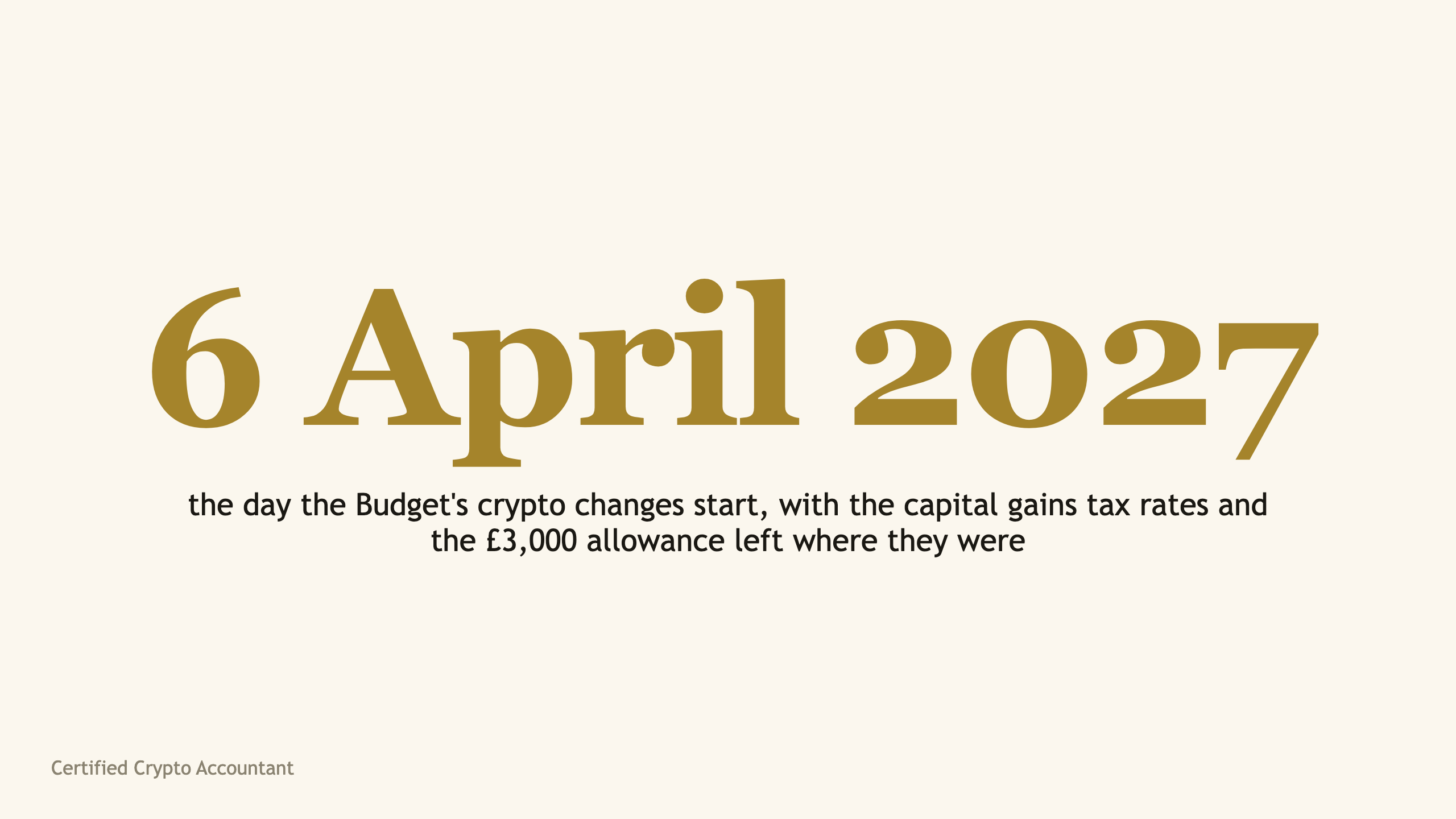
The rate did not move. The base did, and every change that matters starts on 6 April 2027, which leaves about five months to get the pooled cost of every stablecoin and every lent coin right.
What stayed exactly where it was
Capital Gains Tax did not move. Annex A of the Overview of Tax Legislation and Rates shows the rates for gains on assets at 18% for a basic rate payer and 24% for a higher rate payer in both 2026 to 2027 and 2027 to 2028, with trustees and personal representatives at 24%. The annual exempt amount stays at £3,000 for individuals and personal representatives and £1,500 for most trustees in both years. The Business Asset Disposal Relief rate stays at 18%, though its lifetime limit halves to £500,000 for disposals from 6 April 2027, and a new Founders’ Relief at 10% on up to £10 million of lifetime gains arrives the same day for qualifying share disposals. Neither touches a crypto gain.
Income Tax rates and bands are unchanged too, with the personal allowance at £12,570 and the basic rate band ending at £37,700 of taxable income for 2027 to 2028, which matters because the 18% band for gains is whatever is left of your basic rate band after income. Dividend rates and the £500 dividend allowance are unchanged. The cash ISA limit stays at £20,000, which the Budget document says the government decided not to reduce. For a crypto investor whose gains are the whole story, the 2027 to 2028 computation looks exactly like this year’s.
If you sold in October to beat a rise
You paid tax early for nothing, and the sale stands. A disposal made on 15 October to beat a rate that did not change is still a disposal at 18% or 24% on the 2026 to 2027 return, due 31 January 2028. If you bought the same coin back within 30 days, HMRC’s matching rule pairs the sale with the repurchase before it touches your pool, so the gain you meant to lock in is still sitting there and the sale produced only a small gain or loss on the price move in between. The 30 day post works the arithmetic through with a Bitcoin example, and the shares version is identical. The question people typed into Google all week, whether a pre-Budget sale is grandfathered, has no work to do. Nothing changed, so there is nothing to be grandfathered from.
Stablecoins leave Capital Gains Tax on 6 April 2027
This is the biggest change for anyone who parks gains in USDT or USDC between trades. HMRC’s stablecoins paper, first published on 13 July and updated with the Budget, treats eligible stablecoins “more like money for tax purposes” from 6 April 2027 for individuals and trustees and 1 April 2027 for companies. An eligible stablecoin is one designed as a means of payment or settlement, holding a stable value against a fiat currency with fiat or other assets held to support it, and widely available. From that date, disposals of eligible stablecoins by individuals and trustees are exempt from Capital Gains Tax. A swap from Bitcoin into a stablecoin is still a disposal of the Bitcoin, but the later swap out of the stablecoin, and the small gains and losses from the peg moving against sterling, drop out of the computation.
Two parts of the paper matter more than the headline. First, the transition. Anyone already holding eligible stablecoins on 6 April 2027 gets a transitional gain or loss based on market values at commencement, and can elect to defer it until the stablecoins are disposed of. If your stablecoin pool carries a loss, because you acquired it at a higher sterling value than it holds today, the transition is where that loss is either used or lost, and the election is a choice to make with the figures in front of you. Second, income. Interest-like returns from a debt of eligible stablecoins, which is what most exchange earn products on stablecoins are, will be taxed as savings income rather than miscellaneous income. Annex A puts the savings rates at 24%, 44% and 49% from the same day, four points above the main rates, after the £1,000 or £500 personal savings allowance. Until 6 April 2027 every one of these transactions is taxed exactly as it is now. HMRC says around 1.2 million people engage in stablecoin transactions and scores the Exchequer cost as negligible.
Lending and liquidity pools stop being disposals
The cryptoasset loans and liquidity pools paper, also updated for the Budget, confirms the no gain, no loss rule for the Finance Bill with a start date of 6 April 2027. Three arrangements are covered. A single cryptoasset lending arrangement, where you hand over coins and acquire a right to receive the same type of coins back plus a return, is treated as no gain, no loss on the way in and on the way out, so the Capital Gains Tax waits for an economic disposal. A single cryptoasset borrowing arrangement treats the borrowed coins as acquired at market value when borrowed, repayment as a disposal at that value, and any collateral you post as disregarded. An automated market making arrangement, the smart contract liquidity pool, is no gain, no loss on entry and on exit to the extent the coins that come back match the coins that went in, with any difference in quantity producing a gain or a loss. HMRC puts it at about 700,000 people and a negligible Exchequer effect.
Three things the paper does not do. It does not mention staking, so a staking reward is still taxed as income when it arrives and locking coins into a validator is still judged on today’s guidance. It does not say what happens when the coins are never returned, which is the question every lender from 2022 still has, and our loss post covers the negligible value route that remains. And it does not start until 6 April 2027, so every deposit into an earn product or a pool between now and then is a disposal under the current rules, which is the trap the liquidity pool guide explains with figures.
The trading allowance triples, and it covers staking income
The trading allowance paper raises the allowance from £1,000 to £3,000 from 6 April 2027 and raises the Self Assessment reporting threshold for trading income to £3,000 with it. The allowance applies to trading income and miscellaneous income, and miscellaneous income is how HMRC’s cryptoassets manual taxes staking rewards for someone who is not trading. So from 2027 to 2028, up to £3,000 of staking or mining rewards in a year can sit under the allowance instead of being added up and reported. HMRC says up to 1.4 million people could benefit, that about 400,000 would see an average saving of £380, and that 100,000 would no longer need to report at all. The allowance is an either or, the £3,000 or your actual expenses, never both, and it does nothing for the Capital Gains Tax on the rewards when you later sell them.
The compliance numbers nobody else will read
The Budget document promises 670 more compliance officers on top of the 5,500 already being recruited, and scores its package of tax gap measures at over £12 billion a year by 2029 to 2030. The document with the crypto figures is HMRC’s multi-year plan for wealthy compliance, published the same afternoon. Its cryptoasset case study records over 180,000 educational communications issued, over 800 disclosures received through the Cryptoasset Disclosure Service, and over £188 million of cryptoasset compliance yield in 2025 to 2026, of which over £168 million came from activity designed to get people to file correctly before a check starts. From 2027 the plan says HMRC will use Cryptoasset Reporting Framework data and enhanced Common Reporting Standard data to see cryptoasset transactions, e-money products and indirect crypto holdings. Penalties charged to wealthy individuals rose from 456 in 2023 to 2024 to 803 in 2025 to 2026, with a mandatory referral process for complex penalty cases since April 2026. Wealthy, in HMRC’s definition, means income over £200,000 or assets over £2 million in any of the last three years, which one good crypto year reaches on its own.
One line in the Overview deserves its own sentence. Measure 1.89 modernises HMRC’s civil information powers and, in the words of the policy paper, expands the scope of the Financial Institution Notice to include cryptoasset service providers, from Royal Assent to the Finance Bill. A Financial Institution Notice is the one third party notice that does not need tribunal approval, only an authorised HMRC officer, so once the Bill passes HMRC can ask an exchange for a named customer’s records the way it asks a bank today. Our guide to what HMRC can see explains the routes it already uses.
What changes later, with the dates
Four more measures reach ordinary taxpayers, none of them this tax year. A statutory duty to correct an inaccurate return once you know about it, with a new customer correction notice, from 1 April 2028. More regular in-year payments for Self Assessment taxpayers who make payments on account, from April 2029, with the design to be published next year, and capital gains sit outside payments on account in any case. A consultation on reforming the offshore penalties framework later this year. And, already in force from 28 October 2026, late filing penalties for a missed UK property disposal return stop accruing once the disposal is reported and paid through Self Assessment, which closes a trap that caught people who sold a flat and reported it in January. Making Tax Digital for Income Tax goes ahead for the April 2027 joiners with no late submission penalty points for quarterly updates in 2027 to 2028.
What to do now
On the rates, nothing. On the sale you made in October, check the 30 day window before you buy back, and if you have already bought back, get the matching right on the return rather than the figure you hoped for. If you hold stablecoins through 5 April 2027, know your pooled cost before the transition date, because the election only helps if you know which way the number points. If you lent coins or sat in a pool in 2022 to 2023 and never claimed the loss, the deadline is 5 April 2027 and the new rule does not reach back. And if any exchange year is unfiled, HMRC’s own plan says the letters follow the data, and the cryptoasset disclosure route is cheaper than the letter.
Budget questions
Did capital gains tax change in the 28 October 2026 Budget?
No. Annex A of the Overview of Tax Legislation and Rates keeps the rates at 18% and 24% and the annual exempt amount at £3,000 for 2027 to 2028, the same as 2026 to 2027. The only capital gains changes are the Business Asset Disposal Relief lifetime limit falling to £500,000 and a new 10% Founders' Relief, both for share disposals from 6 April 2027.
Is the capital gains tax allowance going down in 2027 to 2028?
No. The annual exempt amount is £3,000 for individuals and personal representatives and £1,500 for most trustees in both 2026 to 2027 and 2027 to 2028.
Are stablecoins tax free in the UK now?
Not yet. From 6 April 2027 disposals of eligible stablecoins by individuals and trustees are exempt from Capital Gains Tax, with a transitional gain or loss computed on holdings at that date. Until then a swap into or out of a stablecoin is a disposal taxed in the normal way, and interest-like returns on stablecoins become savings income from the same date.
Is DeFi lending still a disposal?
Until 5 April 2027, yes. From 6 April 2027 entering and exiting a single cryptoasset lending arrangement or a liquidity pool with the same type of coin is treated as no gain, no loss, so the tax waits for an economic disposal. The paper does not cover staking.
Did the Budget announce new crypto penalties?
No new penalty. HMRC's wealthy compliance plan shows penalties on wealthy individuals rising from 456 to 803 in two years, and the Finance Bill lets HMRC serve a Financial Institution Notice on a cryptoasset service provider without tribunal approval. A duty to correct errors starts on 1 April 2028.
Does the £3,000 trading allowance apply to staking rewards?
From 6 April 2027 the allowance covers trading and miscellaneous income, and HMRC taxes staking rewards as miscellaneous income unless you are trading. Up to £3,000 of such rewards a year can sit under the allowance, instead of the £1,000 that applies now.
Sources
Every figure on this page was checked against the source below on 29 October 2026.
- Budget 2026, Overview of tax legislation and rates, Annex A rates and allowances. HM Revenue and Customs, checked 29 October 2026
- Budget 2026, Overview of tax legislation and rates. HM Revenue and Customs, checked 29 October 2026
- Budget 2026 document. HM Treasury, checked 29 October 2026
- Taxation of stablecoins. HM Revenue and Customs, checked 29 October 2026
- Tax treatment of cryptoasset loans and liquidity pools. HM Revenue and Customs, checked 29 October 2026
- Increasing the trading allowance. HM Revenue and Customs, checked 29 October 2026
- Modernising HMRC's approach to wealthy compliance. HM Revenue and Customs, checked 29 October 2026
- Reforming civil tax information and inspection powers. HM Revenue and Customs, checked 29 October 2026
- CRYPTO22250, the 30 day rule. HM Revenue and Customs, checked 29 October 2026
- CRYPTO21200, staking. HM Revenue and Customs, checked 29 October 2026

Fahad Zar
Crypto tax accountantAAT licensed 1010475
- AAT Licensed Accountant and MAAT, licence 1010475
- MSc Accounting and Finance, BPP University London
- Six years inside digital asset accounting, across several crypto tax firms
- Practises through Zar Enterprises Ltd, ICO registration ZC225094
- Supervised for anti-money laundering by the AAT
What matters to me is that the number on the return is true, whatever it turns out to be.
Whether this is worth a conversation
Where this stops being a reading job and starts being a hiring one.
- You sold crypto in October and bought back, and need the matched figure rather than the one you hoped for
- You hold stablecoins or have coins out on loan and want the pooled cost right before 6 April 2027
- You have an unfiled exchange year and HMRC's plan says the letters follow the data
If every year is filed from a full reconciliation and you hold nothing in stablecoins or lending products, the Budget changes nothing for you until April 2027.
If one of these is you, the first look costs nothing.
Read next
No capital gains tax rise at the Budget, and the 30 day problem
The pre-Budget read and the matching arithmetic for October sellers.
Reviewed 29 October 2026Deep guideCrypto lending tax in the UK
The current rules, which apply to every loan until 5 April 2027.
Reviewed 29 October 2026Deep guideLiquidity pool tax in the UK
Why entering a pool is a disposal today, with figures.
Reviewed 29 October 2026Deep guideCrypto staking tax in the UK
Rewards as miscellaneous income, which the £3,000 allowance will cover.
Reviewed 29 October 2026