HMRC sent 81,000 crypto letters last year, four for every person who filed

Published 29 August 2026· Reviewed against gov.uk 29 August 2026· 5 min read·Crypto Tax
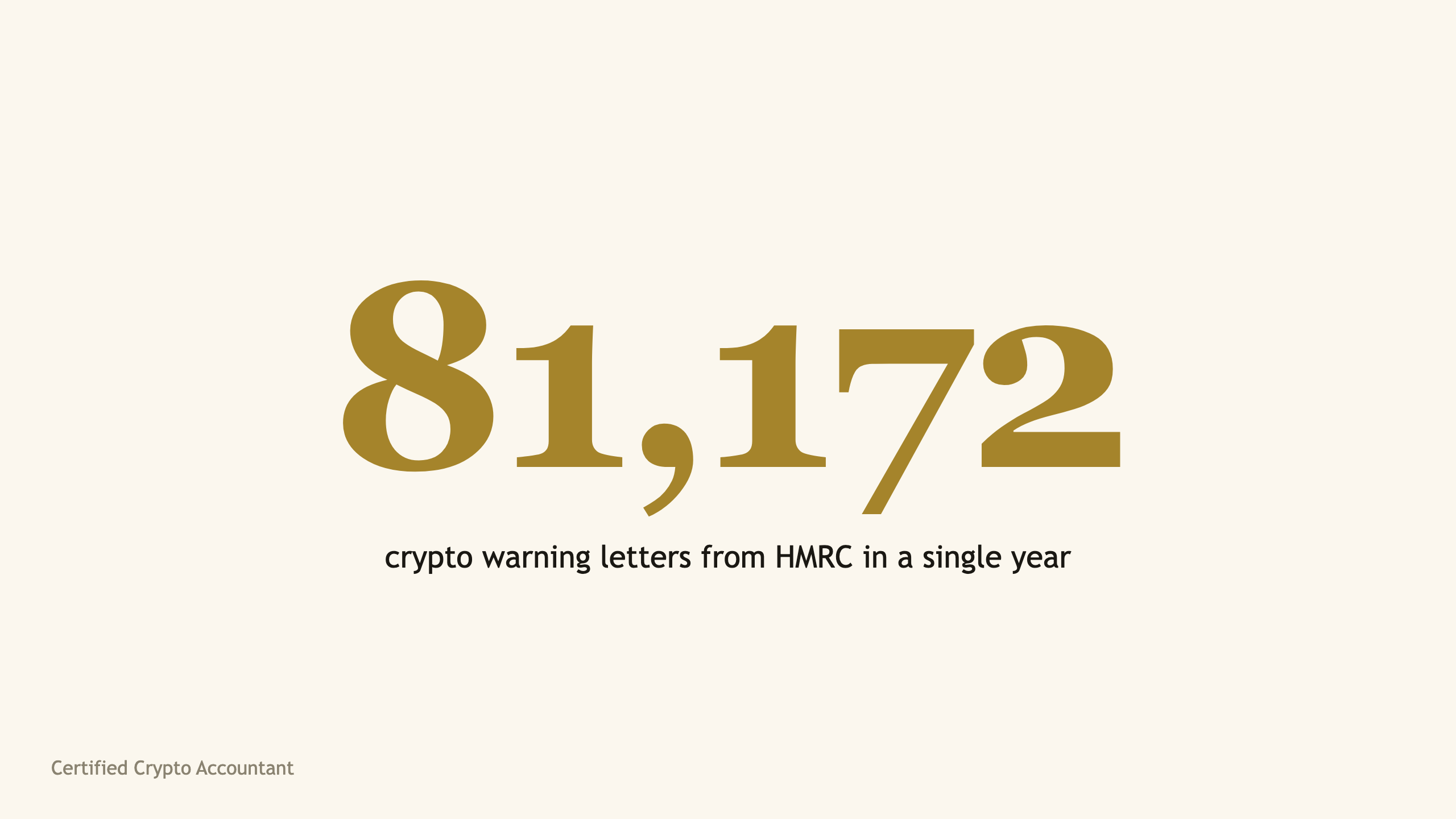
Two days ago, figures obtained by the accountancy group UHY Hacker Young put a number on something crypto holders have been feeling all year. HMRC posted 81,172 warning letters to cryptocurrency holders in the tax year that ended on 5 April 2026.
The trajectory matters more than the total. Two years ago the figure was 27,714. Last year it was around 65,000. The volume has tripled in two years, and it did so before HMRC held any automatic data about who owns what.
The letters tripled before HMRC held a single automatic data feed. From May 2027 it stops writing on suspicion and starts writing from records, and the cheap window to fix a position closes.
Four letters for every person who filed
Put the letters next to the reporting data HMRC published this week, which we broke down in the reporting gap article, and the scale becomes clear. In the most recent published year, 17,600 people in the entire country reported crypto gains. HMRC is now posting more than four letters for every self assessment return that mentioned crypto at all.

That ratio tells you what the letters are. They are not the product of individual investigations, there are nowhere near enough investigators for that. They are generated from data HMRC already holds, exchange information notices served on UK platforms, bank transfer patterns, and older disclosures, matched against returns that either said nothing about crypto or said less than the data suggested.
What a nudge letter actually is
A nudge letter is not a tax assessment, and receiving one does not mean HMRC has concluded you owe anything. It says, in effect, we believe you hold or held cryptoassets, we invite you to review your position, and we expect a response. The people it reaches have not been found to have evaded tax.
The danger sits in the two most common responses. Silence, which converts an invitation into a reason to open an enquiry. And guessing, where someone files or discloses a number they cannot support, which is worse than the gap it was meant to close. What to do instead, step by step, is in our guide to HMRC crypto nudge letters.
Every letter so far was written on partial data
The remarkable fact in the UHY figures is the timing. All 81,172 letters were generated before HMRC received a single automatic report under the Cryptoasset Reporting Framework. The current letters rest on fragments, a platform here, a bank pattern there.
That ends next May. By 31 May 2027, HMRC receives the first automatic feeds covering the whole of 2026, from UK platforms and from 52 jurisdictions including the Cayman Islands, the Channel Islands, Ireland and Liechtenstein, with another 15 jurisdictions joining a year later. The feeds carry complete transaction histories tied to full legal names, addresses and National Insurance numbers. The full mechanics are in our CARF guide.
Neela Chauhan, a partner at UHY Hacker Young, described what follows as shooting fish in a barrel. Strip the image out and the substance is this. Today a nudge letter is a question HMRC cannot yet answer itself. From May 2027 it becomes a statement, because HMRC will already hold the answer, and the letters will carry computed figures rather than invitations.
What to do, depending on where you stand
If a letter has already landed, respond inside the window, and do not respond with a guess. The response is an opportunity to establish an accurate position before anything hardens into an enquiry. Our nudge letter guide covers the sequence.
If no letter has arrived but your position has gaps, the arithmetic of timing is straightforward. A voluntary disclosure made before HMRC writes to you is treated more generously than one made after, on penalties and on posture. HMRC runs a dedicated disclosure route for cryptoassets, and what waiting costs is set out in our guide to crypto tax penalties.
If your records are the problem, dead exchanges, missing purchase prices, half imported transfers, that is a rebuild job, and it is almost always possible. Chain data survives every platform that dies, banks hold six years of statements, and old email archives hold more than people expect. The nine months before the first data feeds arrive are the cheapest this work will ever be.
And if your affairs are clean and filed, a letter is nothing to fear. Reply, point at your return, keep your records. You are the person the system was built to leave alone.
If one of those letters has your name on it, what the reply has to contain and how a disclosure is priced is on our crypto tax advisors page.
Questions on the letters
How many crypto warning letters has HMRC sent?
81,172 in the tax year ended 5 April 2026, according to figures obtained by UHY Hacker Young, up from around 65,000 the year before and 27,714 in 2023-24.
Does an HMRC nudge letter mean I am being investigated?
No. A nudge letter is not an assessment and not a finding. It invites you to review your crypto position and respond. Ignoring it, or replying with figures you cannot support, is what tends to escalate matters.
What data will HMRC receive about crypto in 2027?
From 31 May 2027, automatic reports covering 2026 from UK platforms and 52 jurisdictions, extending to around 67 a year later. The reports carry transaction histories tied to names, addresses and National Insurance numbers.
Should I disclose before HMRC contacts me?
An unprompted disclosure is treated more generously than a prompted one, on penalties and on posture. Once a letter arrives, or once the 2027 data lands, the same disclosure costs more.
Sources
Every figure on this page was checked against the source below on 29 August 2026.
- HMRC widened its net, 81,000 crypto letters. Accountancy Age, checked 29 August 2026
- HMRC sent 81,000 crypto tax letters as 2027 data reporting nears. FinanceFeeds, checked 29 August 2026
- Implementation of the Cryptoasset Reporting Framework. GOV.UK, checked 29 August 2026
- 240 crypto millionaires revealed in new government data. GOV.UK, checked 29 August 2026
Fahad Zar
Crypto tax accountantAAT licensed 1010475
- AAT Licensed Accountant and MAAT, licence 1010475
- MSc Accounting and Finance, BPP University London
- Six years inside digital asset accounting, across several crypto tax firms
- Practises through Zar Enterprises Ltd, ICO registration ZC225094
- Supervised for anti-money laundering by the AAT
What matters to me is that the number on the return is true, whatever it turns out to be.
Whether this is worth a conversation
Where this stops being a reading job and starts being a hiring one.
- A nudge letter has landed and you want the response built on numbers that hold
- Nothing has landed yet, your position has gaps, and you want it fixed before the 2027 data arrives
- Your records run through dead exchanges and you cannot prove what you paid
If your crypto is reported and your records are complete, a letter is a formality. Reply, point at your return, and carry on.
If one of these is you, the first look costs nothing.
Read next
The HMRC crypto nudge letter
What the letter actually says, and the response sequence that keeps it a letter.
Reviewed 29 August 2026ExplainerOnly 17,600 people reported crypto gains last year
The reporting data these letters collide with, broken down in full.
Reviewed 29 August 2026Deep guideDisclosing crypto to HMRC
The unprompted route, while unprompted is still a word that applies.
Reviewed 29 August 2026Deep guideCrypto tax penalties in the UK
The price list for waiting, with the maths shown.
Reviewed 29 August 2026 ExplainerCan HMRC see my crypto wallet
Where the data behind the letters comes from, and what a cold wallet does and does not hide.
Reviewed 5 September 2026