
Bitcoin on the balance sheet is taxed before you sell

Published 23 July 2026· Reviewed against gov.uk 25 August 2026· 9 min read·Income, business and NFTs
As of early July 2026, public trackers count 198 listed companies holding a combined 1.27 million bitcoin, around 6% of every coin that will ever exist, worth roughly $79 billion at current prices. The biggest, Strategy, reported 847,363 BTC in its late-June SEC filing, at an average purchase price of $75,651. With bitcoin trading in the low $60,000s, the most famous treasury position in the world is underwater on cost.
And the model is creaking. Strategy booked a $14.5 billion unrealised loss in Q1 2026, made its first bitcoin sale since 2022 in late May, and in June announced a “BTC Monetization Program” authorising up to $1.25 billion of bitcoin sales to fund dividends and buybacks. MARA sold 15,133 BTC for about $1.1 billion in March 2026 to retire convertible debt. Genius Group sold its final coins at around $66,500 against a cost basis near $102,000. K Wave Media sold its last 88 BTC on 30 June 2026 to repay debt.
Behind every one of those headlines sits a tax computation almost nobody reads about. Bitcoin treasury company tax works completely differently in the US and the UK, and for founders now watching their own company’s crypto position, the differences decide when the tax bill actually lands. Here is how it works on both sides.
What changed in the accounts, and why it started the tax fight
Until 2025, US companies carried crypto at cost less impairment: write-downs only, never write-ups. FASB’s ASU 2023-08 flipped that from fiscal 2025, requiring fair value measurement with changes going straight through net income. Strategy adopted it with a $12.75 billion uplift to opening retained earnings, and its quarterly earnings have swung by billions in both directions since, including a $17.4 billion unrealised loss in Q4 2025.
That accounting change collided with a tax provision written for a different fight. The corporate alternative minimum tax from the 2022 Inflation Reduction Act charges 15% on “adjusted financial statement income” for corporations averaging over $1 billion of book income. Book income now includes unrealised bitcoin gains. In January 2025, Strategy and Coinbase wrote jointly to Treasury arguing this would tax “unjust and unintended” paper gains, with press estimates putting Strategy’s potential exposure in the billions.
The IRS blinked in September 2025. Notice 2025-49 created what it calls the fair value item exclusion option: a company can elect to disregard fair value swings on digital assets it does not mark to market for regular tax purposes. Strategy’s own 10-K now states it plans to exclude unrealised bitcoin gains and losses from its CAMT calculation and does not expect to become subject to CAMT because of them. Read the fine print, though. The election defers rather than eliminates: on sale or other disposal, the cumulative excluded amounts flow back into the CAMT base. And it is interim guidance that final regulations could still reshape, which is exactly why Strategy’s risk factors keep warning about a “material tax obligation” it would need to satisfy in cash.
So when does a US treasury company actually pay tax?
For regular federal tax, mostly on disposal, like anyone else. Crypto is property, gains are realised when sold or exchanged, and the corporate rate is a flat 21%. Two corporate quirks bite harder than founders expect. Capital losses can only offset capital gains for a corporation, with no offset against ordinary income at all, so a Genius Group selling at $66,500 against a $102,000 basis crystallises a loss it can only use against other capital gains. And the deferred tax accounting swings can be violent: in Q1 2026 Strategy reversed a $2.4 billion deferred tax liability, recognised a $1.7 billion deferred tax asset, and then took a full valuation allowance against it, all without a dollar of tax actually changing hands.
How does the UK tax a company holding bitcoin?
More simply, and the simplicity surprises people. HMRC’s Cryptoassets Manual sets the order of analysis (CRYPTO41050): is it trading, does a special regime apply, and if not, disposals are chargeable gains. For a treasury position the special regimes fall away fast. Exchange tokens are not money, so holding them does not create a loan relationship (CRYPTO41100). And the intangible fixed assets regime, the one that does tax accounting movements, requires an asset acquired for use on a continuing basis; the manual says plainly that “exchange tokens which are simply held by the company, even when held in the course of its activities, will not meet this definition” (CRYPTO41150).
So a UK company pays corporation tax, at the 25% main rate for profits over £250,000, on chargeable gains when it disposes (CRYPTO41200). There is no annual exempt amount for companies, losses must be claimed and only offset gains, and pooling follows the company rules: a section 104 pool per token, with a same-day rule and a 10-day rule rather than the 30-day rule individuals get (CRYPTO41350).
The accounting side is gentler too. Under FRS 102, crypto is usually an intangible held at cost, or revalued through other comprehensive income where an active market exists. Either way, book revaluations of a held position do not create taxable profits; UK tax waits for the disposal. A UK treasury company can sit on a huge paper gain with no CAMT-style problem at all. The bill comes, all at once, when it sells.
A worked example, both sides of the atlantic
Say a company buys 100 BTC at $70,000, total $7 million. At year end bitcoin is $90,000. The following year it sells at $85,000.
In the US, the $2 million paper gain hits year-one net income under fair value accounting, and enters the CAMT conversation for billion-dollar groups unless the Notice 2025-49 election is in place. Regular tax charges nothing in year one, then 21% on the realised $1.5 million gain, about $315,000, on sale.
In the UK, year one shows either nothing (cost model) or a revaluation through reserves, and no tax. On sale, the chargeable gain of $1.5 million equivalent is taxed at 25%, about £295,000 at recent exchange rates, with no exempt amount. Same economics, different year, different rate, and a different set of accounts to explain to your board.
The mNAV squeeze is what turns paper positions into tax events
The reason this matters right now is that the sector’s funding model is breaking. K33 Research found about a quarter of public bitcoin treasury companies trading below the value of their coins, with the average multiple collapsing from 3.76 in April 2025. Standard Chartered’s digital assets research argued in December 2025 that treasury company buying “has run its course”. VanEck warned that issuing shares near NAV becomes capital erosion. Galaxy Digital called the model structurally fragile as hundreds of firms ran the same one-directional trade.
When the premium dies and debt comes due, coins get sold, and every forced sale is a crystallised gain or loss with a tax computation attached. The UK has its own miniature version of the story: The Smarter Web Company, the UK’s largest corporate holder at roughly 2,878 BTC, moved to the LSE Main Market in February 2026, while Satsuma Technology, which accumulated 668 BTC at an average cost of £84,026, has seen its shares suspended and is asking shareholders to approve a return of capital. Companies that bought near the top and sell lower will be sitting on capital losses they can only ever use against capital gains. That constraint deserves a line in every treasury proposal, and it almost never gets one.
What founders and finance teams should take from this
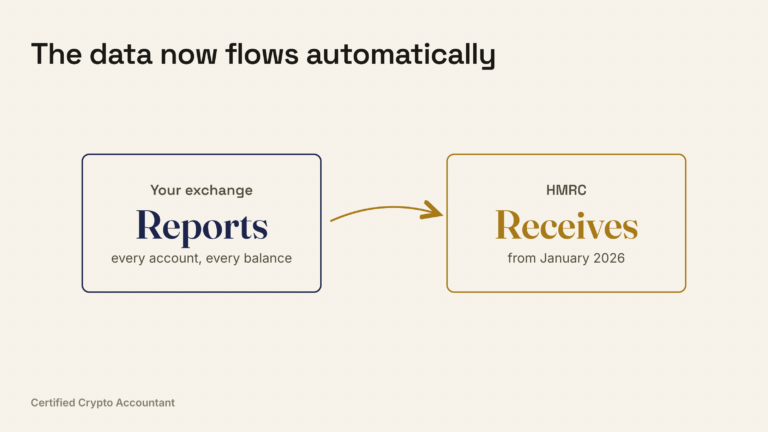
If your company holds or plans to hold crypto, decide the tax posture before the first purchase, not at the first audit. Document whether the holding is investment or trading, because that changes the regime entirely. Model the disposal tax at realistic exit prices alongside the treasury upside. In the US, billion-dollar groups need the Notice 2025-49 election evaluated formally. In the UK, remember the 10-day company matching rule when the treasury desk gets active, and that losses need claiming. And keep exchange-grade records: the reporting frameworks now feeding HMRC and the IRS do not distinguish between a disciplined treasury and a mess.
Frequently asked questions
Does a company pay tax on unrealised crypto gains?
For regular tax, generally no in either country: US federal tax and UK corporation tax both wait for a disposal. The US exception is CAMT for corporations with over $1 billion of book income, where unrealised gains enter the base unless the company elects the IRS’s fair value exclusion, which defers the amounts until disposal.
What rate does a UK limited company pay on bitcoin gains?
Chargeable gains are taxed at corporation tax rates, 25% main rate for profits over £250,000, 19% small profits rate below £50,000, with marginal relief in between. There is no annual exempt amount for companies.
Can a company offset crypto losses against its trading profits?
Generally no. In both the US and UK, corporate capital losses offset capital gains only. A treasury position sold at a loss produces relief only if the company has, or later makes, capital gains.
Is corporate crypto caught by the UK intangible fixed assets rules?
HMRC’s view is that tokens simply held by a company do not meet the “use on a continuing basis” test, so the intangibles regime does not apply and the chargeable gains rules do (CRYPTO41150, CRYPTO41200).
We are a small company, not strategy. Does any of this apply?
The CAMT discussion only affects billion-dollar groups, but everything else scales down: fair value or cost accounting choices, disposal-based tax, loss restrictions, and pooling rules apply to a company holding 2 BTC just as they do to one holding 800,000.
Putting crypto on a balance sheet? Price the tax first
We work with UK companies that hold digital assets, from two-person startups with treasury BTC to groups untangling fair value accounting, CAMT elections and multi-year disposal planning. The right structure set up before the purchase is worth multiples of the cleverest fix afterwards. Book a free, confidential review at certifiedcryptoaccountant.com, and see how our crypto tax services handle corporate crypto from board paper to filed return.
The full set of UK rules sits on our crypto tax UK guide. If you would rather someone else did the pooling and the pounds-sterling conversions, that is what our crypto tax accountants are for.
Sources
Every figure on this page was checked against the source below on 25 August 2026.
- CRYPTO41150. GOV.UK, checked 25 August 2026
- CRYPTO41200. GOV.UK, checked 25 August 2026
Fahad Zar
Crypto tax accountantAAT licensed 1010475
- AAT Licensed Accountant and MAAT, licence 1010475
- MSc Accounting and Finance, BPP University London
- Six years inside digital asset accounting, across several crypto tax firms
- Practises through Zar Enterprises Ltd, ICO registration ZC225094
- Supervised for anti-money laundering by the AAT
What matters to me is that the number on the return is true, whatever it turns out to be.
Whether this is worth a conversation
Most people who read this page do not need an accountant. A few do.
- You were paid in tokens
- Your company holds crypto
- Your NFT sales made real money
If you sold one NFT at a small profit as a hobby, the capital gains pages cover it.
If one of these is you, the first look costs nothing.
Read next
Paid in crypto means income tax before capital gains tax
Paid in crypto in the UK? It is taxed as income at receipt, then again for Capital Gains when you sell. How to report…
Reviewed 25 Aug 2026Deep guideNFT creators and traders are taxed under different rules
How HMRC taxes NFTs in the UK: Capital Gains Tax on disposals, Income Tax for creators and traders, and the record…
Reviewed 25 Aug 2026Deep guideCrypto Tax for Limited Companies and Businesses UK
Crypto tax for UK limited companies: corporation tax not CGT, no annual exempt amount, trading vs investment, and…
Reviewed 25 Aug 2026Deep guideWho pays the tax when a bot does your crypto trading
Every trade your bot makes is your taxable event. How HMRC and the IRS treat automated crypto trading, AI agents, and…
Reviewed 25 Aug 2026