CFD profits are taxable and spread betting is not

Published 16 August 2026· Reviewed against gov.uk 25 August 2026· 4 min read·Capital gains tax
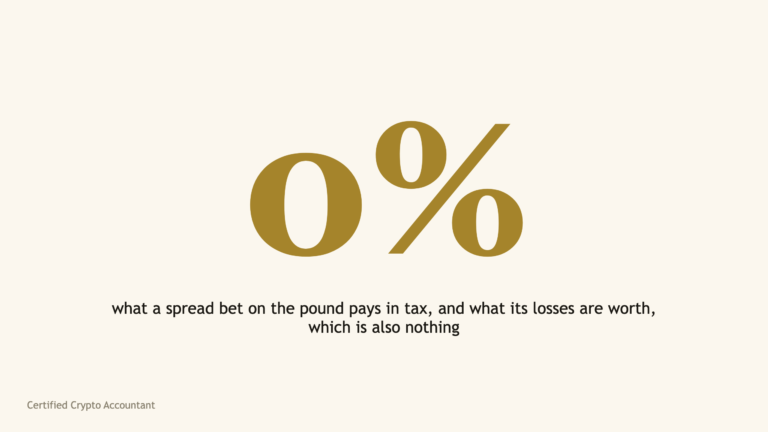
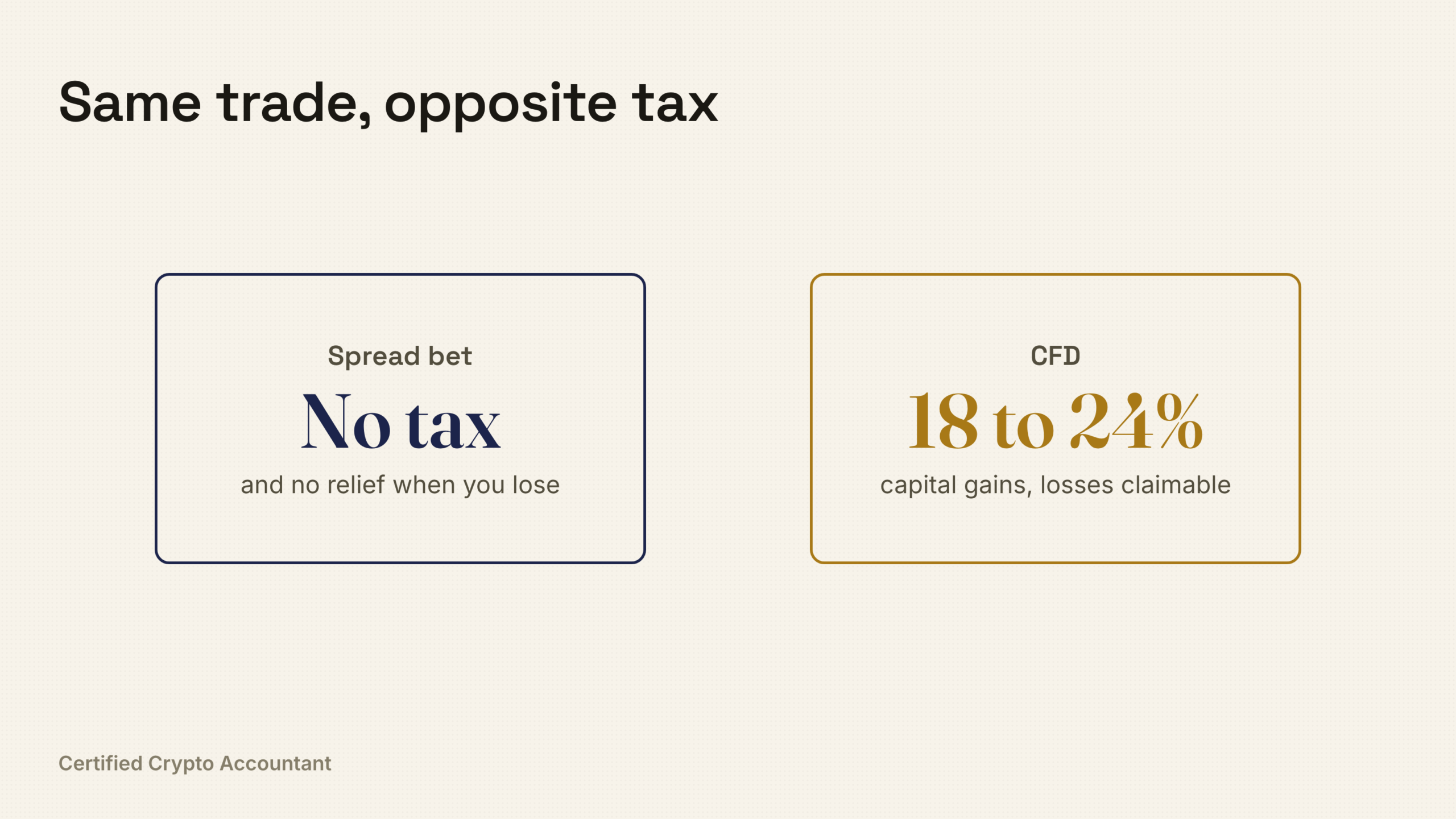
Two products, the same market view, opposite tax treatment. Profit on a CFD is a capital gain, taxable above your allowance. Profit on a spread bet is a gambling win, taxed at nothing. Brokers sell them side by side, and the tax difference is not a loophole or a grey area, it is settled HMRC doctrine on both sides. What almost nobody prices in is that the symmetry cuts both ways: the untaxed product also gives you nothing back when you lose.
CFDs, capital gains, both directions
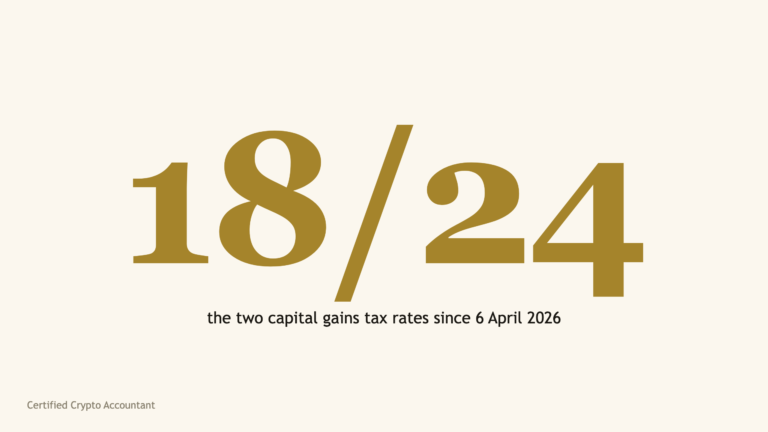
HMRC’s Capital Gains Manual at CG56100 is unambiguous: retail contracts for difference fall under the capital gains regime through section 143 TCGA 1992, unless the rare trading-income exception applies. Every closed position is a disposal. Profits above your £3,000 allowance are taxed at 18% and 24% by the usual income-stacked split, which our calculator handles.
Losses are the flip side and the useful side. CFD losses are capital losses, offsettable against your other gains, shares, crypto, property, and they carry forward once claimed. Claiming is not automatic and the window is four years, the machinery we covered in the losses post. One accounting quirk worth knowing: the interest-like financing charges and dividend adjustments on CFD positions are not treated as interest or dividends for tax, they fold into the capital gains computation of each position. Your broker’s annual statement rarely presents things this way, which makes year-end reconciliation genuinely fiddly for active accounts.
A busy CFD year also walks straight into the reporting thresholds. Gross proceeds across hundreds of closed positions blow past the £50,000 reporting line within months, so a return can be required even in a break-even year, as the reporting guide explains.
Spread betting, outside the system
The spread betting punter is not carrying on a trade, and gambling winnings are not income or gains. HMRC’s Business Income Manual at BIM22015 states it plainly: not taxable on the profits, no relief for the losses. There is a theoretical edge case where an organised operation profiting from the betting public becomes a trade, aimed at bookmakers rather than punters, and ordinary retail spread bettors do not reach it however active they are. The badges of trade post covers why volume alone never gets there.
So the real decision between the two products is a bet on your own results. Expect profits, spread betting keeps them whole. Expect variance, CFD losses at least become tax assets. Most retail traders lose money, which means most retail traders are choosing the wrong wrapper for their actual outcomes, and the ones sitting on years of spread betting losses have nothing to claim for any of it.
Forex and crypto derivatives
Retail forex trading runs through the same two wrappers, spread bet forex is gambling, forex CFDs are capital gains, so the treatment follows the product rather than the currency pair. Crypto sits apart for one regulatory reason: the FCA banned the sale of crypto derivatives to UK retail clients back in 2021, so the crypto CFDs UK traders access are offshore, and the tax analysis of margin and futures positions has its own complications, which our leverage guide works through.
Trader tax questions
Is CFD trading tax free in the UK?
No. That is spread betting. CFD profits are capital gains, reportable and taxable above the allowance, and confusing the two is an expensive assumption to test on an HMRC letter.
Can I offset CFD losses against my salary?
No. They are capital losses, usable against capital gains only, this year or carried forward. Offsetting against income needs trader status, which retail activity essentially never achieves.
Why is spread betting tax free at all?
Because it is legally a bet, and the UK does not tax punters’ winnings, it taxes the bookmaker’s profits instead. The price of that freedom is losing loss relief entirely.
Do I owe tax if my account is with an overseas broker?
Yes. UK residents are taxed on gains wherever the platform sits, and overseas accounts are increasingly visible to HMRC through international data sharing, as our data-sharing post lays out.
Active CFD accounts produce some of the messiest capital gains computations we see, hundreds of positions, financing adjustments, multi-currency statements. If your broker’s tax report and reality need reconciling, that is a job we do all day, and the free review is where it starts.
Sources
Every figure on this page was checked against the source below on 25 August 2026.
- Capital Gains Manual at CG56100. GOV.UK, checked 25 August 2026
- 18% and 24%. GOV.UK, checked 25 August 2026
- Business Income Manual at BIM22015. GOV.UK, checked 25 August 2026
- FCA banned the sale of crypto derivatives. Financial Conduct Authority, checked 25 August 2026
Fahad Zar
Crypto tax accountantAAT licensed 1010475
- AAT Licensed Accountant and MAAT, licence 1010475
- MSc Accounting and Finance, BPP University London
- Six years inside digital asset accounting, across several crypto tax firms
- Practises through Zar Enterprises Ltd, ICO registration ZC225094
- Supervised for anti-money laundering by the AAT
What matters to me is that the number on the return is true, whatever it turns out to be.
Whether this is worth a conversation
Most people who read this page do not need an accountant. A few do.
- Your gains are near the £3,000 line
- You have swapped tokens and doubt the numbers
- You have old losses nobody ever claimed
If you sold one holding once and the figures are plain, file it yourself. Paying someone to check arithmetic you can do is not a service.
If one of these is you, the first look costs nothing.
Read next
Your capital gains tax allowance for 2026 to 2027
£3,000 per person, resets each April, never carries forward. How the annual exempt amount works, the spouse doubling,…
Reviewed 25 Aug 2026ExplainerHow to report capital gains on your Self Assessment
Gains go on the SA108, property runs on its own 60 day track, and proceeds over £50,000 mean reporting even with no tax…
Reviewed 25 Aug 2026ExplainerCapital gains tax on shares and the 30 day trap
Share matching rules define your cost, the 30 day rule rewrites rebuys, and accumulation funds hide base cost. What…
Reviewed 25 Aug 2026DeadlineUnclaimed capital losses expire after four years
A loss HMRC has never been told about is worth nothing, and the claim window closes four years after the tax year ends.…
Reviewed 25 Aug 2026 ExplainereToro tax in the UK depends on which of its three products you used
The three tax treatments inside one eToro account, and what the copy trader inherits.
Reviewed 5 September 2026ExplainerForex profits are taxed three ways in the UK and the product you traded decides which
The three way split applied to forex, including rolling spot and holding the currency itself.
Reviewed 5 September 2026