
Crypto ETFs and ETNs are not taxed the same way

Published 30 July 2026· Reviewed against gov.uk 25 August 2026· 9 min read·Income, business and NFTs
In October 2025 the FCA lifted its four-year ban on retail access to crypto exchange traded notes, and by the 20th of that month BlackRock, Bitwise, 21Shares and WisdomTree products were trading on the London Stock Exchange, with fees knocked as low as 0.05% in the opening price war. Within a month London was the third-largest crypto ETP venue in Europe. Across the Atlantic, US spot bitcoin ETFs now hold about 1.28 million BTC, roughly 6% of every coin that will ever exist.
Here is what almost nobody checked amid the launches: the tax. Bitcoin ETF taxes work nothing like the tax on coins in your own wallet, a crypto ETN in the wrong account is taxed completely differently from the same ETN in the right one, and the UK opened a tax-free window in October 2025 that it half-closed six months later. The wrapper you pick can matter more than the fee you negotiate. Here is the map, UK and US.
What’s actually different between an ETF, an ETN and just buying coins?
Three legal shapes, one price chart. Buying coins directly makes you the outright owner of property. A US spot ETF is a trust that owns the coins, with your shares representing a slice of the pile. A UK-listed cETN is, in HMRC’s own words, a debt security designed to track the performance of referenced cryptoassets: you are a creditor of an issuer, usually collateralised by coins, but you never own them.
Those shapes drive everything that follows, because tax law cares about what you own, not what the chart looks like.
How are US spot bitcoin ETFs taxed?
The big funds, IBIT, FBTC, GBTC and their peers, are structured as grantor trusts, and the iShares Bitcoin Trust prospectus states the consequence plainly: owners of shares are treated for federal income tax purposes as if they owned a corresponding share of the trust’s assets, and “each sale of bitcoin by the Trust will constitute a taxable event to the Shareholders”.
Read that twice, because it contains the quirk that surprises people every January. The trust sells small amounts of bitcoin to pay its sponsor fee, so you realise tiny gains or losses every month without touching your shares. They arrive on a grantor trust tax statement, they are fiddly, and they are real. When you eventually sell the shares, normal capital gains treatment applies: long-term rates of 0%, 15% or 20% after a year, plus the 3.8% net investment income tax at higher incomes, and ordinary rates up to 37% for short holds.
One piece of good news the funds rarely advertise: bitcoin is not a collectible. Gold grantor trust ETFs are taxed at the 28% collectibles cap because gold is tangible property under section 408(m). Bitcoin is intangible, so the cap does not reach it, and a long-term IBIT gain gets ordinary capital gains rates.
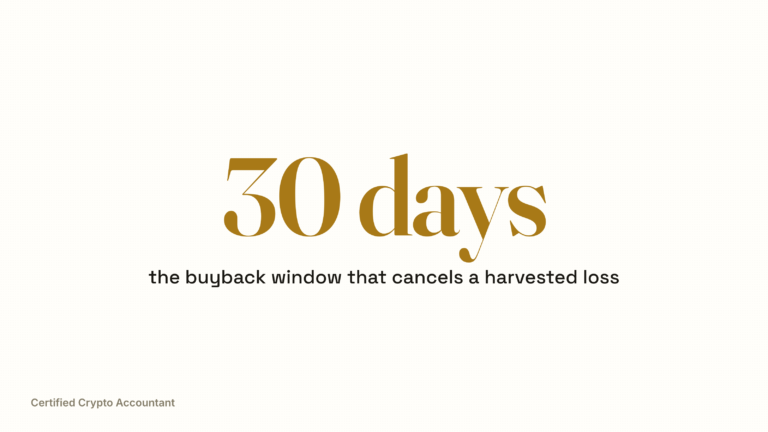
And one asymmetry worth planning around: the wash sale rule almost certainly applies to ETF shares, which are securities, but still does not apply to direct crypto, which is property. A direct holder can harvest a loss and rebuy immediately; an ETF holder who does the same inside 30 days likely loses the deduction. Selling IBIT at a loss and instantly buying FBTC sits in genuinely open territory. If you run losses deliberately, direct coins remain the cleaner tool.
What about staking and futures funds?
The 2025 to 2026 wave brought products that pay yield, and the tax follows the plumbing, not the marketing.
Grayscale’s Ethereum funds became the first US spot ETPs to stake, in October 2025, and BlackRock launched its staked ether ETF in March 2026. The IRS cleared the structural question in Rev. Proc. 2025-31, a safe harbor letting single-asset trusts stake without blowing up their grantor trust status, provided rewards are distributed at least quarterly. What it did not change: staking rewards are ordinary income under Rev. Rul. 2023-14, so yield from these products is income, not capital gain, and the fine mechanics of how it lands on holder statements are still being worked through in the funds’ first full tax year.
The cautionary tale is the very first staking ETF, REX-Osprey’s SOL fund, which launched in July 2025 in a structure that made it taxable as a C corporation, paying tax at the fund level before investors saw a cent, and converted to a regulated investment company two months later precisely to stop the double taxation. Same ticker, materially different after-tax product. Futures funds like BITO are different again: 60/40 long/short-term treatment on the underlying contracts and famously chunky income distributions, which by one estimate ran near a 50% distribution rate in the year to mid-2026. You pay tax on those distributions even if you never sell a share.
The lesson across all of them: two products tracking the same coin can put wildly different lines on your return. Read the tax section of the prospectus before the fee table.
How does the UK tax crypto ETNs?
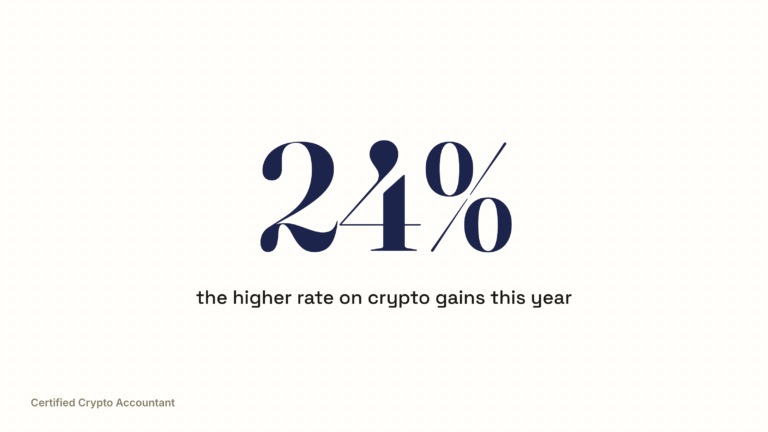
For coins held directly, nothing changes: CGT with section 104 pooling, 18% within the basic rate band and 24% above it, and a £3,000 annual exempt amount for 2026/27.
For cETNs held outside a wrapper, HMRC has published no product-specific guidance, but the standard professional analysis runs through its own characterisation of the notes as debt securities. Because a typical physically-backed cETN offers no capital protection and tracks the asset one-for-one, it falls within the “excluded indexed securities” carve-out from the income tax rules on discounted securities, which lands gains back in the CGT regime (HMRC SAIM3050 and CG53446 territory). Practical upshot: the same 18%/24% CGT computation as coins, with two footnotes. First, check any product offering capital protection, because that can flip it into income treatment. Second, the UK’s 30-day matching rules apply to ETNs and coins alike, so there is no UK version of the American harvest-and-rebuy trick with either.
The genuine UK difference is not the rate. It is the wrapper access, and that story has a twist.
The ISA window that opened, then half-closed
When the FCA lifted the retail ban on 8 October 2025, HMRC’s policy paper made cETNs immediately eligible for stocks and shares ISAs, and allowed them in registered pension schemes including SIPPs from the same day. For six months, UK investors could put bitcoin exposure inside the wrapper where gains and income are simply tax-free.
Then the reclassification: from 6 April 2026, cETNs count as Innovative Finance ISA investments. Anything bought inside a stocks and shares ISA before that date is grandfathered and keeps its tax-free status, with no forced sale. New money, though, must go through an IFISA, which relatively few mainstream platforms offer, or into a SIPP, where the door stays open. The government says it will review letting cETNs back into the main ISA as the market matures. CryptoUK’s verdict on the sequencing, that the UK opened the door and then closed it through the tax system, is hard to argue with.
If you did buy inside an ISA before April 2026, that position is now one of the most tax-efficient ways a UK retail investor has ever held crypto exposure. Do not accidentally sell it while rebalancing.
The same £20,000, three ways
Run the numbers on a £20,000 investment that grows 50% and is then sold. Direct BTC: £10,000 gain, minus the £3,000 exempt amount, leaves £7,000 taxable, which is £1,680 for a higher-rate taxpayer at 24%. A cETN in a general investment account: materially the same computation, same £1,680. The cETN bought inside an ISA before 6 April 2026, or through an IFISA or SIPP now: zero, nothing to report at all.
A US investor putting $25,000 into IBIT and selling at $37,500 after a year pays 15% on the $12,500 gain at typical incomes, about $1,875, plus the small annual expense-sale entries along the way. Direct coins would have produced the same headline rate with no expense-sale noise but full self-custody reporting duty, and, from 2026, wallet-by-wallet basis tracking.
One last data point for anyone who thinks the wrapper debate is academic: research on the flows themselves (a 2025 SSRN study of the five largest US funds) found a $100 million net inflow moves bitcoin about half a percent the same day, with flows explaining around a fifth of daily return variation. The funds are now big enough to move the asset they track. Where those gains land on your return is decided by paperwork most people never read.
Frequently asked questions
Are bitcoin ETFs taxed like holding bitcoin directly in the US?
Close, but not identical. Grantor trust shares give you look-through ownership and the same capital gains rates, but you also pick up small taxable events from the trust’s expense sales, and the wash sale rule likely applies to the shares even though it does not apply to direct coins.
Is a bitcoin ETF taxed at the 28% collectibles rate?
No. The collectibles rate catches tangible property like gold, and bitcoin is intangible, so standard long-term capital gains rates apply to spot bitcoin ETF gains. This is a real advantage over gold trust ETFs.
Can I still put crypto ETNs in my ISA?
Only through an Innovative Finance ISA from 6 April 2026, or a SIPP. cETNs bought in a stocks and shares ISA between 8 October 2025 and 5 April 2026 keep their tax-free status permanently. Outside those routes, gains face CGT at 18% or 24%.
How is a staking ETF taxed?
The staking rewards are ordinary income under Rev. Rul. 2023-14, distributed at least quarterly under the IRS safe harbor for staking trusts, and the capital gain on your shares is separate. Structures vary by product, and at least one early fund was briefly taxed as a corporation, so read each prospectus.
Which is better for tax, coins or the fund?
It depends what you are optimising. UK wrappers (ISA-grandfathered positions, IFISA, SIPP) beat everything if you can use them. US direct coins keep loss harvesting flexible with no wash sale rule. Funds win on simplicity and inheritance logistics. The wrong answer is choosing on fees alone.
Choosing between coins, ETFs and ETNs? Price the tax first
The fee difference between products is basis points. The tax difference between wrappers can be the whole gain. At Certified Crypto Accountant we help UK investors structure crypto exposure across direct holdings, ETNs, ISAs, SIPPs and US funds, and reconcile the grantor trust statements and expense-sale entries that come with them. Book a free, confidential review at certifiedcryptoaccountant.com, and see how our crypto tax services make the wrapper work as hard as the asset.
This is one piece of a larger return. Our crypto tax accountants take the whole transaction history rather than a single event, and the crypto tax UK guide sets out the rules behind it.
Sources
Every figure on this page was checked against the source below on 25 August 2026.
- Innovative Finance ISA. GOV.UK, checked 25 August 2026
- The FCA lifted its four-year ban. Financial Conduct Authority, checked 25 August 2026
Fahad Zar
Crypto tax accountantAAT licensed 1010475
- AAT Licensed Accountant and MAAT, licence 1010475
- MSc Accounting and Finance, BPP University London
- Six years inside digital asset accounting, across several crypto tax firms
- Practises through Zar Enterprises Ltd, ICO registration ZC225094
- Supervised for anti-money laundering by the AAT
What matters to me is that the number on the return is true, whatever it turns out to be.
Whether this is worth a conversation
Most people who read this page do not need an accountant. A few do.
- You were paid in tokens
- Your company holds crypto
- Your NFT sales made real money
If you sold one NFT at a small profit as a hobby, the capital gains pages cover it.
If one of these is you, the first look costs nothing.
Read next
Paid in crypto means income tax before capital gains tax
Paid in crypto in the UK? It is taxed as income at receipt, then again for Capital Gains when you sell. How to report…
Reviewed 25 Aug 2026Deep guideNFT creators and traders are taxed under different rules
How HMRC taxes NFTs in the UK: Capital Gains Tax on disposals, Income Tax for creators and traders, and the record…
Reviewed 25 Aug 2026Deep guideCrypto Tax for Limited Companies and Businesses UK
Crypto tax for UK limited companies: corporation tax not CGT, no annual exempt amount, trading vs investment, and…
Reviewed 25 Aug 2026Deep guideWho pays the tax when a bot does your crypto trading
Every trade your bot makes is your taxable event. How HMRC and the IRS treat automated crypto trading, AI agents, and…
Reviewed 25 Aug 2026