No capital gains tax rise at the Budget, and anyone who sold crypto to beat one has a 30 day problem

Published 23 October 2026 Reviewed against gov.uk 29 October 2026 7 min readCapital gains tax
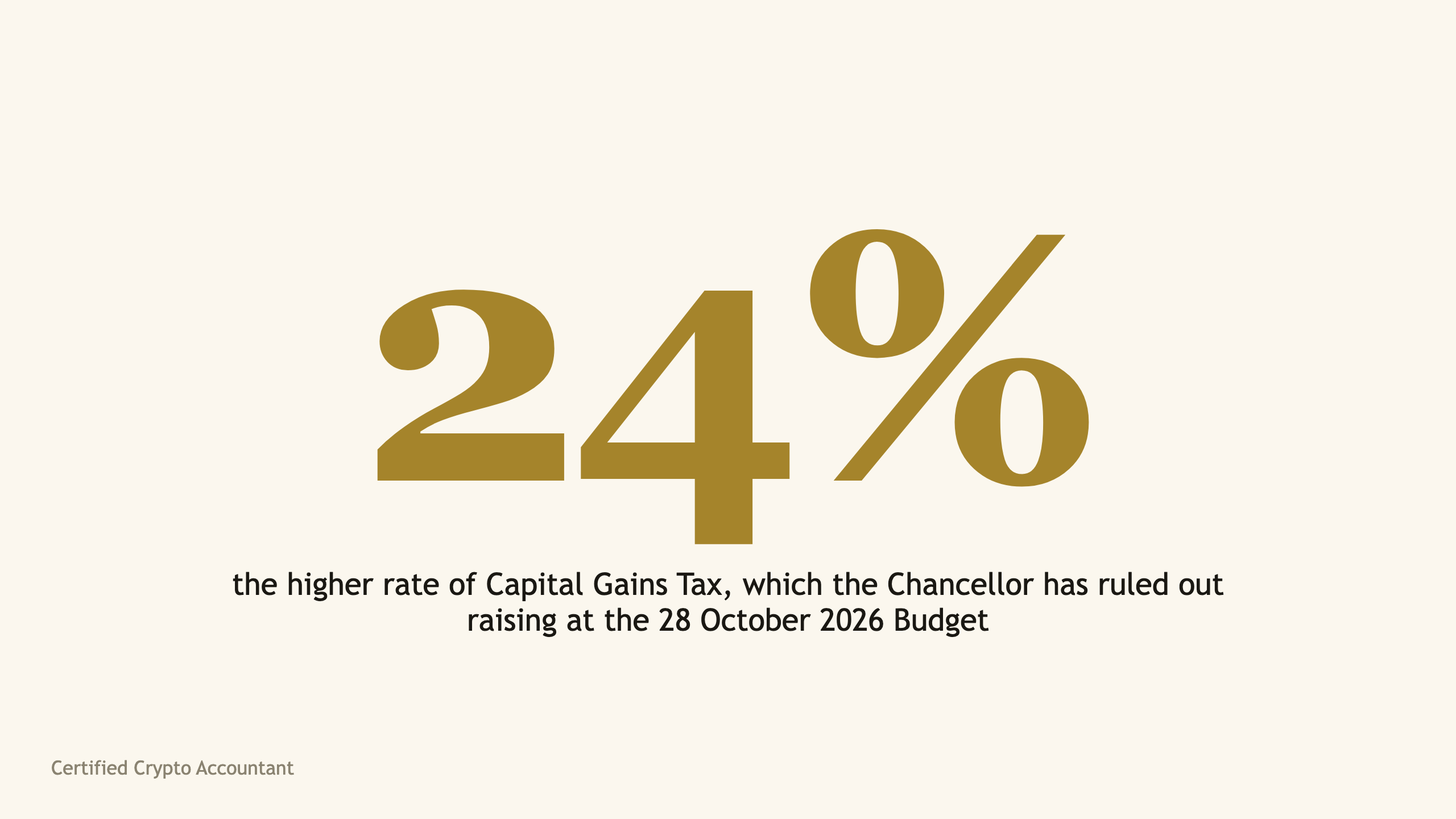
Updated 29 October 2026. The Budget documents are out and the reports were right. Annex A of the Overview of Tax Legislation and Rates keeps Capital Gains Tax at 18% and 24% and the annual exempt amount at £3,000 for 2027 to 2028. What did change for crypto, stablecoins leaving Capital Gains Tax, lending and liquidity pools deferred, the trading allowance tripled and HMRC’s new compliance numbers, is in the post written from the documents. The rest of this post is as it was written on 22 October.
The Chancellor had ruled out raising Capital Gains Tax at the Budget on Wednesday 28 October 2026, according to the Financial Times and The Times, reported on 19 and 20 October and carried since by City AM, ITV and the Guardian. John Healey, Chancellor since 20 July 2026, is said to have rejected calls from Louise Haigh and Wes Streeting to put the rate up, after earlier dismissing the idea of taxing gains at income tax rates, and to be funding his cost of living package from a higher surcharge on bank profits instead. The Treasury’s only words on the record are that “decisions on tax are a matter for the chancellor to set out at fiscal events”, which is what it says every year. That was the position six days out, and it held. Everything below was checked on GOV.UK on 22 October 2026 and stood up on the day.
The rate is staying where it is. The data HMRC receives, the deadlines on old losses and the 30 day rule on every panic sale are not.
What stayed
Gains above the £3,000 annual exempt amount are taxed at 18% inside your basic rate band and 24% above it, per GOV.UK, the rates that have applied since 30 October 2024. For crypto that means the same arithmetic as last year. Each sale, swap, spend or gift of a token is a disposal, per CRYPTO22100, the cost comes from the same day, 30 day and section 104 pooling rules at CRYPTO22200, and the rate depends on your income in the year. Our guide to what you pay on crypto gains works the bands through with figures.
The allowance is settled too. The £3,000 exempt amount is set year by year, it was £12,300 in 2022 to 2023, and a Budget that leaves the rates alone can still move it. This one did not. Annex A keeps £3,000 for 2027 to 2028, so the figure has stopped falling, for now.
Why a rise was never the money the rumour said
HMRC publishes a ready reckoner twice a year called Direct effects of illustrative tax changes. The June 2025 edition is still the latest listed on GOV.UK, and its Capital Gains Tax table costs a ten percentage point rise in the higher rate at minus £540m in 2026 to 2027, minus £2,060m in 2027 to 2028 and minus £3,565m in 2028 to 2029. A ten point rise in the lower rate loses £130m, £55m and £135m. Those are Exchequer effects after behaviour, which in HMRC’s model means people hold assets rather than sell them when the rate goes up, and the gains that would have been taxed never happen.
That is the document the Chancellor’s advisers had in front of them, and it explains the decision better than any quote. The commentary against a rise, that it would push higher earners out of the country and send the wrong message to business, is politics. The reckoner is arithmetic, and the arithmetic says a rate rise on its own costs money within three years. The bank surcharge, reported at around £2bn a year, is simply a number that goes the right way.
If you sold crypto to beat a rise
A lot of people did, in October 2024 and again this autumn. Selling before a Budget to lock in the current rate only works if the sale is final. HMRC’s 30 day rule matches any disposal of a token to acquisitions of the same token in the following 30 days before it touches the pool. Sell 1 BTC on 15 October at £60,000 and buy 1 BTC back on 30 October at £61,000, and the sale is matched to the repurchase, giving a loss of £1,000, while your original pooled cost carries on untouched. The gain you meant to crystallise at 24% is still sitting in the pool, waiting for a real disposal.
The same rule cuts the other way. Anyone who sold at a loss to bank it before the Budget, and bought back inside the month, has matched the loss away. Our post on the 30 day trap walks through the shares version, and the crypto version is identical because HMRC applies the share matching rules to tokens. If you sold in the last fortnight and have not bought back, you have until 30 days after the sale to decide whether you want that disposal to stand.
And a sale made on a rumour is still a sale. Swapping Bitcoin into a stablecoin, or into sterling on the exchange, is a disposal at the sterling value received, so the October sales go on the 2026 to 2027 return in January 2028 with the pooled cost against them. Nobody gets to undo a disposal because the rate did not move.
What is changing for crypto whatever the Budget said
Rates are the smallest part of the crypto tax picture this year. The base is what is moving.
Kraken told its UK customers on 7 October that it may be handing HMRC account data for the 2022 to 2023, 2023 to 2024 and 2024 to 2025 tax years under a Schedule 23 notice, aggregated per coin and per transaction type above a £5,000 line, which we covered in the Kraken post. Under the Cryptoasset Reporting Framework, UK exchanges have collected tax identification numbers since 1 January 2026 and send the first reports to HMRC by 31 May 2027, per GOV.UK, which our CARF guide explains. HMRC’s letters follow the data, and the time limits for a year that was never filed run from four years to twenty depending on why.
The deadline that matters most to people who lost money is the one for claiming the loss. A capital loss has to be claimed within four years of the end of the tax year it arose in, per GOV.UK, so a 2022 to 2023 crypto loss, the crash year for most portfolios, has to be on a return or in a claim by 5 April 2027. A Budget that leaves the rates alone does nothing for a loss nobody claimed.
What to do now
Nothing rash. The rate you were going to sell to avoid did not change, and a sale made now to beat a rise that did not come is a disposal you will pay tax on at the same rate anyway. If you have already sold, check the 30 day window before you buy back. If you have a loss from 2022 to 2023, get it claimed. If you have exchange accounts from any of the three years Kraken is reporting and no return for them, that is the deadline worth your attention, and the cryptoasset disclosure service is the route.
We read the Budget documents on 28 and 29 October. The rates and the allowance did not move, and everything that did is in the post written from the documents.
Budget questions
Did capital gains tax go up in the October 2026 Budget?
No. The Budget on 28 October 2026 left the rates at 18% and 24% and the annual exempt amount at £3,000 for 2027 to 2028, confirmed in Annex A of the Overview of Tax Legislation and Rates published the same day.
Should I have sold my crypto before the Budget?
Selling to beat a rate rise that did not happen gives you a taxable disposal at the same rate you were trying to avoid. If you sell and buy the same coin back within 30 days, the sale is matched to the repurchase and your pooled gain stays where it was.
What is the capital gains tax rate on crypto in 2026 to 2027?
18% within your basic rate band and 24% above it, on gains over the £3,000 annual exempt amount, after HMRC's same day, 30 day and section 104 pooling rules.
Why would HMRC lose money by raising capital gains tax?
HMRC's ready reckoner estimates that people hold assets rather than sell when the rate rises, so fewer gains are realised. Its June 2025 figures put a ten point rise in the higher rate at minus £540m in 2026 to 2027 and minus £3,565m by 2028 to 2029.
Does a no-change Budget mean I can leave my crypto off the return?
No. Reporting is driven by your gains and proceeds whatever the rate. Kraken has told UK customers it may be handing HMRC account data for 2022 to 2025, and UK exchanges send their first CARF reports, covering 2026, by 31 May 2027. Losses from 2022 to 2023 must be claimed by 5 April 2027.
Sources
Every figure on this page was checked against the source below on 29 October 2026.
- Budget 2026, Overview of tax legislation and rates, Annex A rates and allowances. HM Revenue and Customs, checked 29 October 2026
- John Healey rules out capital gains tax hike in Budget. City AM, checked 22 October 2026
- John Healey, no capital gains tax rise at the Budget. The Guardian, checked 22 October 2026
- John Healey rejects calls to raise capital gains tax at the Budget. ITV News, checked 22 October 2026
- Direct effects of illustrative tax changes, June 2025 edition. HM Revenue and Customs, checked 22 October 2026
- Capital Gains Tax rates. GOV.UK, checked 22 October 2026
- Capital Gains Tax, losses. GOV.UK, checked 22 October 2026
- CRYPTO22100, what is a disposal. HM Revenue and Customs, checked 22 October 2026
- CRYPTO22200, pooling. HM Revenue and Customs, checked 22 October 2026
- CRYPTO22250, the 30 day rule. HM Revenue and Customs, checked 22 October 2026
- Reporting cryptoasset user and transaction data. HM Revenue and Customs, checked 22 October 2026
- Tell HMRC about unpaid tax on cryptoassets. HM Revenue and Customs, checked 22 October 2026

Fahad Zar
Crypto tax accountantAAT licensed 1010475
- AAT Licensed Accountant and MAAT, licence 1010475
- MSc Accounting and Finance, BPP University London
- Six years inside digital asset accounting, across several crypto tax firms
- Practises through Zar Enterprises Ltd, ICO registration ZC225094
- Supervised for anti-money laundering by the AAT
What matters to me is that the number on the return is true, whatever it turns out to be.
Whether this is worth a conversation
Where this stops being a reading job and starts being a hiring one.
- You sold crypto in the last few weeks ahead of the Budget and are not sure what the sale did to your pooled gain
- You have a 2022 to 2023 loss that has never been claimed and the 5 April 2027 deadline is now in sight
- You have exchange years that were never on a return and HMRC is about to receive the data for them
If every year is filed from a full reconciliation and you made no disposals this autumn, a Budget that leaves the rates alone changes nothing for you.
If one of these is you, the first look costs nothing.
Read next
Capital gains tax did not move at the Budget, and three crypto changes start on 6 April 2027
The Budget read from the documents, stablecoins, lending, the trading allowance and the compliance numbers.
Reviewed 29 October 2026ExplainerWhat you actually pay on crypto gains in 2026 to 2027
The 18% and 24% bands worked through with figures.
Reviewed 29 October 2026ExplainerCapital gains tax on shares and the 30 day trap
The matching rule that catches every sell and rebuy.
Reviewed 29 October 2026ExplainerKraken is giving HMRC three tax years of UK account data
What is being reported for 2022 to 2025 and what CARF adds.
Reviewed 29 October 2026ExplainerHow far back HMRC can go
Four, six, twelve or twenty years, depending on why a year is missing.
Reviewed 29 October 2026