HMRC can go back four, six, twelve or twenty years and your own conduct picks the number

Published 7 September 2026 Reviewed against gov.uk 5 September 2026 7 min readHMRC and compliance
Four years for an honest error, six for carelessness, twelve where the money or the asset was offshore, and twenty where the loss of tax was deliberate or you never told HMRC you owed anything. Those are the assessment time limits in sections 34, 36 and 36A of the Taxes Management Act 1970, in the versions on legislation.gov.uk as of 5 September 2026, and every one of them runs from the end of the tax year in question. The number HMRC can use depends on what you did, and HMRC has to show which category you fall into before it can use the longer ones.
The years are not fixed. They are what HMRC can prove about how the tax was lost, and a return that was filed and full is the shortest clock there is.
The four limits and what each one needs
| Behaviour behind the lost tax | Years HMRC can go back | Where it says so |
|---|---|---|
| Reasonable care taken, the return was simply wrong | 4 | TMA 1970 section 34 |
| Careless | 6 | TMA 1970 section 36(1) |
| Offshore matter or offshore transfer, careless or not | 12 | TMA 1970 section 36A |
| Deliberate, or a failure to notify chargeability | 20 | TMA 1970 section 36(1A) |
The four year rule at section 34 is the default. An assessment to income tax or capital gains tax may be made at any time not more than four years after the end of the year of assessment to which it relates, and that is the whole of it. For the 2021 to 2022 tax year, which ended on 5 April 2022, the ordinary window closed on 5 April 2026.
Section 36 supplies the two extensions. Six years where the loss of tax was brought about carelessly by the person, and twenty years where it was brought about deliberately. The same subsection puts two more things in the twenty year list. A failure to comply with section 7, which is the duty to tell HMRC you have tax to pay when no return has been issued, and failures to disclose certain avoidance schemes. It also says that a loss brought about by someone acting on your behalf counts as yours, so an accountant’s carelessness is your carelessness for this purpose.
Why the clock is about behaviour rather than time
People ask the question as if the answer were a fixed number of years, and it is more useful to see it as a burden. Inside four years HMRC needs nothing beyond the fact that tax is due. To reach year five or six it has to be able to say the loss was careless, meaning you failed to take reasonable care, and to reach years seven to twenty it has to say the loss was deliberate. Those are the same behaviour tests that set the penalty percentages, which is why an enquiry that starts with a question about a single year turns into an argument about conduct. Win the conduct argument and the years fall away with it.
The exception is the failure to notify line. If you never told HMRC you had a liability, the twenty year limit is available without HMRC needing to show anything deliberate. HMRC’s own Compliance Handbook at CH53600 says the time limit for failure to notify is twenty years whether or not the failure was deliberate, and it is the reason a person who has held crypto since 2016 and never filed cannot assume the early years are safe. In my experience this is the line that matters most for crypto, because the typical unfiled case is someone who never registered rather than someone who filed a wrong figure.
The twelve year rule and whether crypto counts as offshore
Section 36A was inserted by the Finance Act 2019 and gives HMRC twelve years where the lost tax involves an offshore matter or an offshore transfer. An offshore matter means income from a source outside the UK, assets situated outside the UK, or activities carried on mainly abroad. An offshore transfer covers the case where the income or proceeds were moved out of the UK in a way that made the loss significantly harder to find. Section 80 of the Finance Act 2019 applies it from 2013 to 2014 where the loss was careless and from 2015 to 2016 otherwise.
Whether a coin on a foreign exchange is an asset situated outside the UK is the interesting question, and HMRC has answered it against itself. Its manual at CRYPTO22600 says the location of an exchange token is determined by the residency of the beneficial owner. A UK resident’s bitcoin is therefore a UK asset in HMRC’s own view, wherever the exchange happens to be incorporated, and on that reading the twelve year limit does not reach ordinary crypto holdings. There is no case law on this yet. What follows is how I would argue it, and I would expect HMRC to reach instead for the offshore transfer limb where proceeds were parked on a platform abroad, which is a harder argument for them and a fact question in each case.
Enquiry windows are a different clock
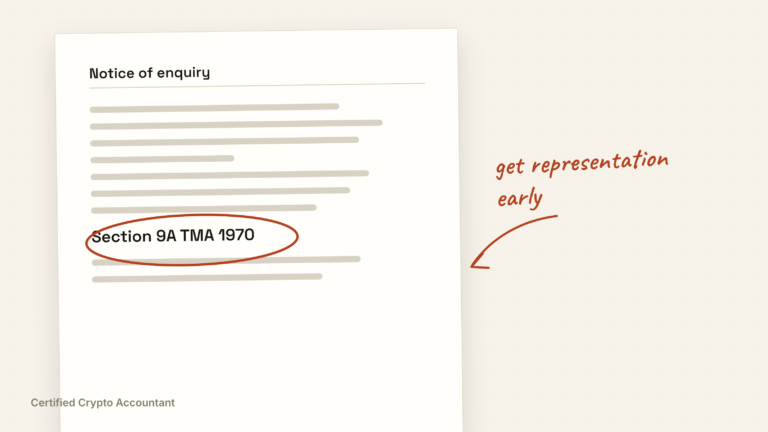
None of the above is about opening an enquiry into a return you filed. That has its own limit under section 9A. For a return filed on time, HMRC has twelve months from the day the return was delivered. For a late return the window runs to the quarter day after the first anniversary of filing, the quarter days being 31 January, 30 April, 31 July and 31 October, and an amendment reopens a fresh window for the amended part.
Once that window shuts HMRC cannot open an enquiry. It can only make a discovery assessment under section 29, and a discovery has conditions. Either the loss came about through careless or deliberate conduct, or the officer could not reasonably have been expected to be aware of the underpayment from the information available before the enquiry window closed. That second condition is why a full and accurate return protects you. If the figures were on the return and HMRC did nothing, it has usually lost the right to come back. Our guide to what happens during a crypto enquiry covers the process once one is open.
What this means if you have crypto years to put right
Three practical consequences. First, the number of years you need to reconstruct is set by conduct, and the honest answer for most unfiled crypto cases is that HMRC can reach back to the first year there was a liability, because nothing was ever notified. Second, coming forward before HMRC writes turns a prompted disclosure into an unprompted one, which changes the penalty range rather than the years, and our guide to disclosing unpaid crypto tax explains the difference. Third, the same four year limit runs in your favour for most claims, including refunds and unclaimed losses, under section 43, so a year you overpaid in 2021 to 2022 is already beyond reach.
The reconstruction is the hard part. Exchanges that closed, wallets that were forgotten and prices from six years ago do not come back on request, which is why reconciliation starts from the first deposit rather than the first year that looks worrying.
Time limit questions
How far back can HMRC investigate?
Four years from the end of the tax year as standard, six where the loss of tax was careless, twelve for offshore matters and twenty where it was deliberate or you never told HMRC you had tax to pay. HMRC has to show the behaviour before it can use the longer limits.
Can HMRC go back more than 6 years?
Yes, but only where the loss was deliberate, where you failed to notify chargeability at all, or where an offshore matter or transfer is involved. For careless errors the limit stops at six.
How far back can HMRC go for capital gains tax?
The same limits apply to capital gains tax as to income tax. Four, six, twelve and twenty years, all counted from the end of the tax year the gain fell in.
Does the 20 year limit apply if I just never filed?
It can. A failure to comply with the duty to notify HMRC of a liability is listed in section 36(1A) alongside deliberate behaviour, so unfiled years can be assessed for up to twenty years.
How far back can HMRC go for crypto?
The same rules. Most unfiled crypto cases involve never notifying HMRC, which opens the twenty year limit. HMRC's own manual places a UK resident's tokens in the UK, so the twelve year offshore rule is arguable rather than automatic.
Sources
Every figure on this page was checked against the source below on 5 September 2026.
- Taxes Management Act 1970, section 34, ordinary time limit. legislation.gov.uk, checked 5 September 2026
- Taxes Management Act 1970, section 36, loss of tax brought about carelessly or deliberately. legislation.gov.uk, checked 5 September 2026
- Taxes Management Act 1970, section 36A, offshore matters and transfers. legislation.gov.uk, checked 5 September 2026
- Finance Act 2019, section 80, commencement of the 12 year limit. legislation.gov.uk, checked 5 September 2026
- Taxes Management Act 1970, section 9A, notice of enquiry. legislation.gov.uk, checked 5 September 2026
- Taxes Management Act 1970, section 29, discovery assessments. legislation.gov.uk, checked 5 September 2026
- Taxes Management Act 1970, section 43, time limit for claims. legislation.gov.uk, checked 5 September 2026
- CRYPTO22600, determining the location of exchange tokens. HM Revenue and Customs, checked 5 September 2026
- CH53600, the 20 year time limit. HM Revenue and Customs, checked 5 September 2026
Fahad Zar
Crypto tax accountantAAT licensed 1010475
- AAT Licensed Accountant and MAAT, licence 1010475
- MSc Accounting and Finance, BPP University London
- Six years inside digital asset accounting, across several crypto tax firms
- Practises through Zar Enterprises Ltd, ICO registration ZC225094
- Supervised for anti-money laundering by the AAT
What matters to me is that the number on the return is true, whatever it turns out to be.
Whether this is worth a conversation
Where this stops being a reading job and starts being a hiring one.
- You have held crypto for years, never registered for Self Assessment, and want to know which years actually need rebuilding
- HMRC has written about one year and you suspect the conversation will widen
- An accountant filed something years ago that you now know was wrong
If every year with a liability was filed, filed on time and filed in full, the enquiry window has probably closed on all but the latest, and there is nothing here to hire anyone for.
If one of these is you, the first look costs nothing.
Read next
What happens during an HMRC crypto enquiry
The process once a letter turns into questions, and where COP9 comes in.
Reviewed 5 September 2026Deep guideHow to disclose unpaid crypto tax before HMRC finds it
Prompted against unprompted, and what each one costs.
Reviewed 5 September 2026Deep guideHow much HMRC can charge for unpaid crypto tax
The behaviour tests that set both the years and the percentages.
Reviewed 5 September 2026ExplainerHow HMRC's Digital Disclosure Service actually works
The channel for putting old years right, step by step.
Reviewed 5 September 2026