What capital gains tax is and how the bill is actually worked out

Published 25 August 2026· Reviewed against gov.uk 25 August 2026· 4 min read·Capital gains tax
Capital gains tax is the tax on the growth, not the money. When you dispose of something that has risen in value since you got it, the rise is the gain, and the gain is what gets taxed, per GOV.UK. Sell shares for £20,000 that cost £15,000 and you are taxed on £5,000, whatever the £20,000 is doing next.
It reaches most things you own that can grow. Shares outside an ISA, crypto, a second property, valuable possessions sold for over £6,000, business assets. It does not usually reach your main home, your car, or anything inside an ISA or pension.
The rate gets the attention and the cost basis decides the bill. Most overpaid capital gains tax is a basis error, not a rate error.
What counts as a disposal
Selling is the obvious one, and not the only one. Giving an asset away is a disposal at market value, apart from gifts to your spouse, civil partner or a charity, the gifts rules run through those. Swapping one asset for another is a disposal of the first, which is why every crypto swap is a taxable event even when no pounds appear. Compensation for something lost or destroyed counts too.
The computation, in order
The shape of every capital gains calculation is the same five steps.
| Step | What happens |
|---|---|
| 1 | Work out each gain, proceeds minus cost, minus buying and selling costs such as fees and stamp duty |
| 2 | Net off current year losses against gains |
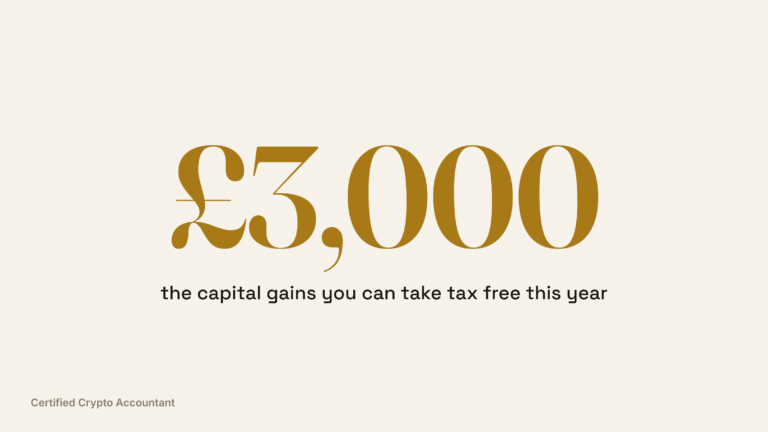
| 3 | Take off the £3,000 annual exempt amount |
| 4 | Use carried forward losses, only as far as needed to reach the allowance |
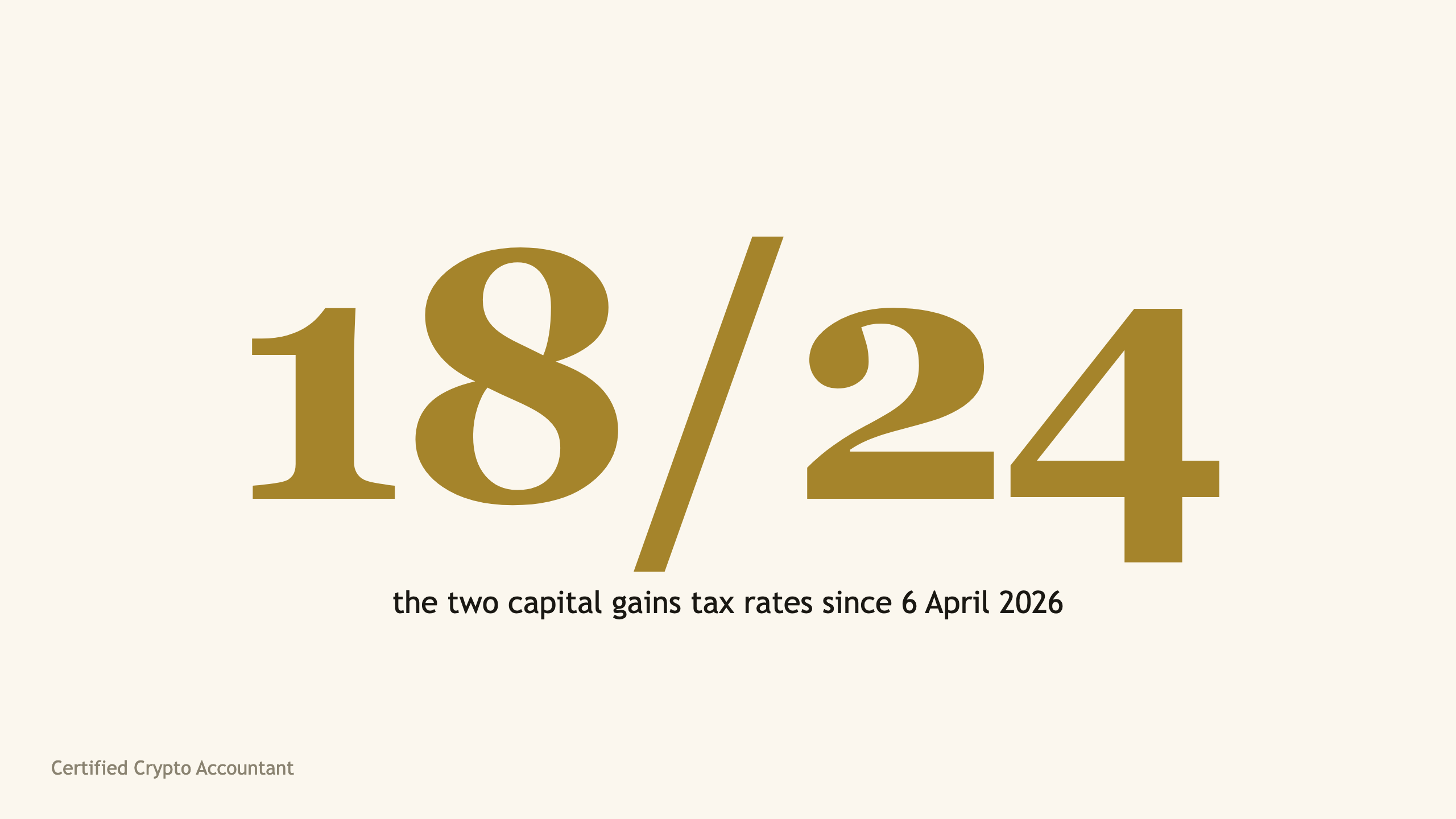
| 5 | Stack what is left on your income to find the rate, 18% inside the basic rate band, 24% above it |
Step five is the one people misread. The rate is not set by your salary alone, the gain itself stacks on top, so a large gain can push part of itself into the 24% band. Residential property gains follow the same bands since the rates aligned, but they run on a much faster payment clock.
Cost basis, where the real work lives
Everything above assumes you know what the asset cost, and that is the number that goes wrong in practice. Shares bought in tranches pool their costs. Crypto pools per token under the same share pooling rules, with same day and 30 day rules on top for rebuys. Assets held since before March 1982 use their 1982 value. Inherited assets take probate value, not what the deceased paid. Get the basis wrong and every later number is wrong with it.
What legitimately cuts the bill
The allowance, first and always. Losses, claimed properly, within four years. Spouse transfers before a sale, which double the allowances and bands in play. Main home relief on the house you live in. Business Asset Disposal Relief at 14% for qualifying business sales. None of this is aggressive, all of it is in HMRC’s own guidance, and the difference between using it and not is routinely the whole bill.
When the asset is shares, crypto or a second property and the numbers are real, our capital gains tax accountants compute the gain the way HMRC will check it.
Questions on the basics
What is capital gains tax in simple terms?
A tax on the profit when you dispose of something that grew in value. You are taxed on the gain, the difference between what it cost and what you got, not on the full amount received.
How much is capital gains tax in the UK?
For disposals from 6 April 2026, 18% on gains inside your basic rate band and 24% above it, after the £3,000 annual exempt amount. Business Asset Disposal Relief gains are at 14%.
Who has to pay capital gains tax?
Anyone whose total gains in a tax year beat the £3,000 allowance after losses, on assets like shares outside ISAs, crypto, second properties and valuables sold above £6,000.
Is capital gains tax paid on my main home?
Usually not. Private Residence Relief covers a home you have lived in throughout ownership, with edge cases around letting, business use and large grounds.
Sources
Every figure on this page was checked against the source below on 25 August 2026.
- Capital Gains Tax, overview. GOV.UK, checked 25 August 2026
- Capital Gains Tax rates and allowances. HM Revenue and Customs, checked 25 August 2026
- Capital Gains Tax, rates. GOV.UK, checked 25 August 2026
- Capital Gains Tax, gifts. GOV.UK, checked 25 August 2026
- Private Residence Relief. GOV.UK, checked 25 August 2026
Fahad Zar
Crypto tax accountantAAT licensed 1010475
- AAT Licensed Accountant and MAAT, licence 1010475
- MSc Accounting and Finance, BPP University London
- Six years inside digital asset accounting, across several crypto tax firms
- Practises through Zar Enterprises Ltd, ICO registration ZC225094
- Supervised for anti-money laundering by the AAT
What matters to me is that the number on the return is true, whatever it turns out to be.
Whether this is worth a conversation
Where this stops being a reading job and starts being a hiring one.
- Your first taxable gain just happened
- You do not know if you need to report
- The numbers feel bigger than the guides
One asset, one purchase price, one sale. The five steps above are the whole job and you can run them yourself.
If one of these is you, the first look costs nothing.
Read next
Your capital gains tax allowance for 2026 to 2027
Step three of the computation, in full.
Reviewed 25 August 2026ExplainerWhen do you pay capital gains tax
The three clocks that start once the computation says you owe.
Reviewed 25 August 2026DeadlineUnclaimed capital losses expire after four years
Step two and four, and the deadline that kills them.
Reviewed 25 August 2026Deep guideWhat you actually pay on crypto gains
The same computation where the pooling gets hard.
Reviewed 25 August 2026