
Donating crypto to charity is not always the cheaper route

Published 6 July 2026· Reviewed against gov.uk 25 August 2026· 7 min read·Reducing your tax
Giving to a cause you believe in can also be one of the most tax-efficient things you do with appreciated cryptoassets. If you want to donate crypto to charity in the UK, the headline benefit is striking: gifting tokens directly to a UK registered charity is generally not treated as a chargeable disposal, so you sidestep the Capital Gains Tax you would otherwise pay if you sold the same coins first.
That sounds simple, but there is a real decision underneath it. Gift Aid, the relief most people associate with charitable giving, applies to gifts of money, not to gifts of crypto in kind. So the tax-smart choice depends on the size of your gain and your wider tax position. This guide walks through both routes and the evidence to keep.
Why donate crypto to charity in the UK at all?
For anyone sitting on tokens that have risen sharply in value, charitable giving and tax planning point in the same direction. Sell those tokens and you crystallise a gain that may be taxable. Give them away to a UK registered charity instead and, in most cases, no Capital Gains Tax is due, because gifts of assets to charity are not treated as a chargeable disposal for CGT. The charity receives the full value of the asset, and you avoid a tax bill on a gain you never actually pocketed.
The CGT exemption for gifts to charity
HMRC is clear that you do not have to pay Capital Gains Tax on assets you give away to charity. While the published guidance is usually framed around land, property and shares, the same disposal-to-charity principle applies to cryptoassets, which HMRC treats as chargeable assets for CGT under the HMRC Cryptoassets Manual.
There is one important boundary. The relief applies to an outright gift. If you sell the asset to the charity below market value, the relief is restricted and you calculate the gain on what the charity actually pays you. For a genuine donation, where you receive nothing back, this is not a concern.
In-specie gift vs sell-then-donate
This is the choice that matters. An in-specie gift means transferring the cryptoassets themselves straight to the charity’s wallet. A sell-then-donate gift means converting to cash on an exchange first, then donating the proceeds.
| Route | Capital Gains Tax | Gift Aid | Best when |
|---|---|---|---|
| Donate crypto directly (in specie) | No CGT on the gain | Not available | The gain is large and would produce a real CGT charge |
| Sell first, then donate the cash | CGT due on the gain (subject to the annual exempt amount) | Available on the cash gift | The gain is small or covered by your allowance |
Neither route is automatically better. The right answer turns on how big your gain is, whether your annual exempt amount is already used, and your income tax band.
The gift aid limitation explained
Gift Aid lets a charity claim an extra 25p for every £1 you give, and higher and additional-rate taxpayers can claim back the difference between their rate and the basic rate on the donation. But Gift Aid is a relief for gifts of money. A direct transfer of tokens is a gift in kind, so it cannot carry a Gift Aid declaration.
That is the trade-off at the heart of donating crypto. Go in specie and you keep the CGT exemption but lose Gift Aid. Sell and donate cash and you unlock Gift Aid and income tax relief, but you first have to settle any CGT on the disposal. For higher-rate taxpayers the Gift Aid relief forgone can outweigh the CGT saved, so the winner is not automatic. It turns on your rate band and the size of the embedded gain.
Keep evidence of the donation
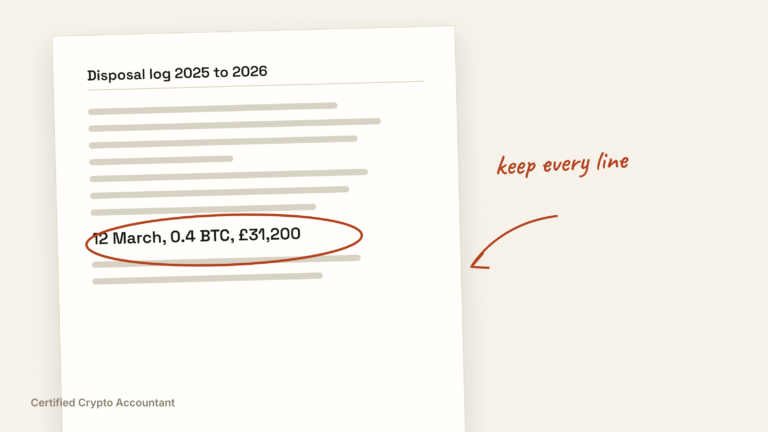
Whichever route you take, the paperwork protects you if HMRC ever asks. Keep a record of the charity’s name and registration, the wallet address or transaction hash for an in-specie gift, the date of transfer and the sterling market value of the tokens on that date. For a cash gift, retain the Gift Aid declaration and the bank or exchange record. Good records also let you claim any relief correctly on your Self Assessment return.
Worked example, a £20,000 gift, two routes
Priya, a higher-rate taxpayer, wants to give £20,000 of value to a UK registered charity. She holds tokens now worth £20,000 that cost her £4,000, an embedded gain of £16,000. She has already used her £3,000 annual exempt amount this year.
Route A, donate the crypto directly. The transfer to charity is not a chargeable disposal, so no CGT arises on the £16,000 gain. The charity receives the full £20,000 of value. There is no Gift Aid, because this is a gift in kind.
Route B, sell then donate the cash. Priya sells the tokens, realising a £16,000 gain. With her allowance already used, the whole gain is taxed at 24%, giving CGT of £3,840. She donates the remaining £16,160 in cash under Gift Aid. The charity reclaims basic-rate tax, lifting its receipt to about £20,200, and as a higher-rate taxpayer Priya claims around £4,040 of relief through her return. Once that relief lands, her net cost is roughly £15,960.
Run the numbers and Route B is the surprise winner here. The charity ends up slightly better off and the higher-rate relief cuts Priya’s net cost below the £20,000 that Route A costs her. Route A stays the simpler path, with no CGT computation, no cash-flow gap while relief comes back through the return, and no risk of the sale price moving before the gift is made. For a basic-rate taxpayer, who gets no higher-rate relief, the comparison tightens and the direct gift often wins. The honest answer is that the better route depends on your rate band, your remaining exempt amount and the size of the gain, so model both before you give.
How a specialist handles it
On a sizeable gift we model both routes side by side using your actual cost basis, current market value, remaining annual exempt amount and income tax band, then quantify the after-tax cost of each. We confirm the charity is UK registered, set up the transfer so the evidence trail is airtight, and make sure the donation is reported correctly on your Self Assessment. The aim is simple: the charity gets the most, and you keep your tax position clean.
Frequently asked questions
Do I pay Capital Gains Tax if I donate crypto to a UK charity?
Generally no. A genuine outright gift of cryptoassets to a UK registered charity is not treated as a chargeable disposal, so the gain does not attract CGT. The position differs if you sell the asset to the charity rather than give it.
Can I claim gift aid on a crypto donation?
No. Gift Aid applies to donations of money, not to gifts of crypto in kind. If you want Gift Aid, you would need to sell the crypto and donate the cash proceeds instead.
Is it better to donate crypto directly or sell and donate the cash?
It depends on your gain and tax position. With a large gain and your annual exempt amount used, donating directly usually saves more by avoiding CGT. With a small gain inside your allowance, selling and donating cash can win because Gift Aid then adds value at little CGT cost.
What are the CGT rates on crypto if I sell first?
From 30 October 2024, crypto gains are taxed at 18% within the basic-rate band and 24% above it, after deducting the annual exempt amount, which is £3,000 for 2026/27.
Does the charity have to be UK registered?
The CGT treatment for gifts to charity is built around UK charities and certain qualifying bodies. Always confirm the recipient’s charitable status before transferring, and keep a record of it.
What records should I keep for a crypto donation?
Keep the charity’s details, the wallet address or transaction hash, the date of transfer and the sterling market value on that date. For a cash gift, also keep the Gift Aid declaration and the payment record.
Make your crypto giving as tax-efficient as your cause deserves
Donating crypto well is part generosity, part planning. Choose the wrong route and you can hand HMRC tax you never needed to pay, or miss out on relief that was yours to claim. We help UK clients give appreciated cryptoassets in the most tax-efficient way, with the evidence to back it up. Book a free, confidential review at certifiedcryptoaccountant.com, and see our crypto tax services for the full picture.
If the history behind this is years long and spread over several exchanges, an estimate will not hold up. That is a crypto tax accountant job, and the capital gains tax calculator is the quickest way to see whether the numbers justify one.
Sources
Every figure on this page was checked against the source below on 25 August 2026.
- Capital Gains Tax. GOV.UK, checked 25 August 2026
- Gifts of assets to charity. GOV.UK, checked 25 August 2026
- HMRC Cryptoassets Manual. GOV.UK, checked 25 August 2026
- Gift Aid. GOV.UK, checked 25 August 2026
Fahad Zar
Crypto tax accountantAAT licensed 1010475
- AAT Licensed Accountant and MAAT, licence 1010475
- MSc Accounting and Finance, BPP University London
- Six years inside digital asset accounting, across several crypto tax firms
- Practises through Zar Enterprises Ltd, ICO registration ZC225094
- Supervised for anti-money laundering by the AAT
What matters to me is that the number on the return is true, whatever it turns out to be.
Whether this is worth a conversation
Most people who read this page do not need an accountant. A few do.
- A big disposal is coming
- You have losses and reliefs sitting unused
- You want the plan checked before you act
If the move you are weighing is using this year's allowance before April, just use it.
If one of these is you, the first look costs nothing.
Read next
Gifting crypto outside marriage triggers capital gains tax
Gifting crypto in the UK is usually a disposal for Capital Gains Tax, even with no cash changing hands. When it is…
Reviewed 25 Aug 2026Deep guideWhat you actually pay on crypto gains in 2026 to 2027
How Capital Gains Tax on crypto works in the UK: rates, the annual allowance, Share Pooling, and the same-day and…
Reviewed 25 Aug 2026Deep guideWays to pay less crypto tax that HMRC accepts
Legal ways to reduce your UK crypto tax: the CGT allowance, loss harvesting, spouse transfers, pensions and timing.…
Reviewed 25 Aug 2026Deep guideHow to use crypto losses to cut your capital gains bill
Crypto loss harvesting can legally cut your UK Capital Gains Tax, but the 30-day bed and breakfasting rule catches most…
Reviewed 25 Aug 2026