eBay reports your sales to HMRC and most sellers owe nothing

Published 17 August 2026· Reviewed against gov.uk 25 August 2026· 4 min read·Self Assessment and side income
Yes, eBay reports sellers to HMRC. It has done since the rules took effect in January 2024, with the first reports filed in January 2025. And no, that almost certainly does not mean you owe tax, because reporting and owing are governed by two different rulebooks, and the panic industry that grew up around “the eBay tax” has done its best to blur them.
Here are both rulebooks, short version first: selling your own old stuff is not taxable, trading is, and the £1,000 line only matters for the second group.
What eBay actually reports, and when
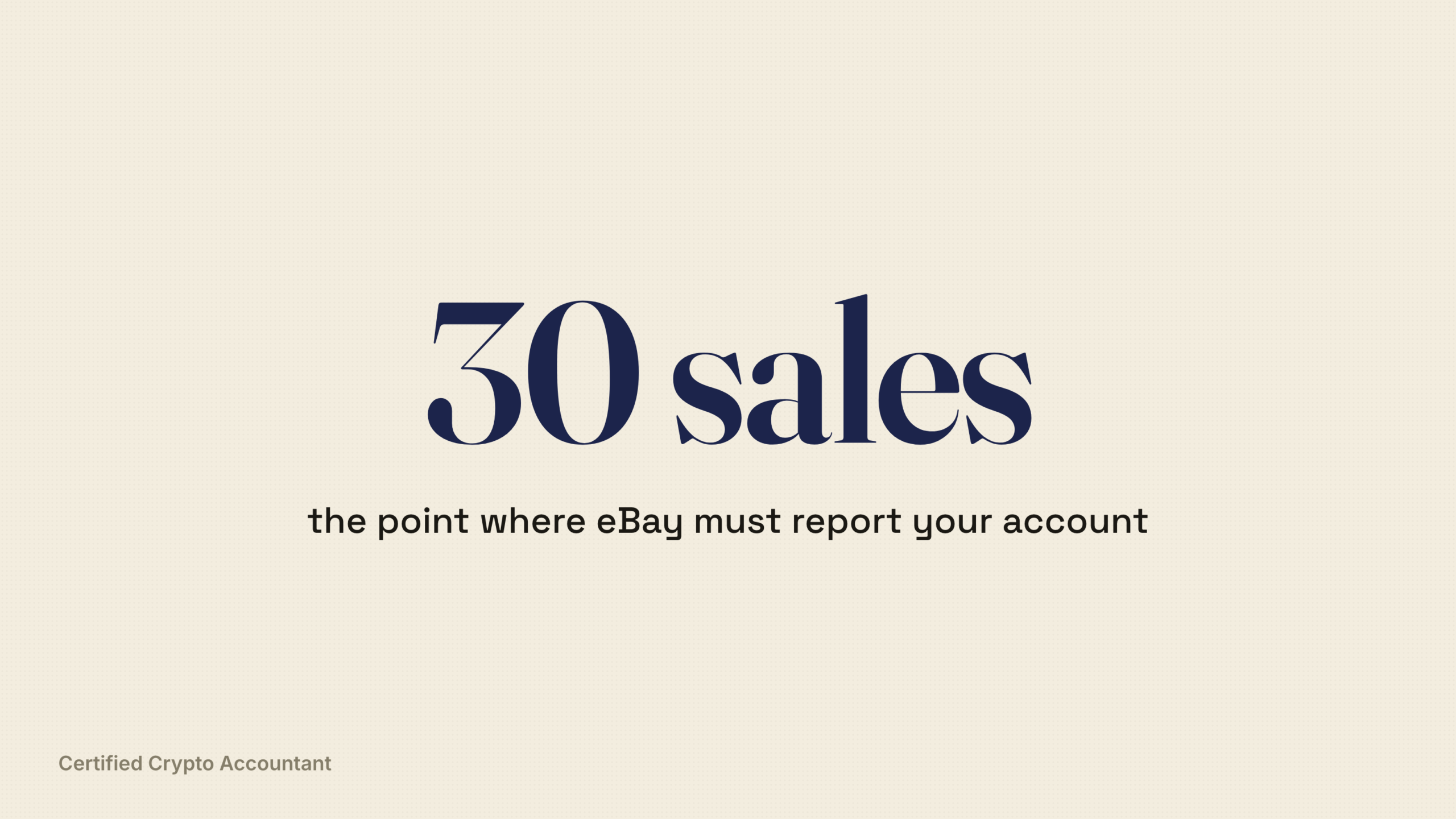
Under the digital platform reporting rules, eBay collects and passes seller details to HMRC once you cross either threshold in a calendar year: 30 or more sales, or roughly €2,000, about £1,700, in proceeds. Below both, your activity is not reported at all. Above either, eBay files your details and totals to HMRC by the following January, and you will have been asked for your National Insurance number along the way.
Note what the report contains: totals. Not whether you were clearing the loft or running a business. That judgement, the one that decides everything, is made by the tax rules, and HMRC letters prompted by platform data still have to be answered with those rules, not with fear.
When selling is not taxable at all
Selling personal possessions for less than you paid produces no income and no gain. The volume does not matter. Someone clearing twenty years of accumulated life through three hundred listings owes nothing, because disposing of your own belongings at a loss is not a source of income, per HMRC’s own online income guidance. The only edge case for personal items is capital gains on a single item sold for over £6,000, the chattels rule, which catches jewellery, paintings and watches, and pointedly not your old sofa.
When it becomes taxable
Buying to resell, or making things to sell, is trading, and trading has thresholds. The first £1,000 of gross trading income per tax year is covered by the trading allowance, nothing to report. Beyond that, you register for Self Assessment, by 5 October after the tax year ends, and report the income with either the allowance or your actual costs deducted.
The honest test is intent and pattern. Sourcing stock at car boots for resale, buying wholesale, flipping retail arbitrage finds, that is trading from the first item. Selling the pram your kids outgrew is not, and never becomes it through repetition. The grey zone in between, the collector thinning a collection, the hobbyist selling occasional makes, is where the badges of trade do the deciding, and where keeping your own simple records converts arguments into answers.
If the letter has already arrived
HMRC has been writing to sellers whose platform data suggests undeclared trading. The letter is a prompt, the same one-to-many format as the other letters we have covered, and the response depends entirely on which rulebook you are actually in. Genuine personal selling gets explained, with dates and context, and closes. Genuine trading gets disclosed, and disclosed beats discovered on every line of the penalty table, the mechanics we set out in the disclosure guide.
eBay seller questions
Will HMRC tax me for selling my old things?
No. Personal possessions sold for less than they cost are not income, however many listings it takes. Keep a rough record of what went and roughly why, in case the totals ever need a sentence of explanation.
Is there a 30 sales limit before tax kicks in?
The 30 sales figure is a reporting threshold, it decides whether eBay sends your details to HMRC, nothing more. Tax depends on whether you are trading, which the report itself does not establish.
I flip items for profit as a side hustle. When do I owe tax?
Once gross trading income passes £1,000 in a tax year, you need to register and report. Below that, the trading allowance covers you, though the reporting threshold may still be crossed, which is fine and changes nothing.
eBay asked for my National Insurance number. Should I give it?
Yes, it is the platform complying with the collection rules, and refusing tends to end in account restrictions. Providing it does not create a tax liability that did not already exist.
If a platform letter has landed and your selling sits anywhere near the trading line, get the position assessed before replying. Our free review covers exactly this kind of sorting.
Sources
Every figure on this page was checked against the source below on 25 August 2026.
- Digital platform reporting rules. GOV.UK, checked 25 August 2026
- Online income guidance. GOV.UK, checked 25 August 2026
- Chattels rule. GOV.UK, checked 25 August 2026
- Trading allowance. GOV.UK, checked 25 August 2026
Fahad Zar
Crypto tax accountantAAT licensed 1010475
- AAT Licensed Accountant and MAAT, licence 1010475
- MSc Accounting and Finance, BPP University London
- Six years inside digital asset accounting, across several crypto tax firms
- Practises through Zar Enterprises Ltd, ICO registration ZC225094
- Supervised for anti-money laundering by the AAT
What matters to me is that the number on the return is true, whatever it turns out to be.
Whether this is worth a conversation
Most people who read this page do not need an accountant. A few do.
- Crypto has pushed you into Self Assessment
- Platform income sits alongside your crypto
- A return you already filed looks wrong
If your only question is whether you need to register, the guide above answers it for free.
If one of these is you, the first look costs nothing.
Read next
Your cashback is almost never taxable and HMRC said so in 1997
Ordinary cashback on cards, shopping and bank switching is not taxable for private individuals, per HMRC’s Statement of…
Reviewed 25 Aug 2026DeadlineHow to register for Self Assessment
The deadline is 5 October after the tax year ends, and registering is not filing. Who needs to register, how the UTR…
Reviewed 25 Aug 2026ExplainerVinted sellers rarely owe tax even when Vinted reports them
Selling your own clothes below what you paid is never taxable. Why Vinted asked for your details, what gets reported,…
Reviewed 25 Aug 2026ExplainerHow to change accountants without losing your records
Four steps, a few signatures, and the professional clearance process does the rest. What your old accountant can and…
Reviewed 25 Aug 2026