Your capital gains tax allowance for 2026 to 2027

Published 7 August 2026· Reviewed against gov.uk 24 August 2026· 4 min read·Capital gains tax
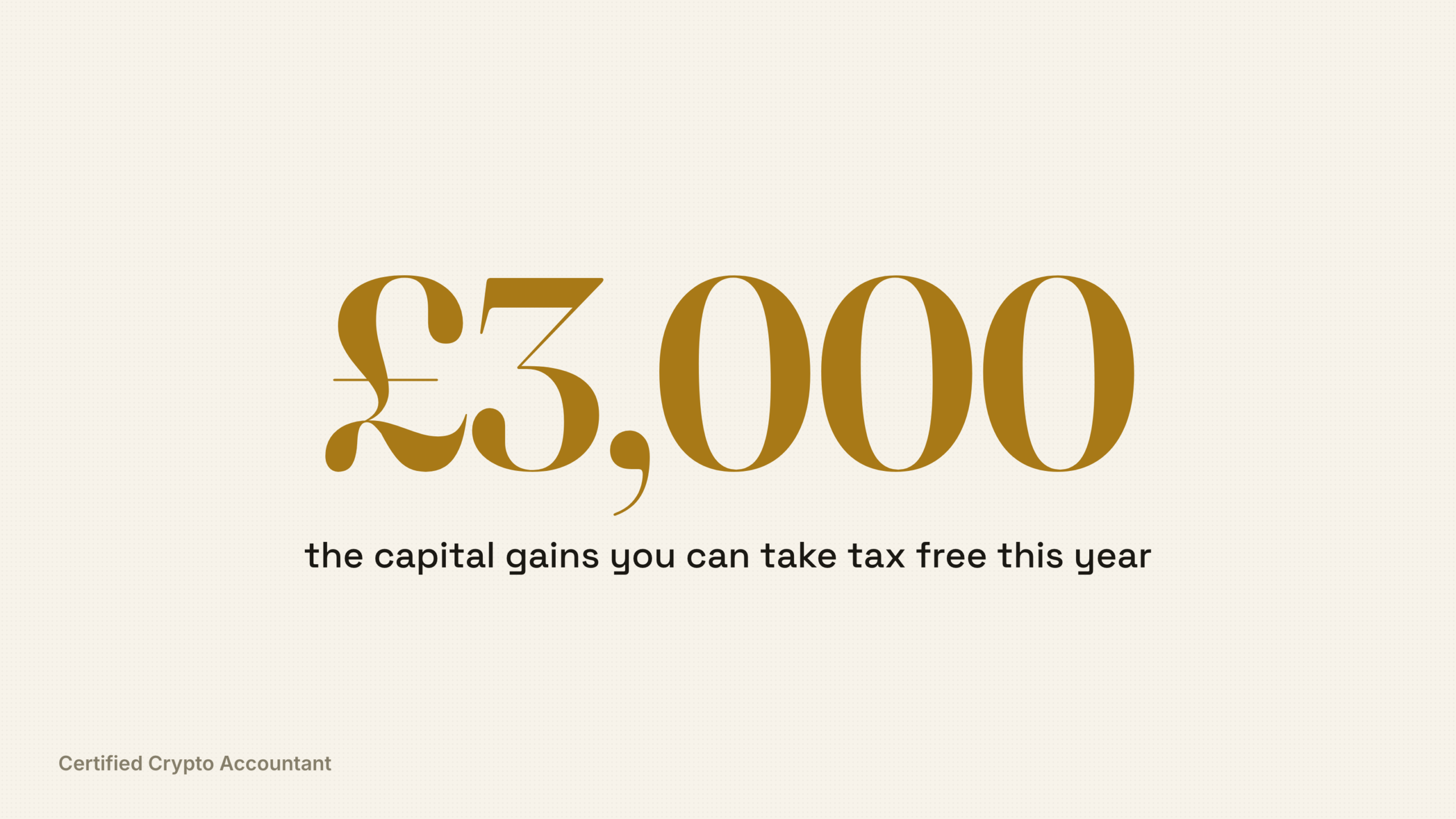
Every tax year you can realise £3,000 of gains before capital gains tax touches you. That is the annual exempt amount for 2026 to 2027, per GOV.UK, and if it sounds small, your memory is not wrong. It stood at £12,300 as recently as the 2022 to 2023 tax year, then was cut to £6,000, then halved again. A shrinking allowance pulled hundreds of thousands of ordinary investors into a tax that used to belong to the wealthy.
On what needs reporting above and below the allowance, LITRG sets out the thresholds independently.
Since the number is now small enough to matter, using it properly matters too. Trusts get £1,500.
Your cost basis decides your bill before the allowance ever gets a look in, and on a crypto portfolio cost basis is the number software gets wrong.
The rules that decide whether you keep it
It resets every 6 April and does not carry forward. Unused allowance from last year is gone. That single fact drives most of the planning around it, because two disposals split across 5 April and 6 April can use two allowances, £6,000 of tax-free gains, where the same disposals a week apart inside one year use one.
It is one allowance across everything. Shares, crypto, a second property, a valuable painting, all share the same £3,000. People who track their crypto and their share portfolio separately routinely double-count it, and the return corrects them expensively.
It comes off after losses. Current-year losses reduce your gains first, then the allowance applies to what is left, then carried-forward losses only as far as needed to bring you down to the allowance. The ordering is friendlier than people assume, since it stops carried losses being wasted on gains the allowance would have covered anyway. How losses work, and the deadline for claiming old ones, is a subject of its own we cover in the losses guide.
Married couples get double, properly used
Transfers between spouses and civil partners carry no capital gains tax, the recipient inherits the original cost. Which means a couple has £6,000 of allowance and two sets of rate bands between them, and moving half an asset to the lower-earning partner before a sale is among the oldest legitimate planning there is. The transfer has to be genuine, an outright gift, and it needs doing before the disposal rather than after, but there is nothing aggressive about it. The same mechanism is why gifting crypto to a spouse works and gifting it to anyone else is a taxable disposal.
The reporting trap above £50,000
Staying under the allowance does not always mean staying off the return. If you file Self Assessment and your total proceeds, the sale amounts, not the gains, exceed £50,000, you report anyway, even with no tax due. Active traders hit this constantly, sell £60,000 of holdings for a £2,000 gain and the gain is covered by the allowance while the reporting duty stands. For crypto, where a year of swaps can produce startling gross proceeds, this rule catches almost everyone who trades at all, and every swap counts as a disposal, as our crypto gains guide explains.
What sits outside the allowance entirely
Some things never need it. Gains inside ISAs and pensions are not taxable at all. Your own car, and most personal possessions sold for under £6,000, are exempt under the chattels rules. Your main home is usually covered by Private Residence Relief. Gilts are exempt. The allowance is for what is left, which these days mostly means shares outside wrappers, crypto, and property beyond your own home.
Questions on the allowance
Do I pay tax if my gains are under £3,000?
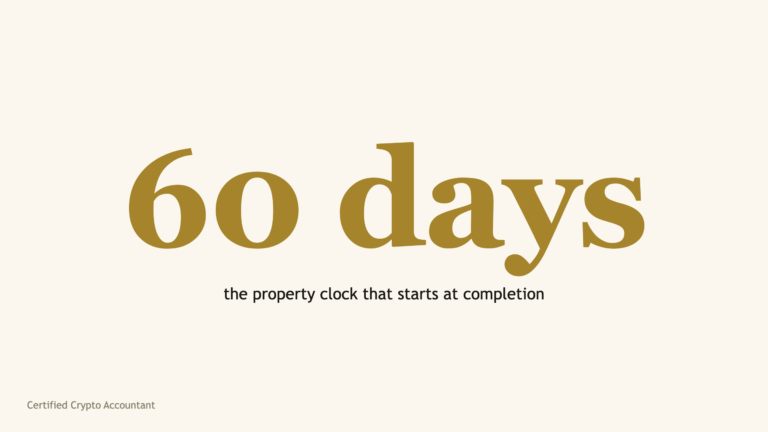
No tax. You may still have to report if you are in Self Assessment and proceeds exceeded £50,000, and property has its own 60 day reporting rule regardless.
Can I carry unused allowance forward?
No. It expires each 5 April, which is exactly why timing disposals around the year end is worth doing.
Do my spouse and I each get £3,000?
Yes, and no-gain transfers between you mean the allowances and rate bands can be used where they do the most good, provided the gift is real and made before the sale.
Does the allowance apply to crypto?
Fully. Crypto disposals are capital gains like any other asset’s, and the same single £3,000 covers them together with everything else you sold that year.
Sources
Every figure on this page was checked against the source below on 24 August 2026.
- Capital Gains Tax rates and allowances. HM Revenue and Customs, checked 24 August 2026
- Capital Gains Tax, allowances. GOV.UK, checked 24 August 2026
- Capital Gains Tax, rates. GOV.UK, checked 24 August 2026
- Capital Gains Tax, work out if you need to pay. GOV.UK, checked 24 August 2026
- Cryptoassets Manual, Capital Gains Tax, CRYPTO22000. HM Revenue and Customs, checked 24 August 2026
- Capital Gains Tax reporting. Low Incomes Tax Reform Group, checked 24 August 2026
Fahad Zar
Crypto tax accountantAAT licensed 1010475
- AAT Licensed Accountant and MAAT, licence 1010475
- MSc Accounting and Finance, BPP University London
- Six years inside digital asset accounting, across several crypto tax firms
- Practises through Zar Enterprises Ltd, ICO registration ZC225094
- Supervised for anti-money laundering by the AAT
What matters to me is that the number on the return is true, whatever it turns out to be.
Whether this is worth a conversation
Most people who read this page do not need an accountant. A few do.
- Your gains are near the £3,000 line
- You have swapped tokens and doubt the numbers
- You have old losses nobody ever claimed
If you sold one holding once and the figures are plain, file it yourself. Paying someone to check arithmetic you can do is not a service.
If one of these is you, the first look costs nothing.
Read next
Unclaimed capital losses expire after four years
The allowance comes off after losses, so the order these two rules run in changes the bill.
Reviewed 24 Aug 2026Deep guideWhat you actually pay on crypto gains
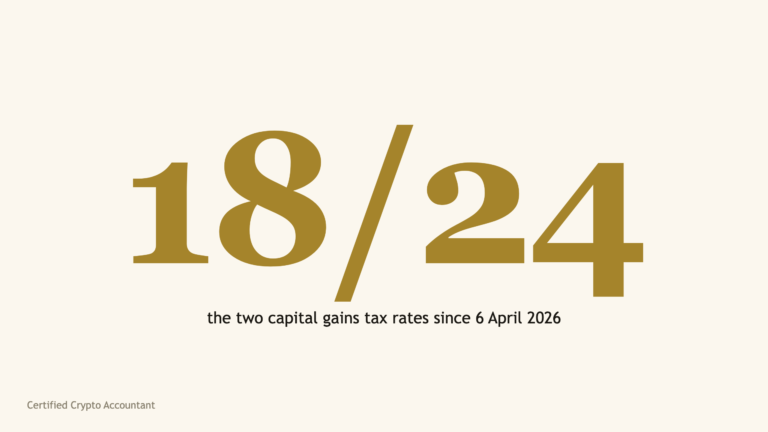
Where the 18% and 24% bands land once a crypto portfolio is involved.
Reviewed 24 Aug 2026ExplainerGifting crypto outside marriage triggers capital gains
The spouse transfer rule that doubles the allowance, and where it stops working.
Reviewed 24 Aug 2026ExplainerHow to report capital gains on your Self Assessment
What to do once you know you are over the allowance or over the proceeds test.
Reviewed 24 Aug 2026