Your founder tokens create a tax bill on the day they unlock

Published 20 July 2026· Reviewed against gov.uk 25 August 2026· 9 min read·Income, business and NFTs
Around $97 billion of locked tokens entered circulation in 2025, according to Tokenomist’s January 2026 unlock review, one of the largest emission years on record. Roughly $600 million of tokens unlock every single week. And a study by market maker Keyrock covering more than 16,000 unlock events found that about 90% of them push the price down, with team unlocks the most damaging category of all.
Founders read those numbers and think about price. Almost nobody thinks about the other bill: token vesting tax. In both the UK and the US, tax on your vested tokens usually lands at the moment of vesting, at whatever the market says they are worth that day, whether or not your lockup lets you sell a single one. Get the timing wrong and you can owe six figures in cash on tokens you are contractually barred from touching.
This guide walks through when the tax hits, the US section 83(b) election that can shrink the bill, why UK founders have nothing like it, and what to do before your next unlock date.
When exactly does tax hit vested tokens?
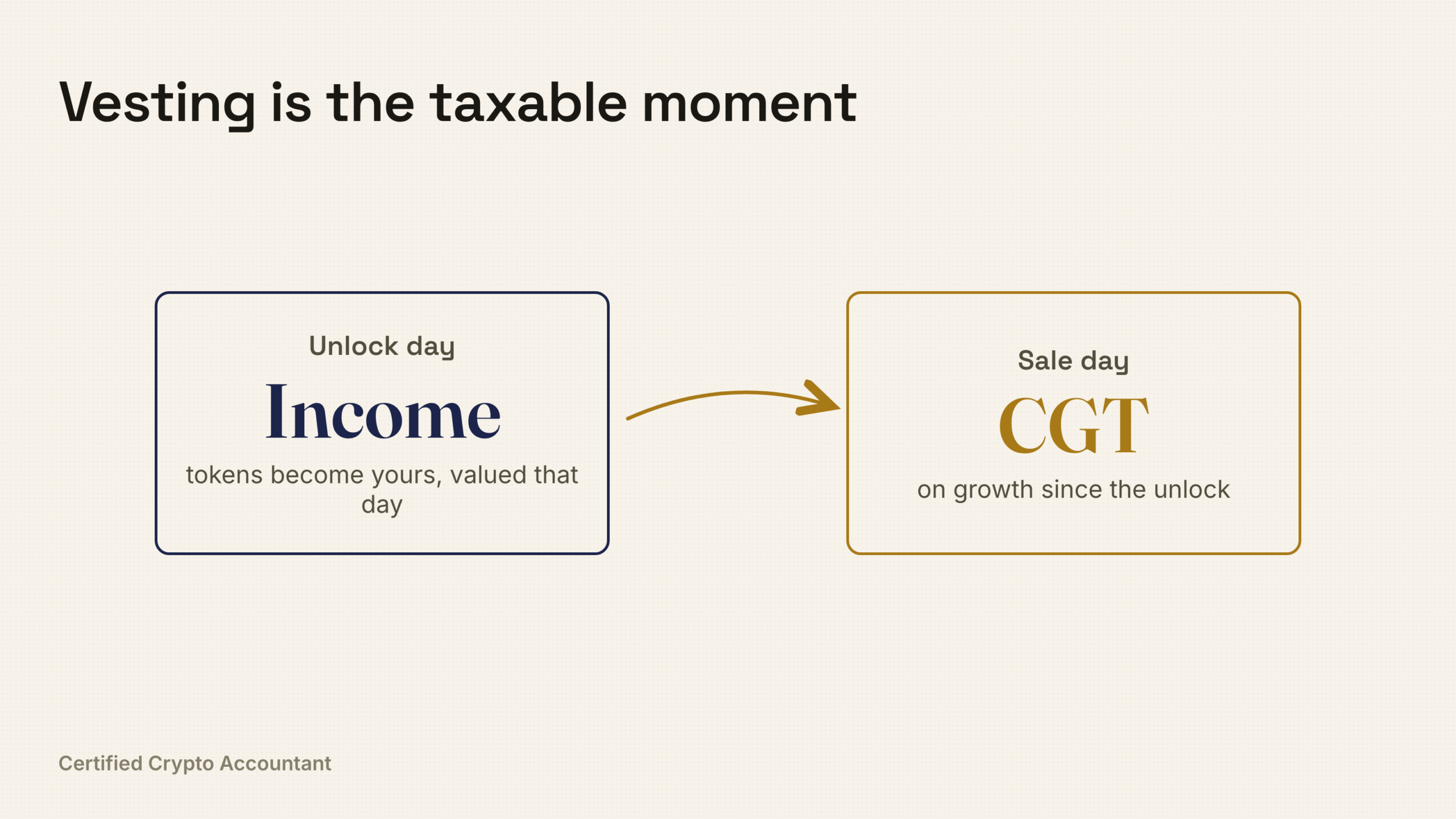
Both countries answer the same way: when the tokens become yours, not when you sell them.
HMRC’s position is blunt. Exchange tokens paid for employment duties count as money’s worth, “and to therefore be employment income subject to Income Tax and National Insurance contributions on the value of the asset” (Cryptoassets Manual CRYPTO42050). Because most project tokens trade somewhere, HMRC considers they “generally will be readily convertible assets” (CRYPTO42100), which means the company must run a best-estimate valuation through payroll and deduct PAYE and Class 1 NIC in real time, exactly as if it had paid you cash.
The US route is IRS Notice 2014-21: digital assets are property, and a taxpayer paid in them “must, in computing gross income, include the fair market value of the virtual currency, measured in U.S. dollars, as of the date that the virtual currency was received.” For employees that value goes on the W-2 with withholding, FICA and FUTA. For advisors and contractors it is self-employment income, with self-employment tax on top.
For tokens that vest over time, US timing runs through section 83: the income lands in the year the tokens are no longer subject to a substantial risk of forfeiture. Your four-year vest with a one-year cliff, the structure a16z’s token compensation guidance treats as standard, is a series of tax events, one per vesting tranche, each priced at that day’s market.
The 83(b) election, the one move US founders get
Section 83(b) lets you elect, within 30 days of the grant, to be taxed on the tokens’ value at grant rather than at each vest. For a founder granted restricted tokens before launch, when the network barely exists and a defensible valuation is low, that can convert years of income tax events at unlock prices into one small tax bill now, with everything after taxed as capital gain. The long-term capital gains clock also starts at grant rather than at each vest (section 83(f)).
The mechanics tightened up recently. The IRS released a standard form for the election, Form 15620, and since mid-2025 it can be filed online through an IRS online account. The 30-day deadline has no exceptions and the election is irrevocable.
Two honest warnings. There is no 409A-style safe harbor for token valuations; Lowenstein Sandler’s guidance on token awards notes a token valuation may only be reliable for a couple of weeks, against up to a year for startup stock. And if you elect, pay tax, and then forfeit the tokens or watch them go to zero, you do not get the tax back.
Why UK founders are stuck with the full bill
Here is the part that surprises founders who have done a UK startup before. With shares, UK employees use the restricted securities rules and s.431 elections to manage exactly this timing problem. With tokens, on the prevailing professional reading, none of that machinery applies.
The restricted securities regime only covers “securities” as defined in ITEPA 2003 s.420, and the list (shares, debentures, loan stock, warrants, units in collective investment schemes, futures, CFDs and so on) does not mention cryptoasset tokens. HMRC’s employment income guidance for cryptoassets never discusses the regime, and HMRC has said treatment depends on the nature and use of the token (CRYPTO10100), so a token that genuinely carries share-like rights could be different. But for the ordinary utility or exchange token a founder receives, most advisers conclude the whole value is simply general earnings when it vests or is received. Taxed at up to 45%, plus 2% NIC, through PAYE, at the unlock-day price.
There is a second trap behind the first. When a company accounts for PAYE on a notional payment like a token vest and the employee does not repay that tax within 90 days of the end of the tax year, ITEPA s.222 charges tax on the tax, treating the unpaid amount as further earnings. A founder who shrugs at the payroll entry because no cash moved can turn a large bill into a larger one.
The market drops while the tax bill doesn’t
Now stack the research on top of the law. Keyrock’s study of 16,000+ unlocks found prices start sliding up to 30 days before an unlock as traders front-run it, and that team unlocks trigger the worst falls. Their coverage of ApeCoin is the cautionary tale: after a team unlock, APE fell 77% over seven months while ETH fell 9% in the same window.
Run that through a UK founder’s numbers. Your tranche of tokens vests at an unlock-day value of £400,000. As an additional-rate taxpayer you owe roughly £188,000 in income tax and NIC, through payroll, now. Your lockup agreement, of the kind a16z’s launch guidelines recommend for at least a year from launch, means you cannot sell. Seven months later the tokens are worth £92,000. The £188,000 does not shrink. Selling at £92,000 just crystallises a capital loss of about £308,000 against the vest-date value, and capital losses only offset capital gains, never the income tax you already owe. A US founder without an 83(b) election is in the same boat: ordinary income at vest, capital loss on the fall, and only $3,000 of that loss usable against ordinary income per year.
That asymmetry, income tax on the way up and capital loss on the way down, is the entire reason token compensation needs planning before the grant, not at filing time.
Is any of this changing?
In the US, Congress is actively working on digital asset taxation. The House Ways and Means Committee held a full legislative hearing on 9 June 2026 covering bills on wash sales, mining and staking, and mark-to-market. The bipartisan PARITY Act (H.R. 8899, May 2026) would let taxpayers defer tax on staking and mining rewards for up to five years. But read the drafts closely: none of the 2025 to 2026 proposals defers tax on tokens received as compensation for services. Section 83 timing still governs founder vesting, and nothing on the UK side suggests HMRC’s readily convertible asset framework is moving either.
Plan around the law that exists, not the reform that might arrive.
What founders should do before the next unlock
Before the grant is signed, model the tax at realistic unlock valuations, not at today’s zero. US founders with restricted token grants should get an 83(b) analysis done inside the 30-day window while a low valuation is still defensible; the online Form 15620 filing removes the old excuse about certified mail. Negotiate sell-to-cover or net settlement into the token agreement so a slice of each tranche can be liquidated for the tax where the lockup permits, which a16z’s compensation primer notes some projects already do for employee grants. UK founders should agree with the company, in advance, how the PAYE on each vest is funded, and diarise the s.222 90-day deadline. And if past vests were never put through payroll or a return, fix that voluntarily before HMRC or the IRS finds it through exchange reporting, because both now receive exchange data automatically.
Frequently asked questions
Do I owe tax on vested tokens if I haven’t sold any?
Yes, in most cases. In the UK, tokens received for work are earnings taxed at their value on receipt. In the US, restricted tokens are taxed as ordinary income as they vest under section 83, unless a timely 83(b) election moved the charge to grant.
Can I really file an 83(b) election for tokens?
Practitioners widely treat restricted tokens as property eligible for section 83(b), and the IRS provides Form 15620 for the election, with online filing available since mid-2025. The deadline is 30 days from the transfer, without exceptions. Take advice on valuation before filing.
What happens if my tokens crash after i’ve been taxed?
The income tax charge stands. The fall in value becomes a capital loss when you dispose of the tokens, usable against capital gains but not against the income tax already due. This is the single biggest risk to model before accepting a token package.
Is there a UK version of the 83(b) election for tokens?
No. The s.431 election applies to employment related securities, and tokens do not appear in the ITEPA 2003 s.420 definition. On the standard reading, UK founders are taxed on the full value at receipt or vesting with no election available. Genuinely share-like security tokens may differ, so get the token’s rights reviewed.
I’m an advisor paid in tokens, not an employee. Same rules?
The timing is similar but the boxes differ. UK advisors are typically taxed on the tokens’ value as trading or miscellaneous income with Class 4 NIC where applicable. US advisors have self-employment income at fair market value on receipt, plus self-employment tax.
Sort the tax before the unlock, not after
The founders who come to us in trouble all share one feature: the token agreement was signed, the tokens vested, and the tax question was asked afterwards. At Certified Crypto Accountant we work with UK founders and early team members on the whole sequence: grant structuring reviews, 83(b) timing, PAYE and readily convertible asset treatment, unlock-date valuations and the disclosure work where past vests were missed. Book a free, confidential review at certifiedcryptoaccountant.com, and see how our crypto tax services keep the unlock from becoming the emergency.
This is one piece of a larger return. Our crypto tax accountants take the whole transaction history rather than a single event, and the crypto tax UK guide sets out the rules behind it.
Sources
Every figure on this page was checked against the source below on 25 August 2026.
- Section 83(b). Cornell Law School, checked 25 August 2026
- Cryptoassets Manual CRYPTO42050. GOV.UK, checked 25 August 2026
Fahad Zar
Crypto tax accountantAAT licensed 1010475
- AAT Licensed Accountant and MAAT, licence 1010475
- MSc Accounting and Finance, BPP University London
- Six years inside digital asset accounting, across several crypto tax firms
- Practises through Zar Enterprises Ltd, ICO registration ZC225094
- Supervised for anti-money laundering by the AAT
What matters to me is that the number on the return is true, whatever it turns out to be.
Whether this is worth a conversation
Most people who read this page do not need an accountant. A few do.
- You were paid in tokens
- Your company holds crypto
- Your NFT sales made real money
If you sold one NFT at a small profit as a hobby, the capital gains pages cover it.
If one of these is you, the first look costs nothing.
Read next
Paid in crypto means income tax before capital gains tax
Paid in crypto in the UK? It is taxed as income at receipt, then again for Capital Gains when you sell. How to report…
Reviewed 25 Aug 2026Deep guideNFT creators and traders are taxed under different rules
How HMRC taxes NFTs in the UK: Capital Gains Tax on disposals, Income Tax for creators and traders, and the record…
Reviewed 25 Aug 2026Deep guideCrypto Tax for Limited Companies and Businesses UK
Crypto tax for UK limited companies: corporation tax not CGT, no annual exempt amount, trading vs investment, and…
Reviewed 25 Aug 2026Deep guideWho pays the tax when a bot does your crypto trading
Every trade your bot makes is your taxable event. How HMRC and the IRS treat automated crypto trading, AI agents, and…
Reviewed 25 Aug 2026