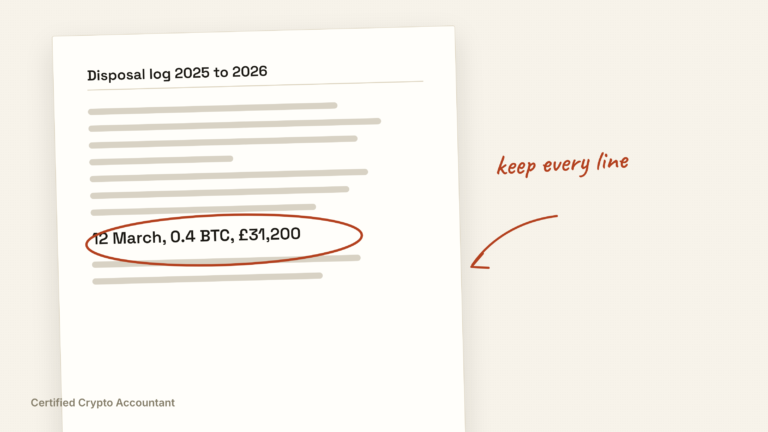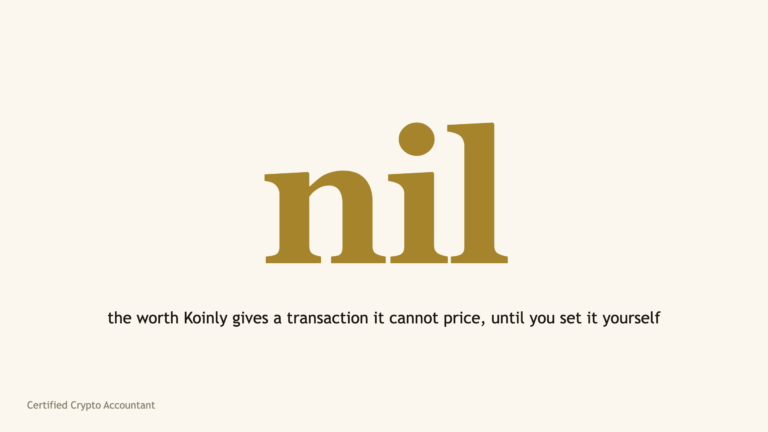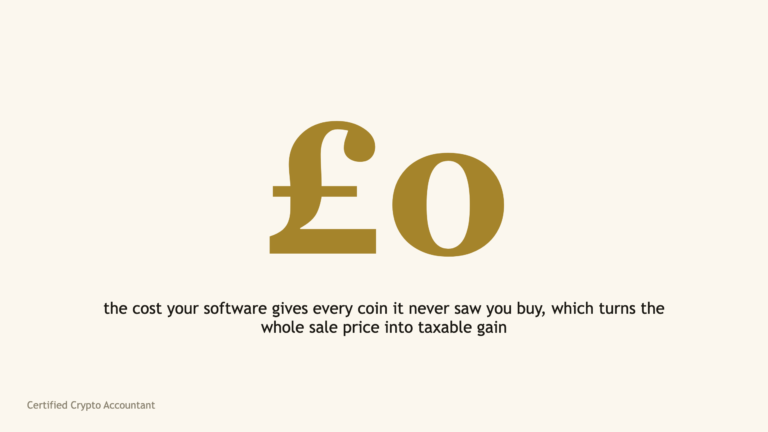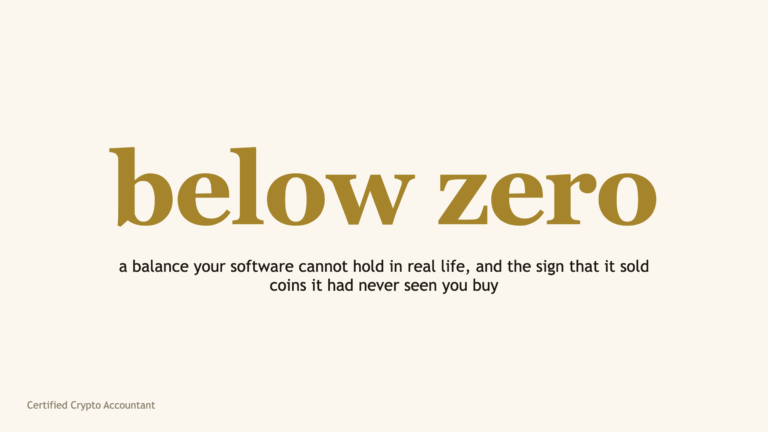
Your tax report counted a transfer to your own wallet as a sale. Moving coins is not a disposal. The fix

Published 12 November 2026 Reviewed against gov.uk 12 November 2026 10 min readTools and records
Moving coins between wallets you own is not a disposal, so a transfer that shows as a sale in your tax report is a pairing failure rather than a tax charge. The software saw coins leave one wallet and could not match them to the coins arriving in the other, so it recorded a sale at market value on the way out and a purchase at market value on the way in. The fix is to make the two sides meet, and the gain or loss the software invented on the day of the move then disappears.
The guide to moving crypto between wallets covers the law in full. This page is for the moment after, when the report is already built and one line in it is wrong.
A transfer between your own wallets is not a disposal. When the report shows one as a sale, the software could not pair the withdrawal with the deposit, so it sold the coins at market value and bought them back, inventing a gain on the day of the move and resetting the cost. Connect both wallets, fix the timestamp or amount that broke the pair, merge by hand if it is one case, and re-run the year.
What HMRC says a transfer is
CRYPTO22100 lists what counts as a disposal, selling tokens for money, exchanging them for a different token, using them to pay for goods or services, and giving them away other than to a spouse or civil partner. Then it says there is no disposal if the individual retains beneficial ownership of the tokens throughout the transaction, for example moving tokens between public addresses that the individual beneficially controls, commonly described as moving tokens between wallets.
So the coins keep their place in the pool. Under CRYPTO22200 every token of one type sits in a single pool under section 104 of the Taxation of Chargeable Gains Act 1992 with one pooled cost, and a move between your own wallets changes neither the number of tokens in the pool nor the cost they carry. Nothing happens for tax on the day of the move, except for the fee, which comes further down.
Why the software breaks the pair
The software keeps two records for every transfer, a withdrawal from wallet A and a deposit to wallet B, and merges them into one non taxable line only when they pass its matching checks. The vendor’s help page sets out six. The deposit and withdrawal must be the same coin. They must be within twelve hours of each other. The withdrawal must come before the deposit. The deposited amount must be equal to or smaller than the withdrawn amount. The difference between them must be no more than twenty per cent. And the two must share a transaction hash, or one or both must have none. The page is here.
A pair that fails any one check is left as a withdrawal and a separate deposit, which the vendor’s other page calls a broken transfer. Its words are that on a broken transfer a withdrawal is equivalent to sold at market price, so gains will be calculated for this disposal, while the deposit will be treated like an acquisition at current market price, and that this effectively resets the cost basis of your assets. Read the page.
In our files the checks fail for a handful of reasons. The receiving wallet was never added, so there is nothing to pair with. A CSV was imported in the wrong timezone, so the deposit appears to land before the withdrawal and the chronology check fails. The exchange rounded the amount, or recorded the deposit only after several confirmations, so the timestamps are hours apart. The coin changed name across a bridge, ether on one chain arriving as a wrapped token on another, which fails the likeness check and is recorded as an exchange of one token for another. And the same quantity moved through three wallets in quick succession, where the software pairs the first withdrawal with the last deposit and leaves the middle wallet with an orphan on each side. The vendor calls that hopping and says it can happen when the middle wallet was added last.
What a broken transfer does to the year
Three things, and each one is wrong on its own.
It invents a disposal on the day of the move. The coins are treated as sold at that day’s price against their pooled cost, so a gain or a loss appears in the tax year of the transfer, in a year where you may have sold nothing at all.
It resets the cost. The deposit is treated as a purchase at that day’s price, so when you do sell, the gain is measured from the day of the move rather than from what you originally paid. Across the two events the total can come out close to the true figure, but it lands in the wrong years, against the wrong annual exempt amounts and possibly at the wrong rate, and if the price fell between the move and the sale, the report shows a gain in one year and a loss in another where the truth was one smaller gain.
If the receiving wallet was never connected, the real sale is missing. The software has sold the coins on the day of the move and knows nothing after that. The disposal that actually happened, from the wallet it cannot see, is not in the report. That is the direction HMRC’s data finds, because the exchange that received the coins reports the sale and the report does not contain it. The page on what HMRC receives covers the exchange reporting.
How to repair it, step by step
One. Confirm both wallets are yours and both are connected. The receiving address on the withdrawal is the test. If it is a wallet you control and it is not in the software, add it. This single step pairs most broken transfers on the next sync, because the deposit side now exists.
Two. Check the timestamps and the amounts. If both sides are present and still unpaired, one of the six checks failed. A deposit dated before its withdrawal is almost always a timezone error on a CSV, and the vendor’s advice is to re-import the file with the right timezone rather than edit lines by hand. A deposit larger than the withdrawal is a rounding or a wrong currency problem on one leg.
Three. Merge by hand where it is a single case. Every tool has a way to mark a withdrawal and a deposit as one transfer, and a way to split a pair that was merged wrongly and re-merge it in the right order. The vendor’s warning is worth repeating, do not mark a withdrawal as a transfer when the deposit is already there with a wrong timestamp, because that duplicates the coins instead of pairing them.
Four. Treat a bridge with a name change on its merits. Where ether went out and a wrapped token came in, the software records an exchange, and HMRC’s manual does treat an exchange of one token for another as a disposal. Whether wrapping is a disposal is a question the wrapping and bridging guide works through, and the answer decides whether to merge that pair or leave it.
Five. Re-run the report and read the year again. The invented gain on the date of the move should be gone, the later sale should carry the original cost, and the pooled quantity should match what you actually hold.
The fee is the one part that is a disposal
You sent one ether and 0.998 arrived. The 0.002 paid to the network left your ownership, and CRYPTO22280 says the token given as a fee is disposed of for its market value. The allowable costs page lists transaction fees paid for having the transaction included on the distributed ledger among the costs of an acquisition or a disposal, and a move between your own wallets is neither, so we do not deduct a transfer fee against the pool. The fee tokens are a small disposal of their own, measured against their share of the pooled cost.
The software has a setting for when it recognises those fee disposals, immediately on each transfer or only when the whole holding is finally sold. The vendor’s page says the second option postpones the gains on fees rather than removing them. For most people the fees are pence or a few pounds and either setting is defensible, as long as it is used the same way every year.
A worked example with figures
Suppose you bought two ether in 2023 for £2,800 in all, and in January 2026 moved them from the exchange to a hardware wallet when ether was £2,600. You sold them in June 2026 for £5,000. The hardware wallet was never added to the software.
As the report stands, the January move is a sale of two ether for £5,200 against a cost of £2,800, a gain of £2,400 in the year to 5 April 2026. The June sale is not in the report at all, because the software never saw the wallet it came from. The gain is in the wrong year, and the real disposal is missing.
Add the wallet, and the pair merges. The January move is no longer a disposal. The June sale is a disposal of two ether for £5,000 against a cost of £2,800, a gain of £2,200 in the year to 5 April 2027. The 2025 to 2026 return no longer carries a £2,400 gain, which against the £3,000 annual exempt amount and the published rates of 18% and 24% could have been up to £576 of tax on a sale that never happened. The return for the year to 5 April 2026 is due online by 11.59pm on 31 January 2027, and if it has already been filed with the broken transfer in it, gov.uk says a return can be corrected within 12 months of the filing deadline.
When it needs an accountant
One broken pair between two wallets you can both connect is a ten minute fix, and you should do it yourself first. It becomes a job when transfers run across several exchanges, chains and bridges, when the same coins hopped through wallets that were added in the wrong order, when a receiving wallet was never connected and the later sales have to be found on the chain, or when returns have already been filed on the broken figures and have to be corrected. Then the pools are rebuilt from source rows and every merge is written down with its evidence. The fees below cover the whole report, and the first look at it is free.
Three fixed fees, quoted in writing before any work starts
One taxpayer, one tax year unless the line says otherwise. Written position within 15 working days of software access.
For an exchange-only history under about 5,000 trades where the software report is already built.£499
For several platforms, wallet transfers read as sales, duplicates, and one or two back years.£950
For DeFi, derivatives, high volume, or balances that do not tie.£1,750
Send your software report to zar@certifiedcryptoaccountant.com for a written fee the same working day, or start with the free review. Licensed and regulated by the AAT, licence 1010475.
Questions about transfers counted as sales
Is a transfer between my own wallets taxable?
No. HMRC's manual at CRYPTO22100 says there is no disposal if the individual retains beneficial ownership of the tokens throughout, for example moving tokens between public addresses that the individual beneficially controls. The coins keep their place in the pool and their cost. Only the network fee paid in tokens is a disposal, and it is small.
Why does the software show a gain on a transfer to my own wallet?
Because it could not pair the withdrawal with the deposit. The pair must pass six checks, same coin, within twelve hours, withdrawal first, deposit no larger than the withdrawal, no more than twenty per cent apart, and a matching transaction hash or none. A pair that fails one check is left as a sale and a separate purchase, which the vendor calls a broken transfer.
Does a broken transfer change the total tax, or just the timing?
Both. It puts a gain or a loss into the year of the move, measures the later sale from the day of the move instead of from what you paid, and if the receiving wallet was never connected, the real sale is missing from the report altogether. The total across years can be close to right while every year is wrong.
Can I just mark the withdrawal as a transfer?
Only if the deposit side is genuinely missing. If the deposit is already in the software with a wrong timestamp, marking the withdrawal as a transfer duplicates the coins. Check both wallets are connected first, then fix the timezone or amount that broke the pair, and merge by hand only for a single case.
What about a bridge where the coin arrives under a different name?
The software records that as an exchange of one token for another because it fails the same coin check, and HMRC does treat an exchange of tokens as a disposal. Whether wrapping or bridging is a disposal depends on what happened to beneficial ownership, which the wrapping and bridging guide works through before you decide to merge the pair.
I already filed with the broken transfer in the return. What now?
Gov.uk says you can correct a return within 12 months of the Self Assessment deadline, online or by sending another paper return, so a 2024 to 2025 return can usually be changed by 31 January 2027. Fix the pairing in the software first, then amend the return with the corrected gain.
Sources
Every figure on this page was checked against the source below on 12 November 2026.
- How Koinly handles transfers between your own wallets. Koinly help centre, checked 12 November 2026
- Transfers between my own wallets are showing gains (or losses). Koinly help centre, checked 12 November 2026
- CRYPTO22100, Capital Gains Tax, what is a disposal. HM Revenue and Customs, checked 12 November 2026
- CRYPTO22280, Capital Gains Tax, fees satisfied in tokens. HM Revenue and Customs, checked 12 November 2026
- CRYPTO22150, Capital Gains Tax, allowable expenses. HM Revenue and Customs, checked 12 November 2026
- CRYPTO22200, Capital Gains Tax, pooling. HM Revenue and Customs, checked 12 November 2026
- CRYPTO10400, record keeping. HM Revenue and Customs, checked 12 November 2026
- Capital Gains Tax rates and annual tax-free allowances. HM Revenue and Customs, checked 12 November 2026
- Self Assessment tax returns, deadlines. GOV.UK, checked 12 November 2026
- Self Assessment tax returns, if you need to change your return. GOV.UK, checked 12 November 2026
- Taxation of Chargeable Gains Act 1992, section 104. legislation.gov.uk, checked 12 November 2026

Fahad Zar
Crypto tax accountantAAT licensed 1010475
- AAT Licensed Accountant and MAAT, licence 1010475
- MSc Accounting and Finance, BPP University London
- Six years inside digital asset accounting, across several crypto tax firms
- Practises through Zar Enterprises Ltd, ICO registration ZC225094
- Supervised for anti-money laundering by the AAT
What matters to me is that the number on the return is true, whatever it turns out to be.
Whether this is worth a conversation
Where this stops being a reading job and starts being a hiring one.
- Transfers run across several exchanges, chains or bridges and more than a few pairs are broken
- A receiving wallet was never connected and the sales that followed have to be found on the chain
- A return has already been filed on the broken figures and needs correcting with evidence
If one pair is broken, both wallets are yours, and connecting the second one or fixing a timezone merges it on the next sync, you have fixed it yourself. Re-run the year, check the pooled quantity matches what you hold, and file the corrected figure.
If one of these is you, the first look costs nothing.
Read next
Do you pay tax moving crypto between wallets
The beneficial ownership test, and the network fee that is a disposal.
Reviewed 12 November 2026ExplainerA negative balance in your crypto tax software
The commonest result of an unpaired transfer, and how to clear it.
Reviewed 12 November 2026ExplainerWrapping and bridging crypto tax
When a coin changes name on the way and whether that is a disposal.
Reviewed 12 November 2026ExplainerYour report says you owe tax but you lost money
The five places a software report overstates the gain, with a corrected year.
Reviewed 12 November 2026 ExplainerMerging two rows in Koinly turns a sale and a purchase back into one transfer. How to merge, split and edit
The clicks that repair it. How to merge the two rows into one transfer in Koinly, split a wrong merge, and which merges keep the tax.
Reviewed 13 November 2026