Missing purchase history means the software gave your coins a nil cost. Here is how to find the real one

Published 11 November 2026 Reviewed against gov.uk 11 November 2026 11 min readCrypto Tax
The warning means the software never saw you acquire the coins it watched you sell, so it has given them a cost of nil and the whole sale price has become gain. The fix is to find the acquisition, prove what you paid in sterling on the day, and put that cost back where the nil is.
One tool prints it as “Missing purchase history”, another as “missing cost basis”, and they describe the same gap. A quantity of a token appeared in an account the software can see, with no buy, no deposit it could match and no reward it could price, so the cost column reads nil and the gain on that disposal is the full proceeds. In our files this one warning is the most frequent reason a report is higher than the truth, and the most fixable, because the purchase almost always happened and can be found.
Missing purchase history means the software never saw you acquire the coins it watched you sell, so it gave them a nil cost and taxed the whole sale. Find the source, prove the sterling cost from a bank line, an email or the chain, and put it back. Where it is truly lost, HMRC accepts a reasoned estimate explained on the return.
Why the warning appears
Software can only match a movement when it can see both ends, and every version of the warning comes from one end being out of sight.
A wallet or exchange you never added. You bought on one platform in 2021, moved the coins to a hardware wallet, and years later sent them to a different exchange and sold. If neither the first platform nor the wallet was connected, the software first sees the coins arriving at the second exchange with no purchase behind them. CRYPTO22100 says there is no disposal when you move tokens between addresses you control and keep beneficial ownership throughout. But a transfer the software cannot pair is read as a deposit from nowhere, and a deposit from nowhere has no cost.
A platform that has closed. The purchase sat on an exchange that no longer exists, with no API to connect and no export to download. The coins left it and arrived somewhere the software can see. The acquisition did not.
Amounts that differ by a network fee. You sent 1.000 ether and 0.998 arrived. Software that matches on exact quantity sees an unrelated deposit of 0.998 with a nil cost, and often reads the 1.000 withdrawal as a sale as well, the error the guide to moving crypto between wallets covers. CRYPTO22280 adds that the tokens given up as a fee are themselves disposed of at market value.
Gaps in a CSV. An export that starts in January 2023 when the account opened in 2020, or two exports with a month missing between them, leaves every coin bought in the gap without a record.
An airdrop, a fork or a reward. These are a real case of no purchase. Whether nil is the right cost for them comes further down.
What HMRC lets you count as cost
HMRC’s Cryptoassets Manual at CRYPTO22150 lists the allowable costs. The consideration in pound sterling originally paid for the asset, transaction fees paid for having the transaction included on the distributed ledger, and the costs of a valuation or apportionment needed to work out the gain, among others. Its table on exchange fees says a fee paid to buy tokens with sterling is a cost of acquiring them, and a fee paid to sell tokens for sterling is an incidental cost of the disposal.
The cost does not attach to specific coins. CRYPTO22200 puts every token of one type into a single pool under section 104 of the Taxation of Chargeable Gains Act 1992, with one pooled allowable cost that rises when you buy and falls in proportion when you sell, after matching each disposal first against anything acquired the same day and then against anything acquired in the following 30 days under section 106A. So a missing purchase put back raises the pooled cost of every token of that type, and a single missing buy from 2021 can change the gain on a dozen sales in 2025.
Whose job the record is
CRYPTO10400 says cryptoasset exchanges may only keep records of transactions for a short period, or the exchange may no longer be in existence when an individual completes a tax return, and that the onus is on the individual to keep their own records, including the value in pound sterling at the date of each transaction and bank statements and wallet addresses in case of an enquiry.
The gov.uk guidance on tax when you sell cryptoassets, last updated 5 October 2026, adds that exchange transaction reports are not tax calculations and do not keep track of your pooled costs. The guide to crypto record keeping sets out a filing habit that stops the gap opening again.
How to rebuild the cost, step by step
Work the warnings from the largest disposal down. The source is usually one of five.
One. Add the missing wallet or account. The deposit record on the exchange, or the receiving transaction on the chain, names the sending address. If that address is yours, add it to the software so the transfer matches at both ends and the purchase behind it comes into view. If the amounts differ by a fee, most tools have a manual match that joins the two sides. This step alone clears most warnings in our files.
Two. Find the bank or card payment. The statement line gives the date and the sterling amount, which is the consideration CRYPTO22150 allows. Match the payment to the quantity of coins that appeared the same day.
Three. Search your email for the exchange confirmations. A closed exchange cannot give you an export now, but the emails it sent for each buy, deposit and withdrawal while it was alive still record the trade, the quantity and the price.
Four. Read the receiving transaction on the chain. For coins that arrived at a wallet you control, the chain explorer for that network shows the transaction, its date and time, the quantity, the sending address and the network fee. That proves when and how many, though not what you paid, so it is paired with step two, three or five.
Five. Put a sterling value on the day. CRYPTO10400 asks for the value in pound sterling at the date of the transaction. Where you have the sterling you actually paid, use that. Where the acquisition was a swap, the cost of the new token is the sterling value of what you gave up that day. Otherwise take the price from a published source you can name again if HMRC asks, and use the same source throughout. Then enter the cost in the software as a manual acquisition on the right date, and the warning goes.
When nil is actually right, or nearly right
Some coins did arrive for nothing. CRYPTO22350 says airdropped tokens go into their own section 104 pool, or into your existing pool if you already hold that token, and it does not give them a cost. The market value rule in section 17 of the Taxation of Chargeable Gains Act 1992 does not step in either, because subsection 2 switches it off where there is no corresponding disposal and nothing was paid. You can still avoid being taxed twice. CRYPTO22100 says that where Income Tax has already been charged on the value of tokens received, the consideration on their later disposal is reduced by that amount under section 37. The airdrop tax guide works through the income side.
Tokens from a hard fork are different. CRYPTO22300 says the new tokens go into their own pool and the allowable costs of the original pool are split between the original and the new tokens on a just and reasonable basis under section 52(4), so a nil cost on forked tokens is usually too low.
When the cost truly cannot be found
Sometimes the exchange is gone, the bank account is closed and the emails were deleted. HMRC’s Self Assessment Manual at SAM121190 separates a provisional figure, one supplied pending the final figure, from an estimated figure, one the taxpayer wants accepted as final because an accurate figure cannot be provided, for example where records have been lost. For an estimate, you explain in the Any other information box of the return why estimated figures were used. For a provisional figure you mark the return in the finishing your tax return section and replace it when the final figure is known, and HMRC says it should be reasonable and take account of all available information.
A reasonable estimate is built from what you do know. If you can date the purchase to within a month but cannot document it, the lowest published price in that month is a cost HMRC is unlikely to think generous. Write down how you arrived at it and keep the working with the return.
The fallback is to leave the nil in place and pay tax on the whole sale price. HMRC will not object, because it can only overstate the gain, and where the amount is small it is sometimes the right call. For anything large, the estimate route exists so that lost records do not become a tax charge on money you never made.
A worked example with figures
Suppose you sold 2 ether in November 2025 for £5,600 after fees. You bought them in February 2024 on a platform that has since closed, paying £3,582 plus an £18 purchase fee, £3,600 in all. The software never saw the purchase, so the whole £5,600 is gain. Your other disposals in the year to 5 April 2026 produced gains of £2,400, and you have no losses.
As the report stands, the year’s gains are £8,000. After the £3,000 annual exempt amount, £5,000 is taxable. The published rates for the 2025 to 2026 tax year are 18% and 24% for individuals, depending on the total of your taxable income and gains, so the tax is £900 inside the basic rate band or £1,200 above it.
Now put the cost back. The bank statement shows £3,600 leaving on the day of the purchase, and an old confirmation email gives the quantity. The gain on the ether becomes £2,000, the year’s gains £4,400, and the taxable amount £1,400. The tax is £252 at 18% or £336 at 24%, so the nil cost was costing you £648 or £864 on a single disposal. The return that carries the right figure is due online, with the payment, by 11.59pm on 31 January 2027.
When it needs an accountant
One or two warnings on a single exchange history are an evening’s work with the steps above, and you should do them yourself first. It becomes a job when the warnings run across several platforms and chains, when a closed exchange holds years of purchases, or when the pooled cost of a token you traded dozens of times depends on a buy nobody can see. Then it needs someone who can read the chain, rebuild the pools and write a position HMRC will accept on any figure that had to be estimated. The page on reports that owe tax in a losing year covers the other four places a report overstates the gain. The fees below cover the whole report.
Three fixed fees, quoted in writing before any work starts
One taxpayer, one tax year unless the line says otherwise. Written position within 15 working days of software access.
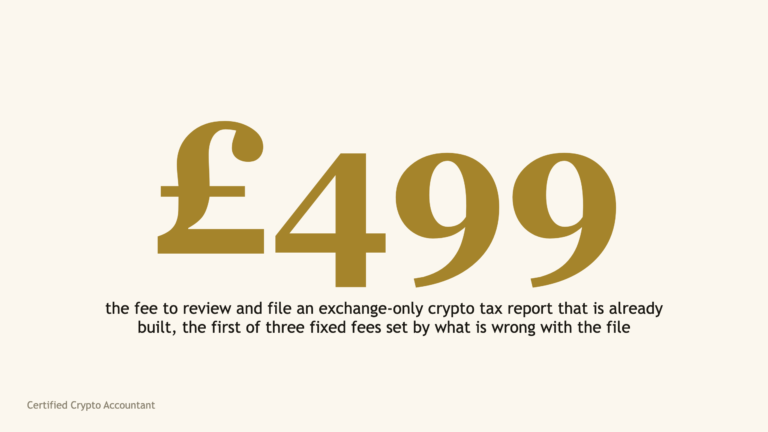
For an exchange-only history under about 5,000 trades where the software report is already built.£499
For several platforms, wallet transfers read as sales, duplicates, and one or two back years.£950
For DeFi, derivatives, high volume, or balances that do not tie.£1,750
Send your software report to zar@certifiedcryptoaccountant.com for a written fee the same working day, or start with the free review. Licensed and regulated by the AAT, licence 1010475.
Questions about the missing purchase history warning
What does missing purchase history mean in Koinly and similar software?
It means the software has a record of you selling or sending a quantity of a token but no record of you buying or receiving it. With no acquisition to price, it gives those coins a cost of nil, so the entire sale price is treated as gain. The warning points to a source the software has not been shown, most often a wallet or exchange account that was never added.
Does HMRC let me use a cost of nil if I cannot find what I paid?
You can, and it can only overstate your gain, so HMRC will not object. But HMRC's own manual allows the sterling you actually paid plus acquisition fees as the cost, and its Self Assessment Manual accepts an estimated figure explained in the Any other information box where records have been lost. A nil cost is the fallback rather than the rule.
Will adding my hardware wallet fix the warning?
Usually, yes. If the coins reached the exchange from a wallet you control, adding that wallet lets the software pair the withdrawal and the deposit as a transfer, which HMRC's CRYPTO22100 confirms is not a disposal, and the purchase behind the wallet comes into view. If the quantities differ by a network fee, use the manual match in your software so the two sides join.
What records does HMRC want for the cost of my crypto?
CRYPTO10400 lists the type of cryptoasset, the date, whether it was bought or sold, the number of units, the value in pound sterling at the date of the transaction, the cumulative units held, and bank statements and wallet addresses in case of an enquiry. It also says exchanges may not keep records for long or may have closed, so the duty to hold them sits with you.
Is the cost of an airdrop really nil?
Often, yes. CRYPTO22350 puts airdropped tokens into their own section 104 pool and gives them no cost, and section 17(2) of the Taxation of Chargeable Gains Act 1992 keeps the market value rule away from an acquisition where nothing was paid and nobody disposed of the tokens to you. If you declared the airdrop as income, CRYPTO22100 says the consideration on disposal is reduced by the amount already charged to Income Tax, so you are not taxed twice. Forked tokens are different and take a share of the original pool's cost.
Sources
Every figure on this page was checked against the source below on 11 November 2026.
- CRYPTO22150, Capital Gains Tax, allowable expenses. HM Revenue and Customs, checked 11 November 2026
- CRYPTO22200, Capital Gains Tax, pooling. HM Revenue and Customs, checked 11 November 2026
- CRYPTO22100, Capital Gains Tax, what is a disposal. HM Revenue and Customs, checked 11 November 2026
- CRYPTO22280, Capital Gains Tax, fees satisfied in tokens. HM Revenue and Customs, checked 11 November 2026
- CRYPTO22300, Capital Gains Tax, blockchain forks. HM Revenue and Customs, checked 11 November 2026
- CRYPTO22350, Capital Gains Tax, airdrops. HM Revenue and Customs, checked 11 November 2026
- CRYPTO10400, record keeping. HM Revenue and Customs, checked 11 November 2026
- Check if you need to pay tax when you sell cryptoassets. HM Revenue and Customs, checked 11 November 2026
- SAM121190, returns containing provisional or estimated figures. HM Revenue and Customs, checked 11 November 2026
- Capital Gains Tax rates and annual tax-free allowances. HM Revenue and Customs, checked 11 November 2026
- Self Assessment tax returns, deadlines. GOV.UK, checked 11 November 2026
- Taxation of Chargeable Gains Act 1992, section 17. legislation.gov.uk, checked 11 November 2026
- Taxation of Chargeable Gains Act 1992, section 104. legislation.gov.uk, checked 11 November 2026
- Taxation of Chargeable Gains Act 1992, section 106A. legislation.gov.uk, checked 11 November 2026

Fahad Zar
Crypto tax accountantAAT licensed 1010475
- AAT Licensed Accountant and MAAT, licence 1010475
- MSc Accounting and Finance, BPP University London
- Six years inside digital asset accounting, across several crypto tax firms
- Practises through Zar Enterprises Ltd, ICO registration ZC225094
- Supervised for anti-money laundering by the AAT
What matters to me is that the number on the return is true, whatever it turns out to be.
Whether this is worth a conversation
Where this stops being a reading job and starts being a hiring one.
- Your report carries missing purchase history warnings across more than one platform or chain and the return is due by 31 January 2027
- A closed exchange or a forgotten wallet holds years of purchases and you cannot see how to get the cost back into the pool
- Some costs truly cannot be found and you need an estimate written up in a way HMRC will accept
If the warnings are few, the coins came from a wallet you can add or a bank line you can find, and the pooled cost recomputes once you enter it, you have fixed it yourself. File the corrected figure and keep the evidence behind each cost with the return.
If one of these is you, the first look costs nothing.
Read next
Your report says you owe tax but you lost money
The five places a software report overstates the gain, with a corrected year.
Reviewed 11 November 2026ExplainerDo you pay tax moving crypto between wallets
The beneficial ownership test and the network fee that is a disposal.
Reviewed 11 November 2026Deep guideWhat crypto records HMRC expects you to keep
The filing habit that stops a missing cost from happening twice.
Reviewed 11 November 2026Deep guideWhy crypto tax software gets UK returns wrong
What the tools do well, where they fail, and how to read the output.
Reviewed 11 November 2026 ExplainerFixing a crypto tax report costs £499, £950 or £1,750, and the look that decides which one is free
How much it costs to have the nil costs and unmatched transfers put right, and when the honest answer is to file it yourself.
Reviewed 11 November 2026ExplainerBinance's export stops short of what HMRC wants. The history still exists, and here is where to get it
When the missing purchase sits on Binance. The export limits by Binance's own help pages, and the rebuild from a card statement and the chain.
Reviewed 11 November 2026ExplainerA negative balance means your crypto tax software sold coins it never saw you buy. How to clear it
The balance side of the same fault. Why the ledger goes below zero, which balance warnings matter, and the step by step clear up.
Reviewed 12 November 2026ExplainerKoinly's missing price warning means that transaction is worth nil until you set it. The two minute fix
The other warning in the same menu. Why Koinly records an unpriced transaction as nil, the two minute fix on video, and the sterling value HMRC accepts.
Reviewed 13 November 2026