Do I need to declare crypto to HMRC

Published 13 September 2026 Reviewed against gov.uk 5 September 2026 6 min readCrypto Tax
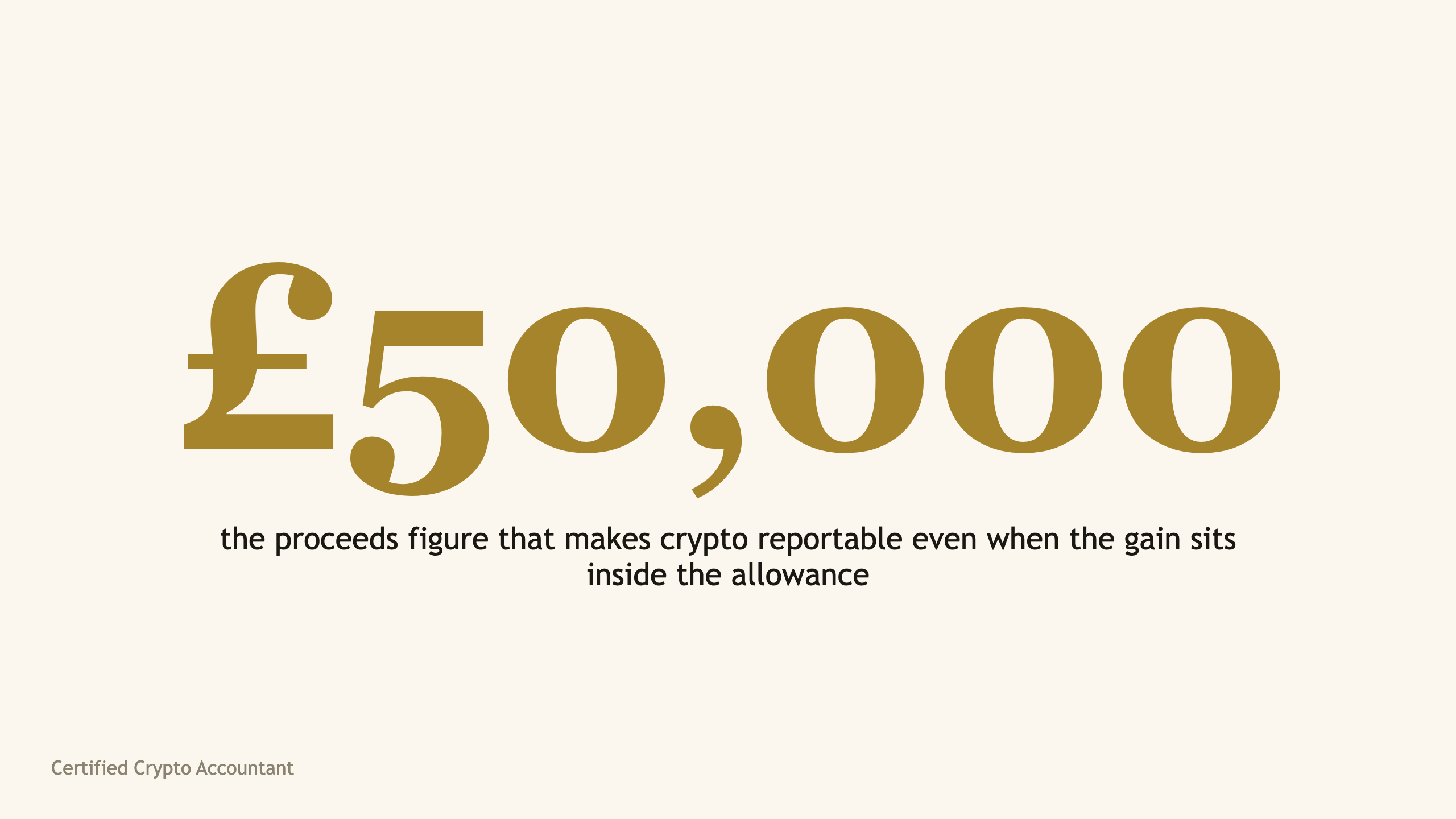
You need to declare crypto to HMRC if any one of three things happened in the tax year. Your gains from disposing of crypto came to more than the £3,000 annual exempt amount. The total proceeds from those disposals came to more than £50,000, whatever the gains were. Or you received crypto as income, from staking, mining, airdrops or work, worth more than the £1,000 trading and miscellaneous income allowance. The first two rules are on GOV.UK’s reporting page, checked 5 September 2026, and the third comes from the allowance at GOV.UK, which HMRC’s manual at BIM86000 confirms covers miscellaneous income as well as trading income. If none of the three applies you have nothing to send, though you may still want to send something, which is the part about losses below.
Three numbers decide it, £3,000 of gains, £50,000 of proceeds and £1,000 of income. Losses decide nothing and are still worth telling HMRC about.
The three triggers
| Trigger | Threshold for 2026 to 2027 | What it means |
|---|---|---|
| Gains after losses | Above £3,000 | Tax is due and a return is required |
| Total proceeds from disposals | Above £50,000 | A return is required even if the gains are inside the £3,000 |
| Crypto received as income | Above £1,000 | Income tax is due on the excess and a return is required |
The proceeds rule is the one that surprises people, and it is the one that catches active traders with modest gains. Proceeds means the sterling value of everything you disposed of, and a disposal includes every swap from one coin to another, every stablecoin rotation and every purchase paid for in crypto, as HMRC’s manual at CRYPTO22100 sets out and our guide to tax without ever selling for pounds explains. Move £10,000 between five coins over a year and you have made £50,000 of proceeds without ever holding more than £10,000. The £50,000 figure has applied since the 2023 to 2024 tax year, when it replaced the old rule of four times the allowance.
Two things never trigger anything. Holding coins, however much they are worth, and buying them with pounds. A person who bought bitcoin in 2019 and has not touched it has nothing to declare, and will not until the first disposal.
Under the thresholds, and why you might still file
If your gains are under £3,000, your proceeds under £50,000 and your income under £1,000, HMRC does not want a return from you for crypto. But a loss is a different case. Losses on crypto are allowable losses, and GOV.UK says you can claim them up to four years after the end of the tax year of the disposal, on a return or, if you are not in Self Assessment, by writing to HMRC. An unclaimed loss is worth nothing. A claimed one reduces gains in the same year and carries forward against any later year, including a year when the market turns and the £3,000 is nowhere near enough. Our guide to claiming capital losses covers the mechanics, and my advice is always the same. If the year was a losing one, tell HMRC about it now, while the exchange records still exist.
There is also a route for gains that are reportable without a full return. If you are not in Self Assessment and the only thing to report is a gain, HMRC’s real time Capital Gains Tax service lets you report and pay by 31 December after the tax year, per GOV.UK. It suits a one off disposal. It does not suit anyone with income to report as well.
Where crypto goes on the return
Since the return for 2024 to 2025, the Capital Gains Summary form SA108 has carried its own Cryptoassets section, boxes 13.1 to 13.8, covering the number of disposals, proceeds, allowable costs, gains, losses, and tax already paid, per the form on GOV.UK. Before that crypto sat inside the other assets boxes, which is one reason HMRC’s own figures on how many people report it were so hard to read. Income from staking, mining or airdrops goes on the main return as other income, unless the activity is a trade, and our reporting guide takes each box in turn.
The figures behind those boxes are the work. Every disposal needs a sterling value on its date and a pooled cost, the pooled cost depends on every earlier purchase of the same coin, and transfers between your own wallets have to be excluded. Software does most of it and gets some of it wrong, which is what reconciliation exists to catch.
Declaring for the first time
If you have never filed a return, you have to tell HMRC you need one by 5 October after the end of the tax year, per GOV.UK. For the 2025 to 2026 year that date is 5 October 2026, and registering produces a Unique Taxpayer Reference which can take a couple of weeks to arrive. The return itself is due online by 31 January 2027, with the tax. Our registration guide covers the steps and what happens if the October date has already passed, which is a late notification rather than a disaster, provided the return and the tax still arrive by January.
If earlier years were never declared
Crypto that should have been reported in a year that has already closed cannot be added to this year’s return. It goes through a disclosure, and coming forward before HMRC writes is cheaper than replying afterwards, as our guide to disclosing unpaid crypto tax explains. How many years are in play depends on why they were missed, which our guide to how far back HMRC can go sets out. Never having told HMRC at all is the case with the longest reach.
What HMRC will already know
From 1 January 2026 every UK crypto platform collects its UK customers’ identity and transaction details for reporting to HMRC, with the first reports due by 31 May 2027, under the framework our reporting guide describes. HMRC sent more than 81,000 letters to crypto holders in the last year on the data it already had. So the question of whether to declare is increasingly one of whether to declare first. A return that matches what the platform reports is the strongest position there is, and the thresholds above tell you whether one is due.
Declaring questions
Do I need to declare crypto if I made less than £3,000?
Not for the gains alone. But if your total proceeds from disposals passed £50,000, or you received more than £1,000 of crypto as income, a return is still required. And a loss is worth claiming even though nothing is due.
Do I need to report crypto losses?
There is no requirement to, and an unclaimed loss cannot be used. Claim it within four years of the end of the tax year, on a return or by letter, and it reduces gains in that year and any later one.
Do I need to declare crypto I have not sold?
No. Holding is not a disposal and neither is buying with pounds. Swapping one coin for another, spending crypto or giving it away are disposals and count towards the thresholds.
What if my only crypto is staking income?
Crypto received as income is reportable once it exceeds the £1,000 trading and miscellaneous income allowance in the year. Below that there is nothing to report. Above it, the excess is taxed as income and needs a return.
Where do I put crypto on my tax return?
Gains and losses go in the Cryptoassets section of the SA108, boxes 13.1 to 13.8, which has existed since the 2024 to 2025 return. Income from staking, mining or airdrops goes on the main return as other income unless it amounts to a trade.
Sources
Every figure on this page was checked against the source below on 5 September 2026.
- Reporting and paying Capital Gains Tax. GOV.UK, checked 5 September 2026
- Capital Gains Tax, if you make a loss. GOV.UK, checked 5 September 2026
- Tax free allowances on property and trading income. GOV.UK, checked 5 September 2026
- BIM86000, trading and miscellaneous income allowance. HM Revenue and Customs, checked 5 September 2026
- CRYPTO22100, what is a disposal. HM Revenue and Customs, checked 5 September 2026
- SA108 2025, Capital Gains Tax summary. HM Revenue and Customs, checked 5 September 2026
- Self Assessment tax returns, deadlines. GOV.UK, checked 5 September 2026
Fahad Zar
Crypto tax accountantAAT licensed 1010475
- AAT Licensed Accountant and MAAT, licence 1010475
- MSc Accounting and Finance, BPP University London
- Six years inside digital asset accounting, across several crypto tax firms
- Practises through Zar Enterprises Ltd, ICO registration ZC225094
- Supervised for anti-money laundering by the AAT
What matters to me is that the number on the return is true, whatever it turns out to be.
Whether this is worth a conversation
Where this stops being a reading job and starts being a hiring one.
- You are over one of the three thresholds for the first time and have never registered
- Your proceeds passed £50,000 on swaps alone and the software's gain figure looks too neat
- There are earlier years that were never declared and a letter has not arrived yet
If you bought, held, and never swapped, spent or earned anything, there is nothing to declare and no reason to pay anyone to say so.
If one of these is you, the first look costs nothing.
Read next
How to report crypto to HMRC
Box by box, once you know a return is due.
Reviewed 5 September 2026DeadlineHow to register for Self Assessment
The 5 October step and what a late registration costs.
Reviewed 5 September 2026DeadlineUnclaimed capital losses expire after four years
Why a losing year still deserves a return.
Reviewed 5 September 2026ExplainerYou can owe crypto tax without ever selling for pounds
The disposals that count towards the £50,000 without touching a bank.
Reviewed 5 September 2026