Can HMRC see my crypto wallet

Published 9 September 2026 Reviewed against gov.uk 5 September 2026 6 min readHMRC and compliance
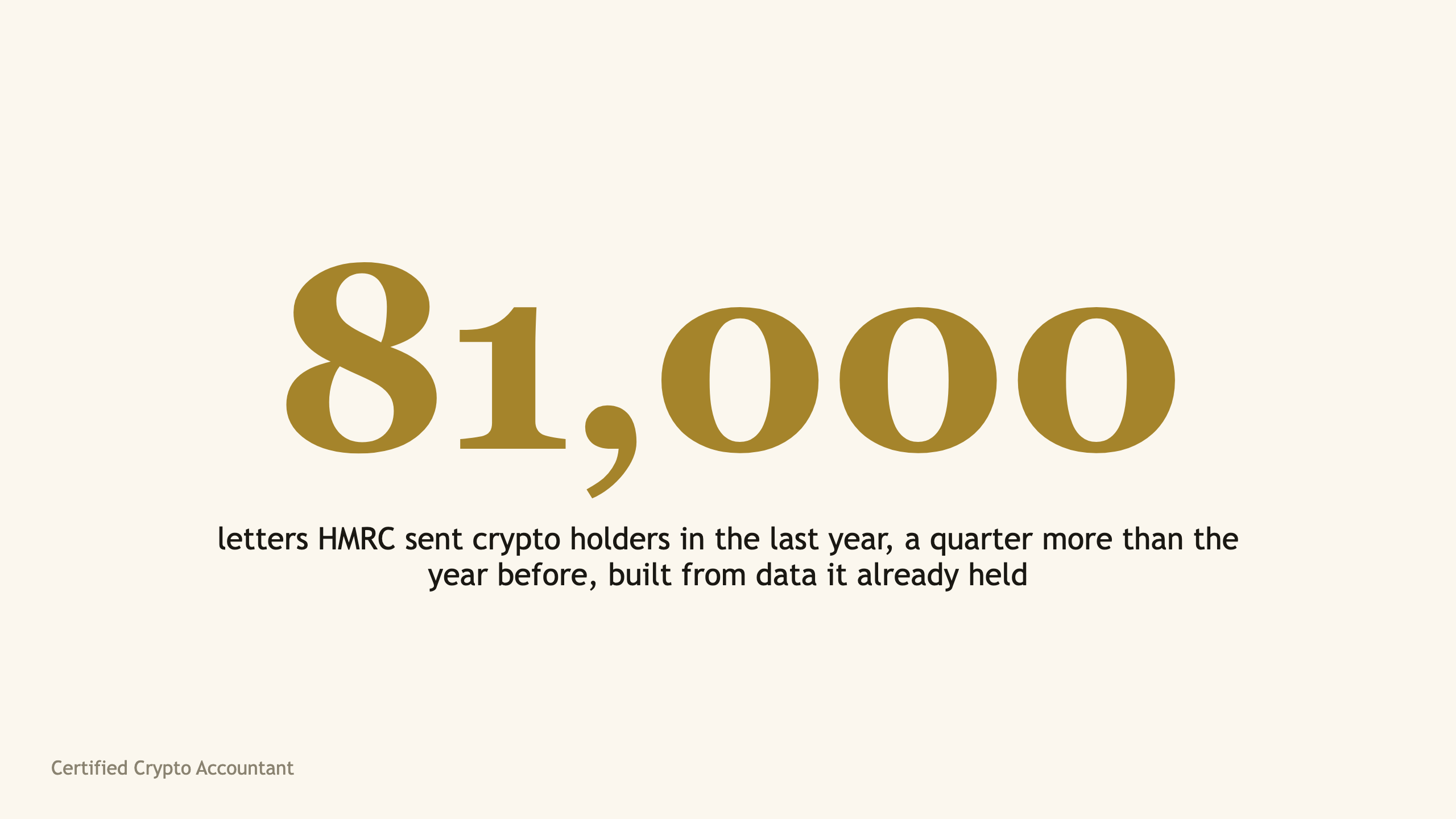
HMRC cannot open your wallet, and it does not need to. It sees the accounts the wallet was funded from, it has been taking customer records from exchanges since 2020, and from 1 January 2026 every platform serving UK customers collects their identity and transaction data for automatic reporting. In the 2025 to 2026 year HMRC sent 81,000 letters to people it believed had crypto to declare, a quarter more than the year before, per Accountancy Age, and its current campaign, running from July 2026 to March 2027, reaches people by letter, email and text message, per ICAEW. Every one of those contacts started from data HMRC already held. So the useful version of the question is what HMRC can see, from where, and how quickly.
HMRC does not need to see inside the wallet. It sees the exchange that filled it, and from this year the exchange sends the record without being asked.
What HMRC already holds from exchanges
The clearest public record is Coinbase. In 2020 it agreed to hand HMRC details of UK customers, and in March 2023 it told customers who had cashed out more than £5,000 in the 2021 tax year that their names were being disclosed, as Protos reported at the time. The legal tool behind requests like that is a data-holder notice under Schedule 23 of the Finance Act 2011, which an officer can serve on a business in writing. Tribunal approval is optional. Coinbase is the exchange that told its customers. Nothing in the law limits the notice to Coinbase.
HMRC’s own release on the 2024 to 2025 figures, published on 27 August 2026, says 17,600 people reported crypto disposals that year and that automatic exchange data starts arriving in 2027. Everything HMRC has used so far, then, was either on a return or obtained by asking, and the compliance letters our letters guide covers still went to named people at named addresses, which is not something a blockchain provides.
What arrives automatically from 2026
Until this year every exchange record HMRC held had to be asked for. The government’s October 2024 decision extended the Cryptoasset Reporting Framework to UK residents, so from 1 January 2026 UK reporting platforms collect identity details and transaction information on their UK customers, with the first annual reports due by 31 May 2027. HMRC’s guidance at IEIM8000480 adds that each platform must notify its users that their information will be reported, by 31 January following the reporting year. If you hold an account with a UK platform, expect that notice by the end of January 2027 if it has not already arrived.
The scope is the point. Every business that exchanges crypto for money, or one crypto for another, or holds coins for customers in the UK has had to be registered with the FCA under the money laundering regulations since January 2020, per the FCA’s own page, and registration means identity checks. The reporting framework sits on top of that register. Our guide to the framework lists what is collected.
Can HMRC see a wallet with no exchange attached
A self custody wallet has no name on it, and HMRC receives no feed from it. What HMRC has instead is a chain analysis capability. In January 2020 it published a £100,000 tender for software to cluster transactions on bitcoin, ethereum, litecoin, ripple, tether and several other chains, with a stated preference for tools that could reach monero, zcash and dash, as Decrypt reported from the notice. The purpose in HMRC’s words was to identify and cluster transactions and link them to service providers.
That last phrase is how a wallet becomes visible. The coins in a cold wallet came from somewhere, and for almost everyone that somewhere is a registered exchange where pounds went in and an identity was checked. Once one address is tied to a person, the analysis follows the chain outward. The blockchain itself is public and permanent. What HMRC lacks for a wallet is the name, and the on ramp supplies it. In my experience the people who believe they are invisible are the ones whose exchange withdrawal history maps every wallet they own, one transfer at a time.
Two honest limits. A wallet funded only with coins earned or received off any platform, and never cashed out, is not on any feed HMRC receives. And HMRC’s tracing effort is intelligence work, aimed at cases it has already chosen, rather than a live scan of every address in the country.
The bank account side
Crypto rarely stays in crypto. The pounds that bought it left a bank account, and the pounds that came back landed in one. Banks report interest to HMRC every year, HMRC can demand statements in an enquiry, and larger movements between an exchange and a current account are the ordinary starting point for a compliance letter, all of which our guide to whether HMRC can see your bank account sets out. The crypto question and the bank question are the same question from two ends.
What to do with the answer
The better question for 2026 is whether your return will match what the platforms report about you for the 2026 calendar year, because that comparison is coming whether or not a letter has arrived yet. Our guide to what Coinbase and Binance send shows the shape of the data. If earlier years were never filed, coming forward before HMRC writes is cheaper than replying afterwards, and the disclosure guide explains why. If they were filed and the figures are right, the visibility works for you, since a return that matches the feed is the strongest defence there is.
Questions on what HMRC can see
Can HMRC track crypto wallets?
Not by name on its own. HMRC has held blockchain analysis software since 2020 that clusters addresses and links them to service providers, and once an address is tied to an exchange account with your identity on it, the rest of the chain follows.
Does HMRC know about my crypto?
If you have used a UK exchange, assume it does or soon will. Exchanges have supplied customer data on request since 2020, and from 1 January 2026 every UK platform collects its customers' details for automatic reporting to HMRC.
Can HMRC see my cold wallet?
Not directly. A hardware wallet sends nothing to anyone. The coins in it came from a platform that knows who you are, and that transfer is what links the wallet to you.
Does Coinbase report to HMRC?
Yes. Coinbase disclosed UK customer details under HMRC notices in 2020 and 2023, and as a UK platform it falls within the automatic reporting that started on 1 January 2026.
Can HMRC see my Crypto.com account?
Any platform that serves UK customers under FCA registration is within the reporting framework from 2026. Our separate guide covers what Crypto.com provides and where to find your records.
Sources
Every figure on this page was checked against the source below on 5 September 2026.
- Coinbase warns users their info was passed to UK tax office. Protos, checked 5 September 2026
- Finance Act 2011, Schedule 23, data-gathering powers. legislation.gov.uk, checked 5 September 2026
- HMRC explains why it wants to track your bitcoin. Decrypt, checked 5 September 2026
- Cryptoasset Reporting Framework and Common Reporting Standard, summary of responses. HM Treasury and HM Revenue and Customs, checked 5 September 2026
- IEIM8000480, notification to reportable users. HM Revenue and Customs, checked 5 September 2026
- Cryptoassets, AML and CTF regime. Financial Conduct Authority, checked 5 September 2026
- 240 crypto millionaires revealed in new government data. HM Revenue and Customs, checked 5 September 2026
- £16bn in unpaid corporate tax and 81,000 crypto letters. Accountancy Age, 27 August 2026, checked 5 September 2026
- HMRC targets tax liabilities from cryptoassets. ICAEW Tax Faculty, July 2026, checked 5 September 2026
Fahad Zar
Crypto tax accountantAAT licensed 1010475
- AAT Licensed Accountant and MAAT, licence 1010475
- MSc Accounting and Finance, BPP University London
- Six years inside digital asset accounting, across several crypto tax firms
- Practises through Zar Enterprises Ltd, ICO registration ZC225094
- Supervised for anti-money laundering by the AAT
What matters to me is that the number on the return is true, whatever it turns out to be.
Whether this is worth a conversation
Where this stops being a reading job and starts being a hiring one.
- You have exchange accounts going back years and have never filed, and the 2026 reporting year is already running
- A letter has arrived and you want to know what HMRC could already be holding before you reply
- Your coins moved through several wallets and exchanges and you cannot reconstruct the path yourself
If every year was filed and the figures were built from complete exchange histories, HMRC seeing them is the outcome you wanted.
If one of these is you, the first look costs nothing.
Read next
What Coinbase and Binance actually send to HMRC
The data notices, what they covered, and what the platforms told customers.
Reviewed 5 September 2026Deep guideFrom 2026 HMRC receives your crypto data automatically
What the reporting framework collects and the dates that matter.
Reviewed 5 September 2026ExplainerCan HMRC see my bank account
The other end of the same question, from the pounds side.
Reviewed 5 September 2026ExplainerHMRC sent 81,000 crypto letters last year, four for every person who filed
Where the letters come from and what they ask for.
Reviewed 5 September 2026