What HMRC’s own numbers say about the crypto crackdown

Published 22 August 2026· Reviewed against gov.uk 25 August 2026· 5 min read·HMRC and compliance
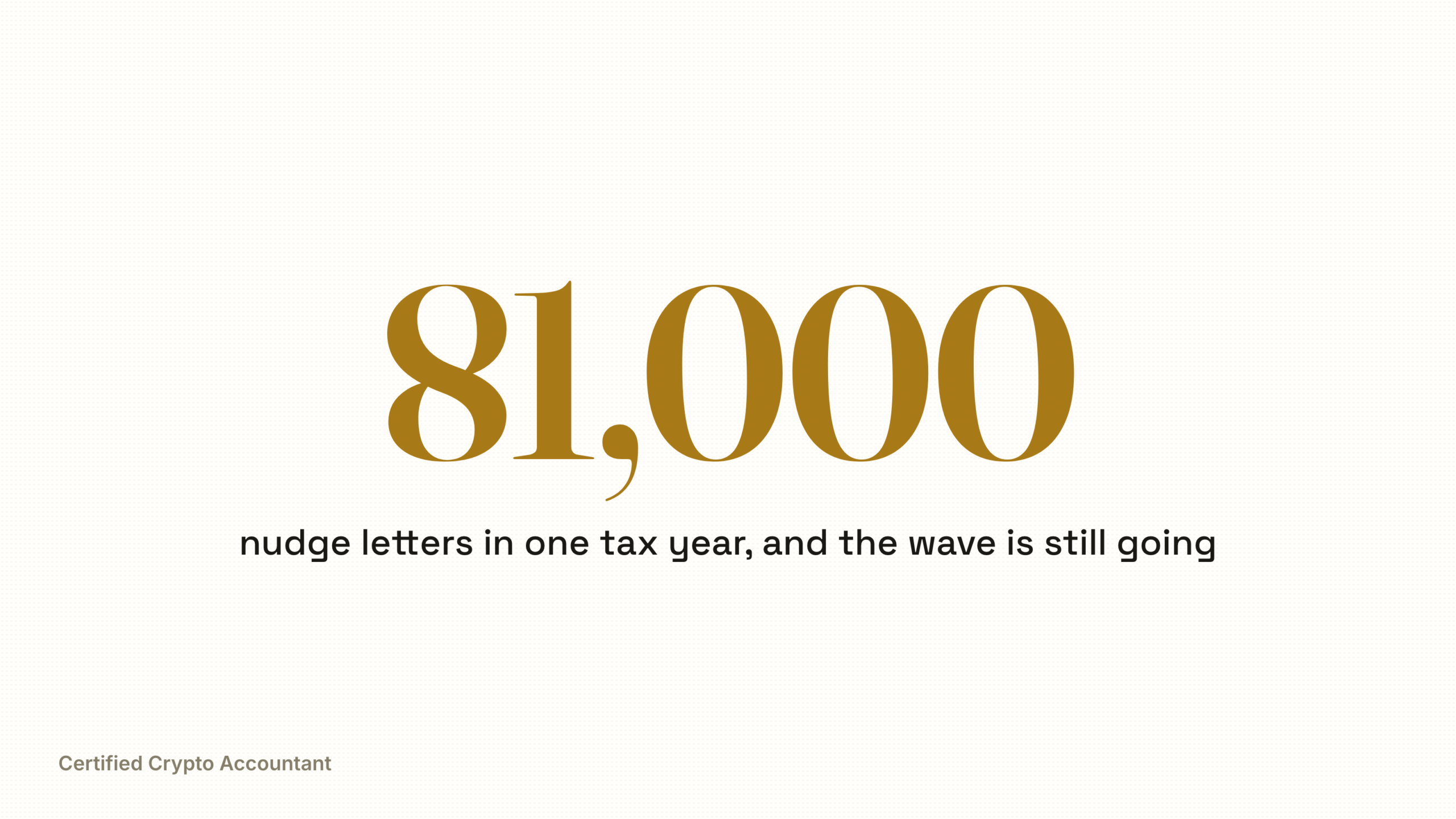
HMRC sent roughly 81,000 warning letters to crypto investors in the year to April 2026. In the same period it reached settlements with just 222 crypto investors. Those two numbers, both pulled out of HMRC by freedom of information requests, tell you what the crypto crackdown actually is right now. It is a deterrence campaign running ahead of the data that will make real enforcement cheap, and HMRC has published, in its own paperwork, the year it expects that to change.
The letters are the loud part
The nudge letter volumes have roughly tripled in two years. Around 27,700 went out in 2023 to 2024, about 65,000 the following year, then the 81,000 last tax year, and KPMG reports a further wave running from July 2026 to March 2027. A nudge letter is not an enquiry and not a bill. It is a prompt to check your position and disclose if something is missing, and we covered how to respond to one properly when the campaign was a third of this size.
At that volume the letters are a broadcast, and a broadcast is what you send before you have the names.
The settlements are the small print
Now the other number. Across two tax years HMRC reached settlements with 502 crypto investors for a combined £8.3 million, figures obtained under freedom of information by Identomat. The interesting movement is inside the average. A settlement in 2024 to 2025 averaged £12,654. A year later it averaged £21,552, up around seventy per cent, while the number of cases actually fell from 280 to 222.
Fewer cases, bigger cheques. That is what an enforcement team does when it is still choosing targets by hand and wants each one to justify the hours. It is not what mass enforcement looks like. Mass enforcement needs mass data, and the mass data has a delivery date.
The data arrives in May
Since 1 January 2026, UK crypto platforms have been legally required to collect identifying details and transaction data on their users under the Reporting Cryptoasset Service Providers Regulations 2025, the UK’s implementation of CARF. Around 50 providers are in scope. Their first reports, covering everything you did in 2026, reach HMRC by 31 May 2027, and parallel reports flow in from exchanges in every other participating country. A user who refuses to hand over their details faces a £300 penalty, and a provider filing inaccurate reports faces £300 per user. The full mechanics are in our CARF guide.
Using an overseas exchange changes nothing here. If the platform operates in a CARF country, the report on your account still lands in the exchange of information, routed to HMRC because you are UK resident.
HMRC wrote down when it expects the money
This is the detail almost nobody has read. The tax information and impact note for CARF forecasts what the measure adds to the exchequer. Forty million pounds in 2026 to 2027. Then £110 million in 2027 to 2028, the year the first reports arrive. Then £85 million and £80 million in the two years after.
The forecast nearly triples in the twelve months after the data lands. HMRC’s own planning assumption is that the profitable enforcement starts once it can see the accounts, and the same document says the framework provides a deterrent effect on individuals who hold cryptoassets. The letters are that deterrent, working the crowd before the evidence arrives. HMRC’s press office was blunter than any of its documents, it headlined the campaign crypto bros being forced to pay fair share of tax.
What this means if you have unreported years
The economics of coming forward are entirely about who moves first. Disclose unprompted and the penalty floor sits low, sometimes at nothing for a careful taxpayer who acts promptly. Wait until HMRC writes to you with your own exchange data attached and the same liability carries prompted penalties, more years in scope, interest on all of them, and far less room to argue behaviour. Every month between now and May 2027 is the cheap window, and it only closes once. The route is the disclosure facility, walked through in our guide to disclosing unpaid crypto tax, and if the missing piece is simply that you never knew how reporting works, start with how to report crypto to HMRC.
I have watched this pattern once before, with offshore bank accounts after the Common Reporting Standard switched on in 2017. The letters came first then too. The people who moved before the data did paid the tax and got on with their lives. The ones who waited met an HMRC that no longer needed their cooperation to know the answer.
Questions we get on the crackdown
Is the HMRC crypto crackdown actually real?
Yes, every figure in this piece is on the record, though the centre of gravity is still ahead. Enforcement so far is selective. The infrastructure for it to stop being selective went live in January 2026.
Will HMRC know about my overseas exchange account?
If the exchange operates in any CARF participating jurisdiction, its report on you reaches HMRC through the international exchange, the same way domestic reports do. Choosing a non UK platform was a privacy strategy in 2020. It is not one now.
Does a nudge letter mean HMRC has found something?
It means an algorithm matched you against data HMRC holds, usually from exchanges, and flagged a possible gap. It is not an enquiry, but ignoring it is how a cheap problem becomes an expensive one, because a later disclosure counts as prompted.
When will HMRC see my 2026 trading?
By 31 May 2027 for the first CARF reports, covering the whole 2026 calendar year. Anything you disclose before that date is disclosed before HMRC holds the file.
If any of your crypto years are unreported, our free review will tell you what a disclosure would involve while it is still the cheap kind.
Sources
Every figure on this page was checked against the source below on 25 August 2026.
- KPMG reports a further wave running from July 2026 to March 2027. KPMG, checked 25 August 2026
- Obtained under freedom of information by Identomat. Money Age, checked 25 August 2026
- The Reporting Cryptoasset Service Providers Regulations 2025. legislation.gov.uk, checked 25 August 2026
- Tax information and impact note for CARF. GOV.UK, checked 25 August 2026
- Crypto bros being forced to pay fair share of tax. HMRC press office, checked 25 August 2026
Fahad Zar
Crypto tax accountantAAT licensed 1010475
- AAT Licensed Accountant and MAAT, licence 1010475
- MSc Accounting and Finance, BPP University London
- Six years inside digital asset accounting, across several crypto tax firms
- Practises through Zar Enterprises Ltd, ICO registration ZC225094
- Supervised for anti-money laundering by the AAT
What matters to me is that the number on the return is true, whatever it turns out to be.
Whether this is worth a conversation
Most people who read this page do not need an accountant. A few do.
- A letter from HMRC has arrived
- You have years HMRC does not know about
- HMRC's figures do not match yours
If your letter is a routine tax code notice and your filings are current, you probably just needed this page.
If one of these is you, the first look costs nothing.
Read next
Crypto tax deadlines for the 2026 to 2027 tax year
Key UK crypto tax dates for 2025/26: Self Assessment registration, the 31 January filing and payment deadline, and what…
Reviewed 25 Aug 2026Deep guideHow much HMRC can charge for unpaid crypto tax
What HMRC crypto tax penalties actually cost: late filing, late payment and undeclared gains. How penalties are…
Reviewed 25 Aug 2026ExplainerHow to tell a real HMRC letter from a scam
HMRC never threatens arrest and never asks for bank details to pay a refund. The thirty second sorting method, and…
Reviewed 25 Aug 2026DeadlineThe HMRC savings tax warning is about your bank interest
Banks report interest automatically and rising rates pushed ordinary savers over the £1,000 allowance. What the letters…
Reviewed 25 Aug 2026