What accountants charge for a tax return in 2026 and why crypto changes the number

Published 11 September 2026 Reviewed against gov.uk 5 September 2026 6 min readSelf Assessment and side income
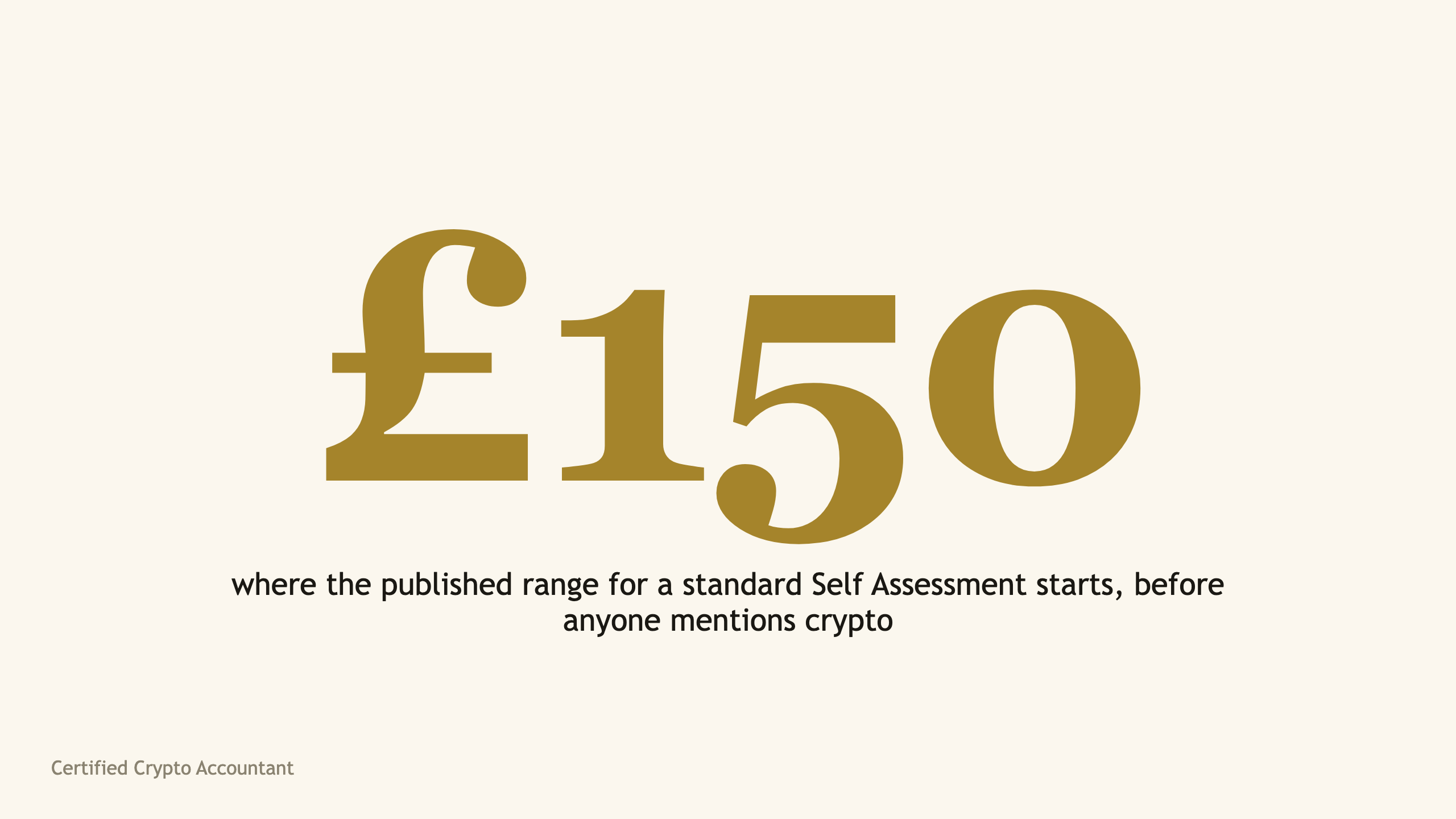
A standard Self Assessment return costs between £150 and £400 plus VAT from a UK accountant in 2026, according to the two published fee surveys that were updated this summer, and the hourly rate for general work runs from £50 to £150. Those are market figures, drawn from Unbiased, updated 23 July 2026, and Sleek, updated 24 August 2026, and they describe a return with a salary, some interest and perhaps a rental property. Crypto sits on a different scale, because the work is measured in transactions rather than income sources, and the bands for it start where the ordinary ones stop.
The published ranges tell you what a normal return costs. Crypto is priced on how many events have to be rebuilt, and the records you bring decide most of it.
The published ranges for a standard return
| Type of return | Published range, plus VAT | Source |
|---|---|---|
| Employed with one untaxed income source | £150 to £250 | Sleek, August 2026 |
| Sole trader or freelancer | £200 to £350 | Sleek, August 2026 |
| Company director | £250 to £400 | Sleek, August 2026 |
| Partnership | £300 to £600 and above | Sleek, August 2026 |
| Complex personal affairs | £150 to £600 or more | Unbiased, July 2026 |
| Hourly, general accounting | £50 to £150 an hour | Unbiased, July 2026 |
Two adjustments sit on top of every line. Sleek puts central London at 20% to 30% above the base fee, with a London range of £250 to £450 against £150 to £400 across the rest of England. And timing costs money. A return handed over in the last fortnight before the 31 January deadline attracts a rush fee of £50 to £150 in the same survey, which is a cheap lesson in the value of filing in October.
What moves the price
Every accountant prices the same three things, whatever the invoice says. How many income sources you have, since each one is a set of figures to gather and check. What state the records are in, since a shoebox costs hours a spreadsheet does not, and Sleek puts the penalty for disorganised records at £100 to £300 on an ordinary return. And how much judgement the return needs, which is where a rental property, a capital gain or foreign income earns its £75 to £200 supplement per stream. Fees fall the other way too. Filing from a clean cloud accounting export takes £50 to £100 off in the same survey.
None of that is specific to crypto, and all of it applies with more force once crypto is in the file.
Why crypto is priced differently
A year of crypto is a capital gains computation with hundreds or thousands of disposals, each needing a sterling value on its date and a pooled cost under the rules HMRC sets out in its cryptoassets guidance, and the pooling has to be rebuilt from the first purchase rather than the first year that looks worrying. The software most people arrive with gets the transaction count right and the cost basis wrong in a handful of places, and finding those places is the job. Our guide to why the software gets UK returns wrong lists the usual failures, and the reconciliation service exists to fix them. So crypto is priced on the number of transactions, the number of platforms, and whether any of those platforms has since closed, which decides whether the history can be exported at all.
The market bands we publish on our pricing page, gathered from what UK firms quote in September 2026, look like this.
| Who does the work | What you get | Market band |
|---|---|---|
| Flat rate filers | You arrive with a finished software report and they file it | £99 to £349 |
| Generalist bundles | Reconciliation bolted onto a standard practice | £298 to £500 |
| UK crypto specialists, one year | Reconciled properly and filed | £750 to £2,000 |
| Heavy DeFi or NFT years | Many chains and many protocols | £1,200 to £2,500 |
| Multi year catch up with a disclosure | Several years rebuilt and reported to HMRC | £1,500 to £3,500 |
The gap between the first row and the third is the whole story. A £150 filing takes your software’s number as true. A specialist year starts by testing it. Which one you need depends on whether the number is true, and the honest answer is that nobody knows until someone looks, which is why we do the first look for nothing.
The hourly rate question
Unbiased’s £50 to £150 an hour covers general accounting. Most crypto specialists avoid hourly billing for a simple reason, which is that a reconciliation can take four hours or forty depending on what turns up in the export, and a client cannot budget for a number that moves like that. Fixed fees by transaction band shift that risk onto the firm, and an hourly rate on a crypto file is a sign the firm has not done many of them. Where an hourly rate does appear it is usually for work outside an agreed scope, and it should only ever run with your written approval.
What you should get for the money
For an ordinary return, a completed and filed SA100 with any supplementary pages, a calculation you can follow, and a copy of everything submitted. For a crypto return, the same plus a transaction level reconciliation you could hand to HMRC in an enquiry, showing the pooled cost behind every disposal, the treatment of every transfer between your own wallets, and the income figures for staking, mining or airdrops with their sources. If a quote does not include that schedule, the fee is buying a filing rather than a defence, and HMRC’s record expectations assume the schedule exists. GOV.UK’s rule on keeping records is at least 22 months after the end of the tax year for a return filed on time, and the schedule is the record.
How to keep the fee down
Export every platform’s full history before you ask for a quote, including the closed exchanges while you still can. List every wallet address you have ever used. Bring the previous returns. And go in October rather than January, because the rush fee is real and so is the queue. In my experience the difference between a quote at the bottom of a band and one at the top is almost always the records, and the records are the one part of the price the client controls. If you are moving from another firm, our guide to changing accountants without losing your records covers what to ask for before you leave.
Fee questions
How much do accountants charge for a Self Assessment tax return?
Published UK surveys updated in July and August 2026 put a standard return at £150 to £400 plus VAT, with simple employed returns around £150 and directors or partnerships at £250 to £600. Central London adds 20% to 30%.
How much does a crypto accountant cost in the UK?
For a single tax year with proper reconciliation, UK specialist firms typically quote £750 to £2,000. Flat rate filers who take a finished software report start around £99, and multi year catch ups with a disclosure usually land between £1,500 and £3,500.
Do accountants charge per hour?
Some do, at £50 to £150 an hour for general work according to Unbiased. Most crypto specialists quote fixed fees by transaction band instead, because the hours on a reconciliation cannot be predicted from the outside.
Is an accountant worth it for a simple return?
If your income is a salary and a little interest, HMRC's own online return is designed for you and costs nothing. An accountant earns the fee once there is judgement involved, a capital gain, a rental, foreign income or anything in crypto.
Why is crypto more expensive to file?
Because the work is measured in disposals rather than income sources. Each swap, spend or sale needs a sterling value and a pooled cost, the software gets some of those wrong, and finding the wrong ones is what the fee pays for.
Sources
Every figure on this page was checked against the source below on 5 September 2026.
- How much do accountants charge?. Unbiased, updated 23 July 2026, checked 5 September 2026
- How much do accountants charge for Self Assessment in 2026?. Sleek, updated 24 August 2026, checked 5 September 2026
- Crypto tax pricing, market bands. Certified Crypto Accountant, September 2026, checked 5 September 2026
- Self Assessment tax returns, deadlines. GOV.UK, checked 5 September 2026
- Check if you need to pay tax when you sell cryptoassets. GOV.UK, checked 5 September 2026
- Keeping your pay and tax records. GOV.UK, checked 5 September 2026
Fahad Zar
Crypto tax accountantAAT licensed 1010475
- AAT Licensed Accountant and MAAT, licence 1010475
- MSc Accounting and Finance, BPP University London
- Six years inside digital asset accounting, across several crypto tax firms
- Practises through Zar Enterprises Ltd, ICO registration ZC225094
- Supervised for anti-money laundering by the AAT
What matters to me is that the number on the return is true, whatever it turns out to be.
Whether this is worth a conversation
Where this stops being a reading job and starts being a hiring one.
- You have had one quote that felt low and one that felt high and want to know which of them is pricing the actual work
- Your software report is finished and you want someone to test the number before it is filed
- There are several unfiled years and a platform that no longer exists
If your only income is a salary and some bank interest, HMRC's online return is free, takes an evening, and does not need any of us.
If one of these is you, the first look costs nothing.
Read next
How to change accountants without losing your records
What to ask for before you leave, so the new fee does not include rebuilding it.
Reviewed 5 September 2026Deep guideWhy crypto tax software gets UK returns wrong
The errors a flat rate filing never tests for.
Reviewed 5 September 2026DeadlineHow to register for Self Assessment
The 5 October step if this is your first year with a return.
Reviewed 5 September 2026ExplainerHow to report capital gains on your Self Assessment
What the completed return should contain when you get it back.
Reviewed 5 September 2026