From 2026 HMRC receives your crypto data automatically

Published 12 June 2026· Reviewed against gov.uk 25 August 2026· 9 min read·HMRC and compliance
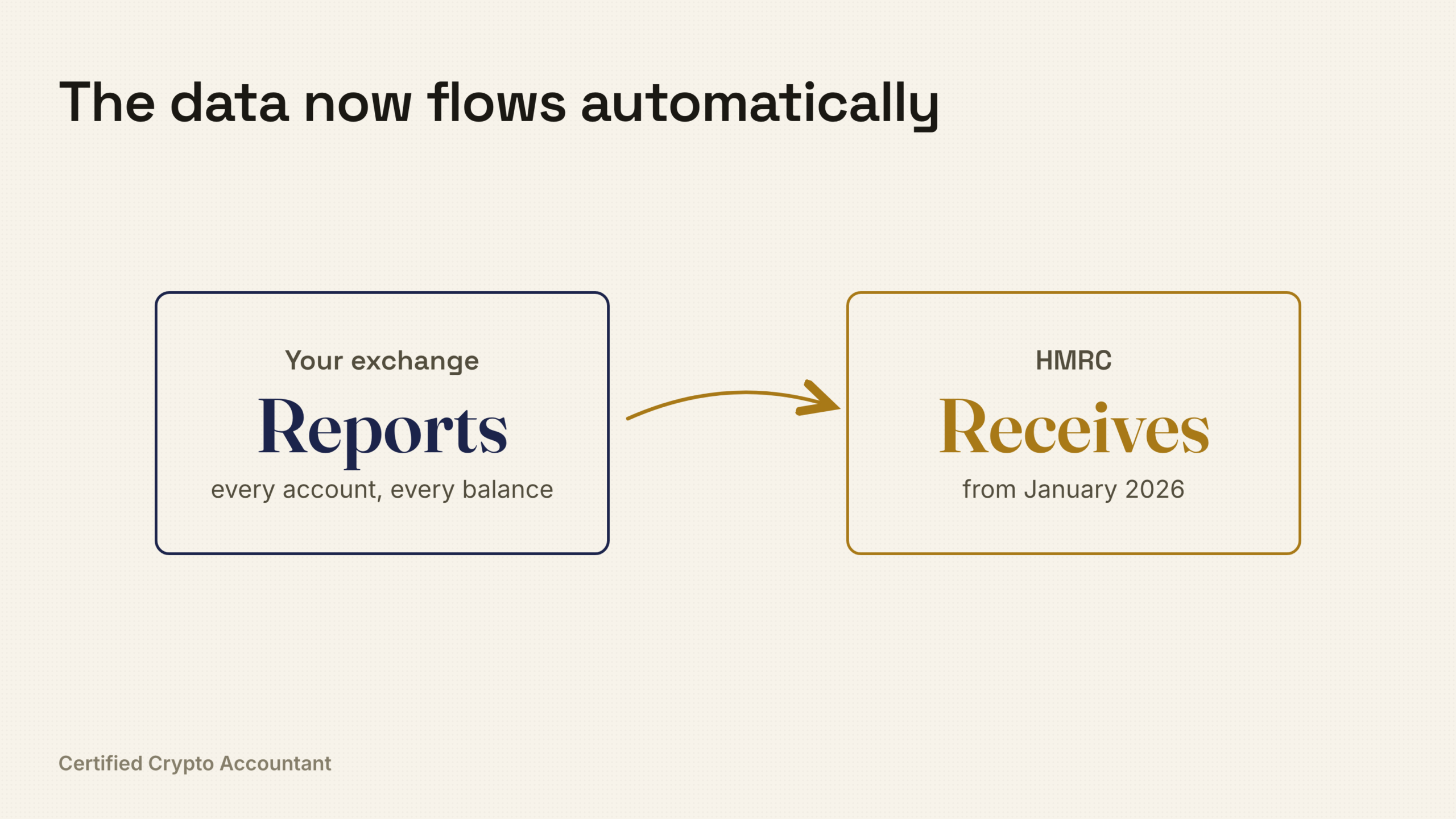
The CARF crypto UK regime, short for the Crypto-Asset Reporting Framework, forces exchanges and wallet providers to collect your identity and transaction data and hand it to HMRC, with collection running since 1 January 2026 and the first reports due by 31 May 2027. If the numbers on your Self Assessment return do not match what your exchange reports, HMRC will be able to see the gap automatically, without buying data or guessing, and that changes the rules on crypto privacy in the UK for good.
This guide explains exactly what CARF is, the timeline you need to know, the precise data exchanges must collect and report, who is in scope, and what it means for ordinary UK crypto holders. Most importantly, it sets out what to do now, while you still have time to put your position right on your own terms.
What is the CARF crypto UK reporting framework?
The Crypto-Asset Reporting Framework, or CARF, is an international standard developed by the OECD. It does for crypto what the Common Reporting Standard already does for bank accounts: it creates a system in which financial intermediaries collect customer data and report it to their tax authority, who then shares it across borders.
In the UK, CARF is delivered through domestic regulations that take effect from 1 January 2026. From that date, crypto businesses operating in the UK, known as reporting cryptoasset service providers, must carry out due diligence on their users and record their transactions. They are not reporting on your behalf as a favour. They are legally required to, and failing to do so exposes them to penalties.
The practical headline is simple. The data gap that has existed between what exchanges know about you and what HMRC knows is closing, and CARF is the mechanism closing it.
Who is in scope under CARF?
CARF applies to a broad set of businesses that facilitate crypto transactions for users. HMRC refers to these as reporting cryptoasset service providers. In scope you will typically find:
- Registered cryptoasset exchanges, where you buy, sell and trade tokens.
- Custodial wallet providers that hold or transact crypto on behalf of users.
- Brokers and dealers who execute crypto transactions for customers.
- In some cases, DeFi applications or protocols with a controlling entity able to carry out the required due diligence.
The activity in scope is wider than many people assume. Alongside ordinary exchange trades, stablecoin transfers and certain NFT activity fall within the framework. The general rule is that if a business sits between you and the blockchain and can identify you, it is likely to be reporting on you.
What data will exchanges collect and report?
This is where CARF becomes real. Reporting providers must verify who you are and then report both your identity and your transaction totals. The information collected is detailed and personal.
| Category | What is collected |
|---|---|
| Identity | Full legal name, address, date and place of birth |
| Tax status | Jurisdiction of residence and tax identification number (for UK residents, your National Insurance number or Unique Taxpayer Reference) |
| Transactions | The gross amounts of relevant transactions, including the value, type of cryptoasset and number of units |
| In-scope activity | Ordinary exchange trades, stablecoin transfers and certain NFT activity |
Crucially, what is reported is the gross value of transactions, not your calculated gain or loss. HMRC sees totals, not your carefully worked-out cost basis. That distinction matters, because a large gross figure can look alarming next to a modest or nil return, even where little or no tax is actually due.
What is the CARF timeline?
The framework rolls out in clear stages. The collection of data starts well before the first report is due, which is why action this year is sensible rather than premature.
| Date | Milestone |
|---|---|
| 1 January 2026 | UK providers begin collecting user identity and transaction data |
| 31 December 2026 | End of the first reportable calendar year |
| 31 May 2027 | Deadline for providers to file the first report with HMRC, covering 1 January to 31 December 2026 |
| From 2027 onwards | HMRC exchanges the data automatically with other CARF jurisdictions |
The key takeaway from the timeline is that your 2026 activity is already being recorded. By the time the first report reaches HMRC in 2027, the data is fixed. The window to correct earlier years and align your 2026 figures is open now and narrows steadily.
What does CARF mean for UK taxpayers?
For the firms involved, there are real penalties. A provider can be charged up to £300 per user for a report that is missing, late, inaccurate, incomplete or unverified. That penalty sits on the exchange, not on you. But it tells you something important: providers are strongly incentivised to over-report and to collect more data, not less. They will not take a relaxed view of your records.
For you as a taxpayer, the effect is automatic mismatch detection. From 2027, HMRC can place your CARF data and your Self Assessment return side by side. If you reported no crypto disposals but an exchange reported £120,000 of gross trades, that contrast is visible without any manual investigation. CARF does not change what tax you owe. It changes how easily HMRC can see whether you have paid it.
Because participating jurisdictions include all EU countries such as Germany, France, Italy and Spain, plus Brazil, Canada, Japan and South Korea among more than 40 nations, holding crypto on an overseas exchange offers no shelter. The EU runs its own equivalent, known as DAC8, and the United States requires brokers to file Form 1099-DA from the 2025 tax year. The reporting net is global.
A worked example, how a mismatch arises
Suppose you traded actively on a major exchange throughout 2026 but, like many people, assumed that no tax was due because you never withdrew cash to your bank. Under CARF, the exchange reports your gross 2026 activity to HMRC.
- Your exchange reports £85,000 of gross disposals across the year.
- Your Self Assessment return for 2026/27 shows no crypto entries at all.
- After a proper reconciliation, your actual taxable gain turns out to be £6,000 above the annual exempt amount, producing roughly £1,440 of Capital Gains Tax at the 24% rate for a higher-rate taxpayer.
The tax at stake is modest. The risk is the £85,000 gross figure sitting against a blank return. To HMRC’s matching system, that looks like a serious omission until it is explained. Had you reconciled your history and declared the £1,440, there would be no mismatch to flag. The lesson is that CARF rewards accurate, complete returns and punishes silence, even where the underlying tax is small.
What should you do now?
CARF is not a reason to panic, but it is a firm reason to act before the first report lands. A sensible order of work looks like this:
- Reconcile your full history. Pull every exchange account, wallet and on-chain transaction, including closed and dormant accounts, into one reconciled view.
- Check your past returns. Work out, year by year, whether you under-declared, over-declared or owe nothing.
- Correct earlier years through an amendment or a voluntary disclosure where tax is owed, ideally before HMRC sees the CARF data.
- Get 2026 right the first time, so your first reportable year matches your return cleanly.
- Keep your evidence trail, so any large gross figure can be explained with a documented cost basis.
Coming forward voluntarily, before a mismatch is flagged, keeps you in the lowest penalty bands. Waiting until HMRC contacts you does the opposite.
How a specialist handles CARF readiness
When a client comes to us ahead of CARF, we work in one order: data first, return second. We reconcile every wallet and exchange, including the dormant ones, establish the true taxable position for each year, and correct any earlier returns through the right route. Then we make sure the 2026 figures that exchanges will report to HMRC line up exactly with what goes on the Self Assessment return. The goal is simple: no mismatch for HMRC’s system to find, and a documented answer ready if it ever asks.
Frequently asked questions
Does CARF mean I owe new tax?
No. CARF does not create any new tax. It is purely a reporting framework. Your Capital Gains Tax and Income Tax obligations on crypto are unchanged. What changes is HMRC’s visibility, which makes it far harder to leave a genuine liability undeclared.
When does CARF start in the UK?
UK providers begin collecting data from 1 January 2026. The first report is due to HMRC by 31 May 2027 and covers the 2026 calendar year. After that, the data is exchanged automatically between participating countries.
Will my overseas exchange report me to HMRC?
Very likely. CARF data is exchanged between more than 40 participating jurisdictions, including all EU countries, Brazil, Canada, Japan and South Korea. The EU operates its own equivalent, DAC8, so holding crypto abroad does not keep you outside the net.
What exactly will my exchange report?
Your full legal name, address, date and place of birth, jurisdiction of residence and tax reference, plus the gross amounts of your relevant transactions. This includes ordinary trades, stablecoin transfers and certain NFT activity.
What happens if my exchange data and my tax return do not match?
From 2027, HMRC can compare the two automatically. A mismatch can prompt a nudge letter or a formal enquiry. The fix is to reconcile your records and correct your returns before the first report is filed.
Is CARF the same as the US Form 1099-DA?
They are equivalents rather than identical. CARF is the OECD framework adopted by the UK and many others. The EU version is DAC8, and the US requires brokers to file Form 1099-DA from the 2025 tax year. All three push the same outcome: automatic reporting of crypto activity to tax authorities.
Get ahead of CARF before the first report lands
CARF makes accurate, complete crypto reporting non-negotiable from 2026 onwards. The taxpayers who fare best are the ones who reconcile their history and correct their returns now, while it is still voluntary and on their own terms. At Certified Crypto Accountant we handle exactly this for UK clients: full reconciliation, disclosure where needed, and a clean match between exchange data and your Self Assessment. Book a free, confidential review at certifiedcryptoaccountant.com.
For tailored help, see our crypto tax services or book a free review.
Authoritative sources: HMRC Cryptoassets Manual; IRS: Digital Assets.
The practical question is what you actually owe, not what the letter implies. Work out a starting figure with the capital gains tax calculator, and if crypto is involved our crypto tax accountants can check it against the real transaction history.
Sources
Every figure on this page was checked against the source below on 25 August 2026.
- HMRC Cryptoassets Manual. GOV.UK, checked 25 August 2026
- IRS: Digital Assets. Internal Revenue Service, checked 25 August 2026
Fahad Zar
Crypto tax accountantAAT licensed 1010475
- AAT Licensed Accountant and MAAT, licence 1010475
- MSc Accounting and Finance, BPP University London
- Six years inside digital asset accounting, across several crypto tax firms
- Practises through Zar Enterprises Ltd, ICO registration ZC225094
- Supervised for anti-money laundering by the AAT
What matters to me is that the number on the return is true, whatever it turns out to be.
Whether this is worth a conversation
Most people who read this page do not need an accountant. A few do.
- A letter from HMRC has arrived
- You have years HMRC does not know about
- HMRC's figures do not match yours
If your letter is a routine tax code notice and your filings are current, you probably just needed this page.
If one of these is you, the first look costs nothing.
Read next
Crypto tax deadlines for the 2026 to 2027 tax year
Key UK crypto tax dates for 2025/26: Self Assessment registration, the 31 January filing and payment deadline, and what…
Reviewed 25 Aug 2026Deep guideHow much HMRC can charge for unpaid crypto tax
What HMRC crypto tax penalties actually cost: late filing, late payment and undeclared gains. How penalties are…
Reviewed 25 Aug 2026ExplainerHow to tell a real HMRC letter from a scam
HMRC never threatens arrest and never asks for bank details to pay a refund. The thirty second sorting method, and…
Reviewed 25 Aug 2026DeadlineThe HMRC savings tax warning is about your bank interest
Banks report interest automatically and rising rates pushed ordinary savers over the £1,000 allowance. What the letters…
Reviewed 25 Aug 2026 ExplainereToro tax in the UK depends on which of its three products you used
eToro's crypto side is reported from 2026 while its shares side is reported by nobody.
Reviewed 5 September 2026