
When an airdrop is income and when it is capital

Published 24 June 2026· Reviewed against gov.uk 25 August 2026· 8 min read·DeFi, staking and earning
If free tokens have ever landed in your wallet, your first question was probably “do I have to pay tax on this?” The honest answer on airdrop tax UK rules is: it depends entirely on what, if anything, you did to receive them. People assume that because tokens arrived for nothing, there is nothing to declare. That is a common and expensive misreading of how HMRC’s Cryptoassets Manual treats airdrops.
The test is not “was it free?” The test is “what did I do to get it?” Get that wrong and you can either overpay on a passive airdrop or, far worse, miss an income tax charge on an earned one and walk into a nil cost basis trap when you later sell. This guide breaks down when an airdrop is income, when it is capital, and how to avoid being taxed twice without realising it.
Airdrop tax UK, the rule that decides everything
HMRC’s position on airdrop tax UK treatment hinges on one question: did you do something in return for the tokens? The answer splits every airdrop into one of two boxes, and the box decides whether income tax applies on receipt.
Per the airdrops guidance at CRYPTO21250, income tax does not apply where tokens are received “without doing anything in return”, meaning the airdrop is not related to any service, action or expectation and is not part of a trade. Where the airdrop is provided in return for, or in expectation of, a service, it becomes taxable as miscellaneous income (or a receipt of an existing trade).
Passive airdrops, free now, taxed on the sale
A passive airdrop is one that simply appears. You did nothing to qualify: no quest, no social post, no holding requirement, no protocol interaction. A project may have distributed tokens to a wide list of addresses to bootstrap a community.
In this case:
- There is no income tax on receipt.
- On the cautious reading, the tokens take a nil base cost for Capital Gains Tax purposes.
- The taxable event is the later disposal, when you sell, swap or spend them.
That nil base cost is the catch. Because nothing was taxed on the way in, the entire sale proceeds count as your gain on the way out. This is the nil cost basis trap: a “free” token can produce a fully taxable gain.
One honest caveat. HMRC’s manual does not spell out the base cost of a passive airdrop, and there is a respectable alternative reading, which most crypto tax software applies, that the tokens are acquired at market value on receipt. The nil base cost position is the cautious one, and the one HMRC is most likely to argue. If you take the market-value position instead, document it, because the difference is the entire value of the airdrop.
Earned airdrops, income first, then capital
An earned airdrop is one where you did something to qualify. Common triggers include:
- Completing a quest, task or testnet activity.
- Retweeting, posting or referring others to earn an allocation.
- Holding a particular NFT or token to become eligible.
- Using a protocol, bridge or DEX so your activity qualified you for a retroactive drop.
Here the tokens are miscellaneous income at their sterling market value on the day you receive them, taxed at your income tax rate. Crucially, that same value becomes your base cost for CGT. When you later dispose of the tokens, you only pay CGT on the growth above that recorded value, not on the whole amount again.
Passive vs earned airdrops at a glance
| Feature | Passive airdrop | Earned airdrop |
|---|---|---|
| Did you do anything? | No service, action or expectation | Quest, post, holding or protocol use |
| Income tax on receipt | None | Yes, market value as miscellaneous income |
| CGT base cost | Nil | Market value at receipt |
| Taxed on later sale? | Yes, gain on full proceeds | Yes, gain above recorded value |
Valuing an earned airdrop on receipt
For an earned airdrop, you need the sterling market value on the date the tokens became yours to control. If the token already trades, use the price at receipt. If there is no market yet, you need a reasonable, evidenced valuation and a record of how you reached it. That figure does double duty: it is your income tax base for the year and your CGT base cost on disposal.
The later CGT event applies to both
Whether your airdrop was passive or earned, the disposal is a Capital Gains Tax event. A disposal includes selling for fiat, swapping for another token, or using the tokens to pay for something. Per the CGT guidance in the manual, the disposal of an airdropped token can produce a chargeable gain even where it was not chargeable to income tax on receipt.
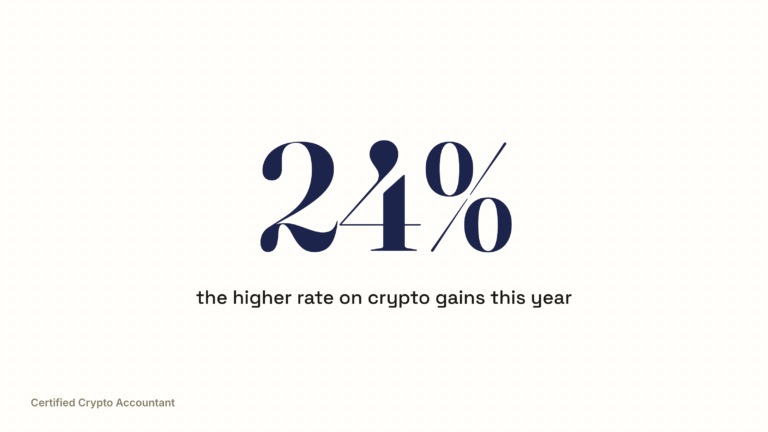
For the 2026/27 tax year, each person has a Capital Gains Tax annual exempt amount of £3,000, which cannot be carried forward. On crypto disposals on or after 30 October 2024, gains above that allowance are taxed at 18% within your remaining basic-rate band and 24% above it.
Worked example, an earned airdrop taxed twice
Priya is a basic-rate taxpayer. She completes a series of testnet quests for a new protocol. In June 2025 it rewards her with tokens worth £4,000 at the moment they hit her wallet. Because she earned them through an action, this is an earned airdrop.
Step 1: income tax on receipt. The £4,000 is miscellaneous income for 2025/26. As a basic-rate taxpayer, she pays income tax at 20%, so £800 of income tax. That £4,000 also becomes her CGT base cost.
Step 2: CGT on disposal. In March 2026 the tokens have risen and she sells them all for £9,000. Her gain is £9,000 minus the £4,000 base cost, which is £5,000. She has made no other disposals, so she applies her £3,000 annual exempt amount, leaving a taxable gain of £2,000. At the 18% basic-rate crypto CGT rate, that is £360 of CGT.
Total tax across both events: £800 income tax plus £360 CGT, so £1,160. Note how the base cost worked in her favour: without recording the £4,000 acquisition value, the full £9,000 could have been treated as gain, exactly the nil cost basis trap that hits passive airdrops.
How a specialist handles it
When a client brings us a wallet full of airdrops, we work in one order: classify, then value, then reconcile to disposal. We separate the passive drops from the earned ones, fix a defensible sterling value at receipt for every earned token, record that as the base cost, and track each disposal against it. The result is an income tax figure and a CGT figure that both stand up to scrutiny, with no token taxed twice or missed.
Frequently asked questions
Are airdrops taxable in the UK?
It depends on how you received them. A passive airdrop, received with no service, action or expectation, is not subject to income tax on receipt but carries a nil base cost, so it is taxed as a capital gain when you dispose of it. An earned airdrop is income tax at market value on receipt.
What makes an airdrop “earned” rather than passive?
Doing something to qualify. A quest, a social post, holding a specific NFT, or using a protocol to become eligible all count as actions. If your activity or expectation led to the tokens, HMRC treats them as miscellaneous income.
Do I pay tax if I never sell my airdropped tokens?
For a passive airdrop, no income tax arises on receipt and no CGT arises until you dispose. For an earned airdrop, income tax applies on receipt even if you hold, because the income point is when the tokens become yours.
What is the nil cost basis trap?
Because a passive airdrop is not taxed on receipt, the cautious reading is that its base cost is nil. HMRC’s manual does not settle the point, and some advisers and most software instead use market value at receipt. On the nil basis reading, when you sell, the entire proceeds count as your gain, so the “free” token can be fully taxable under Capital Gains Tax once your annual exempt amount is used up.
How do I value an airdrop for tax?
Use the sterling market value on the date the tokens became yours to control. If the token already trades, use the market price. If it does not yet, you need a reasonable, evidenced valuation and a record of how you arrived at it.
Can the same airdrop be taxed twice?
An earned airdrop is taxed once as income on receipt and again as a capital gain on the growth above its recorded value at disposal. These are two different taxes on two different events, not double taxation of the same amount.
Get your airdrops classified correctly before HMRC does
Airdrops are one of the easiest areas to get wrong, and one of the easiest for HMRC to spot once exchange data lands on their desk. If your wallet holds a mix of passive and earned drops, classify and value them properly now, not after a letter arrives. Book a free, confidential review at certifiedcryptoaccountant.com, and see how our crypto tax services reconcile every token, income and disposal into one defensible position.
For the wider picture, how crypto tax works in the UK covers disposals, income and reporting in one place. For a figure, the capital gains tax calculator is free and takes a minute.
Sources
Every figure on this page was checked against the source below on 25 August 2026.
- HMRC’s Cryptoassets Manual. GOV.UK, checked 25 August 2026
- Airdrops guidance at CRYPTO21250. GOV.UK, checked 25 August 2026
- Capital Gains Tax. GOV.UK, checked 25 August 2026
- Income tax rate. GOV.UK, checked 25 August 2026
- CGT guidance in the manual. GOV.UK, checked 25 August 2026
Fahad Zar
Crypto tax accountantAAT licensed 1010475
- AAT Licensed Accountant and MAAT, licence 1010475
- MSc Accounting and Finance, BPP University London
- Six years inside digital asset accounting, across several crypto tax firms
- Practises through Zar Enterprises Ltd, ICO registration ZC225094
- Supervised for anti-money laundering by the AAT
What matters to me is that the number on the return is true, whatever it turns out to be.
Whether this is worth a conversation
Most people who read this page do not need an accountant. A few do.
- Rewards arrived and nothing recorded their value
- Your platform calls your staking a sale
- You cannot tell income from gains anymore
If you earned a few pounds of rewards sitting under the £1,000 allowance, note it and move on.
If one of these is you, the first look costs nothing.
Read next
What HMRC actually says about staking rewards
How HMRC taxes crypto staking in the UK: income at receipt, Capital Gains on disposal, and the records stakers need.…
Reviewed 25 Aug 2026Deep guideIs your DeFi yield income or capital in HMRC’s eyes
DeFi tax in the UK explained: lending, staking, liquidity pools and yield. Where HMRC guidance draws the line between…
Reviewed 25 Aug 2026Deep guideAdding liquidity to Uniswap is a taxable disposal
Adding and removing crypto from a liquidity pool can each be a taxable disposal under HMRC rules. How LP tokens,…
Reviewed 25 Aug 2026Deep guideHow HMRC taxes lending and borrowing on Aave and Compound
Crypto lending and interest rewards are taxable in the UK, and the loan itself can trigger a disposal. How HMRC treats…
Reviewed 25 Aug 2026